ABSTRACT
In this paper, we propose a simple and low-cost fabrication method for PMMA (Poly (Methyl Methacrylate)) acoustophoretic microfluidic chips using plasma-assisted bonding followed by MEMS (Microelectromechanical Systems) processes. A metal mold for replicating the PMMA polymer was fabricated using MEMS processes, and the microfluidic channel was imprinted on the PMMA polymer using a hot-embossing process. The closed fabricated microfluidic channel was achieved by means of the plasma-assisted bonding between the PMMA channel and the flat PMMA cover. The plasma treatment and hot-embossing conditions for PMMA-PMMA bonding were studied and evaluated. The particle separation test confirmed that the PMMA acoustophoretic microfluidic chips could be used. We expect the Si-based acoustophoretic microfluidic chip to be replaced by the presented polymer chip in such applications as blood or droplet separation.
-
KEYWORDS: Acoustophoretic chip, Acoustic standing wave, Hot-embossing process, Plasma assisted bonding, Particle separation
-
KEYWORDS: 음파영동 칩, 정상음향파, 핫엠보싱 공정, 플라즈마 본딩, 입자분리
1. 서론
음파를 이용한 입자분리 방법은 전기를 이용한 입자분리 방법(Electrophoresis, Dielectrophoresis 등)에 비해 세포와 같은 바이오 샘플 분리에 있어 생체 적합성(Biocompatibility)이 뛰어나며, 구조가 보다 간단할 뿐 아니라 제작 및 작동에 있어 Robust한 장점이 있다.
1,2 따라서, 바이오 시료 분석 분야에서 혈액 및 암세포 조작과 응용을 위해 음파영동(Acoustophoresis)을 이용한 미세유체 디바이스에 대한 많은 연구가 진행되고 있다.
3-10 음파영동기술은 표면탄성파(Surface Acoustic Wave)
3,4 또는 벌크탄성파(Bulk Acoustic Wave)
5-10를 이용하여 입자를 분리하는 기술로, 특히 채널 내에서의 정상음향파(Acoustic Standing Wave)는 입자들을 Pressure Node 또는 Pressure Anti-Node로 움직이게 할 수 있다. 이와 같이 유체 내에서 벌크탄성파를 이용한 연속적인 입자분리를 위하여 여러 다양한 미세유체 디바이스들이 제작되었다. 지금까지의 많은 연구에서는 주로 실리콘(Silicon, Si)을 기반으로 이방성 습식 식각(Anisotropic Wet Etching) 공정 또는 이방성 건식 식각(Deep Reactive Ion Etching, DRIE) 공정을 이용하여 미세유체 디바이스를 제작하였다.
5-7 그러나 실리콘은 그 가격이 상대적으로 높을 뿐 아니라 비싼 공정 장비를 활용해야 하는 단점이 있다. 최근 실리콘에 비해 값싼 유리 기판을 기반으로 하는 음파영동 미세유체 디바이스를 이용하여 혈액 분리에 성공한 연구가 발표되었으나, 유체 채널의 크기 조절이 어렵고 가공 표면이 나쁜 단점이 있다.
8
저가의 미세유체 디바이스를 개발하기 위해 PDMS (Polydimethylsiloxane) 및 PMMA (Poly (Methyl Methacrylate))와 같은 폴리머를 기반으로 하는 디바이스 제작에 관한 다양한 연구가 진행되었다.
4,9,10 일반적으로 폴리머는 가공이 용이할 뿐 아니라 대량 생산이 가능한 장점이 있다. 특히, PMMA는 광투과성이 좋고 가벼우면서 강도가 우수할 뿐 아니라 가공성이 좋아 성형이 용이하다. 또한, 다른 폴리머와는 달리 음향파와 같은 진동전달 시 감쇄가 상대적으로 적어 음파영동 디바이스 제작에 사용되고 있다.
10
미세유체 디바이스의 제작 중 마지막 단계는 커버 기판(Cover Plate)과 미세유체채널이 형성된 기판의 본딩(Bonding)을 통한 미세유체 디바이스의 실링(Sealing)이다. 폴리머를 이용한 디바이스의 제작에 있어 두 기판의 본딩 방법은 크게 직접 본딩 방법(Direct Bonding)과 접착제(Adhesive)를 이용하는 간접 본딩 방법(Indirect Bonding)으로 나눌 수 있다. 접착제를 이용하는 방법은 가장 간단히 두 기판을 본딩시킬 수 있지만, 접착제가 미세유체채널 내부로 흘러 들어가 채널의 막힘 등을 유발할 수 있다. 직접 본딩 방법 중 열과 압력만을 이용한 본딩(Thermal Bonding)은 높은 온도와 압력에 의해 채널 형상이 변형될 수 있다는 단점이 있으며, 솔벤트를 이용한 폴리머 표면 처리 방법 역시 솔벤트에 의한 폴리머의 변형이 유발될 수 있다.
10 반면, 플라즈마를 이용하여 폴리머의 표면에너지를 증가시켜 두 기판을 본딩하는 방법(Plasma Assisted Bonding)은 열본딩(Thermal Bonding) 방법에 비해 낮은 온도와 압력에서 본딩이 이루어져 미세유체채널의 변형을 최소화할 수 있다.
11-13
본 연구에서는 PMMA 폴리머 기반의 음파영동 미세유체 디바이스를 제작하기 위해, MEMS (Microelectromechanical Systems) 공정을 이용하여 니켈 몰드를 제작하였으며 이를 PMMA 기판에 Hot-Embossing 공정으로 미세유체채널을 형성하였다. 이후 플라즈마 처리를 통하여 PMMA 기판의 표면을 활성화하고 유압 프레스 장비를 이용한 Hot-Embossing 공정을 통해 PMMA 기판과 평판 PMMA를 본딩시켜 최종 디바이스를 완성하였다. 이 때 적절한 플라즈마 조건과 Hot-Embossing 조건은 미세유체채널의 변형을 최소화하였으며, 이와 같이 완성된 디바이스는 음향파를 이용한 입자분리 실험에 사용되어 입자분리에 성공하였다.
2. 실험장치 구성 및 방법
본 연구에서는 음파영동을 이용한 입자분리칩을 폴리머를 이용하여 제작하였다. 사용한 폴리머로는 PMMA 기판을, PMMA 기판에 미세유체채널을 전사할 몰드로는 경도가 좋고 내식성, 내마모성이 뛰어난 니켈(Nickel) 몰드를 사용하였다.
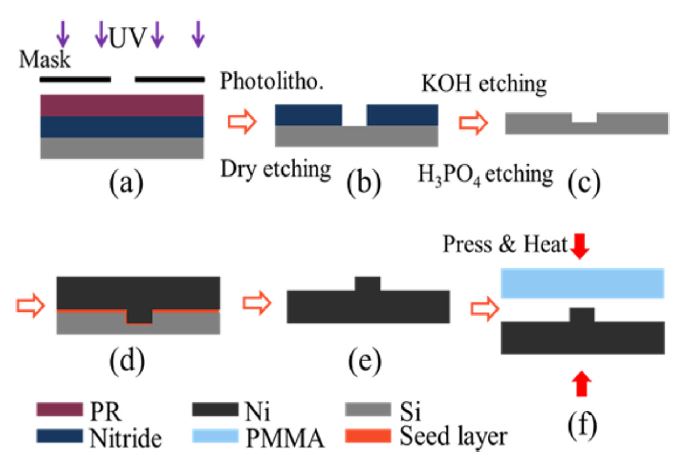
Fig. 1은 MEMS 공정을 이용한 니켈 몰드의 제작공정을 나타낸다. 먼저 100 nm 두께의 질화실리콘(Si
3N
4) 박막층이 증착된 4 인치 <100> 실리콘 웨이퍼(Si Wafer)에 Photolithography 공정 및 반응이온 식각(Reactive Ion Etching, RIE) 공정을 이용하여 패터닝(Patterning)을 하였다(
Figs. 1(a)와
1(b)). 패터닝 후 질화실리콘 박막을 에칭 마스크로 KOH 용액을 이용하여 실리콘 이방성 에칭을 수행하였다. KOH 용액의 농도는 30%, 온도는 60ºC로, 이 때의 에칭 속도는 약 0.3 μm/min로 확인되었다. 이를 통해 실리콘 웨이퍼 위에 미세 유체 채널을 형성한 후 에칭 마스크로 이용되었던 질화실리콘 박막을 인산 용액으로 제거하였다(
Fig. 1(c)). 스퍼터링(Sputtering) 공정을 이용하여 Seed Layer로 Cr/Cu 500 Å/500 Å을 증착한 후 니켈 전주를 이용하여 니켈 층을 0.5 mm 두께로 증착하였다(
Fig. 1(d)). 마지막으로 KOH 용액으로 실리콘 마스터 몰드를 제거하여 니켈 몰드를 완성하였다(
Fig. 1(e)). PMMA 기반의 마이크로 디바이스를 제작하기 위해
Fig. 1(f)와 같이 PMMA 기판에 니켈 몰드로 Hot-Embossing 공정을 수행하였으며, 이 때의 조건은 온도 110ºC, 압력 5 MPa에서 20 분간 수행하였다.
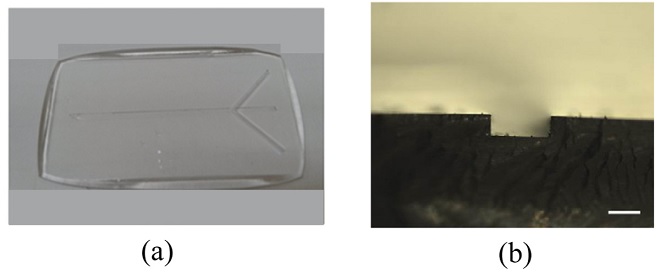
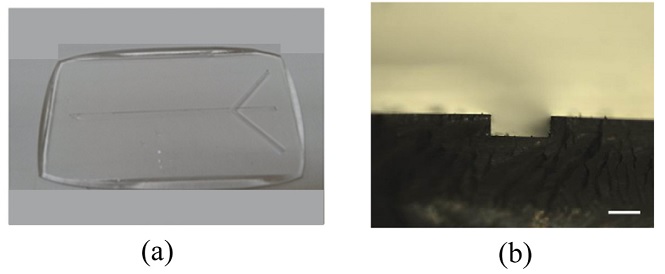
Fig. 2는 제작된 PMMA 디바이스의 채널 단면과 전체 사진을 보여준다. 디바이스의 채널 폭은 375 μm, 깊이는 145 μm로 니켈 몰드의 형상이 정확히 전사된 것을 확인하였다.
Fig. 1 Fabrication of Ni mold for microfluidic channel using hot-embossing process
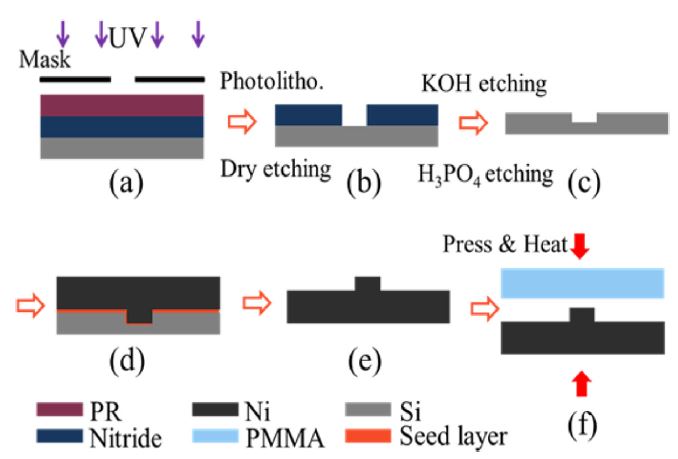
Fig. 2 Microscopic image of (a) cross section of microchannel, (b) microchannel on PMMA substrate (Scale bar: 200 μm)
이후 미세유체채널이 형성된 PMMA 기판의 실링(Sealing)을 위해 평판 PMMA 기판을 본딩하여 디바이스를 완성한다. Harris et al.
10등은 PMMA 기판 사이의 본딩을 위해 PMMA 기판 사이에 솔벤트를 도포하여 본딩을 하였다. 앞에서 언급한 바와 같이 솔벤트를 이용한 본딩은 접착력은 우수하지만 채널 내부로 솔벤트가 흘러 들어가 채널이 변형되거나 막히는 문제점이 발생한다.
따라서, 본 연구에서는 플라즈마 처리를 이용한 본딩 방법을 이용하였다. 일반적으로 폴리머의 본딩에 영향을 미치는 인자로는 크게 표면에너지와 표면거칠기로 나눌 수 있으며, 표면에너지가 클수록 표면거칠기가 작을수록 본딩 효율이 좋아진다.
14,15 본 연구에서는 PMMA의 표면에너지가 최대, 표면거칠기가 최소가 되는 조건을 찾기 위해 플라즈마 처리를 수행하였으며, 이를 통해 가장 적절한 본딩 조건을 찾을 수 있었다. 본 연구에서는 PMMA 기판의 표면 활성화를 위해 상온플라즈마기(MyPL Auto 200, ㈜에이피피)를 이용하였으며, Ar 6 Sccm, O
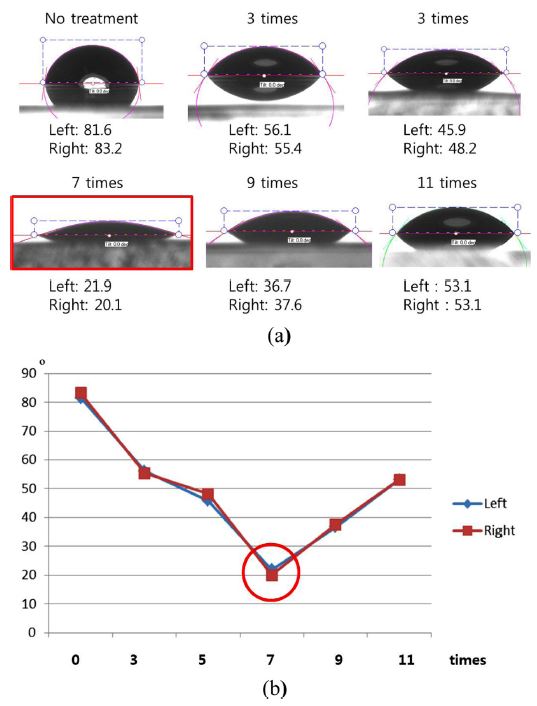
2 60 Sccm, RF 출력 250 W의 조건으로 수행하였다. 이 때 플라즈마 처리 횟수에 따른 PMMA 표면의 활성화 정도를 접촉각 측정을 통해 확인하였다.
Fig. 3에서 보이는 바와 같이 7회 처리하였을 때 접촉각은 약 21º도 가장 낮은 값을 나타냈으며, 처리횟수를 증가시켰을 때 다시 접촉각이 커지는 경향을 보였다. 따라서 7회 처리 조건으로 PMMA 표면을 활성화 시킨 후 온도 75ºC, 압력 3 MPa에서 10 분 동안 유압 프레스기를 이용하여 본딩을 하였다. 본딩된 음파영동 미세유체 디바이스는 입구부와 출구부에 튜브를 삽입하여 입자분리 실험이 가능한 최종 디바이스를 완성하였다.
Fig. 3 (a) Contact angle measurement of PMMA surface after plasma treatment, (b) Graph for contact angle according to plasma treatment times
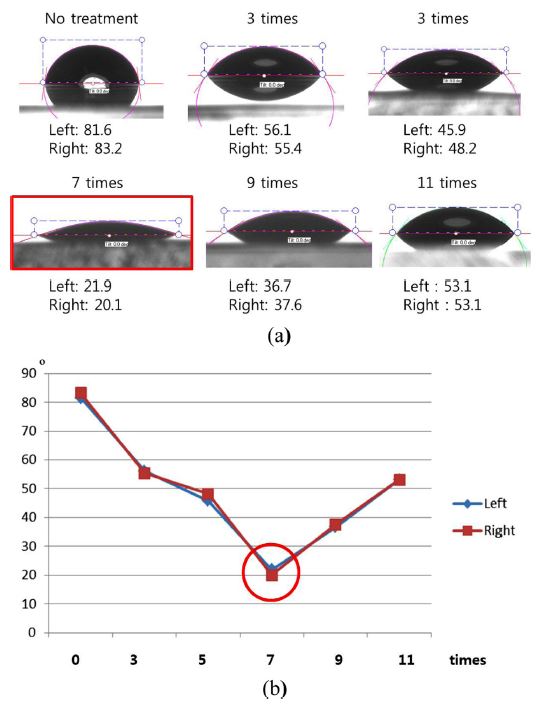
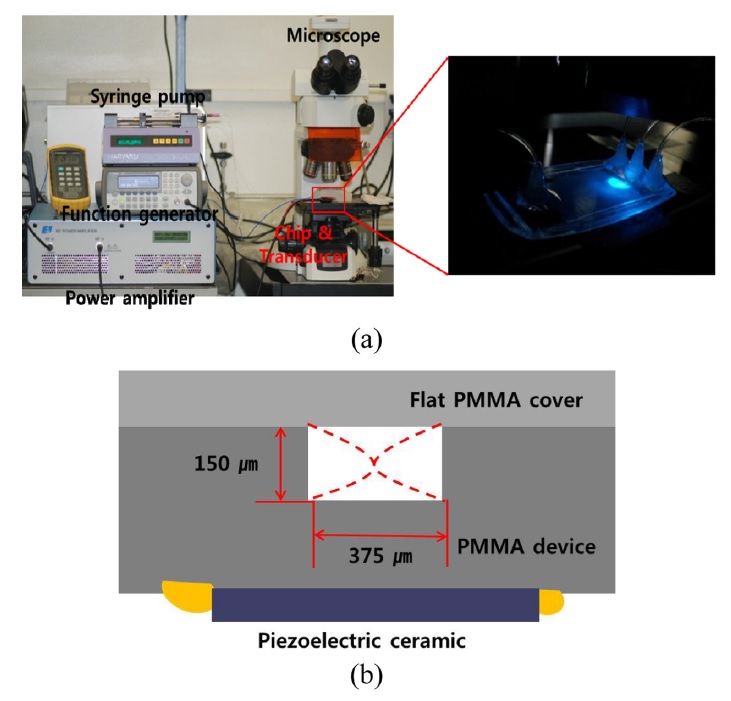
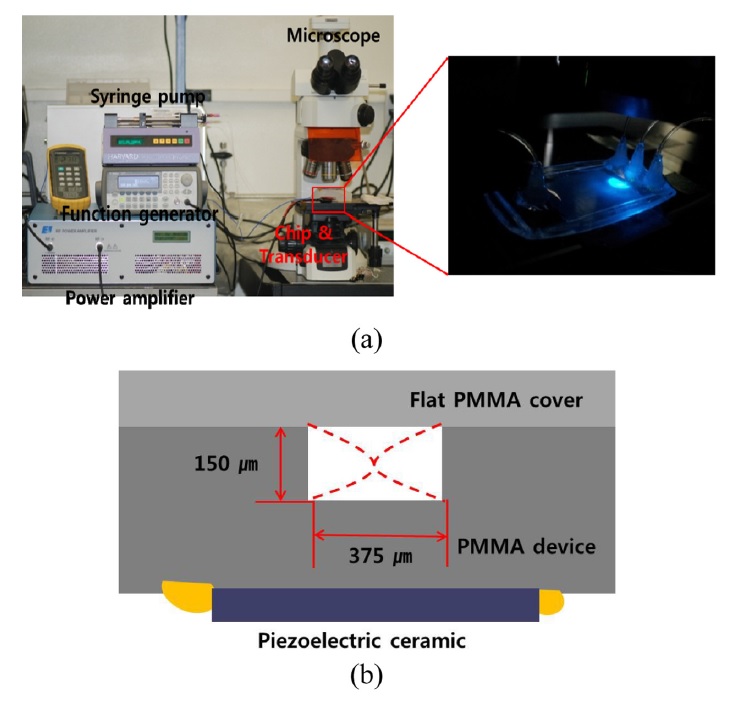
Fig. 4(a)는 음파영동을 이용한 입자분리 실험을 위한 장치를 나타낸다. 실험에 사용한 입자는 직경 10 μm의 형광 폴리스티렌 입자(Polybead Polystyrene 10.0 Micron Microsphere, Polyscience Inc.)를 사용하였으며, DI Water에 1 : 25의 비율로 희석하여 사용하였다. 시린지 펌프를 통해 1 ml/hr의 속도로 유체를 흘려주었으며, 함수발생기를 이용하여 0.947 - 1.93 MHz의 사인파(Sinusoidal Wave)를 전력 증폭기(Power Amplifier)를 통해 PZT Transducer에 인가하였다. 이 때, PZT Transducer에 인가된 전압은 20 - 30 V이다. 입자의 분리 여부는 형광현미경(Eclipse LV100, Nikon)과 디지털 카메라(Digital CMOS Camera C11440, Hamamatsu)를 통해 관찰하였다.
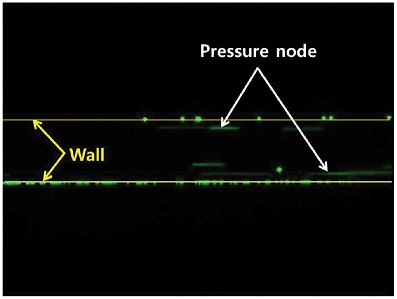
Fig. 4(b)는 미세유체채널 내에서 정상음향파(Acoustic Standing Wave)에 의해 만들어지는 Pressure Node를 나타내고 있으며, 본 연구에서 사용된 형광 입자들은 Pressure Node가 만들어지는 채널의 중앙으로 움직여 분리가 된다.
Fig. 4 (a) Experimental setup for particle separation test, (b) Schematic view of acoustic standing wave induced between the walls
3. 실험 결과 및 고찰
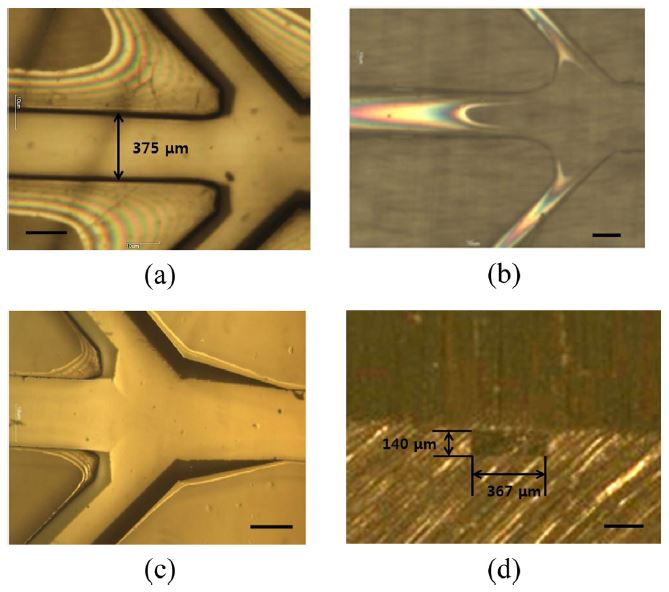
Table 1은 플라즈마 처리를 통해 표면 활성화가 이루어진 두 PMMA의 본딩 시 사용한 유압프레스 장치의 온도와 압력에 따른 본딩 결과를 나타낸다. 낮은 온도(70ºC)에서는 압력에 상관없이 본딩이 완벽히 이루어지지 않는 것을 알 수 있었다. 반면, 높은 온도(80ºC)에서는 미세유체채널이 붕괴되거나(2 MPa), 본딩 자체가 되지 않는 것을 알 수 있었다. 따라서, 플라즈마 처리 후 PMMA-PMMA 본딩을 위한 적절한 압력과 온도를 찾는 것이 중요하다. 본 연구에서는 75ºC의 온도와 3 - 5 MPa의 압력 조건 하에서 본딩이 잘 이루어지는 것을 확인하였다. 미세유체채널의 변형을 최소화하기 위해 가능한 한 낮은 압력에서의 조건이 적절하다고 판단하여 본 연구에서 사용한 본딩 조건은 온도 75ºC, 압력 3 MPa로, 10 분 동안 유지하였다.
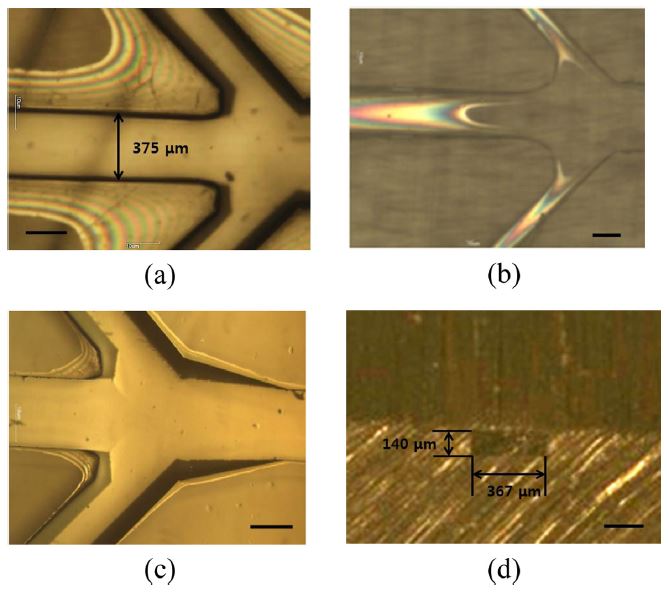
Fig. 5는 본딩 후의 PMMA 디바이스의 채널 상태를 보여주는 현미경 사진으로, 본딩 후 채널 폭(367 μm) 및 깊이(140 μm) (
Fig. 5(d))가 접합 전 채널 폭(375 μm) 및 깊이(145 μm) (
Fig. 2(c))와 비교했을 때 큰 변화가 없는 것을 확인할 수 있었다.
Table 1 Temperature and pressure conditions for bonding after plasma treatment (O: Success, Δ: Partially bonded, X: Fail, C: Channel collapse)
Table 1
|
ºC |
2 MPa |
3 MPa |
4 MPa |
5 MPa |
|
70 |
X |
Δ |
Δ |
Δ |
|
75 |
Δ |
O |
O |
O |
|
80 |
O |
C |
X |
X |
|
85 |
C |
X |
X |
X |
Fig. 5 Microscopic images of bonding states of PMMA device: (a) Partially bonded (70ºC, 3 MPa), (b) Channel collapsed (85ºC, 2 MPa), (c) Perfectly bonded (75ºC, 3 MPa), (d) Cross section of microchannel after bonding (Scale bar: 200 μm)
음파영동을 이용한 입자분리 실험에서 Pressure Node가 생성되는 지점은 가해진 전압의 주파수와 채널 폭 사이의 관계에서 구할 수 있다. 이전 연구에서
5-8 실리콘으로 제작된 디바이스의 경우, 채널 폭이 375 μm, 물속에서의 음파의 속력(20ºC)을 대략 1500 m/s라고 한다면 가해진 전압의 주파수가 2 MHz일 때 첫 번째 정상음향파(1st Harmonic Standing Wave)의 Pressure Node가
Fig. 4(b)와 같이 채널 중앙에 형성된다. 그러나, PMMA로 제작된 마이크로 디바이스의 작동주파수는 실리콘과 유리로 제작된 디바이스보다 낮아, 첫 번째 정상음향파의 Pressure Node가 생성되는 작동주파수는 약 절반 수준인 것으로 확인되었다. 따라서, 본 연구에서 제작된 367 μm의 채널 폭을 가지는 PMMA 디바이스는 약 0.947 MHz (V = 20 V)에서 정상음향파가 형성되는 것을 확인할 수 있었다. 실리콘 디바이스와 달리 PMMA로 제작된 디바이스의 작동주파수가 낮게 나타나는 특성에 대해서는 추가적인 연구가 필요한 것으로 판단된다.
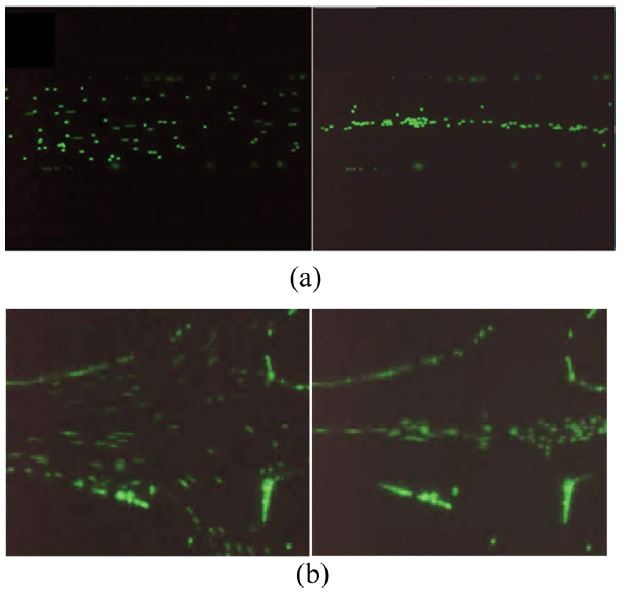
Fig. 6은 PZT Transducer에 전압이 가해져 정상음향파가 형성되기 전과 후의 입자의 상태를 나타낸다. 미세유체채널 내에 정상 음향파가 형성되기 전에는 형광 입자들이 채널 전 영역에 걸쳐 분포되어 이동한다(
Fig. 6(a)). 함수발생기(Function Generator)를 이용하여 PZT Transducer를 통해 발생되는 초음파의 주파수를 변조시켜 정상음향파가 형성되면, 입자들이 Pressure Node가 만들어지는 곳으로 이동을 한다.
Fig. 6 Fluorescent microscopic images of before and after separating by 1st harmonic standing wave, (a) At the middle, (b) At the junction of microfluidic channel
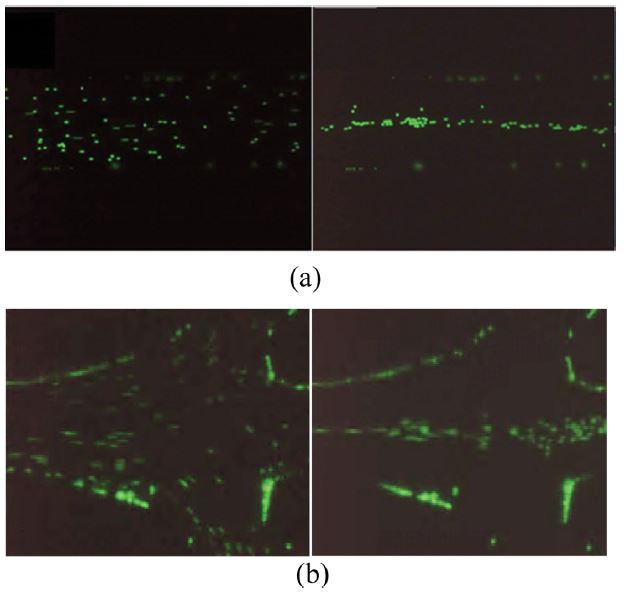
본 연구에서는 먼저 첫 번째 정상음향파를 이용하여 입자분리 실험을 진행하였으며, 이 때 채널 중앙부에 Pressure Node가 생성되어 입자들이 채널 중앙부로 이동하였다. 따라서,
Fig. 6(b)에서 보듯이 형광 입자들은 채널의 가운데 쪽으로 이동하게 되어 최종적으로 입자들의 분리가 가능하였다.
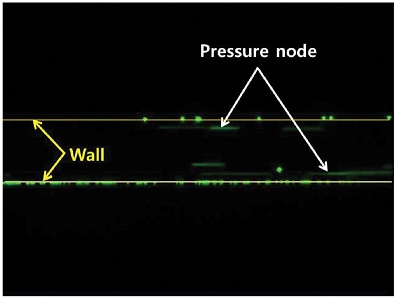
또한, 두 번째 정상음향파(2nd Harmonic Standing Wave)에 대해서도 입자분리 실험을 진행하였다. 가해진 전압의 주파수는 약 1.93 MHz (V = 20 V)로, 이 때의 Pressure Node는 채널의 양 끝단 쪽에 형성되어 입자들이 채널 중앙부가 아닌 바깥쪽의 두 채널을 통해 입자분리가 이루어졌다(
Fig. 7). 앞서 첫 번째 정상음향파의 경우와 마찬가지로 Pressure Node가 생성되는 작동주파수가 실리콘 디바이스의 것(4 MHz)보다 약 절반 수준인 것으로 확인되었다.
Fig. 7 Fluorescent microscopic images after separating by 2nd harmonic standing wave
본 연구에서 제작된 음파영동 디바이스는 음파전달율이 다른 폴리머에 비해 상대적으로 높은 PMMA로 제작되었으나, 실리콘 또는 유리로 제작된 디바이스에 비해 음파영동 실험 중 디바이스의 온도가 크게 상승하였다. 이는
Table 2에서 보이는 바와 같이 PMMA가 다른 재료들에 비해 압축률(Compressibility)과 영의 계수(Young’s Modulus)가 낮아 음향전달손실(Acoustic Transmission Loss)이 상대적으로 크다.
16 따라서, 장시간 사용시 디바이스의 온도가 상승하는 것을 확인할 수 있었다. 본 실험 조건에서 3 분후 약 90ºC까지 상승하였으며, 이 문제를 해결하기 위해 디바이스 아래 쪽에 팬을 설치하여 강제 쿨링으로 급격한 온도 상승이 일어나는 것을 방지하였다.
Table 2 Physical material properties of some materials16
Table 2
|
Material |
Compressibility
(1/Pa) |
Young's modulus
(GPa) |
|
Silicon |
6.0E-12 |
130 |
|
Pyrex glass |
1.40E-12 |
63 |
|
PMMA |
1.30E-12 |
3 |
|
PC |
1.80E-10 |
2 |
4. 결론
본 연구는 음향파를 이용한 입자분리 실험을 위한 디바이스로, 기존 실리콘 기반의 미세유체 디바이스가 아닌 PMMA 폴리머 기반의 미세유체 디바이스를 제작하였다. 먼저 실리콘 기판 위에 미세유체채널을 패터닝한 후, KOH 용액을 이용하여 에칭을 통해 마스터 몰드를 제작하였다. 이후 도금 공정을 이용하여 제작된 니켈 몰드를 제작하였으며, Hot-Embossing 공정을 이용하여 PMMA 기판에 미세유체채널을 전사하였다. PMMA 채널의 실링을 위한 PMMA-PMMA 본딩 공정으로, 플라즈마 처리를 이용한 본딩 방법을 이용하였다. 플라즈마 처리(Ar 6 Sccm, O2 60 Sccm, RF 출력 250W, 7회 처리)를 통해 PMMA 표면을 활성화 시킨 후 낮은 온도(75ºC)와 압력(3 MPa)에서 본딩하여 PMMA 미세유체 디바이스를 완성하였다. 제작된 PMMA 미세유체 디바이스를 이용하여 입자분리 실험을 진행하였다. 미세유체채널 내에서 정상음향파에 의해 만들어지는 Pressure Node는 채널 중앙 또는 양끝단에 형성되어 입자들이 각각의 채널로 움직이는 것을 확인할 수 있었으며, 이를 통해 입자분리가 이루어졌다. 따라서, 정상음향파를 이용한 입자분리를 위해 기존의 실리콘 및 유리 기판을 기반으로 하는 디바이스를 대신하여 PMMA 미세유체 디바이스가 활용 가능할 것으로 기대된다.
ACKNOWLEDGMENTS
이 연구는 서울과학기술대학교 교내 학술연구비 지원으로 수행되었습니다.
REFERENCES
- 1.
Leibacher, I., Reichert, P., and Dual, J., “Microfluidic Droplet Handling by Bulk Acoustic Wave (BAW) Acoustophoresis,” Lab on a Chip, Vol. 15, No. 13, pp. 2896-2905, 2015.
10.1039/C5LC00083A
- 2.
Wiklund, M., “Acoustofluidics 12: Biocompatibility and Cell Viability in Microfluidic Acoustic Resonators,” Lab on a Chip, Vol. 12, No. 11, pp. 2018-2028, 2012.
10.1039/c2lc40201g
- 3.
Lin, S.-C. S., Mao, X., and Huang, T. J., “Surface Acoustic Wave (SAW) Acoustophoresis: Now and Beyond,” Lab on a Chip, Vol. 12, No. 16, pp. 2766-2770, 2012.
10.1039/c2lc90076a
- 4.
Nam, J., Lim, H., Kim, D., and Shin, S., “Acoustic Device for Selective Platelet Extraction from Whole Blood,” Proc. of the 15th International Conference on Miniaturized Systems for Chemistry and Life Sciences, pp. 1326-1328, 2011.
- 5.
Petersson, F., Nilsson, A., Holm, C., Jönsson, H., and Laurell, T., “Continuous Separation of Lipid Particles from Erythrocytes by Means of Laminar Flow and Acoustic Standing Wave Forces,” Lab on a Chip, Vol. 5, No. 1, pp. 20-22, 2005.
10.1039/B405748C
- 6.
Leibacher, I., Reichert, P., and Dual, J., “Microfluidic Droplet Handling by Bulk Acoustic Wave (BAW) Acoustophoresis,” Lab on a Chip, Vol. 15, No. 13, pp. 2896-2905, 2015.
10.1039/C5LC00083A
- 7.
Persson, J., Augustsson, P., Laurell, T., and Ohlin, M., “Acoustic Microfluidic Chip Technology to Facilitate Automation of Phage Display Selection,” FEBS Journal, Vol. 275, No. 22, pp. 5657-5666, 2008.
10.1111/j.1742-4658.2008.06691.x
- 8.
Evander, M., Lenshof, A., Laurell, T., and Nilsson, J., “Acoustophoresis in Wet-Etched Glass Chips,” Analytical Chemistry, Vol. 80, No. 13, pp. 5178-5185, 2008.
10.1021/ac800572n
- 9.
Doria, A., Martin, N. E., and Lee, A. P., “Rapid Two-Step Blood Sample Preparation with Acoustic Microfluidic Chips,” Proc. of the 16th International Conference on Miniaturized Systems for Chemistry and Life Sciences, pp. 1366-1368, 2012.
- 10.
Harris, N., Keating, A., and Hill, M., “A Lateral Mode Flowthrough PMMA Ultrasonic Separator,” International Journal of Applied Biomedical Engineering, Vol. 5, No.1, pp. 20-27, 2012.
- 11.
Abgrall, R., Low, L.-N., and Nguyen, N.-T., “Fabrication of Planar Nanofluidic Channels in a Thermoplastic by Hot-Embossing and Thermal Bonding,” Lab on a Chip, Vol. 7, No. 4, pp. 520-522, 2007.
10.1039/b616134k
- 12.
Brown, L., Koerner, T., Horton, J. H., and Oleschuk, R. D., “Fabrication and Characterization of Poly (Methylmethacrylate) Microfluidic Devices Bonded Using Surface Modifications and Solvents,” Lab on a Chip, Vol. 6, No. 1, pp. 66-73, 2006.
10.1039/B512179E
- 13.
Tsao, C.-W. and De Voe, D. L., “Bonding of Thermoplastic Polymer Microfluidics,” Microfluidics and Nanofluidics, Vol. 6, No. 1, pp. 1-16, 2009.
10.1007/s10404-008-0361-x
- 14.
Yoo, K.-P., Kang, M.-S., Pyo, S.-Y., Hong, S.-I., and Min, N.-K., “The Bonding Properties of PDMS-Substrate by Oxygen Plasma Treatment,” Proc. of the Korean Institute of Electrical Engineers Conference, pp. 1914-1916, 2003.
- 15.
Rymuszka, D., Terpiłowski, K., Hołysz, L., and Chibowski, E., “Changes in Surface Properties of Polymethylmethacrylate (PMMA) Treated with Air Plasma,” Annales Universitatis Mariae Curie-Skłodowska, Chemia, Vol. 70, No. 1, pp. 65-78, 2015.
10.1515/umcschem-2015-0006
- 16.
Laurell, T., Petersson, F., and Nilsson, A., “Chip Integrated Strategies for Acoustic Separation and Manipulation of Cells and Particles,” Chemical Society Reviews, Vol. 36, No. 3, pp. 492-506, 2007.
10.1039/B601326K