ABSTRACT
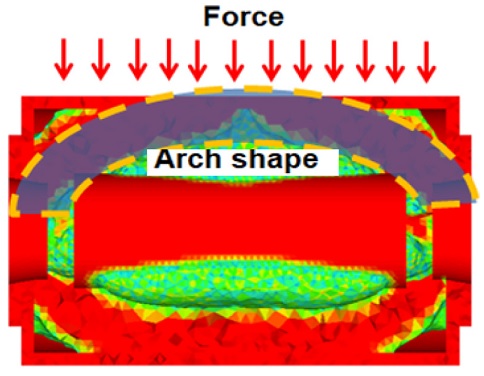
In this paper, topology optimization of a main roller for Multi-wire saws is conducted for the purpose of reducing mass of the main roller. Modal analysis is carried out to evaluate whether the resonance could have occurred, or not. The pressure from the cutting wires are modelled mathematically. Topology optimization analysis with the pressure model developed is conducted to derive optimal solution of the sectional shape of the roller. As a result, the cross section of the main roller manifests as an arch shape. The mass of the final optimal model is reduced by 14%, while the deflection and natural frequencies of the roller is same as those of the base model.
-
KEYWORDS: Topology optimization, Multi-wire saw, Moment of inertia
-
KEYWORDS: 위상최적화, 멀티와이어쏘, 관성모멘트
1. 서론
멀티 와이어쏘(Multi-Wire Saw, MWS) 장비는 다이아몬드 가루가 점착된 여러 줄의 와이어가 롤러에 감겨 있고 롤러가 회전하며 와이어를 움직여 가공물을 절삭하는 설비이다. 장착된 와이어는 가공물의 종류나 용도에 따라 여러가지 절삭조건으로 작동된다.
본 논문의 연구대상인 사파이어 글래스를 가공하는 멀티 와이어쏘 장비의 경우 200줄의 와이어가 장착되어 있고 선속도가 1200 m/min으로 움직일 수 있도록 롤러가 구동 모터에 의해 회전하며 와이어의 장력은 50 N으로 유지하도록 제어한다. 이 멀티 와이어쏘 장비는 메인 롤러의 회전 방향이 약 1분 30초에 한번씩 바뀌게 되는데 이 감가속 구간에서 메인 롤러의 질량이나 관성 모멘트에 따라 구동 모터의 필요에너지가 비례해서 커지게 된다.
멀티 와이어쏘 장비는 메인 롤러의 질량이나 관성 모멘트가 작을수록 작은 모터를 사용할 수 있기 때문에 제작 비용을 절감할 수 있으며, 상대적으로 더 큰 가속도를 가지도록 절삭 제어를 수행할 수 있기 때문에 경쟁력 있는 멀티 와이어쏘 장비를 개발하는데 유리해지지만, 롤러의 최적설계에 대한 연구
6,7는 많이 이루어지지 않고 있다.
멀티 와이어쏘 장비에 대한 이전 연구로 여러 연구가 진행되었다. 대부분의 연구는 절삭 속도, 절삭력을 변화시켰을 경우 가공물 형상의 굽어있는 정도인 보우(Bow) 현상을 평가하는 연구
1,2,9와 절삭 시 가공대상물이 와이어와 가까워지는 속도 변화와 와이어의 장력을 변화시켜 가공물의 품질을 평가하는 연구
3,10가 진행되었다. 이는 설비의 기구부와 메인 롤러 등의 구조는 고려하지 않는 연구로 구조가 달라진다면 가공물의 품질이 달라질 수 있다. 또한 멀티 와이어쏘 가공 시 발생되는 응력 등을 파악하기 위한 시뮬레이션 연구
4가 수행된 사례가 있었으나, 메인 롤러의 형상이 단순화되어 메인 롤러에서 발생 가능한 변위 등은 고려되지 않았다는 한계가 있다.
본 연구에서는 사파이어 글라스를 절삭하는 멀티 와이어 쏘 장비
8를 대상으로 메인 롤러의 질량 감소를 위한 최적설계에 관한 연구를 진행한다. 메인 롤러의 최적설계를 위하여 먼저 유한 요소를 이용하여 메인 롤러 모델을 구성 후 고유진동수, 변위 해석을 통해 기본 모델을 평가한다. 얻어진 결과를 제약조건으로 설정하여 위상 최적화를 진행하여 상세 최적설계를 위한 기초 모델을 도출한다. 도출된 기본 모델을 이용하여 각 부분을 변수로 설정하여 상세 최적화를 진행하고 이를 통해 최적 모델을 도출하여 기초 모델과 비교를 통해 검증을 진행한다.
본 논문의 구성은 다음과 같다. 먼저 2절에서는 메인 롤러의 유한요소 모델링 방법론을 제시한다. 이 모델링을 기반으로 한 정강성 해석 결과 및 고유진동수 해석 결과를 제시한다. 3절에서는 2절에서의 결과를 기반으로 메인 롤러의 위상최적설계를 수행한 결과를 제시한다. 4절에서는 결론을 제시한다.
2. 메인 롤러 유한요소 모델링 및 해석
2.1 멀티 와이어쏘 장비의 메인 롤러
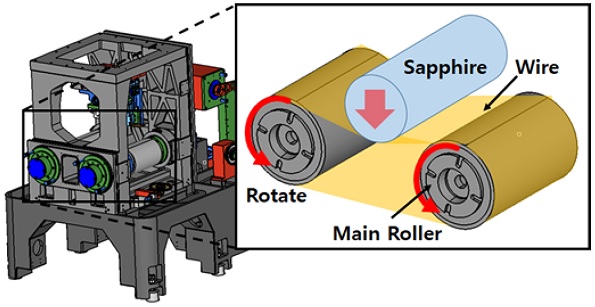
본 논문의 MWS 장비는 강선에 다이아몬드 가루를 점착시켜 사파이어 글라스를 절삭하는 장비로
Fig. 1과 같다. 50 N의 장력을 가지는 200줄의 와이어가 반원 형태로 장착되어 회전하는 원통 형상의 부품을 메인 롤러라고 한다. 상부에 장착된 사파이어 잉곳이 하강하여 절삭이 수행된다. 이때 와이어의 장력이 일정하게 제어되므로 메인 롤러에 작용하는 힘은 일정하다고 할 수 있다. 와이어의 선 속도는 1200 m/min이고 메인 롤러를 회전시키는 모터는 약 1500 rpm으로 회전한다.
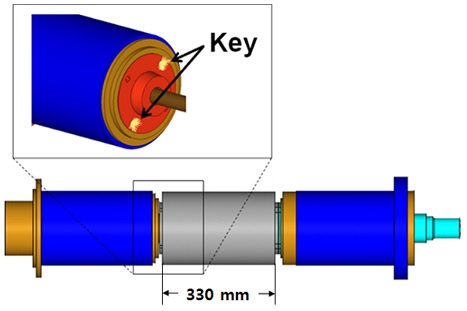
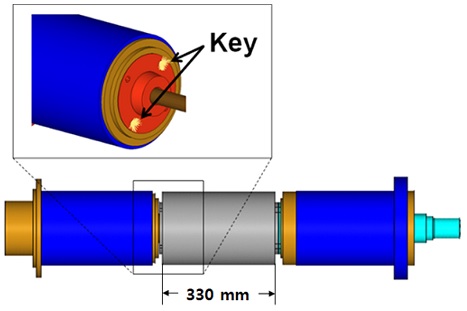
Fig. 2와 같이 메인 롤러는 양쪽에 브라켓과 2개의 키와 중앙에 테이퍼를 이용하여 체결된다. 또한 총 절삭 시간인 약 8~12시간동안 약 1분 30초에 한번씩 회전 방향이 바뀌게 되는데 메인 롤러의 무게가 무거울 경우 회전방향을 바꾸기 위한 에너지가 크게 필요하게 된다. 본 논문에서의 메인 롤러는 330 mm 길이의 메인 롤러로 총 200줄의 와이어가 장착되며 각각 50 N의 장력을 가진다면 메인 롤러에 걸리는 힘은 10
4 N이 된다. 또한 절삭되는 사파이어 글라스는 마이크로미터 단위의 정밀도를 가져야 한다. 따라서 회전 관성이 적으며 고강성의 메인 롤러 설계가 필요하다.
Fig. 1Multi-Wire saw machine and main roller
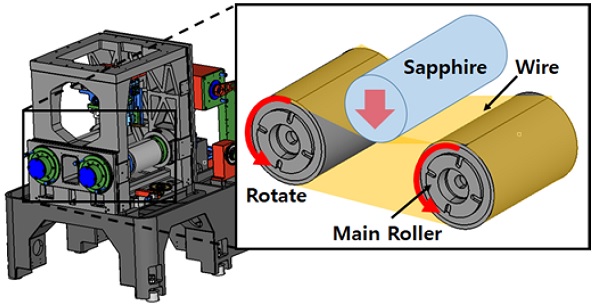
Fig. 2Bracket and key of Main roller
2.2 메인 롤러의 고유진동수 해석
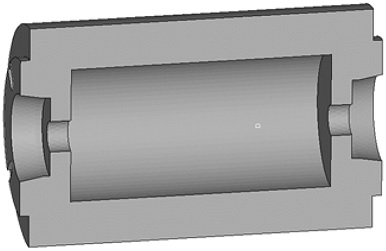
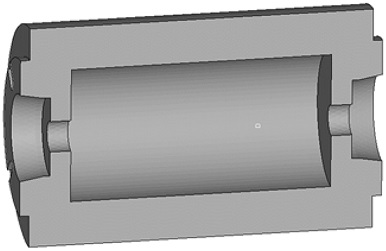
기존 메인 롤러의 선형 해석을 위하여 먼저 유한 요소를 이용한 모델링을 진행하였다. 재질은 Steel이며 무게는 약 70 kg이고 회전 관성 모멘트는 0.52 kg·m
2이다. 전체 형상 및 단면 형상은
Fig. 3과 같다.
Fig. 3Finite element model of main roller section
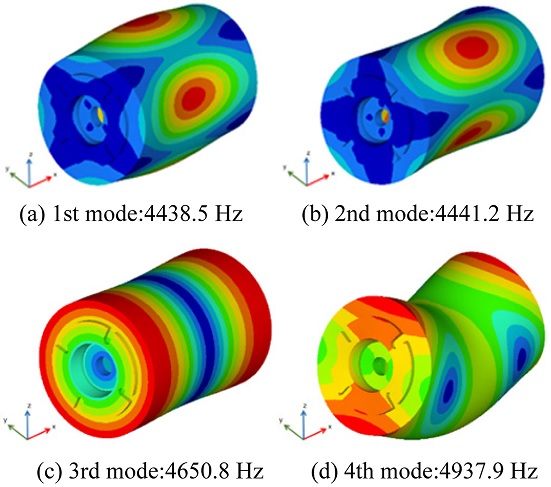
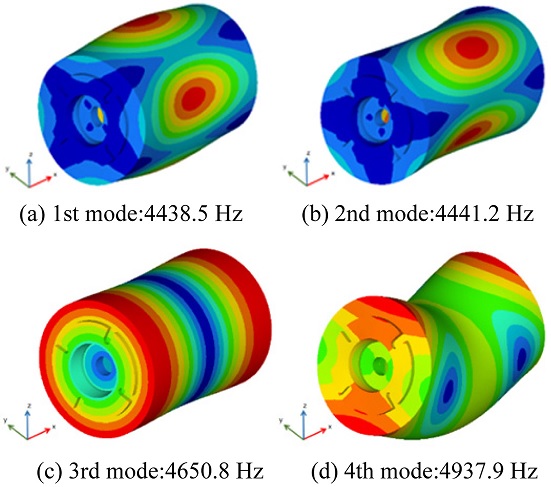
구성된 유한요소 모델을 이용하여 자유단 조건에서 고유진동수 해석을 진행하였다. 첫번째 모드는 약 4438.5 Hz, 두번째 모드는 4441.2 Hz 로 나왔으며 그 모드 형상은
Fig. 4와 같다. 본 장비의 사용되는 모터의 가진 영역을 고려하면 공진은 일어나지 않을 것으로 판단되지만 모드 형상을 보면 3차 모드와 4차 모드의 경우는 각각 비틀림과 굽힘으로 도출되었는데 첫번째 두번째 모드 형상은 롤러 중앙부가 강성이 약하여 눌리는 형상이 도출되었음을 확인할 수 있었다.
Fig. 4Natural frequency mode of main roller on free-free condition
메인 롤러는 양쪽에 두개의 키로 고정되어 회전하는 형상으로 키가 장착되는 부분을 6자유도 구속 후 고유진동수 해석을 진행하였고 그 결과는
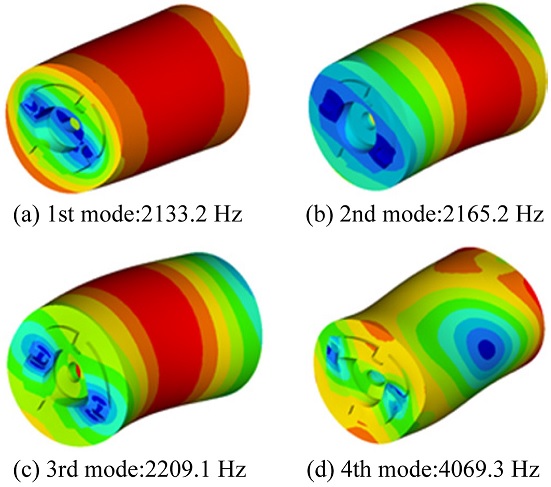
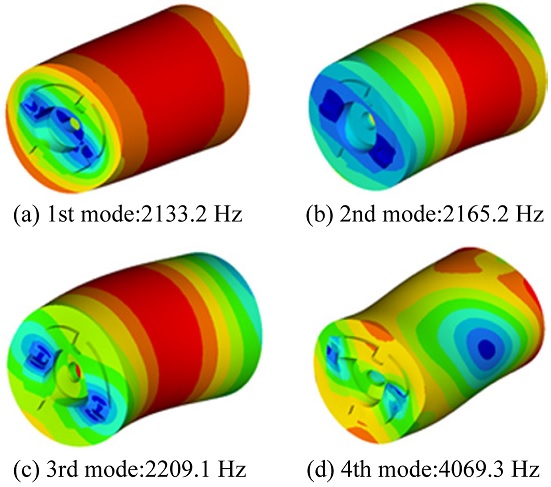
Fig. 5와 같다. 해석 결과 첫번째, 두번째 고유진동수는 각각 2133.2 Hz, 2165.2 Hz로 약 2300 Hz 감소하였지만 모터의 가진 영역대에서는 여전히 공진이 일어나지 않을 것임을 확인하였다. 모드 형상은 자유단 조건과 달리 양쪽 고정으로 인해 강성이 보강되어 비틀림과 굽힘 모드로 도출됨을 확인하였다.
Fig. 5Natural frequency mode of main roller on fixed condition
2.3 메인 롤러의 변위 해석
메인 롤러의 처짐 해석을 위하여 유한요소를 이용한 선형 해석 모델링을 진행하였다. 고유진동수 해석 때와 같이 양쪽에 2개의 키로 고정되는 부분은 6자유도 구속을 하고 하중은
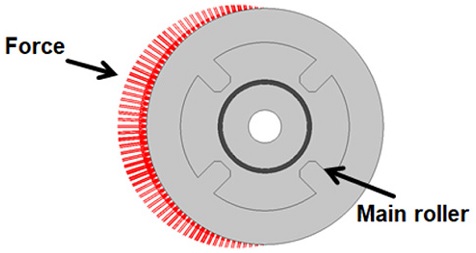
Fig. 6과 같이 반원 형태로 와이어의 장력, 선속, 위치에 따라 메인 롤러 각 부분에 걸리는 힘을 다르게 주어지도록 구성하였으며 이에 대한 수식은
식(1)와 같다.
5
Fig. 6Force condition of main roller
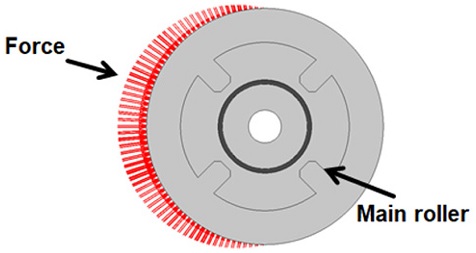
여기서 T는 절삭와이어의 장력을 의미하며 선 하나당 50 N을 메인 롤러에 가한다. v는 와이어의 선속도를 말하며, 본 연구에서는 1200 m/min로 가정하였다. θ는 회전 중심으로부터 반시계 방향으로의 각도이다. dm은 와이어와 접촉하는 메인 롤러의 미소 질량을 의미한다.
해석 결과
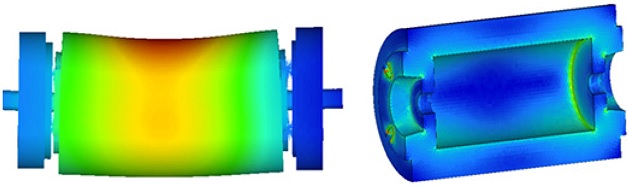
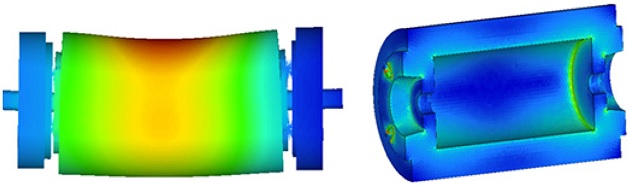
Fig. 7과 같이 변위는 약 2.014 μm가 메인 롤러 중심 부분에서 발생되었으며 최대 응력은 3.30 MPa로 키가 연결되는 부분에서 발생함을 확인하였다.
Fig. 7Static analysis results of main roller
3. 메인 롤러 최적화
3.1 메인 롤러의 위상 최적화
메인 롤러의 최적화 형상 제안을 위해 위상최적화를 진행하였다. 사용한 소프트웨어는 Hyper Works의 Optisturct를 이용하였다.
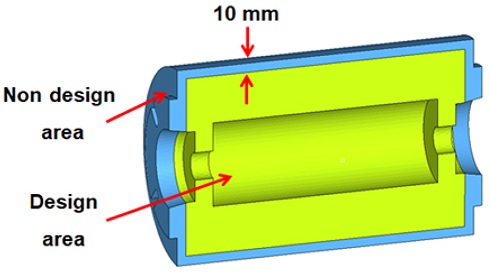
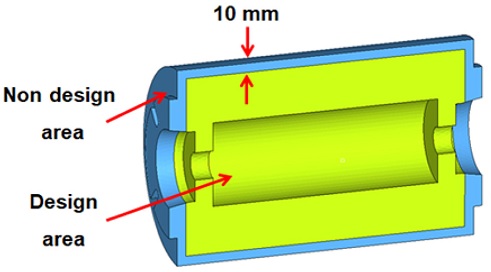
Fig. 8와 같이 메인 롤러의 최 외벽에서 10 mm 두께까지의 영역을 와이어가 장착되기 위한 최소한의 두께로 상정하였으며 비설계 영역으로 설정하였다. 또한, 이 10 mm 두께 안쪽의 영역을 설계 영역으로 설정하였다.
Fig. 8Design area and non-design area of the main roller
위상최적화를 위한 정식화는 아래
Table 1과 같다. 설계 영역의 밀도를 설계 변수로 설정하였다. 또한, 위상최적설계의 제한조건으로 발생하는 최대 응력과 변위를 유지 또는 감소시키고, 동시에 메인 롤러 모델의 고유진동수는 유지 또는 증가시키도록 하였다. 즉, 위와 같은 설계제한조건을 만족시키면서 설계 영역의 밀도를 최적화 알고리즘의 각 턴(Turn)마다 조정하여 질량을 최소화하도록 설정하였다.
Table 1Design condition for topology optimization
Table 1
|
Design variable |
Density of elements |
|
Subject to |
Max displacement ≤ 2.014 mm
Max stress ≤ 3.378 MPa
Natural frequency ≥ 4.438.5 Hz |
|
Objective function |
Minimize mass |
위상 최적화 결과 아래
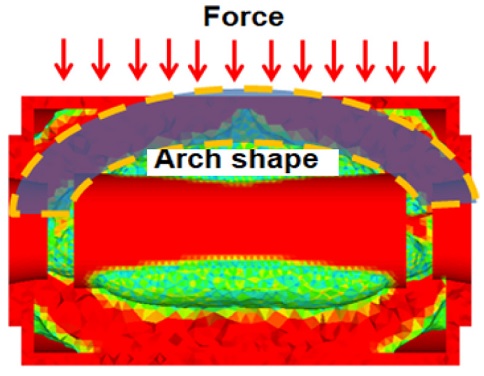
Fig. 9와 같이 메인 롤러의 단면 형상이 도출되었음을 확인하였는데 단면 형상이 아치 형상과 같이 굽은 형태가 도출됨을 확인하였다. 메인 롤러의 상세한 최종 형상을 도출하기 위해서는 상세최적설계를 위한 기초 모델을 수립하여야 한다. 이것은 위상 최적화로 도출된 형상은 최적설계 목표를 달성하는 정성적인 특성을 반영하기는 하지만, 가공을 위한 상세설계 치수를 설정할 수는 없기 때문이다. 따라서, 변형이나 진동수의 최적설계 결과를 반영하면서 가공성을 함께 고려한 메인 롤러의 기초 모델 도출이 필요하다. 즉, 여기서 언급한 기초 모델은 메인 롤러의 내부 혹은 외부에 곡선을 지양하면서, 구조적으로 아치 형상을 표현하는 모델이 필요하다고 할 수 있다.
Fig. 9Result of topology optimization
3.2 메인 롤러의 상세 최적화
메인 롤러의 상세 최적설계를 위해 위상 최적화 결과를 기반으로
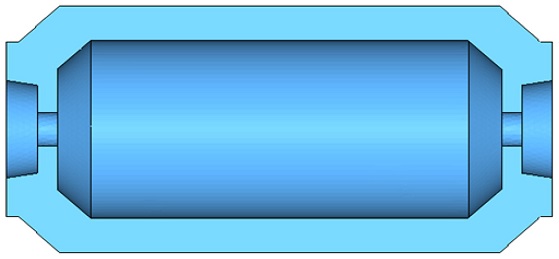
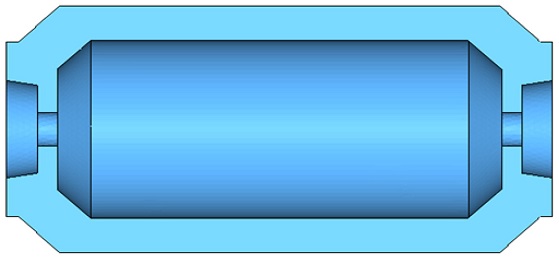
Fig. 10과 같이 상세 최적설계를 위한 기초 모델을 수립하였다. 앞 절에서 설명한 대로 메인 롤러의 단면 형상은 아치 형상을 표현하며 곡선이 없는 형태로 설정하였고 기존 모델과 와이어가 장착되는 부분의 면적은 같다.
Fig. 10Base main roller model for optimization
상세 최적화를 위한 기초 메인 롤러 모델의 단면 형상에서 아치를 표현하는 빗면 형상은 메인 롤러 외곽에도 표현되어 있고 이러한 외곽의 빗면을
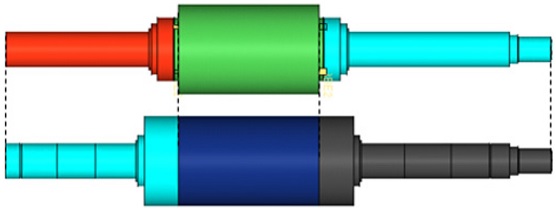
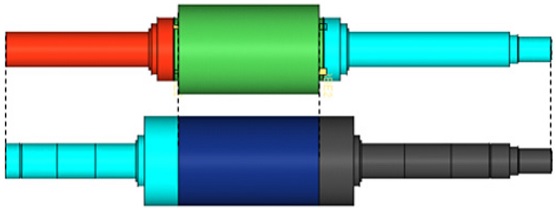
Fig. 11과 같이 양쪽 브라켓에서 감싸도록 형상을 제안하였다. 기 수행된 고유 진동 모드에서 고정단 조건에서의 모드 형상에서 양쪽을 고정할 경우 메인 롤러 중앙의 강성이 증대됨을 확인하였으므로 브라켓이 양쪽을 지지하기 때문에 메인 롤러의 두께를 감소시킬 수 있을 것으로 예상되었다.
Fig. 11Full spindle comparison between basic and proposed model
최종 메인 롤러 형상 도출을 위해서 상세 최적화를 진행하였다.
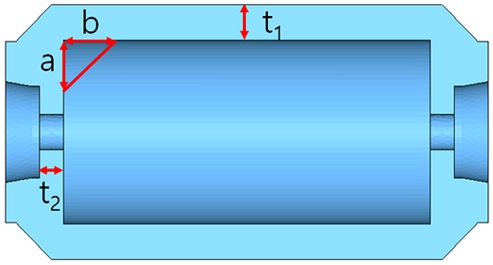
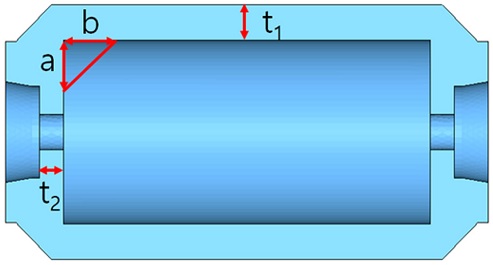
Fig. 12과 같이 메인 롤러 단면의 두께(t
1), 체결부 두께(t
2), 빗면의 높이(a), 넓이(b) 총 4 개의 설계 변수를 설정하여 실험 계획법의 박스벤켄법을 통해 총 27가지의 경우에 대해 시뮬레이션을 진행하고 질량에 대한 근사함수를
식(2)와 같이 도출하였다.
Fig. 12Design variables for detail optimization
도출된 근사 함수 식을 이용하여 위상최적화를 위한 제약조건 및 목적함수를 설정하였다. 제약조건은 변위, 고유진동수, 응력로 설정 후 목적함수는 질량 최소화로
Table 1과 같이 설정하여 최적화 진행 후 최적화 값을 도출하였다. 도출된 최적화 값은 a: 30 mm, b: 30 mm, t
1: 25 mm, t
2: 15 mm로 도출되었으며 해당 값을 이용하여 최적화 모델을 모델링하였고 검증을 위한 변위 및 고유 진동수 해석을 진행하였다.
그 결과
Table 2와 같이 최대 발생변위는 유지되었고, 최대 응력은 약 7% 감소하였음을 확인하였다. 고유진동수는 첫번째 주파수가 3967.6 Hz로 도출되어 소폭 감소하였지만 모터의 가진 주파수 고려 시 문제되지 않을 것으로 판단하였다. 또한 메인 롤러의 질량은 초기 모델 대비 약 14% 감소하였음을 확인하였다. 이로 인해 메인 롤러의 회전 관성 모멘트가 1.54% 감소되었음을 확인하였다.
Table 2Comparison between base and optimal model
Table 2
|
Deflection
[μm] |
Stress
[MPa] |
Mass
[kg] |
Inertia
[kg·m2] |
|
Base |
1.85 |
3.30 |
69.60 |
0.52 |
|
Optimal |
1.85 |
3.07 |
59.90 |
0.51 |
|
Difference [%] |
- |
-6.97 |
-13.94 |
-1.54 |
4. 결론
본 연구에서는 사파이어 글라스 절삭을 위한 멀티 와이어쏘 장비에서 메인 롤러의 회전 관성 모멘트 감소를 위한 최적설계에 관한 연구를 진행하였다.
메인 롤러의 해석을 위해서 유한요소를 이용한 모델링을 진행하였으며 이를 이용하여 고유진동수 해석을 진행하였다. 해석 결과 고유진동수의 경우 멀티 와이어쏘 장비에서 가진원으로 고려하여 하는 장착 모터의 회전속도보다 월등히 높음을 확인하였다.
메인 롤러의 변위 해석을 위해 메인 롤러 위치에 따라 다르게 적용되기 위하여 하중을 위치에 따른 수식으로 대입하였다. 메인 롤러가 브라켓과 체결되는 부위를 구속하여 변위 해석을 진행하여 최대 발생 변위를 확인하였다.
메인 롤러의 최적설계를 위해서는 최적화 기초 모델 수립이 선행되어야 하므로 이를 위한 위상최적화를 진행하였다. 설계 변수로는 유한요소의 밀도, 제약조건으로는 최대 발생 변위 및 응력의 유지 및 감소로 설정하고 목적함수는 질량 최소화로 설정하였다. 그 결과 단면 형상이 아치와 같이 곡선 형태로 도출됨을 확인하였다.
도출된 위상 최적화 결과를 기반으로 상세 최적설계를 위해서 단면 형상에 빗면을 구성한 기초 모델을 수립하고 빗면의 너비, 높이, 메인 롤러 두께 등을 설계 변수로 설정하여 실험계획법을 이용한 최적화를 수행하였다. 최적화를 통해 도출된 최적 모델은 변위는 유지되었고 응력은 약 7% 감소하였으며 질량은 약 14% 감소하여 결과적으로 회전 관성 모멘트가 감소되었음을 확인하였다.
ACKNOWLEDGMENTS
This work was supported by the Technology Innovation Program(10052882), funded by the Ministry of Trade, Industry & Energy (MI, Korea).
REFERENCES
- 1.
Kim, C. M., Kim, S. R., Kim, D. Y., and Kim, H. J., “The Surface Characteristics of Wafer according to Variation of Force in Processing of Multi-Wire Saw Machine,” Proc. of KSPE Autumn Conference, pp. 621-622, 2012.
- 2.
Kim, K. J., Hong, S. H., Ahn, S. H., Mun, J. H., Choi, G. N., et al., “Study on the Influence of Ingot Cutting Speed on Roller in Multi Wire Saw Process,” Proc. of Korean Society of Mechanical Engineers Spring Conference, pp. 245-246, 2014.
- 3.
Kim, C. M., Kim, S. R., Suh, J. M., and Kim, H. J., “Processing Characteristics according to Slicing Conditions in Multi Wire Saw Machine,” Proc. of KSPE Spring Conference, pp. 13-14, 2012.
- 4.
Jung, M. S., Kim, S. R., and Kim, C. M., “Simulation of Solar Cell Ingot Cutting Using Wire-Saw,” Proc. of KSPE Spring Conference, pp. 11-12, 2013.
- 5.
Lee, K. S., Hong, J. H., Son, J. H., and Lee, S. H., “Development of V Belt Pulley Design/Analysis System,” Transactions of Korea Society of Automotive Engineers, Vol. 19, No. 6, pp. 209-218, 2002.
- 6.
Jung, M. S., “Optimization of Cutting Process for Ingot Using Wire Saw,” Proc. of KSPE Autumn Conference, pp. 169-170, 2013.
- 7.
Park, Y. and Hong, J. H., “Torsional Vibration of a Hollow Shaft Subjected to a Moving Mass,” Transactions of the Korean Society for Noise and Vibration Engineering, Vol. 15, No. 8, pp. 975-979, 2005.
10.5050/KSNVN.2005.15.8.975
- 8.
Kim, H., Kim, D., Kim, C., and Jeong, H., “Multi-Wire Sawing of Sapphire Crystals with Reciprocating Motion of Electroplated Diamond Wires,” CIRP Annals-Manufacturing Technology, Vol. 62, No. 1, pp. 335-338, 2013.
10.1016/j.cirp.2013.03.122
- 9.
Ahn, D. C., Shin, E. S., and Lee, Y. S., “Experimental Investigation into the Dynamic Characteristics of High Speed Air Spindles under the Tip Loadings,” Proc. of the Korean Society of Mechanical Engineers Spring Conference, pp. 173-176, 2009.
- 10.
Kim, D. Y., Kim, H. J., Lee, S. J., and Jeong, H. D., “Study on Electroplated Diamond Wire Characterization of Multi Wire Sawing Using Cutting Ability Model,” Proc. of the Korean Society of Mechanical Engineers Spring Conference, pp. 335-338, 2016.
Citations
Citations to this article as recorded by

- Research on High-Speed Vibration and Structure Optimization of Multiwire Sawing Machine
Zhikui Dong, Ao Liang, Long Chang, Shang Wu, Binfeng Hou
Applied Sciences.2023; 13(17): 9889. CrossRef - Optimization Design of Student KSAE BAJA Knuckle Using SLM 3D Printer
Young Woo Im, Geon Taek Kim, Hyeon Sang Shin, Kang Min Kim, Bu Hyun Shin, Jong Won Lee, Jinsung Rho
Journal of the Korean Society for Precision Engineering.2023; 40(9): 719. CrossRef - Study on the Bearing Arrangement of Multi-wire Saw Equipment Using Spring Elements
Hye Ryang Park, Jun Young Lee, Hong Jae Yim, Jay Il Jeong
Transactions of the Korean Society for Noise and Vibration Engineering.2019; 29(4): 488. CrossRef