ABSTRACT
Spinal stability is controlled by two interrelated systems: the spinal column including ligaments and the muscular control system. In addition to these systems, the thoracolumbar fascia (TLF) also interacts with the muscular system to maintain the stability of the spine. The effects of the tensioning of TLF on the spinal stability was investigated using computational analysis. The stability of the spine was analyzed with a three-dimensional finite element model of musculoskeletal system including TLF. The paraspinal muscle activities were calculated based on a hypothesis: the intervertebral disc was assumed to have a transducer function and the muscle is activated according to a sensor driven control mechanism to maintain stability of the lumbar spine. Muscle forces were calculated in examining 40º isometric forward flexed and erect standing postures. As a result, the fascial tension induced a decrease in superficial muscle activity while maintaining the spinal stability.
-
KEYWORDS: Thoracolumbar fascia, Paraspinal muscle, Lumbar spinal stability
-
KEYWORDS: 흉요근막, 척추 주변 근육, 요추부 안정화
1. 서론
인체의 척추 중 몸통과 골반 사이에 캔틸레버 보의 형태로 연결되어 있는 요추부(Lumbar Spine)는 구조적으로 가장 취약한 부분이다. 그러나 척추체 주변에 분포한 척추 주변 근육(Paraspinal Muscle)으로 인하여 상체의 운동이 가능 할 뿐만 아니라 요추의 안정화가 이루어지고 있다. 척추 안정화를 위한 척추 내 수동 요소들(Passive Component)의 영향에 대해서는 많은 연구가 그동안 지속적으로 이루어져 왔으나 척추 주변 근육의 작용에 의한 안정화에 대해서는 상대적으로 제한적인 연구만이 진행되어 왔다.
척추 거동에서 척추 주변 근육들의 역할을 규명하기 위한 실험적 방법은 실험적 한계로 인해 매우 제한적인 정보만을 제공할 수 있다는 취약점 때문에 해석적 방법을 이용한 연구를 통해 이를 보완하고자 하는 노력이 계속되어 왔다. 해석적 방법에는 일반적으로 척추 주변 근육력 도출을 위한 최적화 기법이 사용되고 있는데, 이 경우 사용되는 목적 함수로 각 근육에서 발생되는 응력의 세제곱의 합을 택할 경우에 가장 좋은 해를 구할 수 있는 것으로 알려져 있다.
1 보다 실제에 가깝도록 향상된 근육력을 도출하기 위해 최적화 기법을 통한 근육력 계산 과정에서 표피에 근접한 근육(Superficial Muscle)의 EMG 데이터나 척추의 기구학적 형상(Kinematic Configuration) 정보를 추가적으로 이용하여 근육력을 구하려는 시도의 연구가 수행되기도 하였다.
2,3 지금까지 시도된 해석적 방법에서는 척추체 요소를 단순 수동체로 제한하여 척추 관절에 부과되는 힘과 모멘트의 평형을 이루는 척추 주변 근육력을 도출하도록 하여 추골을 강체로, 추간판과 인대의 변형은 빔 요소로 간략화 시킨 모델이 이용되고 있다. 그러나 최근 실험적 연구를 통해 제안된 정보에 의하면 추간판과 인대들에 존재하는 기계적 수용기(Mechanoreceptor)로부터 전달되는 정보에 의해 근육이 작동되는 것으로 추정되며, 이와 같은 기계적 수용기의 센싱 기능으로 인해 척추의 부상을 방지할 수 있는 최적의 상태로 척추 주변근이 조정되는 것으로 예상되고 있다. 이에 따라 본 연구자들은 추간판이 응력 센서의 기능을 갖고, 추간판에서 발생하는 응력의 차이를 최소화 시키기 위해 척추 주변 근육의 작용이 조정된다는 가정하에 상세 유한 요소 모델과 최적화 기법을 이용하여 척추 주변 근육의 역할을 규명한 바 있다.
4
척추 주변근 이외에도 일부 복근은 흉요근막에 직접 연결되어 척추 안정화에 영향을 미칠 것으로 예상되며, 복근 작용에 의해 생성되는 복압도 역시 척추 안정화에 영향을 미치는 것으로 알려져 있다. 그러나 복근과 복압이 척추 안정화에 미치는 상대적 영향에 대해 분석된 바는 아직 없다. 따라서 본 연구에서는 기존 발표된 기계적 수용체의 응답 특성에 따른 척추 주변 근육력의 해석 모델에 복근의 수축 및 복압의 작용으로 발생되는 흉요근막 인장력(Fascial Tension Force)을 적용한 새로운 모델을 이용하여 흉요근막의 인장력이 척추 안정화에 미치는 영향을 분석하고자 하였다.
2. 모델링
본 연구에서 사용된 모델은 강체(Rigid Body)로 이루어진 흉부(Thoracic Part) 모델과 천골(Sacrum) 및 골반(Pelvis) 모델, 그리고 상세 유한 요소 모델로 이루어진 요추부(Lumbar Spinal Column) 모델, 척추 주변근, 그리고 단순화된 흉요근막의 모델로 구성하였다.
2.1 근골격계 모델
요추부는 L1에서 L5까지 5개의 추골(Vertebrae)과 그 사이를 연결하는 추간판, 인대로 구성되어 있으며, 12번째 흉추골(T12)과 L1 사이의 추간판과 인대를 추가하여 강체로 된 흉부와 연결하였다. 추간판은 수핵(Nucleus)과 섬유륜(Annulus Fibrosus)의 두 부분으로 나뉘어 있으며 4겹의 섬유륜 기저물(Ground Matrix) 요소 사이에 섬유소(Fiber)가 내재된 복합체 형태로 구성하였다. 개발된 모델은 이미 여러 하중 조건에 대한 검증을 통해 모델의 타당성을 제시하였다.
5,6 기존의 검증된 모델에 장요인대(Iliolumbar Ligament)를 추가하여 8종류의 인대에 대해 인장에 대한 저항력을 갖는 트러스(T3D2) 요소로 구성하였다. 장요인대는 L5의 횡돌기(Transverse Process)에서 장골능(Iliac Crest)의 전후방으로 나뉘어 부착되는 인대로 해부학적 정보로 제시된 단면적(전방: 16 mm
2, 후방: 25.4 mm
2)
7을 적용하였고, 횡돌간인대(Transverse Ligament)와 동일한 탄성계수(10 MPa (
ε < 0.18), 58.7 MPa (
ε > 0.18); ε: strain)
5를 적용하였다.
근육 요소를 부착하기 위해 12개의 흉추와 12쌍의 늑골로 구성된 흉곽(Rib Cage)과 천골 및 골반 모델을 포함하였다. 근육 모델은 기존
4에 개발되었던 98개의 근육 요소에 T12-L1에 부착된 대요근(Psoas Major)과 다열근(Multifidus)의 10개 요소를 추가하여 108개의 좌우 대칭 모델로 구성하였다. 척추 기립근(Erector Spinae)인 흉최장근(Longissimus Thoracis)과 요장늑근(Iliocostallis Lumborum)에 대해 흉곽에 부착된 표면근과 추골에 부착된 심층근(Deep Muscle)으로 나누어 모델링 하였고, 상위 추골의 극돌기(Spinous Process)에서 하위 추골의 유두돌기(Mammillary Process)로 부착되는 다열근은 부착된 극돌기의 위치에 따라 층을 나누어 상세히 모델링 하였다. 이외에 대요근과 요방형근(Quadratus Lumborum)이 근육 모델에 포함되었다.
근육 모델은 힘의 작용선을 고려하여 기시점(Origin)과 삽입점(Insertion)을 커넥터(CONN3D2) 요소로 연결하고, 요소 내에 국부 좌표계(Local Coordinate)를 설정하여 모델의 자세 변화와 무관하게 두 점 사이로 근육력이 작용하도록 하였다. 척추 기립근중 흉곽에서 장골능 또는 천골능으로 이어지는 긴 근육은 삽입점과 기시점을 지나는 추골의 측면에 가상 절점을 추가적으로 생성하고 이 점을 지나도록 근육력의 작용 경로를 설정하였다. 추골의 횡돌기 또는 극돌기에 MPC (Multi-Point Constraints)로 가상 절점을 구속하여 상체의 자세 변화 시 추골의 회전을 따라 가상 절점이 함께 이동하여 근육력의 경로가 변경되도록 하였다.
복근에는 복직근(Rectus Abdominis)과 복횡근(Transverse Abdominis), 내복사근(Internal Oblique), 외복사근(External Oblique)이 있다. 이 중 복직근은 두 부착점 사이로 근육력이 작용하도록 커넥터 요소로 모델링 하였고, 복횡근과 내/외복사근의 작용에 대해서는 흉요근막의 섬유 방향을 단순화 하여 모델링하고 인장력으로 부과하였다.
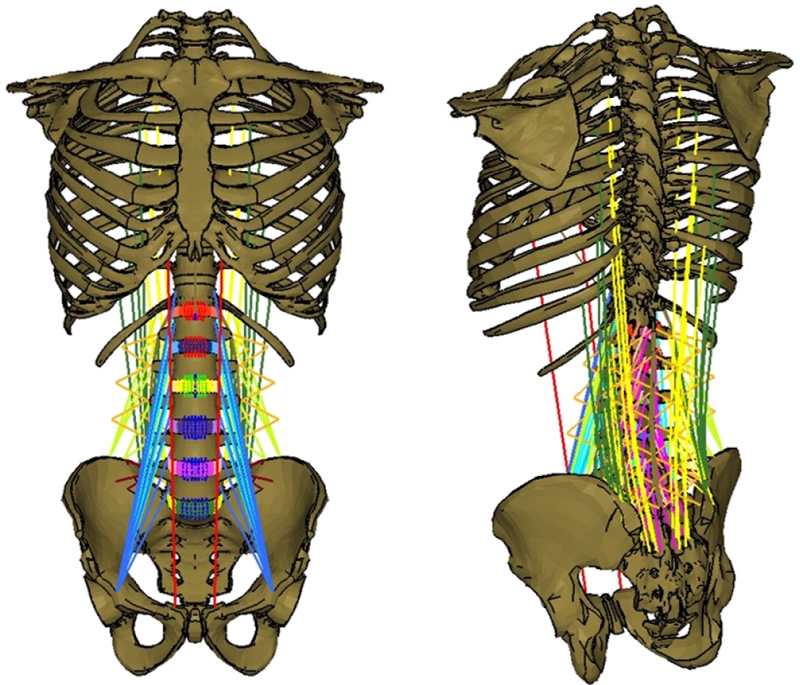
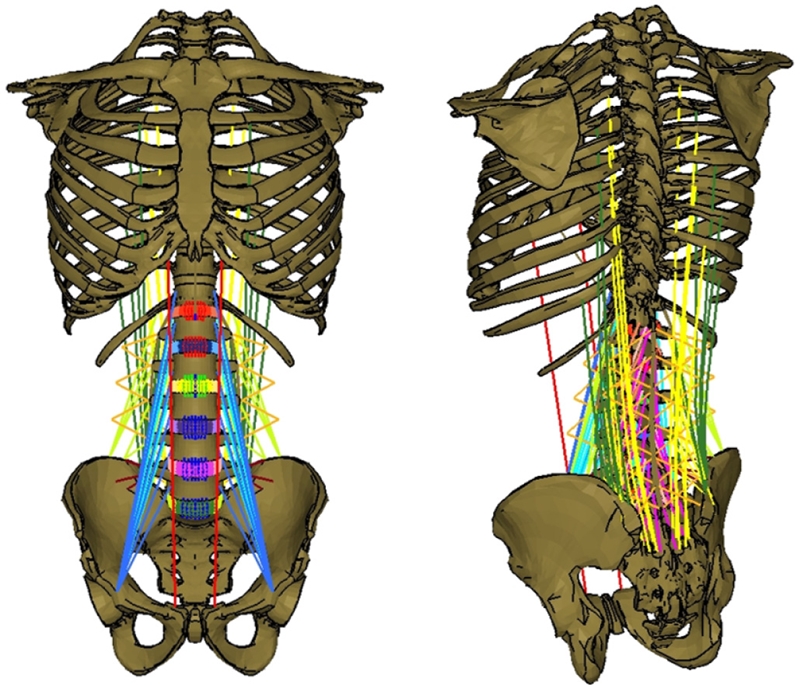
Fig. 1은 본 연구에서 개발된 근골격계 모델의 형상을 보여주고 있다.
Fig. 1Developed musculoskeletal model. Spinal column was modelled with detailed finite element model
2.2 흉요근막 모델
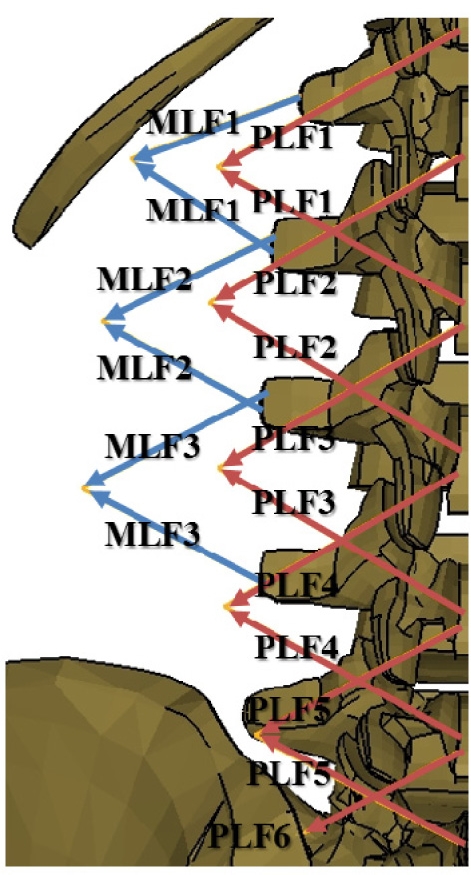
흉요근막은 구조적으로 전층(Anterior Layer), 중층(Middle Layer), 후층(Posterior Layer)으로 구성되어 있으나 본 모델에서는 근육과 부착되어 근육이 수축할 때 인장력이 전달되는 중층과 후층에 대해서만 고려하였다. 흉요근막의 중층은 복횡근 및 복사근과 연결되는데 L3 추골을 기준으로 상위에는 외복사근, 하위에는 내복사근이 연결되고 중층 전반에 걸쳐 복횡근이 연결된다.
8 후층은 광배근(Latissimus Dorsi)과 복횡근, 복사근, 대둔근(Gluteus Maximus)과 연결되어 각 근육의 수축에 의해 흉요근막으로 인장력이 전달된다. 흉요근막의 섬유소는 인접 분절의 횡돌기를 교차한 삼각형 형태로 기립 자세에서는 수평면을 기준으로 20º-30º를 이루며, 최대 굽힘 자세에서는 약 40º의 각도를 갖는 것으로 보고 되었다.
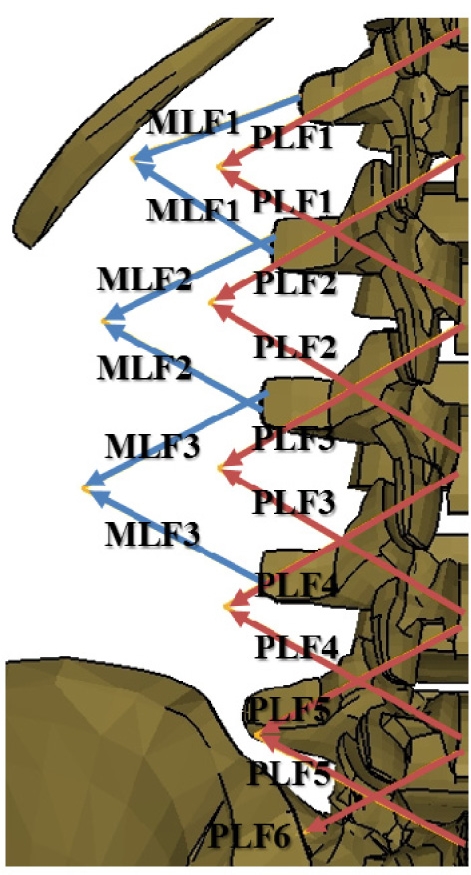
9 이러한 흉요근막의 구조적 특징을 모델에 반영하기 위하여 추체의 돌기에 가상의 빔(B31) 요소를 생성하고 요소의 끝점을 커넥터 요소로 교차 연결하여 상체의 자세 변화에 따라 흉요근막 인장력의 작용 방향이 변화되도록 하였다.
Fig. 2에서는 적용된 흉요근막 형상과 흉요근막 인장력의 작용선을 보여준다.
Fig. 2Simplified thoracolumbar fascia model
흉요근막에 작용하는 인장력은 흉요근막에 연결된 근육의 단면적
10-12과 기립 자세(Erect)와 40º굽힘 자세(FLX40)에서 얻어진 근육의 활성도
13를 고려하여 추정하였으며, 각 자세에 적용된 흉요근막 인장력은
Table 1과 같다.
Table 1Assumed fascial tension force (N)
Table 1
Posture
TLF level |
Erect |
FLX40 |
|
MLF1 |
0.32 |
2.11 |
|
MLF2 |
0.33 |
2.23 |
|
MLF3 |
0.45 |
3.02 |
|
PLF1 |
0.44 |
2.95 |
|
PLF2 |
0.42 |
2.77 |
|
PLF3 |
0.67 |
4.45 |
|
PLF4 |
0.76 |
5.09 |
|
PLF5 |
0.95 |
6.3 |
|
PLF6 |
1.71 |
11.4 |
2.3 해석 방법
유한 요소 모델의 경계 조건으로 천골 및 골반을 고정하였고, 하중 조건으로 75 kg 성인 남자의 상체 무게에 해당하는 400 N의 하중을 상체의 무게 중심에 부과하였다. 앞서 제시한 흉요근막의 인장력을 부과하여 흉요근막 인장력의 작용에 따른 영향을 분석하도록 하였다. 상체 굽힘에 의한 근육력의 변화를 계산하기 위해 기립 자세를 기준으로 40º 굽힘 자세 모델을 구성하였다. 기립 자세 모델에 대해 치골과 좌골 사이의 폐쇄공(Obturator Foramen)의 중점을 기준으로 11.94º의 각도만큼 모델을 회전시켜 골반의 회전(Pelvic Tilting)을 형성
14하고, 유한 요소 해석 과정에서 상체 하중 및 근육력에 의해 발생하는 요추체의 회전을 통해 형성하고자 하는 굽힘 자세 각도를 이루도록 하였다.
척추 주변 근육력의 계산 과정은 앞서 기술한 하중 조건에서 유한 요소 해석을 통해 기계적 수용기가 가장 많이 분포되어 있는 것으로 알려진 각 추간판 섬유륜의 최외층의 기저물
15에서 발생되는 압력(Hydrostatic Pressure)의 평균을 구한 후 이를 최적화 해석에 적용하여 각 운동 분절에서의 추간판 압력 편차를 최소화 하는 근육력을 계산하도록 하였다. 이와 같은 해석 방법은 추간판이 물리적 자극에 대한 수용기로서 작용한다는 가정에 따라 척추 주변 근육들이 요구되는 상체의 자세를 유지하면서 추골의 상대적인 회전 등을 조절하여 각 추간판에서 발생하는 응력의 차이를 최소화시켜 특정 추간판에서 과다 응력이 발생하는 것을 방지하여 부상 가능성을 감소시킬 수 있다. 이와 같은 계산을 수행하기 위해
식(1)의 목적 함수(Cost Function)를 사용하였다.
subject to
LB ≤ Fi (%MVC) ≤ UB, Fi = PCSAi × 0.6
|Ux| ≤ 0.3 mm
|θs| ≤ 0.01 rad
where
Sp,i : Averaged pressure of the annulus ground matrix at the outermost layer in i-th disc
Sp,ave : Averaged pressure of the annulus ground matrix at the outermost layer in all discs
n : Number of disc
Fi : i-th muscle force
LB : Lower bound of muscle force
UB : Upper bound of muscle force
PCSAi : Physiological cross-sectional area of i-th muscle
Ux : Anterior-Posterior translation tolerance of the trunk mass center
θs : Trunk angle tolerance from desired posture
설계 변수(Design Variable)로 선정된 근육력의 초기값은 기존의 실험 연구
13를 통해 제시된 표면 근육의 최대 수축(Maximum Voluntary Contraction)에 대한 측정 데이터의 평균값을 바탕으로 계산되어 적용되었으며, 측정 오차 범위 내에서 최소값과 최대값을 갖도록 설정하였다. 실험 데이터가 제시되지 않은 심층근의 경우에는 표면근의 실험 데이터와 동일하게 가정하여 적용하였다. 최적화 과정을 통해 얻어진 근육력은 유한 요소 해석의 입력값으로 재입력되며 이와 같은 과정은 목적함수가 수렴할 때까지 반복적으로 수행되어 최적화 된 근육력이 얻어진다.
유한 요소 해석은 ABAQUS (v6.10, Dassault System Simulia)를 이용하였으며 최적화 상용 소프트웨어인 VisualDOC (v7.2, VR&D, Inc.)와 연동하여 최적화 과정을 진행하였다. 최적화 알고리즘은 유용방향법(Modified Method of Feasible Directions)을 사용하였다.
3. 해석 결과
척추 주변근들을 상체의 자세를 유지하며 추간판에서의 부상을 최소화 시키도록 작용시킨 결과 다음과 같은 근력들이 계산되었다.
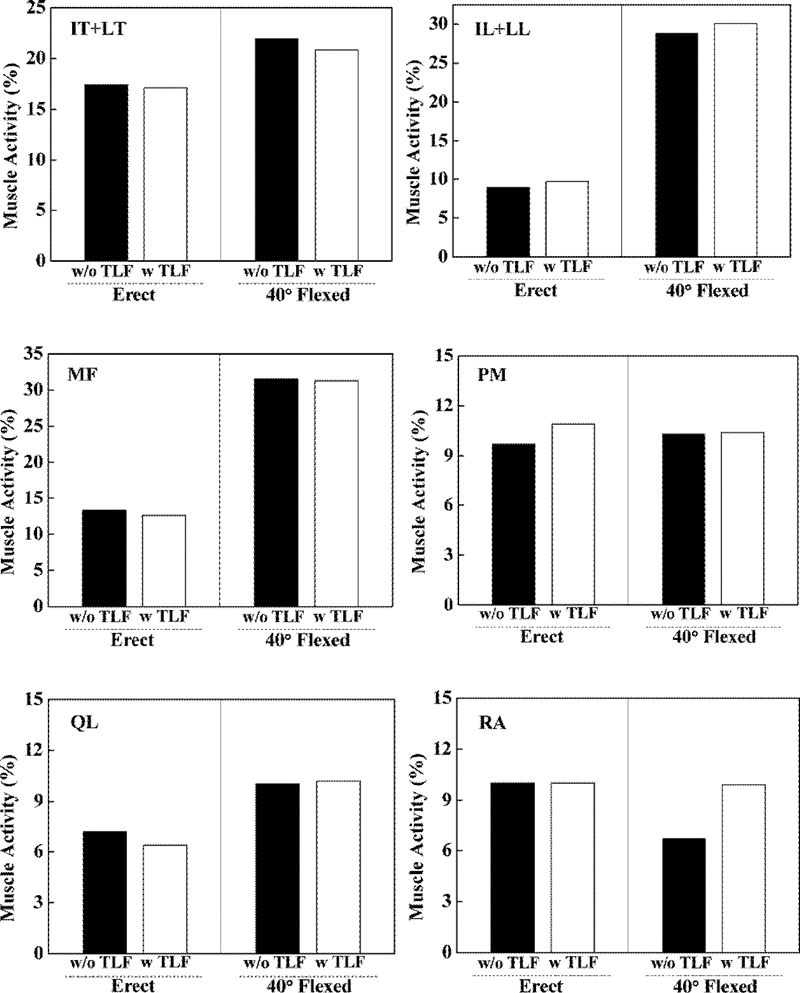
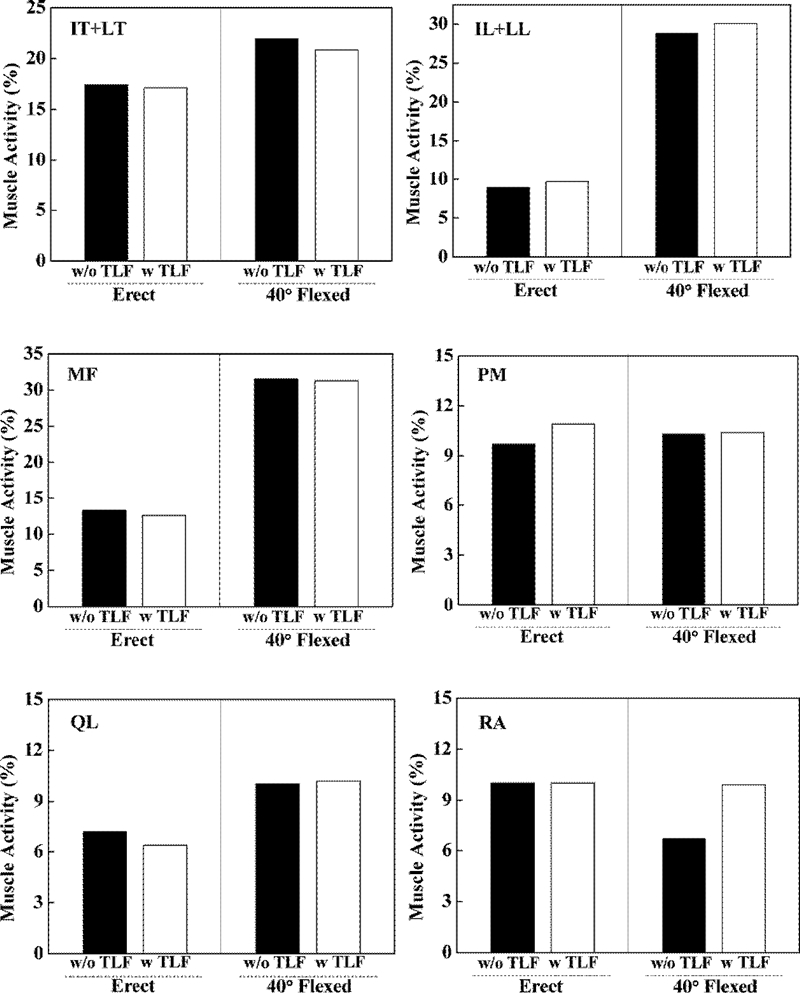
Fig. 3은 각 근육의 근력을 근육의 최대 발생 가능 근력에 대해 표준화된(Normalized) 결과를 보여주고 있다. 신전력을 발생시키는 척추 기립근과 다열근, 요방형근 요소의 작용은 기립 자세 보다 40º 굽힘 조건에서 평균 활성도가 증가하는 결과를 보이고 있다. 반면 대요근과 복직근은 굽힘 각도의 증가에도 불구하고 큰 변화없이 작용되었다. 흉요근막의 인장력을 부과하였을 때, 흉곽에서 골반 및 천골로 연결되는 흉최장근과 요장늑근의 작용이 줄어드는 것을 보여주고 있다.
Fig. 3 Muscle activities at erect standing and 40º forward flexed posture with or without TLF. Muscle activities was normalized with respect to the maximum voluntary contraction (IT: Iliocostalis lumborum pars thoracis, LT: Longissimus thoracis pars thoracis, IL: Iliocostalis lumborum pars lumborum, LL: Longissimus thoracis pars lumborum, MF: Multifidus, PM: Psoas major, RA: Rectus abdominis, QL: Quadratus lumborum)
6종류로 분류된 근육들의 상대적인 기여도를
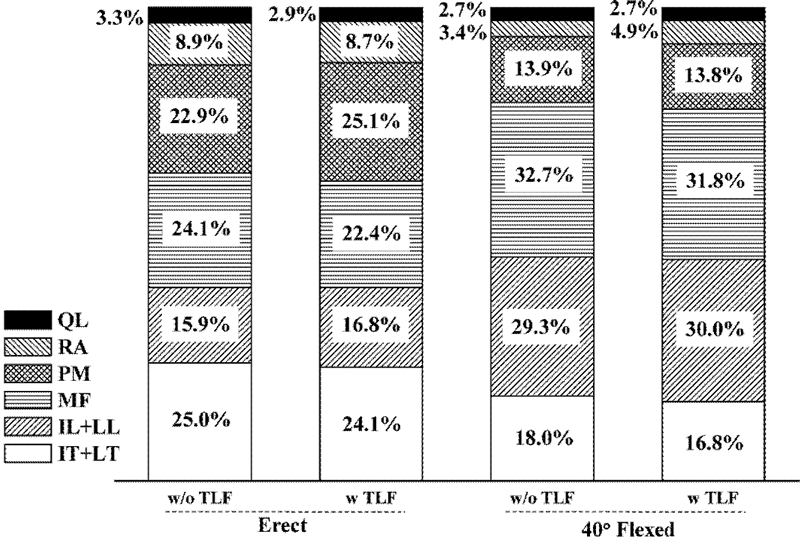
Fig. 4에서 보여주고 있다. 굽힘 각도의 증가하였을 때 흉곽에 부착된 척추 기립근의 역할이 감소한 반면 요추체에 부착된 기립근의 역할은 증가하였다. 이와 유사하게 심부근인 다열근의 작용도 증가함을 보였다. 이와 반대로 대요근과 복직근의 역할은 감소함을 보이고 있다. 흉요근막 인장력을 부과한 경우에는 척추 기립근 중 흉곽에 부착된 표면근의 역할이 상대적으로 감소한 반면 심층근의 역할이 다소 증가함을 알 수 있었다.
Fig. 4 Contribution ratio of each muscle group with or without TLF (IT: Iliocostalis lumborum pars thoracis, LT: Longissimus thoracis pars thoracis, IL: Iliocostalis lumborum pars lumborum, LL: Longissimus thoracis pars lumborum, MF: Multifidus, PM: Psoas major, RA: Rectus abdominis, QL: Quadratus lumborum)
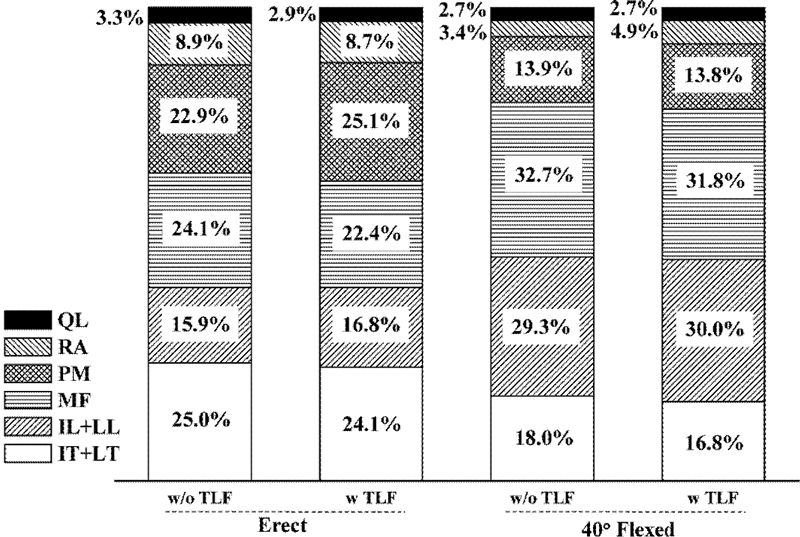
Table 2는 각 추간판에 발생하는 수핵 내 압력의 크기를 보여주고 있다. 흉요근막 인장력은 기립 자세와 40º 굽힘 자세에 대해 추간판 압력을 증가시키고 있다. 기립 자세 및 굽힘 자세에서 각 운동 분절에서의 추간판의 각도 및 운동량을
Table 3에서 보여주고 있다. 흉요근막 인장력의 추가적인 작용에도 불구하고 요추 전만각(Lordotic Angle)은 유지되었고, 추간판 각도의 변화는 매우 미미하였다.
Table 2 Nucleus pressure in each disc (kPa)
Table 2
|
Posture disc level |
Erect |
FLX40 |
|
w/o TLF |
w TLF |
w/o TLF |
w TLF |
|
L1-L2 |
746.8 |
769.0 |
787.9 |
807.3 |
|
L2-L3 |
642.5 |
655.0 |
859.6 |
878.5 |
|
L3-L4 |
614.8 |
619.2 |
914.1 |
935.4 |
|
L4-L5 |
586.7 |
596.7 |
1036.0 |
1057.0 |
|
L5-S1 |
638.4 |
654.0 |
1225.0 |
1249.0 |
Table 3 Final disc angle in each motion segment. Values in parenthesis indicate the motion segment rotation at the flexed posture (degree)
Table 3
|
Posture disc level |
Erect |
FLX40 |
|
w/o TLF |
w TLF |
w/o TLF |
w TLF |
|
L1-L2 |
6.46 |
6.51 |
4.85(1.61) |
4.82(1.69) |
|
L2-L3 |
7.04 |
7.06 |
1.30(5.74) |
1.39(5.66) |
|
L3-L4 |
9.25 |
9.22 |
1.75(7.5) |
1.86(7.36) |
|
L4-L5 |
11.70 |
11.73 |
3.65(8.05) |
3.73(8.0) |
|
L5-S1 |
14.94 |
14.90 |
7.43(7.51) |
7.47(7.43) |
|
Lordotic angle |
52.41 |
52.43 |
22.99 |
22.27 |
4. 토의
지금까지 척추의 능동 요소와 수동 요소의 상호작용을 통한 척추 안정화를 비롯하여 복근 및 복압이 척주의 안정성에 미치는 영향에 대한 논의는 다양한 시도를 통해 계속되어 왔다. 기존 연구자들에 의해 제안된 근육력을 도출할 수 있는 모델은 역학적 균형 상태에서 근육력을 최소화 시키는 방법으로 계산되었으며, 척추 안정화에 기여하는 복근과 복압의 역할에도 불구하고 이들 요소와 척추 주변 근육 사이의 상호적인 작용에 대한 평가는 매우 제한되게 이루어져 왔다. 특히 상체가 큰 굽힘 각도를 유지할 때 능동 요소보다는 흉요근막 등의 수동 요소에 대한 영향이 커지는 것으로 예측되고 있으나 이에 대한 정량적 평가 또한 이루어진 바 없었다. 따라서 본 연구에서 제시된 상체의 굽힘 각도 변화와 흉요근막 인장력의 적용 여부에 따른 척추 주변 근육의 작용 변화는 각 요소의 역할을 분석 할 수 있을 것으로 판단된다.
본 연구에서 제시된 근골격계 모델을 이용하여 계산된 해석 결과는 기존의 In-Vivo 상태에서 측정된 근육의 활성도를 비롯하여 추간판 내 압력에 대한 측정 결과와 매우 일치된 경향을 보여주고 있다. Wilke 등
16에 의한 In-Vivo 실험 측정 결과는 편안하게 서있는 기립 상태와 앞으로 40º 굽혔을 경우 L4-L5 추간판 중심에서 약 0.5 MPa과 1.0 MPa의 압력이 각각 측정되었다. 본 연구의 계산 결과에 의하면 흉요근막 인장력의 작용 여부와 관계없이 유사한 압력이 계산되었다. 기립 자세와 40º 굽힘 자세에서 흉요근막 인장력의 적용으로 인해 L4-L5 추간판에서 약 10-20 kPa의 압력이 증가하였고, 이외 운동 분절의 추간판에서도 10-27 kPa의 압력이 증가하였다. 이러한 결과는 흉요근막을 통해 전달되는 복근의 수축 및 복압의 작용이 요추부에 압축력을 증가시켜 추간판의 압력이 증가하게 되며 증대된 척추의 강성도에 따라 척추의 안정화도 증가되는 것으로 설명할 수 있다.
Arjmand 등
13이 보고한 표면근의 EMG 측정 결과는 기립 자세에서 흉최장근과 요장늑근이 14-18%, 다열근이 14-19%, 복직근이 10-16%의 값을 갖는다. 본 연구의 해석 결과와 비교하여 보면 흉요근막의 인장력이 부과된 기립 자세의 표면근의 계산 결과는 흉최장근과 요장늑근에서 각각 15.4%, 19.6%의 평균 활성도를 보였고, 다열근과 복직근에서 각각 12.1%와 10%의 평균 활성도를 보였다. 40º로 굽힘 각도가 증가됨에 따라 기립 자세를 기준으로 흉최장근의 평균 활성도 변화를 계산한 결과로 흉요근막 인장력이 작용하지 않을 때 158.6%로 계산되었고, 흉요근막 인장력이 부과될 때 113.3%로 계산되었다. 두 결과 모두 Roy 등
17에 의해 측정된 실험 결과 범위 내에 부합되는 결과이며, 흉요근막 인장력의 작용으로 인해 표면근의 작용이 감소하는 결과를 보였다. 각 근육의 역할 변화를 살펴보면 상체가 굽혀짐에 따라 표면근과 심층근의 활성도는 증가하는 결과를 보였다. 반면, 흉요근막 인장력의 작용에 따라 흉최장근과 요장늑근의 표면근의 작용이 감소하였으나 두 근육의 심층근은 증가하는 결과를 보였다. 이러한 결과를 통해 상체가 굽혀짐에 따라 자세 유지와 척추의 안정화를 위한 심층근의 역할이 커지게 되고, 특히 복근 및 복압의 작용에 따른 흉요근막의 인장으로 인해 상대적으로 작은 표면근의 작용만으로도 효과적으로 자세를 유지하고, 척추 안정화를 이룰 수 있음을 알 수 있었다.
각 자세에서의 요추 전만각은 흉요근막 인장력의 부과에도 불구하고 유사한 값으로 유지되었고, 각 추간판의 각도는 X-Ray 측정
18,19을 통해 보고된 추간판의 각도와 일치하는 결과를 보였다. 한편, 흉요근막 인장력의 작용이 각 운동 분절의 회전량의 변화에 미치는 영향은 미미한것으로 계산되었다. 이러한 결과를 통해 흉요근막 인장력을 통한 복근 및 복압의 작용은 요추부의 운동량 변화에 직접적인 영향을 미치지 않으면서 척추 주변근과의 상호작용을 통해 요추부 운동량 및 척추 안정화를 유지하는 것으로 예측할 수 있다.
본 연구에서 제안된 흉요근막 인장력을 이용한 복근 및 복압의 적용은 해석의 편의상 흉요근막 인장력을 고정 변수를 설정하여 각 모델에 예측된 값을 부여하였다. 이와 같은 가정은 복근의 수축 및 복압의 작용이 척추의 안정화에 미치는 영향을 분석하는데 제한점으로 작용하였을 것으로 판단된다. 흉요근막 인장력이 척추 주변근과 같이 설계 변수로 설정되어 최적화 과정이 이루어진다면 흉요근막이 척추 안정화에 미치는 영향에 대해 보다 명확히 분석할 수 있을 것으로 판단된다.
5. 결론
기립 자세로부터 상체 굽힘 자세까지 굽힘 각도 변화와 흉요근막 인장력의 작용에 따른 척추 주변근의 변화를 상세 유한 요소 모델과 최적화 기법을 이용하여 분석하였다. 굽힘 각도의 변화에도 불구하고 척추 주변 근육의 적절한 작용을 통해 척추의 안정성이 유지되는 것을 확인할 수 있었다. 복근 및 복압의 작용을 대체한 흉요근막 인장력이 척추 기립근 중 표면근의 작용을 감소시키는 것을 확인하였고, 흉요근막 인장력의 증가와 근육력의 변화로 추간판 수핵 내 압력이 증가하였으며, 그럼에도 불구하고 운동 분절의 운동량 및 요추 전만이 유지되는 결과를 얻을 수 있었다. 이와 같은 해석 결과를 통해 흉요근막 인장력의 작용에 따라 작은 근육력으로 상체의 자세 및 척추의 안정화가 유지될 수 있음이 확인되었다. 이러한 척추 주변 근육의 해석을 이용하여 척추 유합(Spinal Fusion) 등 다양한 조건에서의 척추 안정성 해석을 수행할 수 있을 것으로 판단된다.
ACKNOWLEDGMENTS
본 연구는 2016년도 정부(미래창조과학부)의 재원으로 한국연구재단의 지원을 받아 수행된 기초연구사업임(No. 2015R1A2A2A01008329).
REFERENCES
- 1.
Granata, K. and Wilson, S., “Trunk Posture and Spinal Stability,” Clinical Biomechanics, Vol. 16, No. 8, pp. 650-659, 2001.
10.1016/S0268-0033(01)00064-X
- 2.
Cholewicki, J. and McGill, S. M., “EMG Assisted Optimization: A Hybrid Approach for Estimating Muscle Forces in an Indeterminate Biomechanical Model,” Journal of Biomechanics, Vol. 27, No. 10, pp. 1287-1289, 1994.
10.1016/0021-9290(94)90282-8
- 3.
El-Rich, M., Shirazi-Adl, A., and Arjmand, N., “Muscle Activity, Internal Loads, and Stability of the Human Spine in Standing Postures: Combined Model and in Vivo Studies,” Spine, Vol. 29, No. 23, pp. 2633-2642, 2004.
10.1097/01.brs.0000146463.05288.0e
- 4.
Kim, Y. E. and Choi, H. W., “Paraspinal Muscle Activation in Accordance with Mechanoreceptors in the Intervertebral Discs,” Proceedings of the Institution of Mechanical Engineers, Part H: Journal of Engineering in Medicine, Vol. 227, No. 2, pp. 138-147, 2013.
10.1177/0954411912463322
- 5.
Choi, H. W., Kim, Y. E., and Chae, S.-W., “Effects of the Level of Mono-Segmental Dynamic Stabilization on the whole Lumbar Spine,” Int. J. Precis. Eng. Manuf., Vol. 17, No. 5, pp. 603-611, 2016.
10.1007/s12541-016-0073-1
- 6.
Kim, Y. E. and Choi, H. W., “Effect of Disc Degeneration on the Muscle Recruitment Pattern in Upright Posture: A Computational Analysis,” Computer Methods in Biomechanics and Biomedical Engineering, Vol. 18, No. 15, pp. 1622-1631, 2015.
10.1080/10255842.2014.936858
- 7.
Aihara, T., Takahashi, K., Yamagata, M., Moriya, H., and Shimada, Y., “Does the Iliolumbar Ligament Prevent Anterior Displacement of the Fifth Lumbar Vertebra with Defects of the Pars?” Bone & Joint Journal, Vol. 82, No. 6, pp. 846-850, 2000.
10.1302/0301-620X.82B6.0820846
- 8.
Barker, P. J., Briggs, C. A., and Bogeski, G., “Tensile Transmission Across the Lumbar Fasciae in Unembalmed Cadavers: Effects of Tension to Various Muscular Attachments,” Spine, Vol. 29, No. 2, pp. 129-138, 2004.
10.1097/01.BRS.0000107005.62513.32
- 9.
Willard, F., Vleeming, A., Schuenke, M., Danneels, L., and Schleip, R., “The Thoracolumbar Fascia: Anatomy, Function and Clinical Considerations,” Journal of Anatomy, Vol. 221, No. 6, pp. 507-536, 2012.
10.1111/j.1469-7580.2012.01511.x
- 10.
Stokes, I. A. and Gardner-Morse, M., “Quantitative Anatomy of the Lumbar Musculature,” Journal of Biomechanics, Vol. 32, No. 3, pp. 311-316, 1999.
10.1016/S0021-9290(98)00164-X
- 11.
Brown, S. H., Ward, S. R., Cook, M. S., and Lieber, R. L., “Architectural Analysis of Human Abdominal Wall Muscles: Implications for Mechanical Function,” Spine, Vol. 36, No. 5, pp. 355, 2011.
10.1097/BRS.0b013e3181d12ed7
- 12.
Bogduk, N., Johnson, G., and Spalding, D., “The Morphology and Biomechanics of Latissimus Dorsi,” Clinical Biomechanics, Vol. 13, No. 6, pp. 377-385, 1998.
10.1016/S0268-0033(98)00102-8
- 13.
Arjmand, N. and Shirazi-Adl, A., “Model and in Vivo Studies on Human Trunk Load Partitioning and Stability in Isometric Forward Flexions,” Journal of Biomechanics, Vol. 39, No. 3, pp. 510-521, 2006.
10.1016/j.jbiomech.2004.11.030
- 14.
Granata, K. P. and Sanford, A. H., “Lumbar-Pelvic Coordination is Influenced by Lifting Task Parameters,” Spine, Vol. 25, No. 11, pp. 1413-1418, 2000.
10.1097/00007632-200006010-00014
- 15.
Roberts, S., Eisenstein, S. M., Menage, J., Evans, E. H., and Ashton, I. K., “Mechanoreceptors in Intervertebral Discs: Morphology, Distribution, and Neuropeptides,” Spine, Vol. 20, No. 24, pp. 2645-2651, 1995.
10.1097/00007632-199512150-00005
- 16.
Wilke, H.-J., Neef, P., Hinz, B., Seidel, H., and Claes, L., “Intradiscal Pressure Together with Anthropometric Data-A Data Set for the Validation of Models,” Clinical Biomechanics, Vol. 16, pp. S111-S126, 2001.
10.1016/S0268-0033(00)00103-0
- 17.
Roy, A., Keller, T., and Colloca, C., “Posture-Dependent Trunk Extensor EMG Activity during Maximum Isometrics Exertions in Normal Male and Female Subjects,” Journal of Electromyography and Kinesiology, Vol. 13, No. 5, pp. 469-476, 2003.
10.1016/S1050-6411(03)00060-9
- 18.
Damasceno, L. H. F., Catarin, S. R. G., Campos, A. D., and Defino, H. L. A., “Lumbar Lordosis: A Study of Angle Values and of Vertebral Bodies and Intervertebral Discs Role,” Acta Ortopédica Brasileira, Vol. 14, No. 4, pp. 193-198, 2006.
10.1590/S1413-78522006000400003
- 19.
De Carvalho, D. E., Soave, D., Ross, K., and Callaghan, J. P., “Lumbar Spine and Pelvic Posture between Standing and Sitting: A Radiologic Investigation Including Reliability and Repeatability of the Lumbar Lordosis Measure,” Journal of Manipulative and Physiological Therapeutics, Vol. 33, No. 1, pp. 48-55, 2010.
10.1016/j.jmpt.2009.11.008