ABSTRACT
The purpose of this study was to examine the effect of gender and foot landing type (forefoot vs. rearfoot landing) on kinematics, kinetics, and energy absorption of lower extremity joint. Twenty males and twenty females performed single-leg landing with two different foot landing types: forefoot landing and rearfoot landing. Three-dimensional kinematic and kinetic parameters were measured using motion capture system. Greater knee valgus angle at peak vertical ground reaction force (p = 0.034) during rearfoot landing increased the risk of anterior cruciate ligament (ACL) injury in females as increasing valgus positioning from neutral alignment could increase the load on ACL. Greater contribution of ankle joint and less contribution of hip joint in energy dissipation were found in females during both forefoot (p = 0.029 and p = 0.016, respectively) and rearfoot landing (p = 0.003 and p = 0.016, respectively). These results suggest that increasing muscular activity of ankle plantarflexor could reduce shock transmission to the proximal joint in females. In addition, greater hip joint’s contribution to total negative work in males induced lower hip flexion angle found in both forefoot and rearfoot landing by elevated activation of the hip extensor. In conclusion, landing strategy differs between genders in both forefoot and rearfoot landing.
-
KEYWORDS: Forefoot landing, Rearfoot landing, Gender difference, Kinematics, Kinetics, Energy absorption
-
KEYWORDS: 전족착지, 후족착지, 성별차이, 운동학, 운동역학, 에너지 흡수
1. 서론
착지는 다양한 스포츠 활동 시 수행되는 흔한 동작이며, 전방십자인대 파열이나 발목 염좌와 같은 하지 부상이 착지 중 빈번하게 발생한다고 보고되고 있다.
1 이러한 착지 동작은 관절에 작용하는 부하를 최소화하고 에너지를 효율적으로 흡수하기 위한 움직임 전략을 필요로 하기 때문에 부상 예방 측면에서 착지 시 하지 관절의 운동학 및 운동역학, 충격흡수 기전에 대한 연구가 필요하며,
2-5 현재까지 착지 높이, 피로도, 신발착용 유무, 성별, 착지 형태 등 다양한 조건에서의 착지 연구가 수행되었다.
3,6-9
착지는 초기접촉 시 지면에 닿는 발 부위에 따라 발가락이 먼저 지면에 닿는 전족착지와 발뒤꿈치가 먼저 닿는 후족착지로 구분된다. 농구 경기 중 전방십자인대 부상이 발생한 비디오 영상들을 분석한 선행 연구에 의하면 부상 당시 선수들이 발 뒤꿈치로 착지함을 보였으며, 후족착지 시 발목의 족저굴곡근인 하퇴 삼두근에서 적절한 에너지 흡수가 일어나지 않기 때문에 무릎관절에 직접적으로 충격이 전달되어 무릎 부상 위험이 높을 수 있다고 보고된 바 있다.
10 전족착지와 후족착지 시 하지의 생체역학 특성을 비교한 선행연구들에서 착지 형태에 따른 두 발 착지 동작 시 하지 관절 운동학과 총 일량에 대해 각 관절이 기여하는 정도가 변하며, 후족착지 시 전족착지 시보다 더 큰 지면반력을 동반한다고 보고된 바 있다.
2,11 또한 착지 형태에 따라 외발 후족착지 시 무릎과 발목 관절의 신전모멘트와 일량 및 관절 가동범위가 전족 착지에 비해 감소하기 때문에, 후족착지 시 전족착지 시 보다 하지 관절 부상 위험이 높을 것이라고 보고되었다.
12
많은 연구들에서 여성은 운동경기 중에 남성보다 약 3배에서 6배 이상 높은 비접촉성 전방십자인대 부상률을 보이며,
10,13 발목 부상 역시 여성이 남성보다 높은 부상률을 보인다고 보고되었다.
14 선행연구에서 착지 시 여성의 경우 남성에 비해 작은 무릎 굴곡각과 높은 외반각을 보이기 때문에 전방십자인대 부상의 위험이 높다고 보고된 바 있다.
15 그러나 현재까지 착지형태에 따른 외발 착지 동작 시 하지의 생체역학적 변화가 남성과 여성 사이에서는 어떻게 다를지는 현재까지 연구된 바 없다. 따라서 본 연구의 목적은 착지 형태와 성별에 따른 외발착지 동작 시 하지의 운동학과 운동역학 및 관절 일을 통합적으로 비교 분석함으로써 남녀간 전족착지와 후족착지 시 하지 관절의 생체역학적 특성 차이를 규명하는 것이다. 본 연구 목적을 달성하기 위해 다음과 같이 가설을 설정한 후 검정하였다. 두 착지 동작이 초기 접촉 시부터 최대 수직 지면반력 시점까지 각 하지 관절의 가동범위와 일량이 다를 것이고, 전체 일량에 대한 각 관절의 상대적인 기여 비율도 변화가 있을 것이며, 이는 남성과 여성에게서 다른 양상을 보일 것이다.
2. 연구 방법
2.1 피실험자
건강한 대한민국 성인 남녀 각 20명을 대상으로 피실험자를 선정하였으며(
Table 1), 수술을 필요로 하는 근골격계 질환의 병력이나 질환의 징후가 있는 피실험자와 최근 6개월 내에 2주 이상 신체활동을 제한하는 부상 경험이 있는 피험자는 본 연구에서 제외되었다. 본 실험에 앞서 실험의 내용을 서강대학교 윤리위원회를 통해 검증 받았으며, 피실험자 모두의 동의를 얻었다.
Table 1
Anthropometric data for subjects
(Mean ± SD)
Table 1
|
Age (yrs) |
Height (m) |
Weight (kg) |
|
Male (n= 20) |
22.2 ± 2.5 |
1.76 ± 0.03 |
75.3 ± 9.6 |
|
Female (n= 20) |
20.8 ± 1.6 |
1.64 ± 0.03 |
54.6 ± 3.9 |
2.2 실험 절차
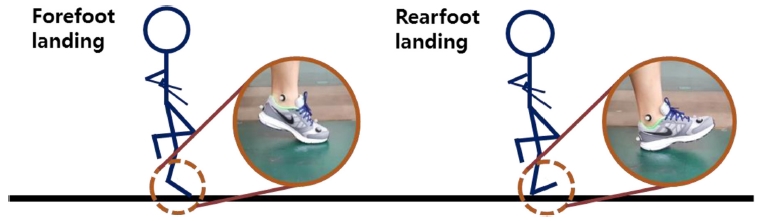
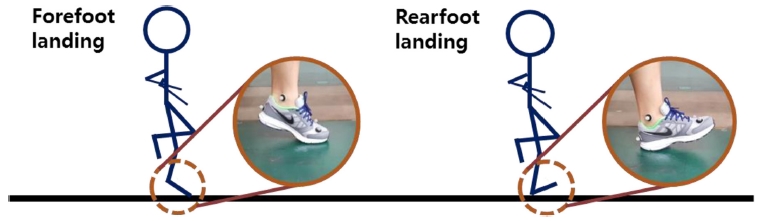
피실험자는 지면반력기 뒤에 위치한 높이 30 cm의 발판에서 발의 반 이상을 발판 밖 허공에 둔 채 주사용 발(Dominant Foot)로 수직이나 수평 방향으로서의 도약 없이 지면반력기의 측정중심에 그대로 낙하하도록 한 후 약 1-2초간 낙하한 자세로 균형을 유지하게 하였다. 이 때 주사용 발은 공을 찰 때 선호하는 발로 정의하였다. 초기 접촉 시 발가락이 먼저 지면에 닿은 후 발뒤꿈치가 뒤따라 닿게하는 전족착지와, 발뒤꿈치가 먼저 지면에 닿은 후 발가락이 뒤따라 닿게 하는 후족착지를 차례대로 수행하도록 하였다 (
Fig. 1). 착지 시 양팔의 움직임에 의한 하지 관절 움직임의 오차를 최소화하기 위해 양 팔을 상체에 고정시킨 후 실험을 진행했다. 신발의 효과를 제거하기 위해 피실험자들에게 모두 같은 런닝화(Nike Downshifter 6, NIKE Inc., Beaverton, OR, USA)를 착용하도록 하였다. 각 착지 별 성공적인 2회의 동작이 나올 때까지 실시하였다. 각 착지 별 초기 접촉 시 먼저 지면에 닿은 부위가 일지하며 착지 후 균형을 유지하는 동안 자세를 잘 유지하여 발이 지면에서 움직이지 않는 경우에 대해서만 성공적으로 실험동작이 이루어졌다고 간주하였다.
Fig. 1Foot position at initial contact of the forefoot landing (left) and rearfoor landing (right)
착지 형태에 따른 하지 관절의 움직임을 측정하기 위해 적외선 카메라 10대로 구성된 3차원 동작분석 시스템(Eagle; Motion Analysis Inc., Santa Rosa, CA, USA)을 사용하여 외발착지 동작을 400 Hz로 측정하였다. 지름 12.5 mm의 반사마커를 다음의 해부학적 주요위치에 부착하였다 양쪽의 상전장골극(Anterior Superior Iliac Spines), 천골(Sacrum), 대전자(Greater Trochanter), 대퇴골 중간지점(Midpoint of Femur), 대퇴골 내외측 상과(Medial And Lateral Epicondyles of The Femur), 내외측 경골면 융기부(Medial And Lateral Plateau of Tibia), 경골 중간지점(Midpoint of Tibia), 내외측 복사뼈(Medical And Lateral Malleolus), 종골(Calcaneus), 첫 번째와 다섯 번째 중족골(First and Fifth Metatarsal Heads). 동작분석 시스템과 동기화된 지면반력기(9260 AA6; Kistler, Winterthur, Switzerland)를 지면에 설치한 후 1200 Hz로 측정하였다.
2.3 데이터 분석
선행연구에 의하면 최대 수직 지면반력이 나타나는 시점에서 전방십자인대 변형(Strain)이 가장 크게 발생하고, 경골의 최대 전방힘과 상관관계가 존재하여 전방십자인대에 작용하는 부하 조건을 예측할 수 있기 때문에
16,17 자료분석 구간은 처음 발이 지면에 닿아 수직 지면반력이 20 N을 넘은 시점부터
18 최대 수직 지면반력 시점까지로 설정하였다. 측정한 운동학 및 운동역학 데이터는 10 Hz의 차단주파수를 갖는 4차 버터워스(Butterworth) 저역통과필터를 사용하여 노이즈를 제거했다. 관절의 움직임을 계산하기 위해서 Dyrby와 Andriacch
19가 제안한 방법을 통해 발을 제외한 신체분절의 해부학 좌표계를 정의하였다. 발은 Hong과 Shin
20이 제안한 방법으로 다음과 같이 좌표계를 정의하였다. 발 좌표계의 상/하방 축은 종골을 기점으로 한 종골, 첫 번째와 다섯 번째 중 족골을 포함하면 면의 법선 벡터로 정의하였다. 내/외측 축은 상/하방 축과 종골과 내외측 복사뼈의 중점을 잇는 벡터와 외적하여 생성하였고, 전/후방 축은 상/하방 축과 내/외측 축을 다시 외적하여 생성하였다. 관절의 모멘트는 뉴턴-오일러 방정식을 통해 역동역학 해를 구함으로써 계산하였다.
21 각 관절의 일량은 모멘트와 각속도를 곱하여 파워를 산출한 후 이를 적분시켜 계산하였다.
5
여기서
j가 각각 발목, 무릎, 엉덩이관절을 나타내는 인덱스일 때
Mj는 모멘트,
ωj는 각 관절의 각속도를 의미한다. 양의 일과 음의 일은 각각 단축성 근수축을 통한 에너지 생성과 신장성 근수축을 통한 에너지 흡수를 가리키므로,
22 음의 파워가 관찰되는 구간만을 적분하여 일량을 계산하였다.
여기서
t1과
t2는 각 관절
j별 파워커브의 음의 구간을 의미한다. 관절 모멘트와 일량은 각 피실험자의 몸무게와 키의 곱으로, 지면반력 데이터는 몸무게로 정규화하였다.
23
성별과 착지 형태에 따른 운동학 및 운동역학 파라미터의 특성 차이를 결정하기 위해 MATLAB (Version R2014b, The Mathworks, Natick, MA, USA)으로 2개의 데이터를 평균한 후 SPSS (Version 20.0, IBM Corporation, NY, USA)를 사용하여 이원배치 분산분석(2-Way Repeated ANOVA)을 수행하였다. 각 데이터가 정규분포를 따르는지 판단하기 위해 Kolmogorov-Smirnov test를 수행하였으며, 결과에 따라 남녀 간 차이와 착지 형태간 차이를 결정하기 위해서는 독립표본 t 검정(Independent Two Sample T-Test) / Mann-Whitney U-Test (유의 수준 = 0.05)를, 착지 형태에 따른 차이는 대응표본 t 검정 (Paired T-Test) / Wilcoxon Signed Rank Test (유의 수준 = 0.05)를 이용해 초기접촉 시점과 최대 수직 지면반력 시점에서의 하지 관절 운동학 및 운동역학 데이터, 관절 일량을 각각 비교하였다.
3. 연구 결과
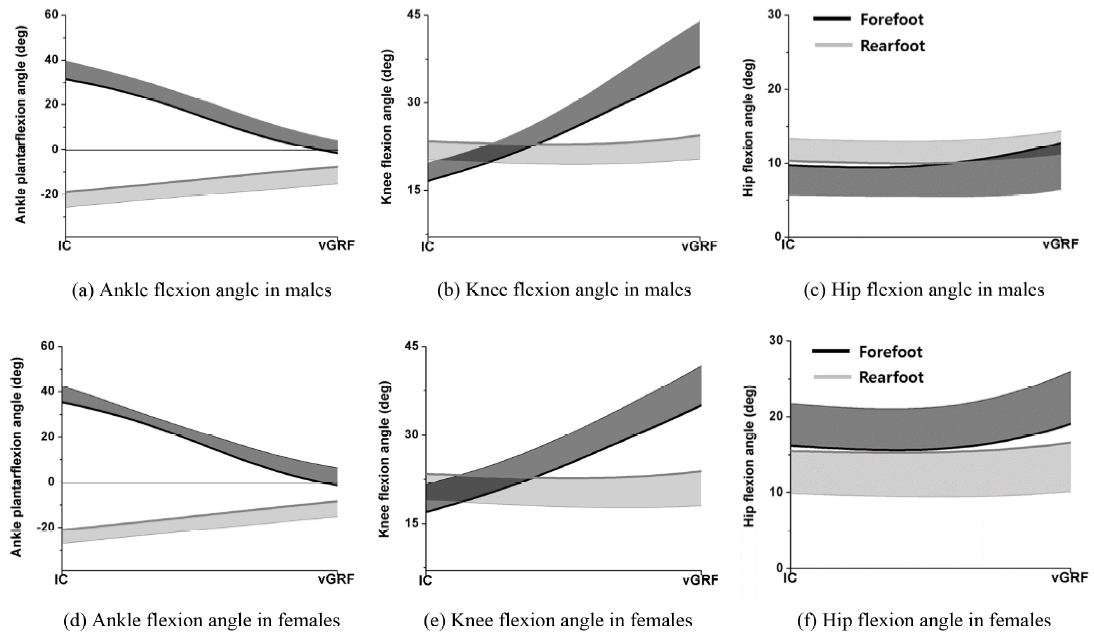
남성과 여성 모두 전족착지 초기 접촉 시 발목관절은 족저굴곡(각각 29.1 ± 7.5°, 32.3 ± 5.9°)을 보인 반면 후족착지 시에는 이와 반대로 배측굴곡(각각 16.1 ± 6.8°, 17.6 ± 5.9°) 함을 보였다(모두
p < 0.001,
Fig. 2(a)). 초기 접촉 시 전족착지에서 후족착지보다 남성은 약 22%, 여성은 약 19% 더 작은 무릎 굴곡각을 보였으나(각각
p < 0.001,
Fig. 2(b)), 최대 수직 지면반력 시점에서는 이와 반대로 전족착지에서 남성에서 약 31%, 여성에서 약 46% 더 큰 무릎 굴곡각을 보였다(각각
p < 0.001,
Fig. 2(b)). 전족착지와 후족착지 시 엉덩이관절 굽힘각에는 차이가 없었으나, 초기 접촉 시와 최대 수직 지면반력 시점 모두 여성이 남성보다 통계적으로 유의하게 큰 결과를 보였다(각각
p < 0.001,
Fig. 2(c)).
Fig. 2 The ensemble mean kinematics of ankle, knee and hip joint in sagittal plane from initial contact to peak vertical GRF for forefoot and rearfoot landing in both males and females. Positive values represented plantarflexion, knee flexion, and hip flexion, respectively

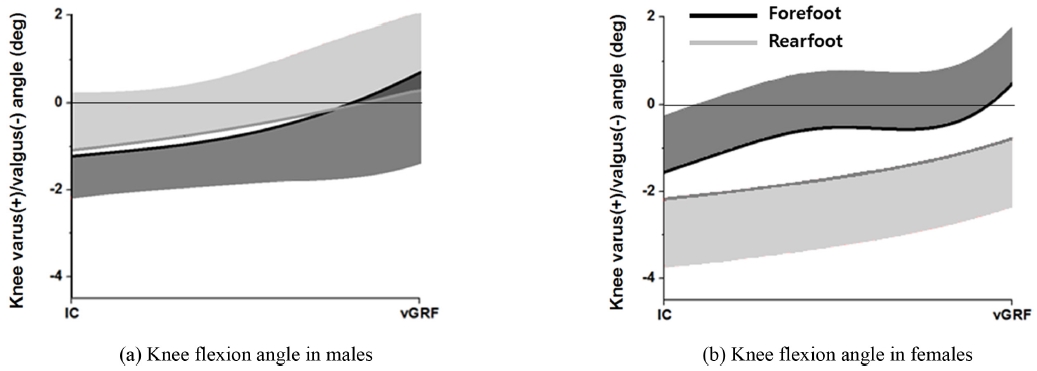
남성의 경우 초기접족 시와 최대 수직 지면반력 시점 모두 무릎관절의 외반각이 전족착지와 후족착지 간 통계적으로 유의한 차이를 보이지 않았으나(
Fig. 3(a)), 여성의 경우 최대 수직 지면반력 시점에서 전족착지 시에는 내반(Varus)함을, 후족착지 시에는 외반(Valgus)함을 보였다(전족착지: 0.5 ± 2.2°, 후족착지: -0.8 ± 1.5°,
p = 0.034.
Fig. 3(b)). 시상면에서 발목관절, 무릎관절, 엉덩이관절의 초기접촉 시부터 최대 수직 지면반력 시점까지 가동범위(Range of Motion)는 남성과 여성 모두 후족착지 시보다 전족착지 시 더 큰 결과를 보였다(
p < 0.001,
Table 2). 전족착지 시에는 각 하지 관절에서 여성이 남성에 비해 통계적으로 큰 가동범위를 보인 반면, 후족착지 시에는 차이를 보이지 않았다(
Table 2).
Fig. 3 Knee varus(+)/valgus(-) angle in male and female from initial contact to peak vertical GRF
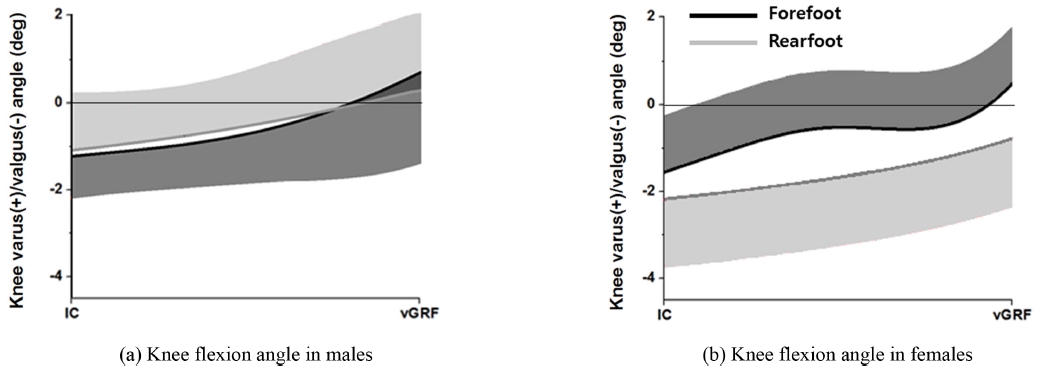
Table 2
Comparison of range of motion of ankle, knee and hip joint from initial contact to peak vertical GRF in sagittal plane between genders during forefoot and rearfoot landing. The values are mean and standard deviation
(Mean ± SD)
Table 2
|
Male |
Female |
P-Value |
|
P-Value |
|
Ankle (deg) |
Forefoot |
28.5 ± 9.5 |
35.9 ± 6.7 |
0.006 |
Gender |
0.003 |
|
Rearfoot |
8.1 ± 3.3 |
8.7 ± 3.4 |
0.425 |
Type |
< 0.001 |
|
P-Value |
< 0.001 |
< 0.001 |
|
Gender*Type |
0.012 |
|
Knee (deg) |
Forefoot |
13.1 ± 4.0 |
15.8 ± 3.9 |
0.049 |
Gender |
0.021 |
|
Rearfoot |
1.0 ± 0.8 |
1.2 ± 1.6 |
0.925 |
Type |
< 0.001 |
|
P-Value |
< 0.001 |
< 0.001 |
|
Gender*Type |
0.050 |
|
Hip (deg) |
Forefoot |
1.3 ± 0.9 |
3.0 ± 2.1 |
0.006 |
Gender |
< 0.001 |
|
Rearfoot |
0.8 ± 0.6 |
1.2 ± 1.3 |
0.425 |
Type |
< 0.001 |
|
P-Value |
0.034 |
< 0.001 |
|
Gender*Type |
0.029 |
초기 접촉부터 최대 수직 지면반력 시점까지의 관절 일량은 발목, 무릎 및 엉덩이관절 모두 후족착지 시보다 전족착지 시 통계적으로 유의하게 큰 결과를 보였고, 이는 남성과 여성 모두에게서 관측되었다(
Table 3). 전족착지 시에는 각 하지 관절에서 여성이 남성에 비해 큰 관절 일량을 보였으나, 후족착지 시에는 차이가 없었다(
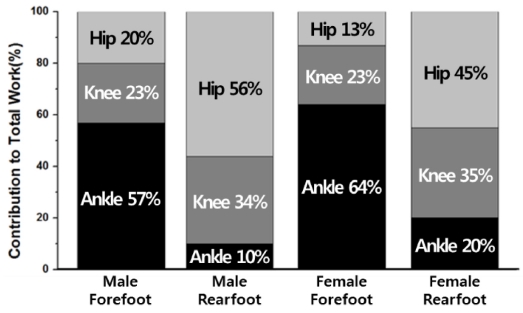
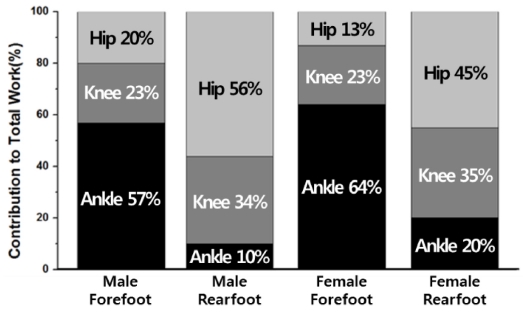
Table 3). 총 관절 일량에 대한 각 하지 관절의 비율은 전족착지 시에는 남성과 여성 모두 발목, 무릎, 엉덩이관절 순으로 크게 기여한 반면, 후족착지 시에는 엉덩이관절, 무릎, 발목 관절 순으로 기여함을 보였다(
Table 4,
Fig. 4). 여성의 경우 발목관절의 기여비율이 남성에 비해 큰 결과를 보인 반면, 엉덩이관절의 기여비율은 더 작은 결과를 보였으며, 이는 전족착지와 후족착지에서 동일하게 관측되었다(
Table 4,
Fig. 4).
Table 3
Comparison of negative work of ankle, knee and hip joint from initial contact to peak vertical GRF in both males and females. The values are mean and standard deviation
(Mean ± SD)
Table 3
|
Male |
Female |
P-Value |
|
P-Value |
Ankle
(%(J/(BW*height))) |
Forefoot |
-3.33 ± 1.39 |
-4.61 ± 1.27 |
0.008 |
Gender |
0.002 |
|
Rearfoot |
-0.09 ± 0.08 |
-0.13 ± 0.08 |
0.072 |
Type |
< 0.001 |
|
P-Value |
< 0.001 |
< 0.001 |
|
Gender*Type |
0.004 |
Knee
(%(J/(BW*height))) |
Forefoot |
-1.23 ± 0.43 |
-1.63 ± 0.67 |
0.044 |
Gender |
0.027 |
|
Rearfoot |
-0.30 ± 0.18 |
-0.32 ± 0.34 |
0.675 |
Type |
< 0.001 |
|
P-value |
< 0.001 |
< 0.001 |
|
Gender*Type |
0.048 |
Hip
(%(J/(BW*height))) |
Forefoot |
-0.93 ± 0.33 |
-1.13 ± 0.41 |
0.126 |
Gender |
0.093 |
|
Rearfoot |
-0.49 ± 0.26 |
-0.56 ± 0.53 |
0.735 |
Type |
< 0.001 |
|
P-Value |
< 0.001 |
< 0.001 |
|
Gender*Type |
0.435 |
Table 4
Contribution to total negative work of ankle, knee and hip joint from initial contact to peak vertical GRF in both males and females. The values are mean and standard deviation
(Mean ± SD)
Table 4
|
Male |
Female |
P-Value |
|
P-Value |
|
Ankle (%) |
Forefoot |
57.1 ± 10.6 |
64.4 ± 5.7 |
0.020 |
Gender |
< 0.001 |
|
Rearfoot |
10.3 ± 6.9 |
20.8 ± 10.6 |
0.002 |
Type |
< 0.001 |
|
P-Value |
< 0.001 |
< 0.001 |
|
Gender*Type |
0.478 |
|
Knee (%) |
Forefoot |
22.7 ± 4.7 |
21.8 ± 4.7 |
0.678 |
Gender |
0.938 |
|
Rearfoot |
32.8 ± 12.9 |
33.4 ± 13.7 |
0.868 |
Type |
< 0.001 |
|
P-Value |
0.007 |
0.008 |
|
Gender*Type |
0.784 |
|
Hip (%) |
Forefoot |
20.2 ± 8.7 |
13.8 ± 4.8 |
0.025 |
Gender |
0.004 |
|
Rearfoot |
56.9 ± 13.6 |
45.8 ± 14.4 |
0.068 |
Type |
< 0.001 |
|
P-value |
< 0.001 |
< 0.001 |
|
Gender*Type |
0.421 |
Fig. 4 Contribution to total joint negative work of hip, knee and ankle from initial contact to peak vertical GRF
4. 토의
본 연구의 목적은 외발착지 동작 시 하지의 운동학과 운동역학, 관절 일을 비교 분석함으로써 남녀 간 착지 형태에 따른 하지 관절의 생체역학적 특성 차이를 규명하는 것이다. 그 결과, 후족착지 시 남성은 최대 수직 지면반력 시점 이전에 무릎관절이 외반에서 내반으로 변해 최대 수직 지면반력 시점에서 남성은 무릎 관절이 내반각을 보였으나, 여성은 초기접촉 시부터 최대 수직 지면반력 시점까지 지속적으로 외반을 유지했다. 남성과 여성 모두 후족착지 시 발목과 무릎, 엉덩이관절의 가동범위가 제한된 강직된(Stiff) 움직임을 보였으며, 각 하지 관절의 일량이 전족착지 시보다 감소하였으나 전족착지 시 여성이 남성에 비해 큰 관절의 가동범위와 관절 일량을 보였다. 착지 시 여성의 엉덩이관절 굽힘각이 남성에 비해 큰 결과를 보였으며, 또한 전체 관절 일량에 대한 각 하지 관절의 비율에서 여성이 남성에 비해 큰 발목관절의 기여비율을 보인 반면, 엉덩이관절의 기여비율은 작은 결과를 보였다.
본 연구에서 후족착지 시 최대 수직 지면반력 시점에서 여성의 무릎관절이 외반함을 보였다. 전방십자인대 부상이 발생했던 경기들의 비디오를 분석한 선행연구에 의하면 착지 시 무릎이 거의 펴진 상태에서 외반과 회전을 동반할 때 가장 많이 부상이 발생한다고 보고되고 있으며,
10 지지기 초반에 무릎의 굽힘각이 30°보다 작을 때 전방십자인대 부상 위험이 증가한다고 보고된 바 있다.
15,24 또한 Bendjaballah 외
25는 무릎 외반각이 5°에 이르게 되면 전방십자인대의 부하가 관상면에 정렬되었을 때에 비해 최대 6배까지 증가할 수 있다고 보고하였으며, 전방십자인대 부상기전을 연구한 많은 선행연구들에서 방향전환이나 착지 동작 시 여성의 무릎의 외반각이 남성에 비해 컸으며, 이는 전방십자인대 힘과 변형을 야기시켜 부상위험을 증가시킬 것이라고 보고하고 있다.
15 즉, 후족착지 시 최대 수직 지면반력 시점에서 여성의 작은 무릎 굽힘각을 동반한 큰 외반각을 통해 후족착지 시 여성이 남성에 비해 큰 전방십자인대 부하가 작용할 것으로 예상되며, 이로 인해 무릎 부상 위험 역시 더 클 것으로 사료된다.
본 연구 결과, 여성과 남성 모두 전족착지 시 후족착지 시보다 각 하지 관절의 가동범위와 관절 일량이 큰 결과값을 보였으며, 이는 두 착지 별 하지 관절의 가동범위와 일량에 차이가 있을 것이라는 가설과 일치한다. 착지 시 발생하는 충격은 관절의 굽힘각과 가동범위를 증가시킴으로써 신체로 전달되는 충격을 효과적으로 흡수할 수 있다.
5,7,9 관절의 음의 일은 신장성 근수축을 통한 에너지 흡수량을 가리키므로,
22 전족착지 시 발목, 무릎 및 엉덩이관절의 굽힘이 증가됨에 따라 발목 족저 굴곡근과 무릎 및 엉덩이관절 신전근이 계속해서 에너지를 흡수하여 관절에 작용하는 부하를 감소시키는 반면 후족착지 시에는 관절의 움직임이 제한되어 충격흡수가 충분히 이루어지지 못해 더 큰 부상위험을 보일 것으로 생각되며, 이는 남성과 여성에게서 동일할 것으로 보인다.
착지 시 발생하는 충격을 효과적으로 흡수하기 위해서 발목, 무릎, 엉덩이관절이 동시에 작용하나 그 기여 비율은 남성과 여성에게서 서로 다른 결과를 보였으며 이는 본 연구 가설과 일치했다. 전족착지와 후족착지 모두 여성이 남성에 비해 상대적으로 높은 발목관절 기여비율을 보였다. 높은 발목관절 기여비율은 여성이 상위관절로 전달되는 충격을 줄이기 위해 발목관절의 신전근인 족저굴곡근을 남성에 비해 더 많이 사용한 결과일 것으로 생각되며, 이를 통해 여성에게서 보인 큰 발목관절 부상률을 일부 설명할 수 있을 것으로 사료된다. 본 연구결과 충격 흡수를 위한 전체 일량에 대한 엉덩이관절의 기여 비율은 남성에게서 더 높게 관측되었다. 착지할 때 신체의 무게중심이 아래로 빠르게 이동하게 되는데, 이때 신체의 무게중심이 과도하게 아래로 떨어지는 것을 막기 위해서 각 관절에서 신전근의 신장성 수축을 통해 속도를 감소시킨다.
7 즉 착지 시 발생하는 충격을 흡수하기 위해 남성의 엉덩이관절 신전근이 여성보다 더 많이 수축했기 때문에 여성보다 작은 엉덩이관절 굽힘각을 보인 것으로 생각된다 (남: 10.1 ± 3.0°, 여: 15.3 ± 5.8°,
p < 0.001). 본 연구에서 남성과 여성 모두 후족착지 시 발목관절이 다른 하지관절에 비해 에너지 흡수에 가장 적게 기여하였다. 착지 시 발목에서는 발이 지면에 닿은 후부터 배측굴곡이 발생하게 되는데,
7 후족착지 특성 상 발목이 이미 배측굴곡한 상태에서 지면에 닿기 때문에 관절의 가동범위가 제한된다. 따라서 본 연구 결과는 남성과 여성 모두 후족착지 시 발목에서 충분한 에너지 흡수가 이루어지지 못한 결과이며, 때문에 발목관절 대신 엉덩이관절에서 많은 에너지가 흡수된 것으로 보여진다.
본 연구는 20대의 건강한 성인 남녀를 대상으로 진행하였으므로 연구의 결과를 모든 연령대에 적용하기에는 어려움이 있다. 나이가 듦에 따라 관절의 경직 정도(Stiffness)가 달라지며,
26 이로 인해 착지 시 에너지 흡수 기전 및 운동학 및 운동역학적 생체역학 특성이 변할 것으로 예상된다. 또한 보다 정확한 에너지 흡수전략을 연구하기 위해서 각 관절의 신전근의 근수축 시 발생하는 근전도 신호를 추가적으로 비교 분석하는 것이 필요할 것으로 보여진다.
5. 결론
본 연구에서는 성별에 따른 전족착지와 후족착지 시 하지 관절의 생체역학적 특성을 비교, 분석하고자 하였다. 후족착지 시 최대 수직 지면반력 시점에서 여성의 큰 외반각은 전방십자인대 부하를 증가시킬 것이며, 이로 인해 후족착지 시 무릎 부상 위험이 여성에게서 더 클 것으로 보여진다. 남성과 여성 모두 전족착지 시 발목, 무릎, 엉덩이관절의 가동범위 및 관절 일량이 후족착지 시보다 컸으며, 이는 에너지를 흡수하는데 효율적이기 때문에 전족착지가 후족착지에 비해 관절에 작용하는 부하를 효과적으로 감소시킬 수 있을 것으로 보여진다. 두 착지 모두 여성이 남성에 비해 상대적으로 작은 전체 일량에 대한 엉덩이관절 기여비율을 보였으며, 그 결과 남성의 엉덩이관절 신전근이 여성보다 더 많이 수축되어 남성의 엉덩이관절 굽힘각이 여성에 비해 작게 관측되었다. 두 착지 모두 여성이 남성에 비해 전체 일량에 대한 높은 발목관절의 기여비율을 보였으며, 이는 남성보다 크다고 보고되고 있는 여성의 발목관절 부상률과 관계가 있을 것으로 사료된다.
ACKNOWLEDGMENTS
이 연구는 2015년 대한민국 교육부와 한국연구재단(NRF-2015S1A5A2A01009376)의 지원을 받아 수행된 연구임.
REFERENCES
- 1.
Beynnon, B., Vacek, P., and Murphy, D., “First-Time Inversion Ankle Ligament Trauma: The Effects of Sex, Level of Competition, and Sport on the Incidence of Injury,” Journal of Orthopaedic & Sports Physical, Vol. 36, No. 5, p. 336, 2006.
- 2.
Cortes, N., Onate, J., Abrantes, J., Gagen, L., Dowling, E., et al., “Effects of Gender and Foot-Landing Techniques on Lower Extremity Kinematics during Drop-Jump Landings,” Journal of Applied Biomechanics, Vol. 23, No. 4, pp. 289-299, 2007.
10.1123/jab.23.4.289
- 3.
Decker, M. J., Torry, M. R., Wyland, D. J., Sterett, W. I., and Steadman, J. R., “Gender Differences in Lower Extremity Kinematics, Kinetics and Energy Absorption during Landing,” Clinical Biomechanics, Vol. 18, No. 7, pp. 662-669, 2003.
10.1016/S0268-0033(03)00090-1
- 4.
Norcross, M. F., Lewek, M. D., Padua, D. A., Shultz, S. J., Weinhold, P. S., et al., “Lower Extremity Energy Absorption and Biomechanics during Landing, Part I: Sagittal-Plane Energy Absorption Analyses,” Journal of Athletic Training, Vol. 48, No. 6, pp. 748-756, 2013.
10.4085/1062-6050-48.4.09
- 5.
Yeow, C., Lee, P., and Goh, J., “Sagittal Knee Joint Kinematics and Energetics in Response to Different Landing Heights and Techniques,” The Knee, Vol. 17, No. 2, pp. 127-131, 2010.
10.1016/j.knee.2009.07.015
- 6.
Coventry, E., O’Connor, K. M., Hart, B. A., Earl, J. E., and Ebersole, K. T., “The Effect of Lower Extremity Fatigue on Shock Attenuation during Single-Leg Landing,” Clinical Biomechanics, Vol. 21, No. 10, pp. 1090-1097, 2006.
10.1016/j.clinbiomech.2006.07.004
- 7.
Devita, P. and Skelly, W. A., “Effect of Landing Stiffness on Joint Kinetics and Energetics in the Lower Extremity,” Medicine and Science in Sports and Exercise, Vol. 24, No. 1, pp. 108-115, 1992.
10.1249/00005768-199201000-00018
- 8.
Shultz, S. J., Schmitz, R. J., Tritsch, A. J., and Montgomery, M. M., “Methodological Considerations of Task and Shoe Wear on Joint Energetics during Landing,” Journal of Electromyography and Kinesiology, Vol. 22, No. 1, pp. 124-130, 2012.
10.1016/j.jelekin.2011.11.001
- 9.
Zhang, S.-N., Bates, B. T., and Dufek, J. S., “Contributions of Lower Extremity Joints to Energy Dissipation during Landings,” Medicine and Science in Sports and Exercise, Vol. 32, No. 4, pp. 812-819, 2000.
10.1097/00005768-200004000-00014
- 10.
Boden, B. P., Torg, J. S., Knowles, S. B., and Hewett, T. E., “Video Analysis of Anterior Cruciate Ligament Injury,” The American Journal of Sports Medicine, Vol. 37, No. 2, pp. 252-259, 2009.
10.1177/0363546508328107
- 11.
Kovács, I., Tihanyi, J., Devita, P., RÁcz, L., Barrier, J., et al., “Foot Placement Modifies Kinematics and Kinetics during Drop Jumping,” Medicine and Science in Sports and Exercise, Vol. 31, pp. 708-716, 1999.
10.1097/00005768-199905000-00014
- 12.
Jeong, J. and Shin, C. S., “The Effect of Foot Landing Type on Lower-Extremity Kinematics, Kinetics, and Energy Absorption during Single-Leg Landing,” Korean Journal of Sport Biomechanics, Vol. 27, No. 3, pp. 189-198, 2017.
10.5103/KJSB.2017.27.3.189
- 13.
Prodromos, C. C., Han, Y., Rogowski, J., Joyce, B., and Shi, K., “A Meta-Analysis of the Incidence of Anterior Cruciate Ligament Tears as a Function of Gender, Sport, and a Knee Injury-Reduction Regimen,” Arthroscopy: The Journal of Arthroscopic & Related Surgery, Vol. 23, No. 12, pp. 1320-1325, 2007.
10.1016/j.arthro.2007.07.003
- 14.
Hosea, T. M., Carey, C. C., and Harrer, M. F., “The Gender Issue: Epidemiology of Ankle Injuries in Athletes who Participate in Basketball,” Clinical Orthopaedics and Related Research, Vol. 372, pp. 45-49, 2000.
10.1097/00003086-200003000-00006
- 15.
Malinzak, R. A., Colby, S. M., Kirkendall, D. T., Yu, B., and Garrett, W. E., “A comparison of Knee Joint Motion Patterns between Men and Women in Selected Athletic Tasks,” Clinical Biomechanics, Vol. 16, No. 5, pp. 438-445, 2001.
10.1016/S0268-0033(01)00019-5
- 16.
Cerulli, G., Benoit, D., Lamontagne, M., Caraffa, A., and Liti, A., “In vivo Anterior Cruciate Ligament Strain Behaviour during a Rapid Deceleration Movement: Case Report,” Knee Surgery, Sports Traumatology, Arthroscopy, Vol. 11, No. 5, pp. 307-311, 2003.
10.1007/s00167-003-0403-6
- 17.
Yu, B., Lin, C.-F., and Garrett, W. E., “Lower Extremity Biomechanics during the Landing of a Stop-Jump Task,” Clinical Biomechanics, Vol. 21, No. 3, pp. 297-305, 2006.
10.1016/j.clinbiomech.2005.11.003
- 18.
Hong, Y. G., Yoon, Y.-J., Kim, P., and Shin, C. S., “The Kinematic/Kinetic Differences of the Knee and Ankle Joint during Single-Leg Landing between Shod and Barefoot Condition,” Int. J. Precis. Eng. Manuf., Vol. 15, No. 10, pp. 2193-2197, 2014.
10.1007/s12541-014-0581-9
- 19.
Dyrby, C. O. and Andriacchi, T. P., “Secondary Motions of the Knee during Weight Bearing and Non-Weight Bearing Activities,” Journal of Orthopaedic Research, Vol. 22, No. 4, pp. 794-800, 2004.
10.1016/j.orthres.2003.11.003
- 20.
Hong, Y. N. G. and Shin, C. S., “Gender Differences of Sagittal Knee and Ankle Biomechanics during Stair-to-Ground Descent Transition,” Clinical Biomechanics, Vol. 30, No. 10, pp. 1210-1217, 2015.
10.1016/j.clinbiomech.2015.08.002
- 21.
Winter, D. A., Patla, A. E., Frank, J. S., and Walt, S. E., “Biomechanical Walking Pattern Changes in the Fit and Healthy Elderly,” Physical Therapy, Vol. 70, No. 6, pp. 340-347, 1990.
10.1093/ptj/70.6.340
- 22.
Winter, D. A., “Biomechanics and Motor Control of Human Movement,” John Wiley & Sons, 2009.
10.1002/9780470549148
- 23.
Favre, J., Hayoz, M., Erhart-Hledik, J. C., and Andriacchi, T. P., “A Neural Network Model to Predict Knee Adduction Moment during Walking Based on Ground Reaction Force and Anthropometric Measurements,” Journal of Biomechanics, Vol. 45, No. 4, pp. 692-698, 2012.
10.1016/j.jbiomech.2011.11.057
- 24.
Boden, B. P., Dean, G. S., Feagin, J. A., and Garrett, W. E., “Mechanisms of Anterior Cruciate Ligament Injury,” Orthopedics, Vol. 23, No. 6, pp. 573-578, 2000.
10.3928/0147-7447-20000601-15
- 25.
Bendjaballah, M., Shirazi-Adl, A., and Zukor, D., “Finite Element Analysis of Human Knee Joint in Varus-Valgus,” Clinical Biomechanics, Vol. 12, No. 3, pp. 139-148, 1997.
10.1016/S0268-0033(97)00072-7
- 26.
Lark, S. D., Buckley, J. G., Bennett, S., Jones, D., and Sargeant, A. J., “Joint Torques and Dynamic Joint Stiffness in Elderly and Young Men during Stepping Down,” Clinical Biomechanics, Vol. 18, No. 9, pp. 848-855, 2003.
10.1016/S0268-0033(03)00150-5