ABSTRACT
Complex parts are manufactured with high production rates using plastic injection. Defects in injection moulded parts are typically caused by non-uniform cooling. The design of cooling channels is a key step in the mould tool design process. Laser sintering allows for the direct fabrication at reasonable price, complex 3D tools with integrated cooling channels without the need of fixtures. This technique allows the designer to optimise the position of cooling channels relative to the heat source. This paper presents a simulation study for a non-constant thickness threaded screw cap. Results comparing conventional to conformal cooling channel show that the range between the highest and the lowest part surface temperatures is reduced by 18.8%. On the other hand, there is only a decrease of 3.9% for the maximum temperature in the interior of the threaded screw cap. Conformal cooling using laser sintering in tool manufacturing achieves an improved heat transfer leading to a better part quality.
-
KEYWORDS: Conformal cooling design, Additive manufacturing material, Injection moulding, Thermal analysis
1. Background
During a typical mould tool design for the thermoplastic injection process, consideration must be given to how the tool assembly would be cooled. The cooling time is a critical parameter as it can lead to increased productivity if kept or reduced to a minimum within the injection moulding cycle. Conventional cooling lines are often straight holes located as close to the wall as possible. If the geometrical shape of the part is complicated, drilled holes will not be suitable for adequate cooling. With the advent of additive manufacturing technologies, the production of mould inserts directly from 3D CAD models using metal powder is possible. This technique gives the designer limitless possibilities and freedom in channel creation and adaptation of configurations that conforms to the part shape being cooled. By so doing, time reduction and better quality can be achieved, as the part can be cooled uniformly and in a shorter period of time. Conformal cooling channels however give rise to structural integrity issues within the inserts. Correct placement, design, and cross section area are therefore needed to balance the mould strength.
The effectiveness and best channel disposition has been studied by Sach et al.
1 who pioneered the use of 3D printing processes to compare the effectiveness of conformal and conventional cooling. Meckley and Edwards
2 investigated the importance of balancing the mould strength while optimising the design of the cooling channels. Saifullah and Masood
3 proposed using finite element analysis and thermal heat transfer analysis, in determining an optimum design for conformal cooling channels. Konsulova-Bakalova
4 compared circular and elliptical cross sections of cooling channels concluding that it was possible to achieve a reduction in cooling time by up to 40%. Mohamed et al.
5 compared the performance of different designs combining conformal and standard cooling channels. Shayfull et al.
6 evaluated the performance of conformal cooling channels compared to straight drilled cooling channels in order to minimize warpage on the thin shallow parts of 1mm thickness. Park and Dang
7 showed that conformal cooling channels were capable of improving the quality of a moulded part in terms of warpage, compared to the conventional straight drilled cooling channels. Au and Yu
8 presented a scaffolding architecture for conformal cooling designed for rapid plastic injection moulding and examined the structural integrity of parts produced to validate the strength of the insert. They concluded that the scaffolding architecture provided more uniform cooling. Wang et al.
9 designed an algorithm to create conformal channels automatically based on the geometrised part shape. They investigated the implementation of a geometric algorithm to a conformal cooling circuit, concluding that automatic generation conforms better to the shape of the product, resulting in a more uniform and accurate control of temperature. Saifullah et al.
10 describe a square section conformal cooling channel system for injection moulding dies, with results showing a uniform temperature distribution with reduced freezing time and hence, a reduction in cycle time. Xu et al.
11 presented a systematic modular approach to the design of conformal cooling channels, with algorithms created to achieve the maximum heat transfer. Li
12 described a feature-based design synthesis approach to developing a cooling system design by first decomposing complex part shape into simpler shapes elements, and then developing an algorithm to generate cooling channels. Agazzi et al.
13 determined the location, number and shape of cooling channels and the coolant fluid temperature, using morphological analysis to design the cooling channels based on the shapes of isotherms. Au et al.
14 used a methodology called visibility-based cooling channel generation to propose an automatic preliminary cooling channel design for rapid tooling, where they considered cooling process between a mould surface and a cooling channel analogous. Jianguo et al.
15 proposed an automatic design of injection-mould cooling channels using genetic algorithms, and generated shapes of the cooling channel are discussed and compared with manually designed cooling channels.
The plastic manufacturing industry is a huge market globally, and injection moulding is a consolidated process with a large history of usage. Still, important advances are constantly being introduced. As metal additive manufacturing techniques are fast becoming popular and economically affordable, inserts with conformal cooling channels are increasingly being fabricated at a reasonable price.
The aim of this study was to conduct a simulated comparative thermal analysis of conventional and conformal cooling system configurations for a non-constant threaded screw cap. Firstly, different parts are designed such that assembling them virtually creates a typical conventional cooling system. Secondly, a conformal cooling design is considered where the lines have a spiral internally bound contour without the need to assembly different parts together. The main objective was to compare parameters such as: part surface temperature, part body temperature, percentage of frozen layer vs. time, mould temperature, volumetric shrinkage and warpage, which in turn will determine the technique that would be the most appropriate for the chosen part.
2. Design of Cooling Channels
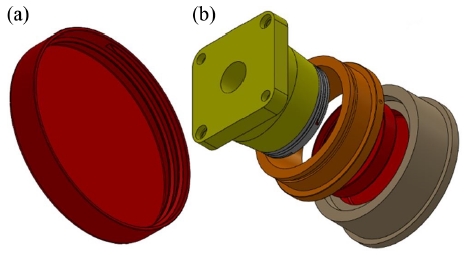
Fig. 1(a) shows the screw cap with dimensions: 94 mm external diameters, 15.5 mm height, 1.5 mm uniform body thickness, thread thickness of 3 mm, volume of 17.5 mm
3 and a mass of 14.7 grams. The difference in thickness of 100% around the thread area is a major problem in the cooling phase, which may cause warpage, cooling stresses, retard the cooling time and give rise to high values of volumetric shrinkage in the cap.
Fig. 1 (a) Threaded screw cap part, (b) Representation of the mould insert and part (exploded view)
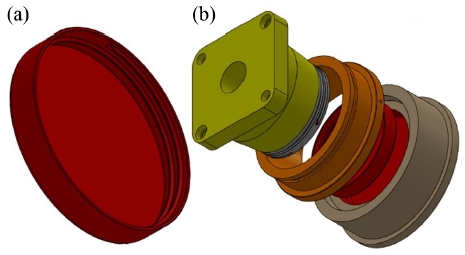
Fig. 1(b) shows the mould insert assembly consisting of 3 parts: the cavity, the core and the ejector. In this configuration, the moving insert is the cavity and the ejector is fixed. This distribution is due to the fact that the injection gate has to be in the bottom part of the plastic piece for aesthetic reasons; so that the injection point is not visible when the cap is in position. The injection is direct from a hot runner, which can also affect the temperature of the mould as it is in contact with the core which has a very high temperature at any instance. The complete mould is composed of 8 inserts and the 8 parts are filled at the same time utilising the same parameters.
2.1 Conventional Cooling Channels
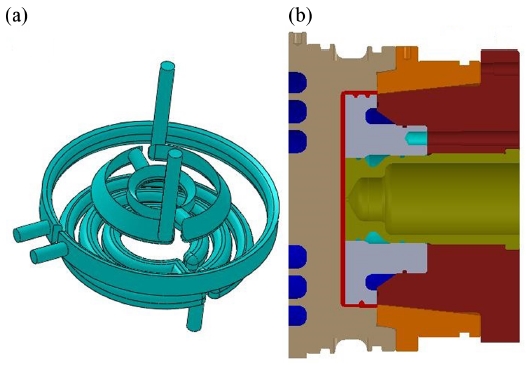
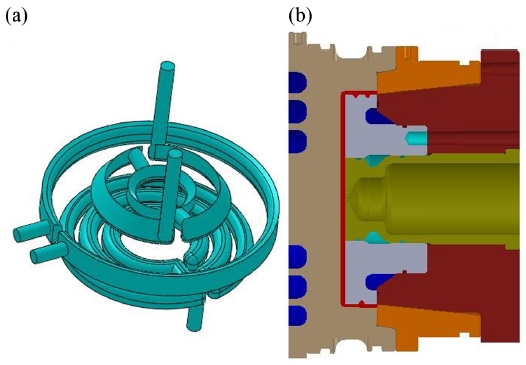
The cheapest, easiest and most utilised option is to create straight drilled holes in the inserts, but usually this often is not the best cooling design for the part. It has also been common to insert a baffle or bubbler in the core but the area is used for the hot runner. This creates a need for a good and optimised conventional cooling system. Nevertheless, the cooling paths are much more expensive because the core has to be divided into three pieces and drilling the contour is complex. Three cooling channels are created: one in the core and two in the cavity. In
Fig. 2 it is possible to see the optimised conventional cooling channels
Fig. 2(a) and a basic representation section in the mould
Fig. 2(b).
Fig. 2(a) Conventional cooling channels, (b) section representation of mould insert with conventional cooling channels
2.2 Conformal Cooling Channels
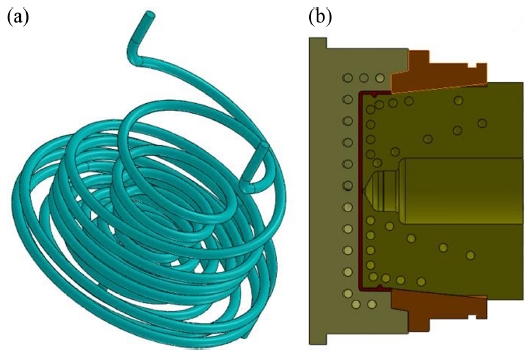
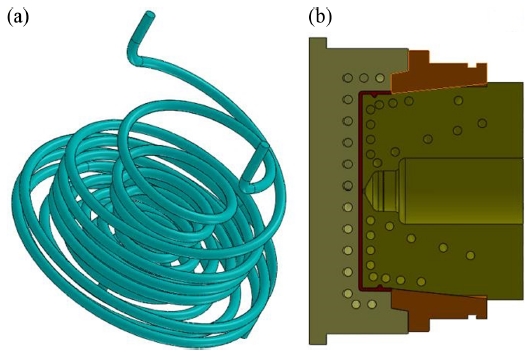
The conformal cooling channels are designed with a spiral contour. The spiral channel cooling structure was chosen over other techniques because it has safer powder removal, defined and orientated turbulent flow, and the channels do not block or clog easily.
As shown in
Fig. 3, there are two cooling circuits, one each for the core and cavity. The core spiral conforms to the part and the hot runner while the cavity spiral only conforms to the part. The diameter of the channel is kept constant at 4 mm to ensure a good and turbulent flow. The distance within the mould surface and the centre of the channels is also 4 mm. However, the distance between channels varies depending on the part of the mould. This could have some structural integrity issues, hence the need to conduct a thorough structural analysis as future work to identify areas of possible improvements.
Fig. 3(a) Conformal cooling channels, (b) Representation of the mould insert with conformal cooling channels
3. Thermal and Melt-Flow Analysis
3.1 Input Parameters
The material used for the part simulation is Polypropylene (PP) with a melting temperature of 260oC and ejection temperature of approximately 105oC. The thermal conductivity (k) of the plastic at 200oC is 0.16 W/(m·oC), while the mould temperature depends on the temperature of coolant in the cooling circuit.
In this study, two mould tool materials have been used. The first material is tool steel P-20 used for the conventional inserts simulation while the second is Maraging steel 1.2709 used for the conformal tools. The conventional cooling mould steel has a thermal conductivity of 29 W/(m·oC) while the conformal cooling steel has a thermal conductivity of 20 W/(m·oC) (after being hardened).
The coolant used throughout is pure water with a thermal conductivity of 0.643 W/(m·oC), with no additives and an inlet temperature of 20oC at a controlled inlet flowrate of 10 L/min for both studies. In the conformal channels, the 10 L/min flowrate is divided equally into the 3 cooling circuits (3.33 L/min per channel) and in the conformal channels study the 10 L/min is divided through 2 equal circuits (5 L/min per channel).
The cycle time is set at 11 seconds (injection + packing + cooling time) to make sure that all sides of the plastic piece would have achieved the ejection temperature. The injection gate is placed in the middle of the part and the hot runner is located in the core. The mould-open time is 3 seconds and the mould-close time before injection is set at 0 second. Thus, the total cycle time is 14 seconds including the mould opening and closing time.
The part channel and mould are meshed with 3D meshing and the approximate numbers of elements are shown in the
Table 1.
Table 1Part surface temperatures (Averaged within cycle)
Table 1
|
Part surface temperature |
Conventional Cooling |
Conformal Cooling |
|
Maximum (oC) |
67.0 |
62.0 |
|
Minimum (oC) |
25.8 |
23.1 |
|
Average (oC) |
36.1 |
29.3 |
3.2 Results and Discussion
3.2.1 Part Surface Temperature
Table 2 shows that conformal cooling gives more uniform and cooler temperature in the part with the same input parameters than conventional cooling. This, however, can vary if the coolant temperature is changed. In this case, fixed input parameters have been utilised.
Table 2Approximate numbers of 3D meshing elements related to number of parts and water volume
Table 2
|
Conventional |
Conformal |
|
Part - number of 3D meshing elements [-] |
1095000 |
1095000 |
|
Channels - number of 3D meshing elements [-] |
309000 |
1278000 |
|
Inserts - number of 3D meshing elements [-] |
1690000 |
1430000 |
|
Number of components for core [-] |
3 |
1 |
|
Volume of cooling water [mm3] |
16058 |
49763 |
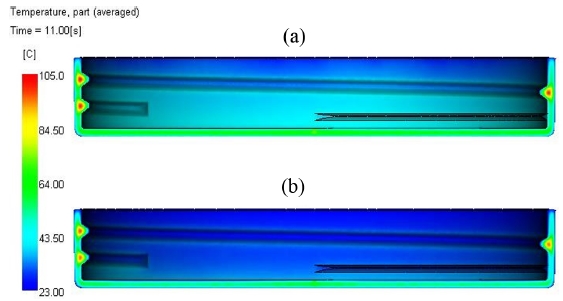
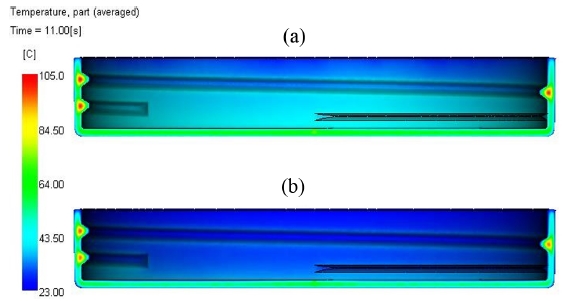
The tool material properties utilized in the simulation of the conformal cooling insert (maragin steel 1.2709) is 31.0% worse in heat transfer coefficient than the conventional cooling tool material (P-20). However, the conformal cooling method achieves low range between the highest and the lowest temperature in the part surface temperature, with the average part surface temperature 18.8% lower with the same cycle time. This means more uniform cooling and better mechanical qualities for the plastic part. The result of the part surface temperature can be complemented with the part body temperature, shown in
Fig. 4.
Fig. 4Part temperature at the end of the cooling phase- (a) Conventional cooling channel and (b) conformal cooling channel
3.2.2 Part Body Temperature
Fig. 4 depicts the temperature of the part at the end of the cooling phase, which indicates that conformal cooling provides more uniform and lower temperature than conventional cooling.
In both cases the maximum temperature is achieved in the interior of the screw, being the side of the part where the temperature is the highest. The main problem though remains in the double wall thickness in the threaded area, the conformal channels can deal with it but not as much as expected. The maximum temperature in the thread area with the conventional channels is 104.8oC and with conformal channels is 100.7oC. There is a decrease of only 3.9% for the maximum temperature with the processing conditions; however, the walls with constant thickness have better heat evacuation, obtaining lower temperatures far from the thread increase of thickness.
3.2.3 Percentage of Frozen Layer vs. Time
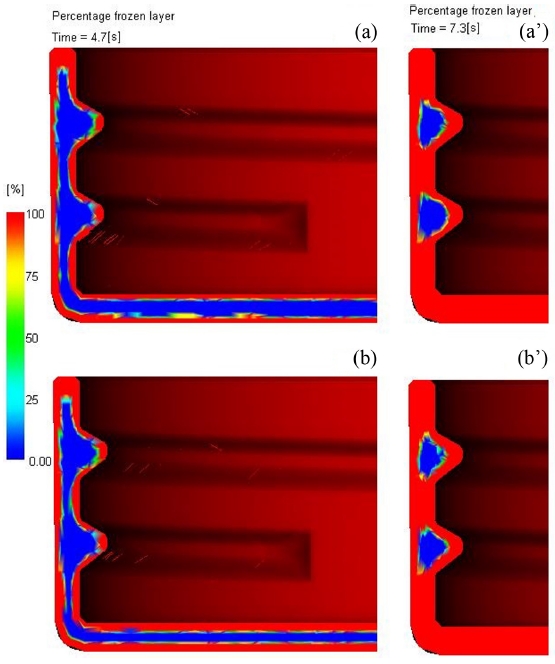
In
Fig. 5, the red part represents the solid layer of the part and the blue represents the interior layer that is hotter and still molten. It can be seen in
Figs. 5(a) and
5(b) that in the conformal cooling part, the molten layer is slimmer at the same time than the conventional cooling part. With a small and uniform wall thickness, the conformal cooling performs better than conventional cooling.
Fig. 5Percentage of frozen layer at time 4.7 seconds- (a) conventional and (b) conformal. At time 7.3 seconds -(a´) conventional and (b´) conformal
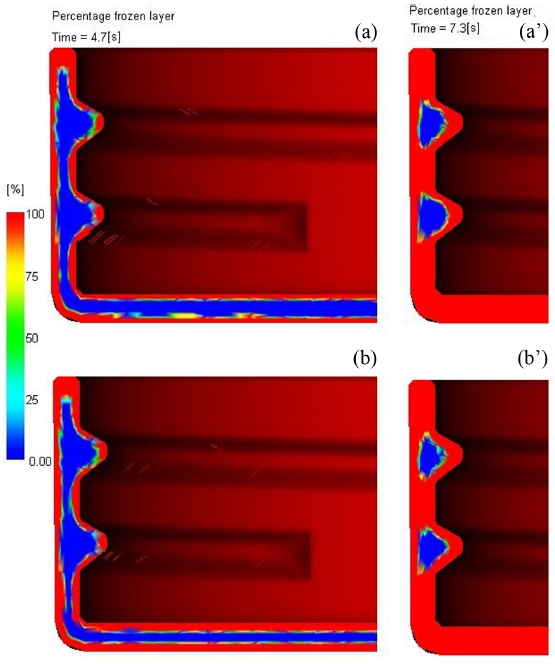
Despite the depiction of good cooling achieved through the conformal channels configuration, the threaded area is problematic as is shown in
Figs. 5(a’) and
5(b’). The material inside the thread area section is still frozen and delays the ejection temperature. The uniformity of the wall surface does not have a great impact in wider areas, caused by the very low thermal conductivity of the plastic material, perhaps accounting for the high and not so different maximum temperature of both parts at the ejection time showed in the part body temperature section.
3.2.4 Mould Temperature
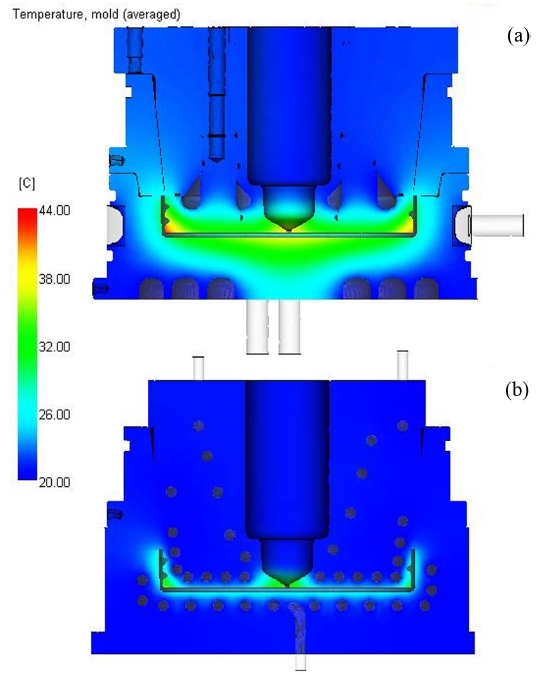
Fig. 6 depicts the mould averaged temperature within cycle (14 seconds). Uniformity in the cooling temperature is more pronounced in the conformal cooling channels (b) than in the conventional one (a). The maximum temperature is reduced by a total of 19.5%, from 43.9
oC to 35.2
oC (
Table 3).
Fig. 6Mould temperature averaged within cycle- (a) Conventional cooling channels and (b) conformal cooling channels
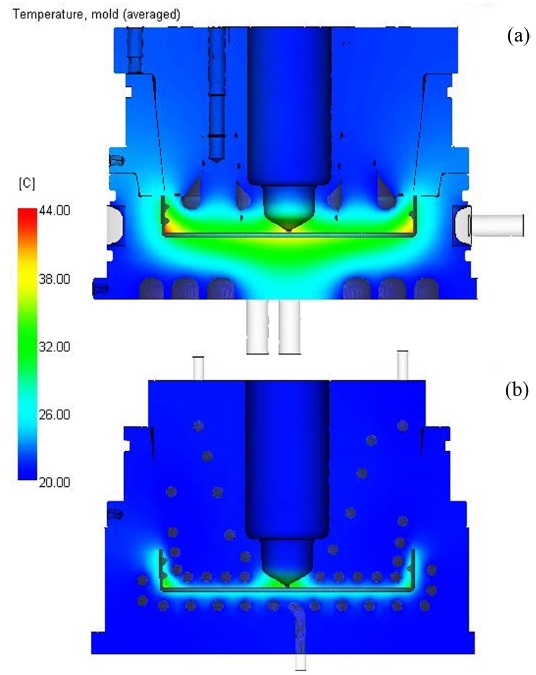
Table 3Mould temperatures (Averaged within cycle)
Table 3
|
Mould temperature |
Conventional cooling |
Conformal cooling |
|
Maximum (oC) |
43.7 |
35.2 |
|
Minimum (oC) |
20.0 |
20.0 |
|
Average (oC) |
23.3 |
21.2 |
Having very low temperatures is not always good; a possible effect of low temperature of the mould could be part defects during the filling phase, often referred to as weld lines or flow pressure gradient lines. Pulse cooling or increasing the cooling temperature would solve this defect but will increase the cycle time and lower the productivity.
3.2.5 Volumetric Shrinkage
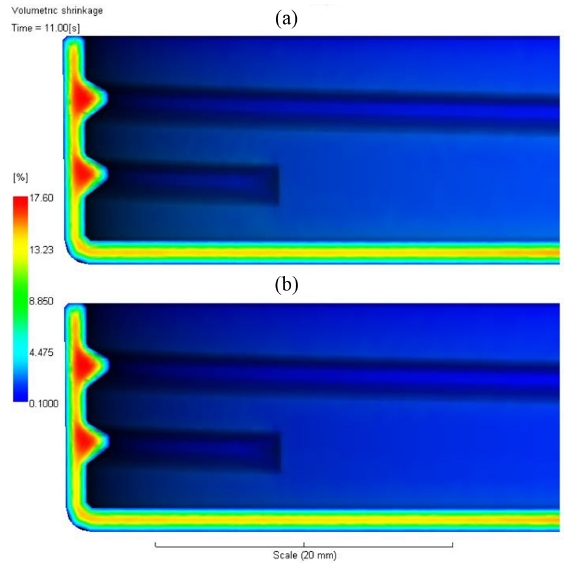
The material used in the moulding process, Polypropylene (PP) is a material with a high percentage contraction. The double thickness in the thread area causes very high volumetric shrinkage observed in almost the same proportions in both cooling systems (
Fig. 7 and
Table 4). This property is highly dependent on the material and processing parameters than the uniformity of the mould, and is important because the screw cap is a precision part with strict dimensional tolerances.
Fig. 7Volumetric shrinkage: (a) Conventional cooling channels and (b) conformal cooling channels
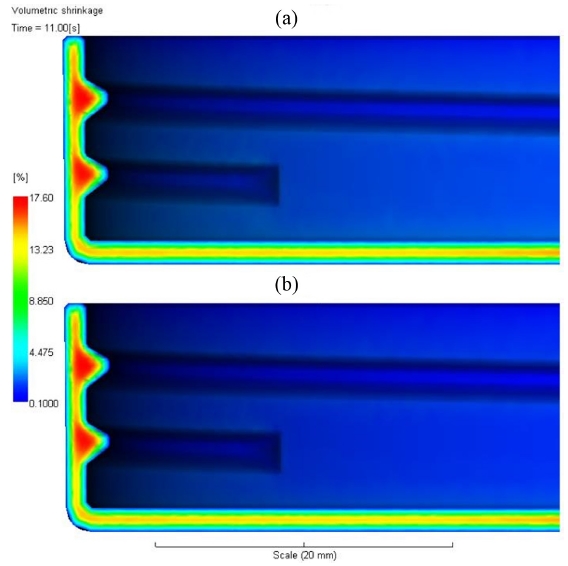
Table 4Volumetric shrinkage
Table 4
|
Volumetric shrinkage |
Conventional cooling |
Conformal cooling |
|
Maximum(%) |
17.5 |
17.5 |
|
Minimum(%) |
0.5 |
0.2 |
|
Average(%) |
4.9 |
4.9 |
3.2.6 Warpage
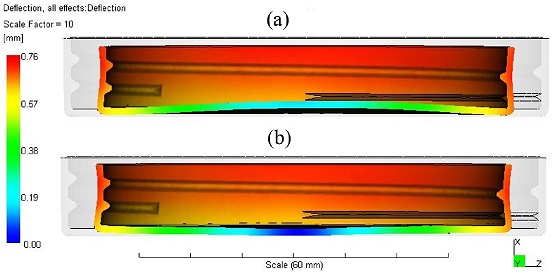
Fig. 8 shows the warpage in all directions by a scale factor of 10. The highest warpage is achieved in the Y and Z axis, as a result of the threaded sections (
Table 5). This exaggerated scale helps to show that the warpage with conventional cooling channels is bigger. The bottom side of the cap deflects to the side that is cooler showing that warpage is important for dimensional tolerances.
Fig. 8Warpage in all directions with scale factor 10 (a) Conventional cooling channels and (b) conformal cooling channels
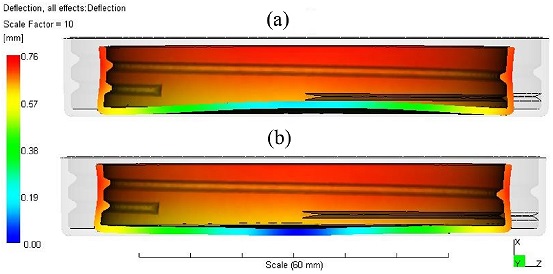
Table 5Minimum/maximum displacements
Table 5
|
Conventional |
Conformal |
|
Min. |
Max. |
Min. |
Max. |
|
Trans-X (mm) |
-0.20 |
0.18 |
-0.16 |
0.10 |
|
Trans-Y (mm) |
-0.75 |
0.72 |
-0.74 |
0.72 |
|
Trans-Z (mm) |
-0.71 |
0.71 |
-0.71 |
0.71 |
3.2.7 Sink Marks
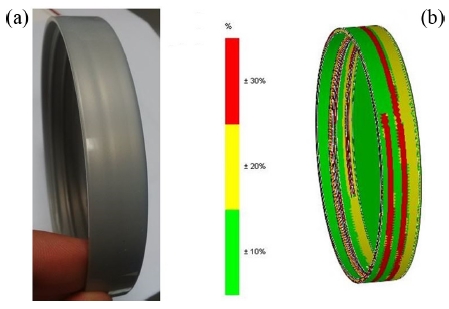
Sink marks are surface defects visible on outer surfaces of plastic injection parts. This sink marks arise from junction of similar thicknesses where temperature is trapped inside the junction as shown in previous
Fig. 4. During cooling the thermal contraction of material leads to such visible effects. Simulation software can predict such surface defects.
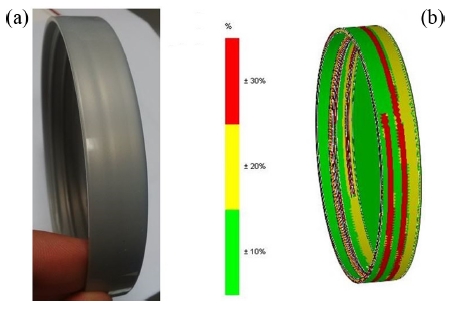
Fig. 9 shows the sink marks on a real part manufactured with conventional cooling on the outer surface due to the thickness of thread junction. Theses sink marks are also well estimated by conventional simulation software describing areas where sinking can achieve a 30% of part thickness for conventional cooling.
Fig. 9Sink marks on (a) a real part and (b) as predicted by simulation using conventional cooling
3.3 Sources of Error
These results are illustrative, so may differ significantly from physical results but melt flow analysis plays a major role in predicting real behaviour.
In a real application scenario, regardless of the type of cooling channel configuration, the assembly can contain unconnected surfaces as a result of air pockets, which will present discontinuity thereby giving rise to difficulty in heat transfer.
The heat of the hot runner has not been considered and this is a great disadvantage. Therefore, the conformal channels must also conform to the hot runner surface to prevent the interference of its heat being transferred to the part.
The properties of the materials used in the simulation study correspond to those used in the actual mould tool for each type. The great disadvantage of the 3D printing steel powder is that it is 31.0 % less conductive. If other materials were used for the study, some values could be different, but the uniformity of the temperature of the conformal cooling channels would remain.
4. Conclusion
This study has shown some of the benefits of using conformal cooling technique to improve the heat transfer in the injection moulding process, with the temperature in the inserts more accurately controlled. This means that the plastic part is cooled more homogeneous with significantly better part quality and better properties, such as less warpage. Lower residual stresses and shorten cycle times are consequently achieved. Moreover, it is possible to achieve the ejection temperature in the part faster, which increases the productivity. For high precision parts with very low dimensional tolerances, such as the screw cap used in this study, traditionally it would be cooled down much more slowly so as not to induce deflections during ejection. Nowadays, it is possible to obtain better part quality in a shorter time, and fewer parts are rejected for exceeding geometrical tolerances.
As 3D printed inserts become less expensive, the gain in the productivity and part properties will inevitably compensate the initial investment costs.
While conformal cooling channels absorbs maximum heat and provides a better cooling system, if considered in conjunction with pulse cooling, a better outcome could be expected. Pulse cooling process achieves very good mechanical proprieties of the part and a glossy surface of the plastic even in plastics with glass fibre.
A stress analysis could be carried out to simulate the pressures that affect the insert so it is possible to see if the separation between channels is wide enough. A fatigue analysis could be carried out to determine the life of the insert.
REFERENCES
- 1.
Sachs, E., Wylonis, E., Allen, S., Cima, M., and Guo, H., “Production of Injection Molding Tooling with Conformal Cooling Channels Using the Three Dimensional Printing Process,” Polymer Engineering & Science, Vol. 40, No. 5, pp. 1232-1247, 2000.
10.1002/pen.11251
- 2.
Meckley, J. and Edwards, R., “A Study on the Design and Effectiveness of Conformal Cooling Channels in Rapid Tooling Inserts,” The Technology Interface Journal, Vol. 10, No. 1, pp. 1-28, 2009.
- 3.
Saifullah, A. and Masood, S., “Finite Element Thermal Analysis of Conformal Cooling Channels in Injection Moulding,” Proc. of 5th Australasian Congress on Applied Mechanics, pp. 337-341, 2007.
- 4.
Konsulova-Bakaloca, M., “Application of SolidWorks Simulation for Design of Cooling System for Injection Molding,” International Virtual Journal for Science, Techniques and Innovations for the Industry Machines, Technologies, Materials, pp. 31-34, 2012.
- 5.
Mohamed, O. A., Masood, S., and Saifullah, A., “A Simulation Study of Conformal Cooling Channels in Plastic Injection Molding,” International Journal of Engineering Research, Vol. 2, No. 5, pp. 344-348, 2013.
- 6.
Shayfull, Z., Bahan, M. S., Adam, S. A., Nasir, S. M., and Nooraizedfiza, Z., “Improving Warpage on Thin Shallow Parts in Two-Plate Moulds with Conformal Cooling Channels,” International Review of Mechanical Engineering, Vol. 7 No. 5, pp. 187-195, 2013.
- 7.
Park, H.-S. and Dang, X.-P., “Design and Simulation-Based Optimization of Cooling Channels for Plastic Injection Mold,” New Technologies-Trends, Innovations and Research, InTech, ISBN: 978-953-51-0480-3, 2012.
10.5772/32730
- 8.
Au, K. and Yu, K., “A Scaffolding Architecture for Conformal Cooling Design in Rapid Plastic Injection Moulding,” The International Journal of Advanced Manufacturing Technology, Vol. 34, Nos. 5-6, pp. 496-515, 2007.
10.1007/s00170-006-0628-x
- 9.
Wang, Y., Yu, K.-M., Wang, C. C., and Zhang, Y., “Automatic Design of Conformal Cooling Circuits for Rapid Tooling,” Computer-Aided Design, Vol. 43, No. 8, pp. 1001-1010, 2011.
10.1016/j.cad.2011.04.011
- 10.
Saifullah, A., Masood, S., and Sbarski, I., “New Cooling Channel Design for Injection Moulding,” Proc. of the World Congress on Engineering, pp. 700-703, 2009.
- 11.
Xu, X., Sachs, E., and Allen, S., “The Design of Conformal Cooling Channels in Injection Molding Tooling,” Polymer Engineering & Science, Vol. 41, No. 7, pp. 1265-1279, 2001.
10.1002/pen.10827
- 12.
Li, C., “A Feature-Based Approach to Injection Mould Cooling System Design,” Computer-Aided Design, Vol. 33, No. 14, pp. 1073-1090, 2001.
10.1016/S0010-4485(00)00144-5
- 13.
Agazzi, A., Sobotka, V., LeGoff, R., and Jarny, Y., “Optimal Cooling Design in Injection Moulding Process-A New Approach Based on Morphological Surfaces,” Applied Thermal Engineering, Vol. 52, No. 1, pp. 170-178, 2013.
10.1016/j.applthermaleng.2012.11.019
- 14.
Au, K., Yu, K., and Chiu, W., “Visibility-Based Conformal Cooling Channel Generation for Rapid Tooling,” Computer-Aided Design, Vol. 43, No. 4, pp. 356-373, 2011.
10.1016/j.cad.2011.01.001
- 15.
Liang, J., Narahara, H., Koresawa, H., and Suzuki, H., “Automatic Design of Cooling Channels for Block Laminated Molds: A Resolution Study,” International Journal of Engineering and Advanced Technology, Vol. 52, No. 6, 2013.