ABSTRACT
A chemical ablation analysis of hypersonic missile for thermal protection design was performed using SAMCEF AMARYLLIS V.17, the specific ablation module of commercial software based on a finite element code. The pyrolysis and surface recession models based on the effects of mass loss, pore gas diffusion, and endothermic reaction energy were applied for non-linearity of material and boundary. The numerical studies were carried out to confirm the tendency of the pyrolysis and chemical ablation of theoretical ablative composite for open testing (TACOT) with a chemical composition similar to charring carbon/phenolic composites. The frequency of variation in surface recession, temperature, density and gas mass flux was reviewed to determine the characteristics of multiple decomposition reactions and oxidation via pyrolysis of gas species.
-
KEYWORDS: Hypersonic missile, Thermal protection design, Charring composite, Phenol resin, Pyrolysis, Chemical ablation
-
KEYWORDS: 극초음속 유도탄, 열보호 설계, 탄화성 복합재료, 페놀수지, 열분해, 화학적 삭마
NOMENCLATURE
Non-dimensional surface recession [-]
Real gas constant [8.314 J/mol·k]
Exchange coefficient [kg/m2·s]
Gas diffusion coefficient [(kg·m)/(N·s)]
Thermal conductivity [W/m·k]
1. 서론
유도무기는 일반적으로 동체와 날개 구조를 갖는 비행체로서 동체 내부에 목표물을 탐지 및 추적하여 타격할 수 있는 다양한 구성품을 탑재한다. 자체 추진력으로 목표물까지 접근하여 표적을 정확하게 타격해야 하는 정밀유도무기는 최근 고속기동 환경에서 경량화와 함께 비행속도의 증가를 요구받고있다.
1 지구 대기권을 마하 20이상의 속도로 재진입하는 ICBM (Intercontinental Ballistic Missile)뿐만 아니라 대기권 내에서도 마하 5이상의 극초 음속 환경에서 운용되는 유도무기는 상대적으로 빠른 속도로 비행하기 때문에 외부 표면이 공기역학적 마찰에 의하여 고속으로 가열되고 동체 전방부 또는 리딩엣지(Leading Edges)부에서 많은 양의 열에너지가 유입되게 된다. 이러한 열에너지는 급격한 온도 상승을 야기하고 열기계적 거동에 영향을 주면서 유도무기 동체 또는 날개부의 강도 저하로 예기치 않은 구조적 파손과 함께 탑재 구성품의 기능장애를 유발할 수 있기 때문에 운용조건에 적합한 열-유동 특성 분석과 고엔탈피 환경으로부터 구조물을 보호할 수 있는 열보호 시스템(Thermal Protection System, TPS) 설계가 중요하다.
2,3
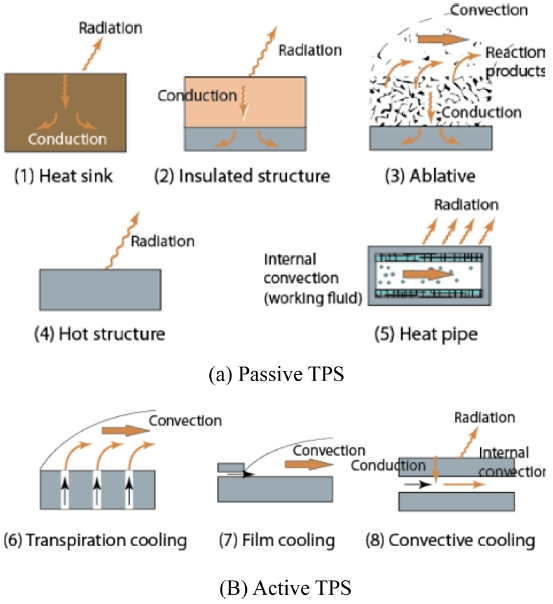
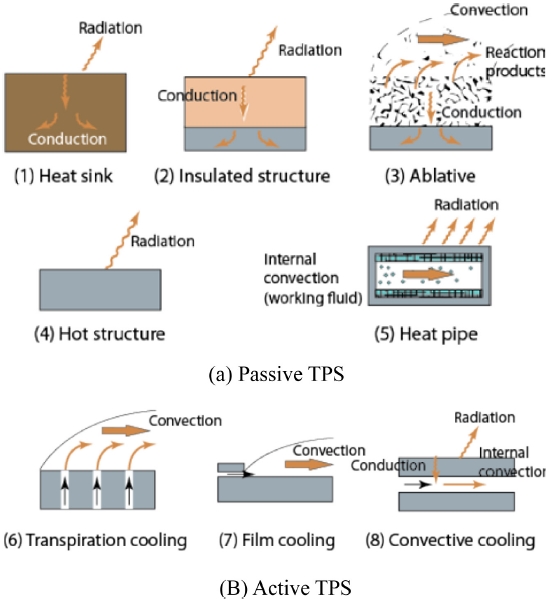
TPS설계는
Fig. 1과 같이 열에너지를 소진하는 방법으로 냉각시스템을 적용하는지에 따라 능동형 또는 수동형 TPS로 구분된다.
1,4 삭마(Ablation), 방열(Heat Sink), 단열구조(Insulated Structure), 발열구조(Hot Structure), 열교환(Heat Pipe) 등으로 구분되는 수동형 TPS 설계는 능동형에 비해 간단한 구조로 설계가 가능하며, 극초음속 유도무기의 TPS 설계에는 외부로부터 유입되는 고온의 열을 효과적으로 차단할 수 있는 삭마 복합재료(Ablative Composites)의 사용이 증가하고 있다. 삭마 복합재료는 그래파이트, C/C, 코르크, 탄소/페놀릭, 실리카/페놀릭 등과 같이 섬유 및 수지 종류, 섬유 방향, 섬유와 수지 비율을 조절하여 사용 목적 및 운용 환경에 적합한 재료로 제작이 가능하다. 특히, 열경화성 수지에 셀룰로스 섬유(Cellulose Nano Fiber)을 불규칙하게 배열함으로써 일반적인 복합재료 대비 밀도가 20% 수준인 저밀도 삭마재(Low-Density Ablator)로 활용할 수 있다.
5,6,12
Fig. 1 TPS concepts in operation or proposed for use on hypersonic vehicles
저밀도 삭마재는 극초음속의 공력가열 환경에서 열분해(Pyrolysis) 및 삭마를 경험한다. 재료표면으로부터 열에너지의 유입과 전달된 열에너지가 고분자수지 층에 축적됨에 따라 열화학 반응이 시작되면서 재료 분해가 발생한다. 재료의 상이 변화하면서 재료 표면에서 숯(Char)이 생성되고 숯 층이 재료 내부에서 발생한 분해 가스와 산화 반응하면서 표면 침식되어 재료의 일부가 제거되는 화학적 삭마에 지배적인 영향을 받는다. 따라서, 열분해 과정에서 복합 열분해 반응과 다종 분해 가스 생성 및 이동에 따른 열에너지 변화와 산화 반응 특성을 고려한 화학적 삭마 특성을 일차적으로 확인하고 적용소재에 대한 내열특성을 검토하여 TPS 설계에 반영하는 것이 매우 중요하다.
7-9
본 연구에서는 공력가열 현상이 발생하는 극초음속 비행환경에서 유도무기 TPS 설계를 위한 기초연구로서 탄화성 페놀수지 복합재와 화학조성 및 열화학적 특성이 유사한 TACOT (Theoretical Ablative Composite for Open Testing)의 기본적인 열분해 특성과 산화 반응에 의한 화학적 삭마 영향성을 확인하였다. 복합 열분해 반응 및 다종 분해 가스에 의한 산화 반응 영향성을 검토하고자 재료 분해 반응을 2차까지 고려하였으며, 다종 분해 가스를 C, H, O, N, CH4, CN, CO, CO2, C2, C2H, C2H2, C3, C4, C4H2, C5, HCN, H2, H2O, N2, CH2OH, CNN, CNC, CNCOCN, C6H6, HNC 의 25종 혼합가스로 결정하였다. 가스 엔탈피 및 화학적 삭마 속도는 CEA (Chemical Equilibrium with Applications) 데이터를 기반으로 구하여 이를 상용 삭마해석 코드 SAMCEF AMARYLLIS V.17을 이용한 수치 해석에 적용하였다. 기공 압력(Pore Pressure), 밀도 및 온도 자유도가 연계된 열분해 및 표면 침식 모델을 통해 삭마 경계면에서 온도, 밀도, 삭마량 및 가스질량플럭스(Gas Mass Flux) 결과를 비교하여 복합 열분해 반응과 다종 분해 가스 적용에 따른 화학적 삭마 특성을 검토하였다.
2. 수치 모델
2.1 경계조건 및 열전달
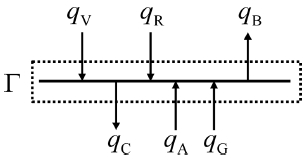
고온 벽면의 열에너지 평형은
Fig. 2와 같이 나타낼 수 있으며 C, V, R, A, B, G는 각각 전도, 대류, 복사, 삭마, 대류 차단 및 분해 가스와 관련된 물리량을 의미한다. 고온 벽면에서 열에너지 평형은 전도와 복사에 의한 열 유입과 산화 반응, 분해 가스 생성 및 대류 차단효과를 고려한
식(1)로 표현된다.
Fig. 2Surface energy balance
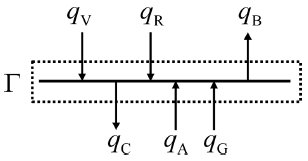
여기서 χf, σ, ι, m˙ig는 각각 대류 전달 계수, 스테판-볼츠만 상수, 복사율, 가스질량플럭스를 의미한다. 상첨자 f, r, w, x, g는 유체, 회복, 고온벽면, 산화 반응, 기공가스와 관련되고 하첨자 AC는 화학적 삭마를 나타낸다.
분해 가스와 산화 반응에 의한 대류 차단 효과는 다음의 수식으로 표현된다.
여기서 η은 대류차단에 기여하는 계수이며 상첨자 a는 삭마와 관련된다.
대류 전달 계수
χf와 가스 전달 계수
χg가 같다고 가정하면
식(3)와 같이 표현된다. 다종 분해 가스를 고려한 화학적 삭마 속도는
식(4)과 같이 온도 또는 분해가스 소산인자
Bg의 함수로 정의된다.
식(2)는
식(5)와 같이 표현된다.
식(6)은 초기재료 및 숯 층의 재료특성에 따라 결정되는 열전도도를 나타내고
식(7) 및
식(8)은 엔탈피 형태로 표현된 열분해 반응열과 재료 내부의 에너지 보존 방정식을 나타낸다.
여기서
식(8)의 좌변은 재료의 내부 에너지 변화율을 나타내며, 우변의 각 항은 열전도, 열분해 반응열, 분해 가스 및 열원과 관련된 에너지항을 의미한다.
열분해 및 삭마 해석을 위해서는 재료 외부 및 내부에서의 열에너지 평형과 함께 열화학적 분해에 따른 재료 밀도 감소, 기공 가스 생성 및 확산 등이 고려된 아레니우스(Arrhenius) 및 다시(Darcy) 구성 방정식을 연계해서 다루어야 하며 열분해 과정 동안 부피가 일정할 경우, 재료 밀도 감소는 열분해 층에서 생성되는 기공 가스 질량에 비례한다고 가정하면 다음과 같이 표현할 수 있다.
재료 분해 속도는
식(10)과 같이 아레니우스 방정식 으로 정의된다. 빈도 인자
A, 활성화 에너지
Ea 및 반응 차수
n은 열중량 분석(Thermogravimetric Analysis, TGA)을 통해 결정된다.
재료의 복합 분해 반응은
식(11)과 같이 0에서 1사이 값을 갖는 밀도 변화비로 표현된다.
열분해 과정에서 생성된 분해 가스를 이상 기체로 가정하면 가스질량플럭스는
식(15)로 표현된다.
여기서,
ρg는 가스밀도,
μg는 가스점성계수,
pg는 기공 압력,
β는 침투성을 의미하며, 가스확산계수(Gas Diffusion Coefficient)로 나타내면
식(16)과 같다.
3. 수치 해석 및 결과
3.1 열분해 및 화학적 삭마 해석
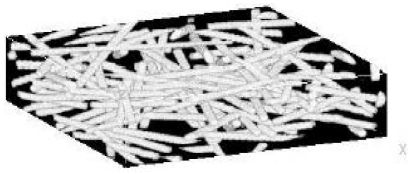
극초음속 유도탄 열보호 설계를 위한 기본적인 열분해 및 화학적 삭마 해석에는 탄소/페놀릭 복합재와 화학조성 및 열화학적 특성이 유사하고 온도에 따른 비선형적 재료물성 확보가 용이한 TACOT를 적용하였다. TACOT는 다양한 삭마 해석 코드의 신뢰성 검증에 이용되며
Fig. 3과 같이 길이 1 mm, 직경 10 μm인 셀룰로스 탄소 섬유가 페놀(Phenol)/포름알데히드(Formaldehyde)로 구성된 노발락(Novolac) 합성 고분자수지에 불규칙하게 배열된 다공성의 저밀도 삭마재이다.
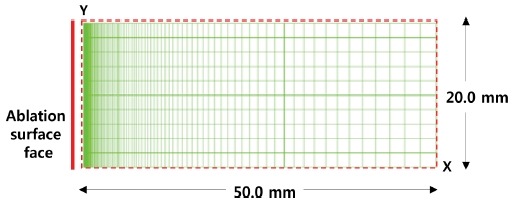
10 수치 해석을 위하여 상용 삭마 해석프로그램 SAMCEF AMARYLLIS V.17을 이용하였으며 SAMCEF AMARYLLIS V.17은 해석모델의 온도, 압력, 밀도 자유도를 연계하여 수치 계산을 수행하기 때문에 열에너지 평형과 재료 분해에 따른 열분해 현상 모사가 가능하고 경계에서 발생하는 열화학적 또는 기계적 삭마 조건 적용이 가능하다. 공력가열에 의하여 열하중에 쉽게 노출되는 유도탄 전방 동체부는 원통형 형상이기 때문에
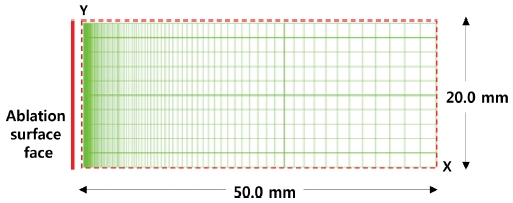
Fig. 4와 같이 전체 영역이 아닌 두께 방향으로 일부 영역만을 해석영역(L = 50.0 mm, W = 20.0 mm)으로 고려하였으며, 직사각형 형상의 2D 열분해 모델을 통해 대류, 복사, 전도에 의한 열전달 현상과 재료의 열분해 및 일방향 삭마현상을 모사하였다. 삭마에 의한 표면침식은 메쉬 재형성(Re-Meshing) 기법을 적용하여 경계면에서 수치적으로 계산되며 해석의 수렴성을 향상시키기 위해 비균일한 크기의 요소를 생성하여 경계면에 요소가 집중되도록 하였다.
Fig. 3Numerical model of TACOT
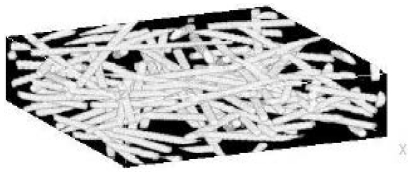
Fig. 42D Pyrolysis and ablation model
수치 예제를 통해
t = 60 s까지 TACOT의 기본적인 열분해 및 화학적 삭마 경향성을 확인하였다. 수치 해석에 사용된 TACOT 물성은
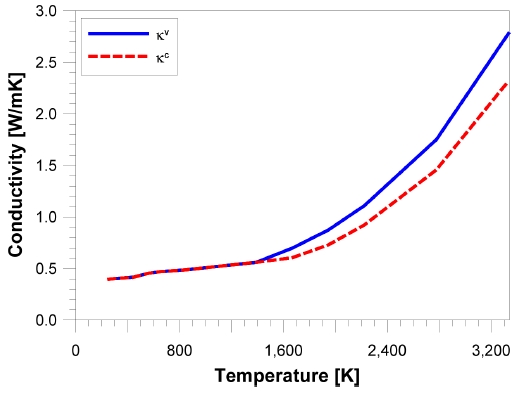
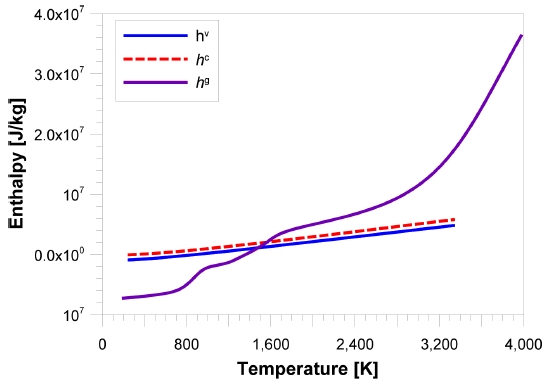
Table 1에 나타내었으며, 초기재료, 숯 층, 분해 가스에서의 열전도도 및 엔탈피 값은
Figs. 5 및
6과 같다.
11-13 고온 벽면에 대한 열 하중 및 경계조건은 비행속도
M > 5이상인 유동조건으로부터 대류 열 전달계수
χf = 0.3 kg/m
2·s를 적용하였고 복사 열전달은 유체온도
θf = 300 K, 복사율
t = 0.9값을 부여하였으며 경계에서의 기공 압력
pg는 벽면압력
pw= 1 atm으로 가정하였다. 화학적 삭마 속도는 Schneider
6의 TGA 시험 값을 이용하였으며 산화 반응열
hx= 2.83MJ/kg을 적용하였다.
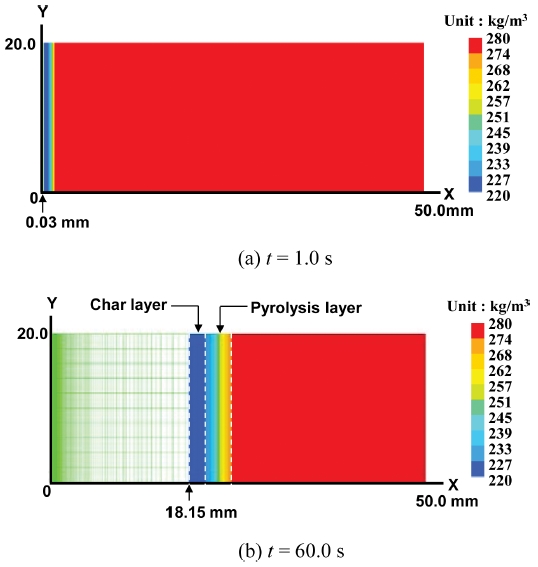
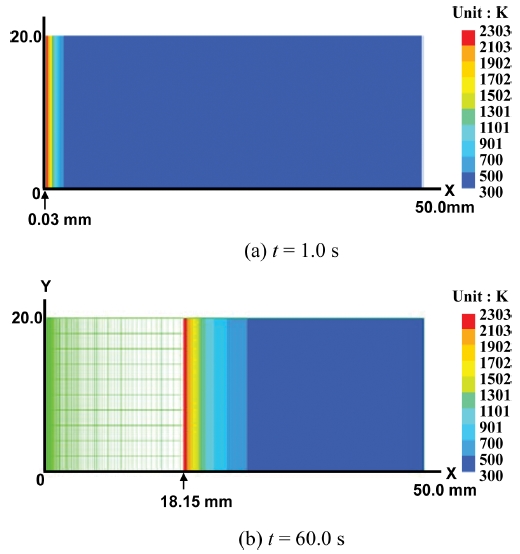
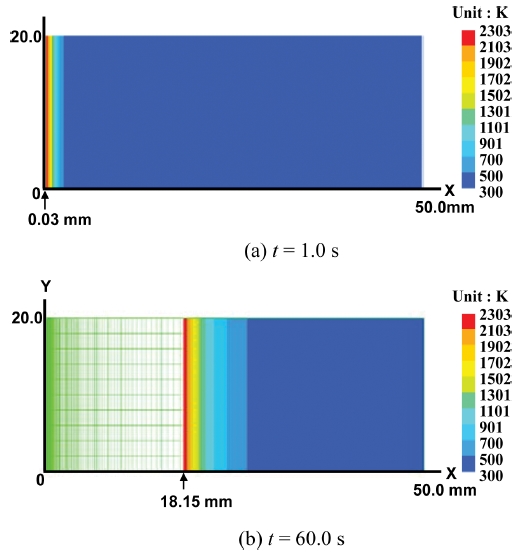
t = 1, 60 s에서 표면 밀도 및 온도 분포 결과를
Figs. 7 및
8에 나타내었다.
t = 1 s일 때, 삭마량은 0.3 mm이며 표면온도는 2,303 K까지 상승하지만 재료의 열분해가 진행되는 초기로서 숯 층이 좁은 영역에서 생성되는 것을 알 수 있다.
t = 60 s일 때, 삭마량은 18.15 mm로 증가하지만 재료의 열분해가 진행됨에 따라 숯 층과 열분해 층이 발달하는 것을 알 수 있으며 표면 온도는
t = 1 s에서 최고온도 도달 이후 일정하게 유지된다. TACOT와 같은 저밀도 삭마재는 밀도가 매우 낮아 산화 반응에 의한 화학적 삭마에 지배적인 영향을 받기 때문에 재료의 복합 분해반응과 열분해 과정에서 생성되는 다종 분해 가스에 의한 고온 및 삭마 영향성을 확인해야 한다.
Table 1Material Properties of TACOT
Table 1
|
Property |
Value |
Unit |
|
Virgin, v
|
Char, c
|
|
Density, ρ
|
280 |
220 |
Kg/m3
|
|
Porosity, φ
|
0.8 |
0.85 |
- |
|
Permeability, β
|
1.6 × 10⁻¹¹
|
2.0 × 10⁻¹¹
|
- |
|
Reaction order, n
|
3 |
- |
|
Reaction rate constant, A
|
1.2E × 104
|
/s |
|
Activation energy, Ea
|
71,134.58 |
J/mol |
Fig. 5Thermal conductivity of TACOT(virgin, char)
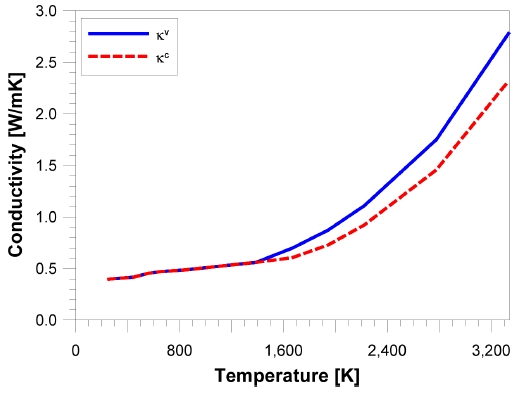
Fig. 6Enthalpy of TACOT(virgin, char, gas)
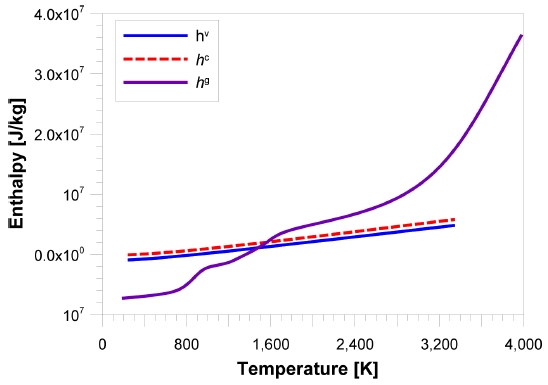
Fig. 7Density contour for 2D numerical model
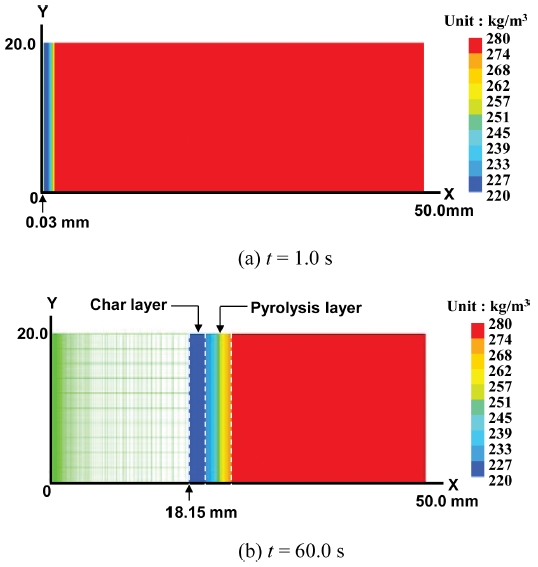
Fig. 8Temperature contour for 2D numerical model
3.2 숯층 표면의 산화 반응 검토
열분해 과정에서 재료의 복합 열분해 반응 및 다종 분해 가스에 의한 산화 반응 영향성을 검토하였다. 수치 해석에는 수치예제 3.1과 동일한 모델 및 조건에서 복합 열분해 반응에 따른 영향성을 검토하고자 TACOT 물성에 분해 반응을 2차까지 고려한 아레니우스 인자
A = 1.08 × 10
10/s,
n = 3,
Ea = 20,440 J/mol을 추가로 적용하였다. 페놀/포름알데히드 수지의 주요 구성원소는 C, H, O이며 몰분율은 각각 0.206, 0.679, 0.115이다.
14 초기 열화학적 분해 과정에서 생성된 분해 가스 C
6H
5OH, H
2, C
6H
6, CH
4, H
2O, CO, CO
2는 재료 외부로 이동하며 경계 및 숯 층에서 산화 반응을 일으킨다. 다종 분해 가스에 의한 영향성을 확인하기 위해 산화 반응에 기여하는 분해 가스를 비응축 혼합가스로 가정하고 C, H, O, N, CH
4, CN, CO, CO
2, C
2, C
2H, C
2H
2, C
3, C
4, C
4H
2, C
5, HCN, H
2, H
2O, N
2, CH
2OH, CNN, CNC, CNCOCN, C
6H
6, HNC의 25종으로 결정하였다.
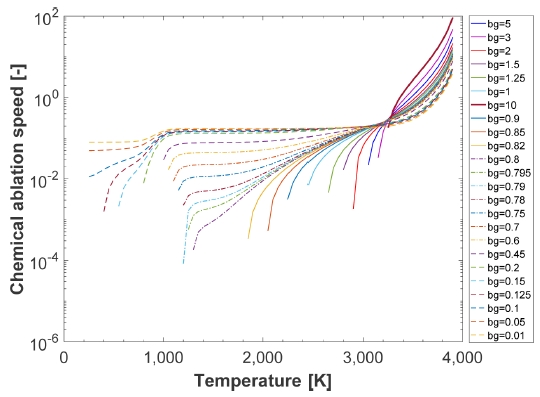
15,16 다종 분해 가스의 열역학적 물성은 물질간 화학평형을 계산하는 CEA를 이용하였으며 모든 혼합가스의 확산계수가 같고 화학적 평형상태에 있다고 가정하였다. 이를 통해,
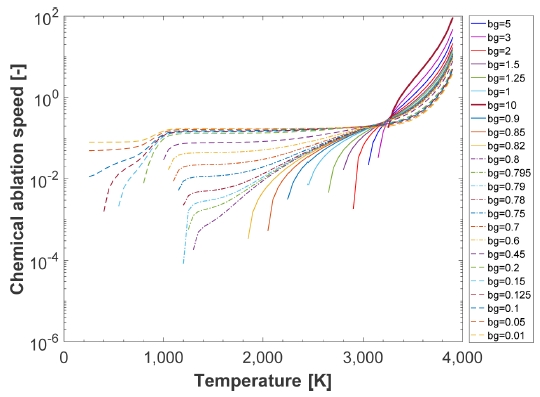
Fig. 9와 같이 산화 반응에 영향을 주는 25종 분해 가스에 대한 소산인자
Bg와 온도의 함수로 정의되는 무차원화된 화학적 삭마 속도를 구하였다. TACOT의 경우, 열분해 과정에서 생성된 대부분의 분해가스는 3,000 K 이상 온도에서 산화 반응에 따른 화학적 삭마가 급격히 증가하는 경향을 나타내었다.
Fig. 9Non-dimension chemical ablation rate by out-gassing parameter
복합 열분해 반응과 다종 분해 가스에 의한 화학적 삭마 영향성을 확인하기 위해서 재료 분해 반응 및 분해 가스 화학종수에 따른 3가지 해석조건을 선정하여
t = 60 s까지 수치 해석을 수행하였다.
Figs. 10에서
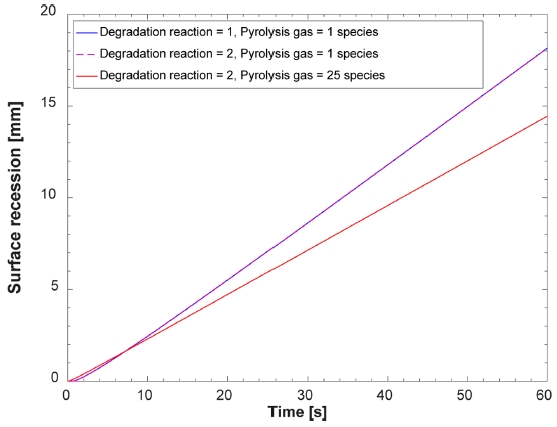
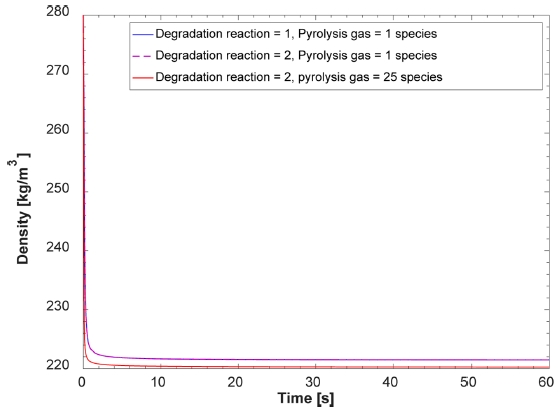
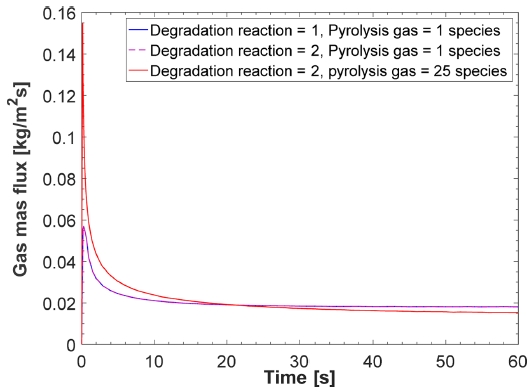
13은 삭마 경계면에서 삭마량, 온도, 밀도, 가스질량플럭스에 대한 결과를 나타내다. 일종 분해 가스(Pyrolysis Gas = 1 Species)에 대한 단일(Degradation Reaction = 1) 또는 복합 분해반응(Degradation Reaction = 2)을 적용한 해석 조건에서 두 결과가 대체로 일치하는 경향을 보여주는 반면, 다종 분해 가스(Pyrolysis Gas = 25 Species)에 대한 복합 분해 반응에서는 다른 해석 조건과 상이한 결과를 나타내었다. 이를 통해, 저밀도 삭마재는 재료 분해 반응보다 다종 분해 가스(Pyrolysis Gas = 25 Species)의 생성 및 확산에 의한 열분해 및 산화 반응에 더 지배적인 영향을 받는 것을 알 수 있다.
Fig. 10을 살펴보면 표면 삭마량은
t = 7 s까지 모든 해석 조건에서 큰 차이를 나타내지 않은 반면,
t = 60 s에서는 복합 분해 반응 및 다종 분해 가스를 고려한 해석 조건에서 최종적인 표면 삭마량이 14.44 mm로 다른 해석조건 보다 4.04 mm 더 적게 표면 침식이 발생하는 것으로 나타났다. 이는 삭마에 영향을 주는 분해 가스들이 표면 온도에 따라 상이한 산화 반응 특성을 갖기 때문인 것으로 판단된다.
Fig. 10Surface recession VS time by Degradation reaction and Pyrolysis gas
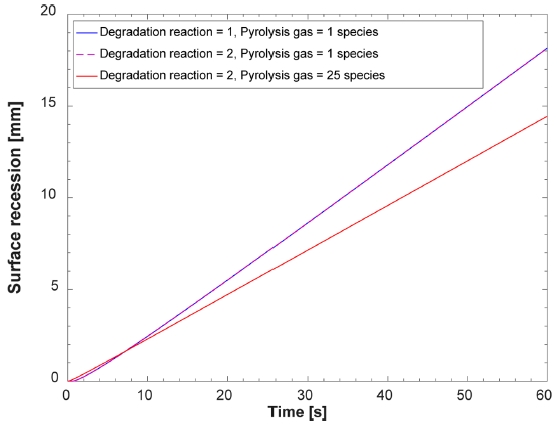
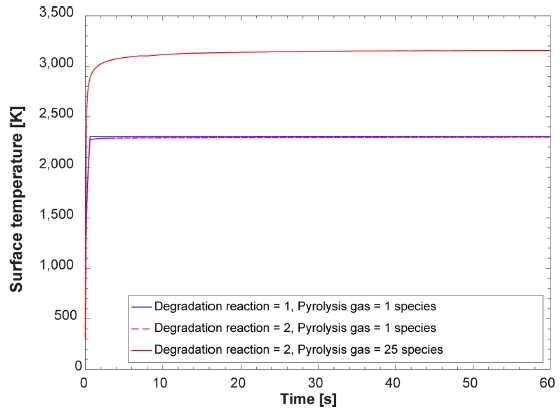
Fig. 11Surface temperature VS time by Degradation reaction and Pyrolysis gas
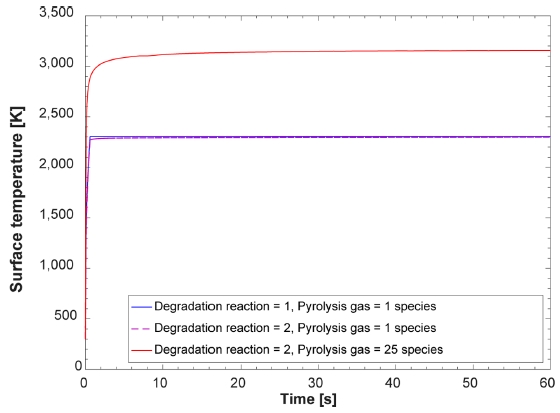
Fig. 12Surface density VS time by Degradation reaction and Pyrolysis gas
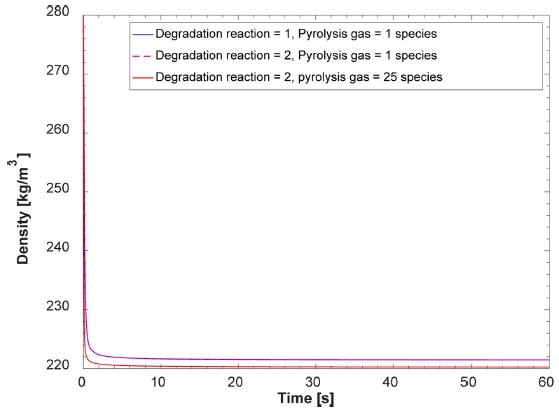
Fig. 13Surface density VS time by Degradation reaction and Pyrolysis gas
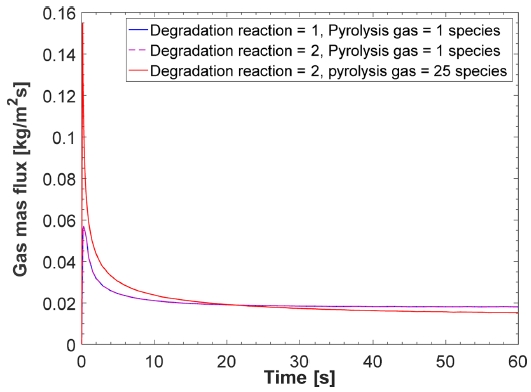
Fig. 11은 시간에 따른 표면 온도 결과를 나타내며 표면 온도는
Figs. 12 및
13과 같이 열분해 과정에서 발생하는 밀도 및 가스질량플럭스 변화와 밀접하게 관련된다. 복합 분해 반응 및 다종 분해 가스를 고려한 해석 조건에서 재료 분해가 더 빠르게 진행되면서 재료 내부로부터 외부 경계면으로 이동하는 가스질량플럭스가 급격히 증가하는 것을 알 수 있으며, 이러한 영향으로 복합 분해 반응 및 다종 분해 가스를 고려한 해석 조건에서 표면 최고 온도는 약 3,156 K까지 상승하는 것으로 나타났다. 일반적으로 재료 내부에서 열분해 과정으로 생성된 분해 가스의 이동에 따른 열에너지의 소산은 경계에서 유입되는 열에너지를 감소시키기 때문에 표면 온도가 낮아지는 경향을 나타내기도 하지만, 본 연구에서는 분해 가스 소산인자
Bg와 온도의 함수인 화학적 삭마 속도값 적용에 따라 표면에서 숯 층이 발달하면서 단열효과가 발생하여 표면에서 최고 온도가 다른 해석조건 대비 약 853 K 정도 더 높게 나타났다. 따라서, TACOT와 같은 저밀도 삭마재를 이용한 열보호 설계를 수행하기 위해서는 열분해 과정에서 발생하는 다양한 분해 가스 종류을 먼저 식별하고 다종 분해 가스의 열역학적 물성 및 화학적 삭마 속도를 적용함으로써 다종 분해 가스에 의한 산화 반응을 고려한 화학적 삭마 해석을 수행하는 것이 중요하다.
4. 결론
본 논문에서는 극초음속 유도탄 열보호 설계를 위한 기초연구로서 탄화성 페놀수지 복합재와 화학조성 및 열화학적 특성이 유사한 저밀도 삭마재 TACOT에 대한 기본적인 열분해 및 화학적 삭마 특성을 확인하였다. 상용 삭마 해석 코드 SAMCEF AMARYLLIS V.17를 이용한 열분해 모델을 기반으로 수치 해석을 수행하였으며 화학평형을 계산하는 CEA를 통해 열분해 과정에서 생성되는 다종 분해가스의 열역학적 물성 및 화학적 삭마 속도를 구하여 이를 해석에 적용하였다.
간단한 수치 예제를 통해 탄화성 페놀계 복합재에 대한 열화학적 분해 및 화학적 삭마 경향성을 일차적으로 확인한 후, 복합 분해 반응 및 다종 분해 가스에 따른 화학적 삭마 영향성을 비교하였다. 삭마 경계면의 삭마량, 온도, 밀도, 가스질량플럭스 결과에서 재료 분해 반응 증가에 따라서는 큰 차이가 없었던 반면 다종 분해 가스에 의한 열역학적 물성과 화학적 삭마 속도를 적용한 경우에서는 기존 해석 결과와 상이한 결과를 나타내었다. 이는 분해 가스 소산인자 Bg 및 온도의 함수로 결정되는 화학적 삭마 속도 적용으로 인해 경계에서 숯 층이 발달하면서 단열효과가 발생했기 때문으로 판단된다.
따라서, TACOT와 같은 저밀도 삭마재는 밀도가 매우 낮아 산화 반응에 의한 화학적 삭마에 지배적인 영향을 받기 때문에 이들 재료를 적용한 열보호 설계를 수행하기 위해서는 먼저 열화학적 분해과정에서 생성되는 다양한 분해가스 종류를 먼저 식별하고 분해 가스의 열역학적 물성 및 화학적 삭마 속도를 고려한 열분해 및 화학적 삭마 해석 수행을 통해 고온 및 삭마 특성을 검토해야 한다.
REFERENCES
- 1.
Kasen, S. D., “Thermal Management at Hypersonic Leading Edges,” University of Virginia Report, 2013.
- 2.
Choi, Y. G., Kim, S. J., and Shin, E. S., “Thermomechanical Analysis of Composite Structures in Pyrolysis and Ablation Environments,” Journal of the Korean Society for Aeronautical & Space Sciences, Vol. 41, No. 8, pp. 597-604, 2013.
10.5139/JKSAS.2013.41.8.597
- 3.
Yang, B. C., Cheung, F. B., and Koo J. H., “A Theoretical Study of Thermomechanical Erosion of High-Temperature Ablatives,” Journal of Applied Mechanics, Vol. 60, No. 4, pp. 1027-1032, 1993.
- 4.
Sutton, G. W., “The Initial Development of Ablation Heat Protection, an Historical Perspective,” Journal of Spacecraft and Rockets, Vol. 19, No. 1, pp. 3-11, 1982.
10.2514/3.62196
- 5.
Reynolds, R., Russell, G., and Nourse, R., “Ablation Performance Characterization of Thermal Protection Materials Using a Mach 4.4 Sled Test,” Proc. of 28th Joint Propulsion Conference and Exhibit, p. 3055, 1992.
10.2514/6.1992-3055
- 6.
Dolton, T., Reed, G., and Schneider, P., “Mechanical Erosion of Charring Ablators in Ground-Test and Re-Entry Environments,” AIAA Journal, Vol. 6, No. 1, pp. 64-72, 1968.
10.2514/3.4442
- 7.
Dimitrienko, Y. I., “Thermal Stresses and Heat-Mass Transfer in Ablating Composite Materials,” International Journal of Heat and Mass Transfer, Vol. 38, No. 1, pp. 139-146, 1995.
10.1016/0017-9310(94)00137-K
- 8.
Dec, J. A. and Braun R. D., “Ablative Thermal Response Analysis Using the Finite Element Method,” Proc. of AIAA 47th Aerospace Science Meeting and Exhibit, p. 259, 2009.
10.2514/6.2009-259
- 9.
Milos, F. S. and Chen, Y.-K., “Two-Dimensional Ablation, Thermal Response, and Sizing Program for Pyrolyzing Ablators,” Journal of Spacecraft and Rockets, Vol. 46, No. 6, pp. 1089-1099, 2009.
10.2514/1.36575
- 10.
Panerai, F., Ferguson, J. C., Lachaud, J., Martin, A., Gasch, M. J., et al., “Micro-Tomography Based Analysis of Thermal Conductivity, Diffusivity and Oxidation Behavior of Rigid and Flexible Fibrous Insulators,” International Journal of Heat and Mass Transfer, Vol. 108, pp. 801-811, 2017.
10.1016/j.ijheatmasstransfer.2016.12.048
- 11.
Mcmanus, H. L. and Springer, G. S., “High Temperature Thermomechanical Behavior of Carbon-Phenolic and Carbon-Carbon Composites, II. Results,” Journal of Composite Materials, Vol. 26, No. 2, pp. 230-255, 1992.
10.1177/002199839202600205
- 12.
Covington, M., Heinemann, J., Goldstein, H., Chen, Y.-K., Terrazas-Salinas, I., et al., “Performance of a Low Density Ablative Heat Shield Material,” Journal of Spacecraft and Rockets, Vol. 45, No. 2, pp. 237-247, 2008.
10.2514/1.12403
- 13.
Ommati, M., Fotovat, A. I., Davachi, S. M., and Motahari, S., “Erosion Rate of Random Short Carbon Fibre/Phenolic Resin Composites: Modelling and Experimental Approach,” Vol. 20, No.12, pp. 943-954, 2011.
- 14.
Sykes, G. F., “Decomposition Characteristics of a Char-Forming Phenolic Polymer Used for Ablative Composites,” National Aeronautics and Space Administration Hampton Va Langley Research Center,
http://www.dtic.mil/dtic/tr/fulltext/u2/a307833.pdf (Accessed 5 SEP 2018)
- 15.
April, G. C., “Energy Transfer in the Char Zone of a Charring Ablator,” Ph.D. Thesis, The Department of Chemical Engineering, Louisiana State University, 1969.
- 16.
De Mûelenaere, J., Magin, T., Lachaud, J., and Mansour, N., “Stagnation Line Approximation for Ablation Thermochemistry,” Proc. of AIAA Thermophysics 42nd Conference, p. 3616, 2011.
10.2514/6.2011-3616
Biography
- Youn Gyu Choi
Research engineer in PGM R&D Lab., LIG Nex1 Co., Ltd. His research interest is Composites Structures Mechanics and Multi-Physics Coupling Analysis.
- Kyung-Ho Noh
Research engineer in PGM R&D Lab., LIG Nex1 Co., Ltd. His research interest is Aerodynamics and System Engineering.
- Jin Yong Park
Research engineer in PGM R&D Lab., LIG Nex1 Co., Ltd. His research interest is Missile System Design and Mechanical Vibration.
- Young Hwan Jo
Research engineer in PGM R&D Lab., LIG Nex1 Co., Ltd. His research interest is Missile System Design and Mechanical Engineering.