ABSTRACT
With increasing demand for disaster response robots, many governments projects have been launched to ensure safety for citizens. This paper reviews government policies and research trends on disaster response robots. To give a bird's eye view on disaster response robots, we first reviewed foreign technologies. We then introduced recent technologies developed in Korea and some ongoing researches on disaster response robots.
-
KEYWORDS: Disaster response robots, Indoor scout robot, Armored robot, Integration operation system, Visualization, Human-life detection
-
KEYWORDS: 재난대응로봇, 실내정찰로봇, 장갑형로봇, 통합운용시스템, 가시화, 인명 탐지
1. Introduction
In 2016, the World Economic Forum announced the 10 global risks, and many items related to disasters and social safety were included. Typical disaster situations are as follows. A massive earthquake and tsunami caused numerous human and material damage in the Fukushima nuclear power plant in 2011. The radiation leak is continuing until now. Fire disasters due to the explosion of flammable material constituted a considerable portion of the total number of accidents in many countries. Building collapses have killed many people (e.g. the Sampoong department store). In such emergencies, the Disaster Response Robot (DRR) can assist people. Thus, many governments have launched strategic projects to develop disaster response robots to prepare for a natural disaster or man-made disaster.
1-7
The DRR is a robot that can directly respond for disaster situations or provide aid to prevent the damages spreading. The DRRs can be categorized as the following: surveillance and reconnaissance robots, counter-terrorism robots, firefighting robots, search and rescue robots, and disaster recovery robots:
5-7
▪ Surveillance and Reconnaissance robot: a robot to obtain site information when it is put into situations that are difficult for humans to access or require periodic reconnaissance.
▪ Counter-terrorism Robots: Robots for counter-terrorism, such as eliminating bomb detection.
▪ Fire-fighting robots: robots to help firefighters put out fires.
▪ Search and Rescue Robot: Robots to search for and rescue survivors in disaster situations.
▪ Disaster Recovery Robot: Robots for disaster recovery, such as disposal of debris after the disaster is over.
The main requirements of DRRs can be summarized as follows:
7
▪ High reliability: High reliability that is not broken in any circumstances is required because failure of products in an urgent disaster can cause significant damage to lives and property.
▪ Convenience of operation: DRRs should be easily operated by first responders without any help by a robotic expert.
▪ Ease of installation: As initial response is very important to minimize damage, installation should be easy and fast for rapid deployment of DRRs.
▪ Convenience of maintenance: The DRRs should be designed and manufactured to facilitate maintenance because damage of DRRs can occur in dangerous disaster environments.
Currently, DRR market is based on government demand and the users of DRR are firefighters, rescuers, and police. They are conservative to use new inventions and want to use only proven products. The DRR requires long development time and huge initial costs, and the pilot operation according to mission scenarios is required for testing and certification.
This paper is organized as follows. We first review research trends on DRRs in Section 2. We introduce major considerations in the development of DRRs, and introduce our approaches in Section 3. Finally, conclusion is given in Section 4.
2. Trends of DRRs and Difficulties in Field Applications
2.1 Trends of Domestic and Foreign Policy
‘The realization of a safe society and the realization of national safety’ is an important policy in developed countries. For example, the R&D budget by the U.S. and Japan is decreasing, but the share of R&D in the disaster and safety sector is gradually increasing. Korea plans to invest 603.2 billion won in R&D investment in the disaster and safety sector in 2016, and the number is increasing by 4.2% (23.2 billion won) year-on-year.
A Roadmap for U.S. Robotics that emphasized the importance of robot technology for the safety and protection of the national territory was established in 2013. The U.S. government continues supporting technology development related to DRRs. Japan included the DRRs development into the five major areas of the 2013 comprehensive strategy for scientific innovation. Japan is currently pushing ahead with the development of DRRs by 2020, through the 2015 robot revolution actual meeting. In particular, New Energy Industrial Technology Development Organization (NEDO), a government agency, has supported the development of human-type robot technologies that operate at disaster sites. The European Union launched the new Grand Challenge euRathlon project for intelligent search and rescue robots in 2013. The EU is pushing for a variety of EU-level DRR projects, with more than 73 million euros in R&D projects. The German-France MMSRSYDERA consortium has developed a variety of robots that detect and remove landmines and improvised explosive devices, and is contributing to the search for counter-terrorism and the enhancement of robot technology for disaster relief through the European unmanned robot race ELROB (European Land-Robot Trial). The China Industrial Intelligence Agency announced that it would invest and develop national strategic dimensions by including firefighting robots within 10 major products (China Robot Industry Development Plan 2016-2020).
2.2 Trends of Domestics and Foreign Technology
Table 1 shows the technical status of representative overseas DRRs. In general, social safety robots includes surveillance robots and counter-terrorism robots. Based on the world's best military robot technology, the U.S. has developed various social safety robots such as TALON and PackBot. Firefighting robots were first developed by developed counties such as Japan, the U.S., and Europe; recently, followed by developing countries such as China, Brazil. The search and rescue robot was developed by Japan and the U.S. to save people from collapsed buildings or hazardous chemical spills. To cope with the disaster in the nuclear power plant, the Group-Intra, a multinational corporation, and the French National Atomic Energy Agency (CEA), developed DRRs and trained personnel to respond within 24 hours of the accident. After the Fukushima nuclear accident, Japan has been actively investing in developing DRRs that can be used in nuclear power plant accidents through the unmanned ground and aerial robot.
Table 1Technical status of representative overseas DRRs
Table 1
|
Section |
Products |
Outline |
|
Social safety robots |
TALON
(Foster-Miller, USA) |
▪ Perform scouting, explosive handling
▪ Over 20,000 bomb disposal missions in Iraq and Afghanistan |
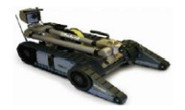
PackBot (iRobot, USA) |
▪ Develops upgrade model that offers more functionality, improved torque, speed, and operational time
▪ U.S. troops have deployed to Iraq |
|
Firefighting robots |
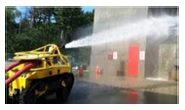
RS1-Ts (Thermite, USA) |
▪ Able to spray up to 600 gallons of water per minute and tow 1,040lb |
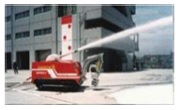
Rainbow5 (Japan) |
▪ An engine-driven, infinite orbital robot with four cameras and remote fire extinguishers
▪ Removable Obstacles by a front mounted high-load manipulator |
|
Life search robots |

BEAR (USA) |
▪ Saving people from collapsed buildings or hazardous chemical spills |
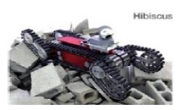
Hibiscus (Japan) |
▪ As a structural robot, it can move in a stable position even if there are obstacles such as building debris |
|
Response to nuclear power plants |
EOLE (France) |
▪ Robots for high-radiation environment, enabling the discovery and treatment of radiation sources |

Tsubaki (Japan) |
▪ Heavy weight instrument mounted mobile robot capable of mounting radiation source identification gamma camera |
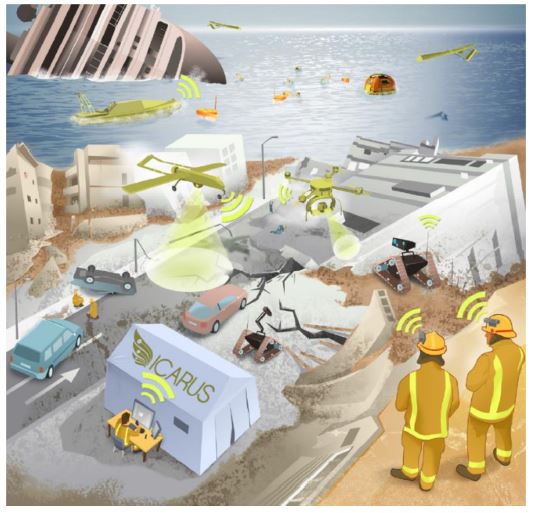
In Europe, a collaborative project of DRRs, “Integrated Components for Assisted Rescue and Unmanned Search operations (ICARUS),” had been completed in 2017. ICARUS is an end-user driven project, aiming to decrease the total cost of a major crisis. To this end, the ICARUS project was proposed to equip first responders with a comprehensive and integrated set of unmanned search and rescue tools, to increase the situational awareness of human crisis managers, such that more work can be done in a shorter amount of time. The collaborative project ICARUS was divided into 9 sub-projects listed as following (
Fig. 1):
Fig. 1The Integrated Components for Assisted Rescue and and Unmanned Search operations (ICARUS) project
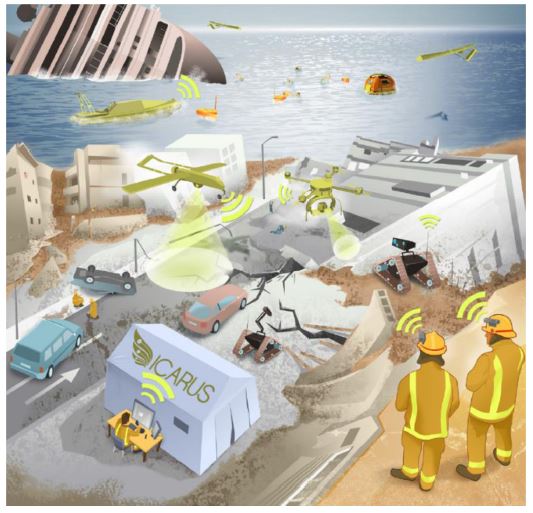
▪ Development of a light sensor capable of detecting human beings
▪ Cooperative unmanned aerial system for unmanned search and rescue (SAR)
▪ Unmanned Ground Vehicle (UGV) robots for unmanned SAR
▪ Unmanned Surface Vehicle (USV) robots for unmanned SAR
▪ Heterogeneous robot collaboration between Unmanned Search and Rescue devices
▪ Development of a self-organizing cognitive wireless communication network, ensuring network interoperability
▪ Integration of unmanned search and rescue tools in the command and control systems of the human search and rescue force
▪ Development of a training and support system for the developed unmanned search and rescue tools for the human search and rescue teams
In Korea, shown in
Table 2, social safety robots have been developed mainly for monitoring basic industries and military facilities and the development of surveillance and reconnaissance robots using ground robots and drones has been carried out. In 2008, the Korea Advanced Institute of Science and Technology (KAIST) and the Korea Atomic Energy Research Institute (KAERI) developed fire robots that can detect and putdown fire by using thermal cameras and water-guns. Unmanned firefighting robots and fire reconnaissance robots were verified by firefighters in real situations. In addition, KAERI developed various robot technologies for operation in nuclear facilities.
Table 2Technical status of DRRs in Korea
Table 2
|
Section |
Products |
Outline |
|
Social safety robots |

DT3 (KIST) |
▪ Equipped with wireless controls, EOD equipment, and thermal imaging equipment
▪ Iraq test operation |

Securo (KIST) |
▪ GPS, laser scanner, direction sensor, camera fusion (10cm error, 5.4km/h)
▪ Safety of public facilities, access to elderly and disabled people |
|
Firefighting robots |

Fire suppression robot
(DRB Fatec) |
▪ Detects and suppresses fire in indoor environments such as underground shopping malls and subways
▪ Robot for indoor fire fighting |

An outdoor fire
control robot
(Hyundai Rotem) |
▪ Suppress fires at high risk of fire and explosion, such as oil/gas storage facilities
▪ Development of outdoor fire control robots |
|
Life search robots |

RobHaz
(KIST, Yujinrobot) |
▪ Move disaster environment and gather information
▪ Development of RobHaz series with infinite track type of manual joints |

Multiple articulation
robot (KAERI) |
▪ Develops multi-tube type robot that can move collapse gaps and pipes to search for buried people |
|
Response to nuclear power plants |

KAEROT-m2
(KAERI) |
▪ Robots that can cross shielded door rail grooves, etc. and inspect high-altitude areas for more than 8m using vertical masts |

Nuclear fuel exchange
emergence action robot
(KAERI) |
▪ Robot that can take emergency measures in case of failure of fuel exchange by fuel exchanger of heavy water reactor |
2.3 Difficulties of the Field Application of DRR
There have been several experiences in using DRRs to perform certain tasks. For example, the Center for Robot-Assisted Search and Rescue (CRASAR) in the U.S. used UGV to the world trade center building collapsed by 9/11 attacks in 2001. The DRRs were used in 20 major disasters including Hurricane Katrina in 2005 and the East Japan Earthquake in 2011. At the time of the earthquake in Japan, ‘Packbot’
2 from iRobot in the U.S., ‘TALON’ from QinetiQ, and 'Quince
4 from Tohoku University in Japan were deployed inside Fukushima nuclear power plants, and the images were taken and sent outside.
The ICARUS project had dealt with the development of a set of integrated components to assist search and rescue teams in dealing with the difficult and dangerous, but life-saving task of finding human survivors. In the event of disaster, a primordial task of the fire and rescue services is the search for human survivors. This is a complex and dangerous task, which leads to loss of first responders themselves.
From the aforementioned experiences, the difficulties of using DRRs into real situations had been reported as follows:
8-12
▪ Emergency: In case of a failure to respond promptly to various accidents or delays in time, larger accidents will occur subsequently and cause damage to the people’s property and lives; thus, urgent response is required for DRRs.
▪ Hazards: In the event of disaster, activities are carried out with a variety of risk factors, such as falls, suffocation, crushing, and burning. In this case, not only the victims but also the first responders themselves are exposed to sudden dangerous situations.
▪ Abnormalities of the disaster environment: Unpredictable situations such as explosions due to gases, oil, and chemicals are always latent at the site, and firefighting activities are conducted under such dangerous and abnormal conditions.
When developing DRRs, it is important to understand the mission, and the environment of the robot. In the next chapter, we will introduce a new approaches of DRR for firefighters.
3. A New Approach of DRR for Firefighters
3.1 User-centered R&D for Firefighters
To develop a DRR for firefighter, we have gathered the opinions of firefighters. Through two surveys and several face-to-face interviews, we derived DRR concepts for firefighters in the complex disaster environment. The first survey was conducted with 155 firefighters nationwide from January 21 to 31 in 2015, while the second was collected from 133 firefighters from February 26 to March 4. All surveys were conducted on a face-to-face basis based on a structured questionnaire.
7-12 The firefighters felt difficult to work in the following situations:
▪ Accessible environment, but there are large fires and toxic gases.
▪ Building collapse or explosion hazards
▪ Long-term, physically demanding tasks.
The following functions of DRRs were suggested by the firefighters:
▪ Assist search and rescue operations in dangerous situations.
▪ Send information from disaster environments.
▪ Repeated operations, such as handling heavy debris, climbing.
▪ Wireless connection and tool transfer, etc.
We could confirm that information of disaster, such as disaster map, position of rescue, is important. Security of firefighters are also important, and the firefighters require a dexterous tool with high power to perform various tasks.
3.2 Purpose and Scope of R&D
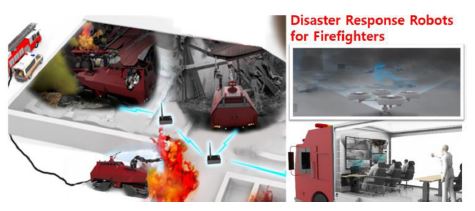
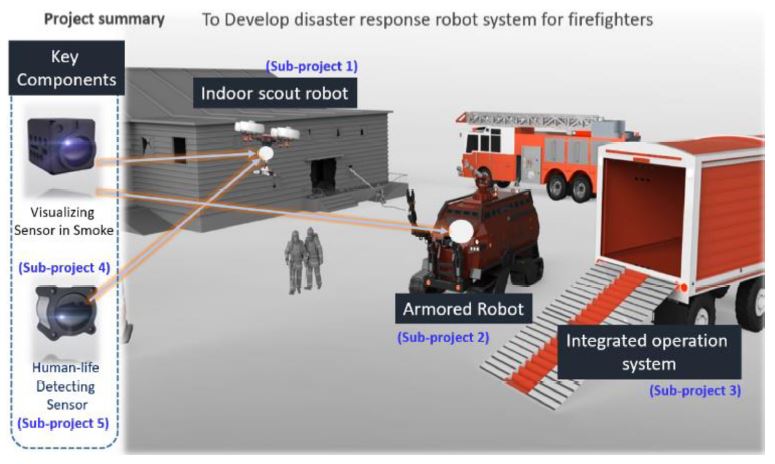
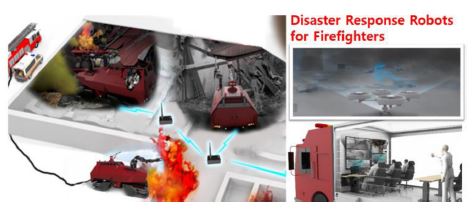
To provide assistance for firefighters, the Ministry of Trade, Industry and Energy has been pushing for the National Safety Robot Project since July 2016 to develop DRRs. As shown in
Fig. 2, the project plans to develop indoor scout robots, armored robots,
13 and an integrated operating system,
14 visualization sensor,
15 and life detecting sensor.
16
Fig. 2The national safety robot project: DRRs for firefighters
3.2.1 Indoor Scout Robot
The acquisition of information in a disaster situation is paramount. Indoor scout robots are proposed to install communication modules, identify disaster situations and search for survivors by using drones and ground observation robots at disaster sites. The main functions are as follows:
▪ Acquire disaster site information with (drone) visualization Sensor in heavy smoke
▪ Installation of communication modules for remote adjustment and transmission of disaster information
▪ Send location information of demand factors using the (ground reconnaissance robot) life detection sensor
▪ Driving over obstacles at disaster sites
▪ (Common) remote and self-controlled
Using indoor scout robots, it is expected that disaster situations can be identified more quickly and accurately, enabling safer and more effective disaster response (
Fig. 3).
Fig. 3The purpose of DRRs for firefighters: indoor scout robot, armored robot, and integrated operation system

3.2.2 Armored Robot
When the firefighters enter the disaster environment, they moves on foot with fire suits and axes. With the armored robot, firefighters can run into dangerous places quickly and safely. The armored robot can cut walls and windows, moving debris, by using hydraulic dual arms. The main functions of an armored robot are as follows:
▪ Up to 4 people on board
▪ Protect passengers from heat, shock and toxic gases
▪ Driving over obstacles 50cm high
▪ Water gun (external hose connection)
▪ Ability to destroy, cut and remove obstacles
▪ Direct operation and remote operation
▪ Provide a panoramic view to see outside in heavy smoke
With the help of armored roots, firefighters can be protected from heat, weight drops, toxic gases, etc. It can be expected that the armored robots provide firefighter more time to rescue people.
3.2.3 Integrated Operation System
Integrated operation system is designed to transport the indoor scout robots and the armored robot to the disaster site, and to effectively control the robots simultaneously in disaster situations. With the integrated operation system, a firefighter can supervise many heterogeneous robots (drones, ground scout robots, and an armored robot) easily. The main functions of the integrated operation system are as follows:
▪ Move other robots up to speed of 100 km/h to the disaster site.
▪ Deploy robots within 10 minutes.
▪ Provide 3D onsite map information display, and robot status.
▪ Comprehensible visualization of robot information
Only when such an integrated operation system is developed will the robots be able to be used effectively in the field.
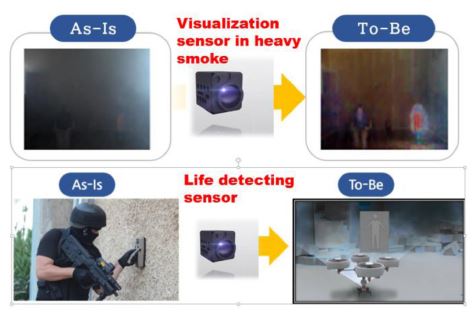
3.2.4 Visualization Sensor in Heavy Smoke
The disaster sited are often filled with heavy smoke (fume). The function of visualization sensor in heavy smoke are as follows:
▪ Extends visibility to view environment using image sensor (visualization)
▪ Show 3D information of an object into heavy smoke using radar (visualization)
▪ Provides 3D information about the environment
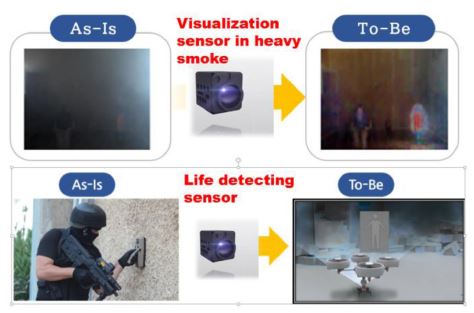
The purpose of this sensor is to create the best image for firefighters to understand the disaster situation through heavy smoke. There is a way to use light in an infrared region that is more likely to pass through a large dust particle because the wavelength is longer than the visible light. The proposed sensors use infrared light image sensors (red camera) and distance sensors (Lidar, Radar, etc.) to expand viewing distance and to simulate 3D environment information in 2D (
Fig. 4).
Fig. 4The visualization sensor in heavy smoke and the life detecting sensor
3.2.5 Life Detecting Sensor
Life-saving is a top priority for firefighters in disaster situations. They enter any dangerous environment if they have found a life to rescue. The sensor is designed to detect living life in an invisible place, such as behind a fog, debris, and wall (
Fig. 4). The main functions are as follows:
▪ Detects if there are living people behind smoke/walls.
▪ Distance/direction information of detected people.
▪ Breathing, heart rate detectable.
The sensor uses UWB radar technology to detect human life, and the sensor is small and light to fit into a robot.
The DRR systems (consist of indoor scout robots, armored robots, and an integrated operating system) collaborate as a coordinated team, communicating via ad hoc wireless radio networking (
Fig. 5). To ensure optimal human-robot collaboration, these robots are seamlessly integrated into the integrated operating system and a set of training and support tools will be provided to first responders to learn to use the DRR system.
Fig. 5Mission scenarios of DRRs for first responders
4. Conclusions
This paper has introduced domestic and foreign policies and technologies status of DRRs. Many DRRs have been developed in developed countries such as the U. S., Japan, and the Europe. In Korea, social safety robots, firefighting robots, search robots, and nuclear power plant robots have been developed for disaster response. This paper also has introduced an on-going research project on DRRs for firefighters. The indoor scout robots, armored robots, and an integrated operating system, visualization sensor, and life detecting sensors have been introduced briefly.
ACKNOWLEDGMENTS
This material is based upon work supported by the Ministry of Trade, Industry & Energy (MOTIE, Korea) under Industrial Technology Innovation Program. No.10067184, ‘Development of armored robot systems for personal protections of rescuemen and emergency management operations in the composite disaster site.’
REFERENCES
- 1.
Murphy, R., “Human-Robot Interaction in Rescue Robotics,” IEEE Transactions on Systems, Man, and Cybernetics, Part C, Vol. 34, No. 2, pp. 138-153, 2004.
10.1109/TSMCC.2004.826267
- 2.
Brian M. Yamauchi, “PackBot: A Versatile Platform for Military Robotics,” In Proceedings of SPIE, Vol. 5422, 2004.
10.1117/12.538328
- 3.
Adam, J. and Elena, M., “DHS/NIST Response Robot Evaluation Exercises,” Proc. of Safety, Security and Rescue Robotics International Workshop, pp. 1-6, 2006.
- 4.
Yoshida, T., Keiji N., Satoshi T., Takeshi N., and Eiji K. “Improvement to the Rescue Robot Quince Toward Future Indoor Surveillance in the Fukushima Daiichi Nuclear Power Plant,” Field and Service Robotics, Vol. 92, pp. 19-32, 2014.
10.1007/978-3-642-40686-7_2
- 5.
Murphy, R. R., “Disaster Robotics,” the MIT Press, 2014.
10.7551/mitpress/9407.001.0001
- 6.
Kim, D. Y., Lee, J. M., Shin, D. I., Shin, S., Hwang J. H., et al., “Quick Target Position Command for Quadrotor in 3D Indoor Map of Disaster Accident Management Using Robot System,” Proc. of Intelligent Robots and Systems IEEE/RSJ International Conference, 2016.
- 7.
Suh, J. H., “Market and Technology Trends of Disaster Safety Robots,” Korea Institute of S&T Evaluation and Planning, pp. 39-51, 2016.
- 8.
Suh, J. H., Oh, S. S., Hahm, J. H., Jin, M. L., Seo, K. H., “Development of Safety Robot System to Response to Composite Disaster Environment based on Mission Scenario,” Proc. of KSPE Autumn Conference, Vol. 2017 No. 5, p. 48, 2017.
- 9.
Oh, S. S., Hahm, J. H., Jang, H. J., Lee, S. Y., and Suh, J. H., “A Study on the Disaster Response Scenarios using Robot Technology,” Proc. of Ubiquitous Robots and Ambient Intelligence International Conference, 2017.
- 10.
Kim, K. S., Kim, S. D., Park, M. Y., Choi, J. H., Koo, B. T., et al., “A High Voltage GaN Impulse Generator for Human Detection UWB Radar Sensor,” Proc. of Ubiquitous Robots and Ambient Intelligence International Conference, 2017.
10.1109/URAI.2017.7992660
- 11.
Suh, J. H., Oh, S. S., and Hahm, J. H., “Considerations for Research and Development of Disaster Response Robots - National Safety Robot Project,” Scientific Society Journal - Robot and Human, Korea Robotics Society, pp. 26-38, 2018.
- 12.
Hahm, J. H., Oh, S. S., Jang, H. J., Lee, S. Y., Suh, J. H., “A Study on Empirical Demonstration Scenario for Performance Evaluation of Disaster Response Robot System,” Proc. of The Korea Robotics Society Annual 13th Conference, pp. 698-699, 2018.
- 13.
Park, S. H., Jin, M. L., Kim, Y. R., Kim, D. I., Kim, J. S., et al, “Vehicle Body Design of Armored Robot for Complex Disaster,” Journal of Korea Robotics Society, Vol. 13, No. 4, pp. 248-255, 2018.
10.7746/jkros.2018.13.4.248
- 14.
Yang, K. M., Seo, K. H., Lee, J. I., Lee, S. J., Suh, J. H., “A Target Position Reasoning System for Disaster Response Robot based on Bayesian Network,” Journal of Korea Robotics Society, Vol. 13, No. 4, pp. 213-219, 2018.
10.7746/jkros.2018.13.4.213
- 15.
Lee, O, J., Kim D. Y., Lee, J. M., Shin, D. I., Hwang, J. H., et al., and Jeon, S. W., “A Study on Heterogeneous Sensor Calibration between IR Sensor and RGB Camera,” Proc. of KSPE 2016 Autumn Conference, No. 10, pp. 103-104, 2016.
- 16.
Jung, S. G., Lee, H. S., Cho, S. W., and Shim, H. C., “Obstacle Penetration Technique by Image-Based Visual Servoing Approach,” Proc. of the 12th Korea Robotics Society Annual Conference, pp. 293-294, 2017.
Biography
- Maolin Jin
Principal Researcher with the Korea Institute of Robots and Convergence (KIRO). His research interest is robot motion control, disaster robotics, and factory automation.
- Kap-Ho Seo
Principal Researcher with the KIRO. His research interest is system control, disaster robotics, and medical robotics.
- Jin-Ho Suh
Professor in the Department of Mechanical System Engineering, Pukyong National University. His research interest is disaster response robot, underwater robots, and system control & integration.