ABSTRACT
Recently, improvement of productivity of the paper cup forming machine has being conducted by increasing manufacturing speed. However, rapid manufacturing speed imposes high load on cams and cam followers. It accelerates wear and cracking, and increases paper cup failure. In this study, a failure diagnosis algorithm was suggested using vibration data measured from cam driving parts. Among various paper cup forming processes, a test bed imitating the bottom paper attaching process was manufactured. Accelerometers were installed on the test bed to collect data. To diagnose failure from measured data, the K-NN (K-Nearest Neighbor) classifier was used. To find a decision boundary between normal and abnormal state, learning data were collected from normal and abnormal state, and normal and abnormal cams. A few representative features such as mean and variance were selected and transformed to the relevant form for the classifier. Classification experiments were performed with the developed classifier and data gathered from the test bed. According to assigned K values, a successful classification result was obtained which means appropriate failure recognition.
-
KEYWORDS: Cam wear, Machine learning, Paper cup forming machine, Failure diagnosis, K-Nearest neighbor classifier
-
KEYWORDS: 캠 마모, 기계학습, 종이용기 성형기, 고장 진단, K 근접 이웃 분류기
1. 서론
종이용기 성형기는 하나의 기계에서 일련(In-line)의 공정을 통해 연속적으로 종이용기를 제조하는 복합 생산설비이다. 하나의 장비에 다양한 공정을 포함하고 있어서 여러 가지 기계요소가 정교하게 맞물려 구동되어야 성공적으로 종이용기가 생산될 수 있다. 최근 배달문화가 활성화 되고 음료와 음식의 테이크 아웃(Take Out)이 보편화 되면서 사용하기 편리한 종이용기의 사용이 증가하고 있다. 이에 따라 종이용기의 생산량과 생산속도의 증가가 요구되고 있으며 국내 종이용기 성형기 업체에서는 성형기의 성능을 개선하기 위한 연구가 활발하게 진행되고 있다. 그러나 국내에서 생산되고 있는 종이용기 성형기는 해외의 선진 성형기의 생산속도에 미치지 못하고 있어 기계의 경쟁력 확보를 위하여 생산속도의 개선과 4차 산업혁명에 대비한 스마트 생산 시스템의 도입이 필요한 상황이다. 현재 진행되고 있는 연구는 실제 현장에서 생산되고 있는
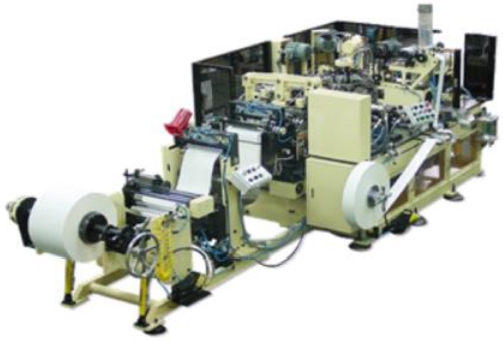
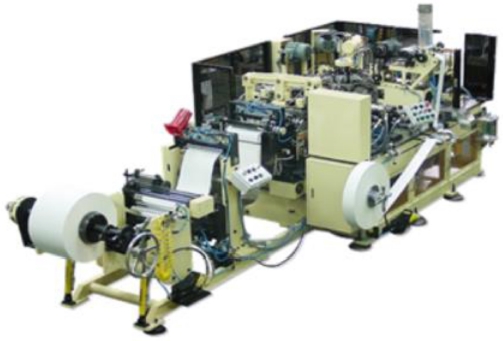
Fig. 1과 같은 종이용기 성형기의 생산속도를 현재 분당 150개에서 해외 선진 성형기의 생산속도인 분당 300개로 증가시키고 성형기의 스마트화를 달성하는 것을 목표로 하고 있다. 본 논문에서는 해당 연구의 한 분야인 종이용기 성형기의 스마트화를 위하여 설비의 상태를 모니터링 하고 고장을 진단하는 시스템의 개발에 대해 다룬다. 고장 진단 시스템의 개발뿐만 아니라 현재 종이용기 성형기에 사용되는 주기적인 예방정비 방법을 개선하여 현재 기계의 상태를 기반으로 정비를 수행하는 예측정비(Condition Based Maintenance)를 적용한 유지보수 시스템의 개발이 가능하다.
1,2 개발된 시스템에는 고장을 진단하기 위하여 최근 활발히 응용되고 있는 다양한 머신러닝 알고리즘 중에서 K 근접 이웃 분류기(K-Nearest Neighbor Classifier, K-NN) 분류 방법이 적용되었다. 이 방법을 이용하여 실제 성형기에서 수집한 데이터를 분석하여 고장발생의 유무를 파악할 수 있으며 이를 사용하여 고장발생 시점을 예측하게 된다.
Fig. 1 Hi-1000 Paper cup forming machine
2. 고장내역의 분석
고장 진단 시스템의 효율적인 사용을 위해서는 기계 전체를 감시하는 것 보다는 고장이 자주 발생하거나 고장의 발생 시 설비에 치명적 영향을 주는 고장을 선별하는 것이 중요하다. 성형기를 사용하여 종이용기를 생산하는 생산 현장에서는 설비의 유지보수 비용 측정을 위하여 고장의 발생이력을 기록하고 있다. 현장에서 1년간 축적된 고장 이력을 분석하여 주요 고장 진단 대상을 통계적으로 분석하였다. 통계자료는 고장 발생 빈도, 수리 시간 등으로 이루어져 있다. 따라서 고장이 얼마나 발생하고 발생하였을 때 생산에 얼마나 영향을 미치는지 파악할 수 있다.
Table 1에 성형기의 부품별로 고장이 발생한 횟수와 총 고장발생 시간을 간략히 나타내었다. 본 논문에서는 통계 분석을 통해서 파악된 다양한 고장 중에서 대표적으로 생산 공정의 동력을 전달하여 고장이 발생하였을 때 성형기에 여러 부품에 고장을 추가로 유발할 수 있는 캠 기구의 고장 진단을 대상으로 선정하였다. 캠으로 회전을 왕복운동으로 변환시키는 메커니즘은 종이용기를 생산하는 공정의 전반에 걸쳐 사용되고 있어 해당 고장 진단 시스템의 개발은 성형기의 전체적인 스마트화에 중요한 역할을 하게 된다. 개발된 진단 알고리즘은 캠 주변에 설치된 가속도계를 이용하여 진동신호를 수집하게 되고 각각의 수집한 데이터들을 기반으로 머신러닝 분류기를 활용하여 캠에 발생하는 고장을 진단한다. 자세한 진단 알고리즘의 개발 내용이 이후에 소개된다.
Table 1 Failure statistics of paper cup forming machine
Table 1
|
Part |
Counts |
Total failure time (min) |
|
Sidewall feeder |
91 |
4540 |
|
Sidewall blanking die |
147 |
9644 |
|
Transfer turret |
53 |
2347 |
|
Sidewall heater station |
223 |
8797 |
|
Mandrel turret |
140 |
6218 |
|
Bottom blanking die |
290 |
15759 |
|
Bottom reformer |
36 |
2066 |
3. 캠 마모 고장 진단 시스템
3.1 고장 진단 데이터의 수집
종이용기를 생산하는 가공공정을 구동하기 위해서는
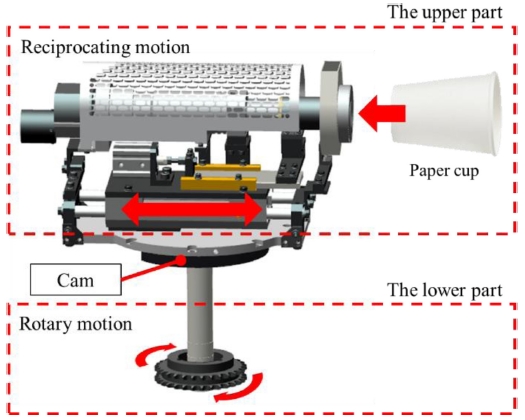
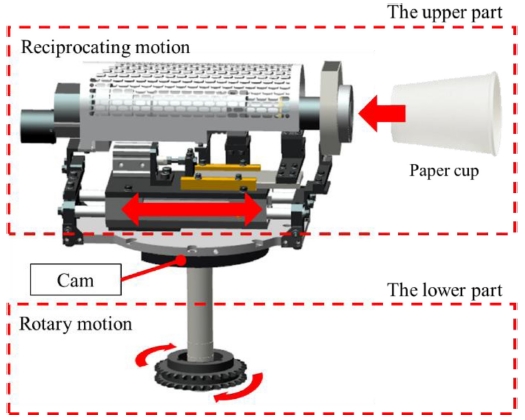
Fig. 2와 같이 동력전달을 위한 캠 기구가 필요하다.
Fig. 2는 종이용기 성형기의 다양한 공정 중 종이용기의 밑면을 접합시키는 Bottom Incurl 공정이다. 상부의 왕복운동을 생산하기 위해 하부의 회전운동부에 입력된 동력을 그 사이에 위치한 캠이 상부에 전달하는 역할을 하며, 이 과정에서 운동의 형태는 회전운동에서 직선왕복운동으로 변환된다. 직선왕복운동 중 상부의 부품이 직선 경로의 각 끝 점에 도달할 때마다 캠은 큰 하중을 받게 되고, 하중을 많이 받는 부분에 마모가 발생하게 된다. 캠에 마모가 발생하면 기계동작 시 발생하는 진동의 크기가 커지게 되는데, 이 때 발생하는 실시간 전압 데이터를 가속도계 센서와 DAQ 장비로 수집하여 진폭의 변화를 확인한다.
3 이 연구에서는 정상상태의 진폭 데이터와 고장상태의 진폭 데이터로 각각 생성시켜 저장하고 이 데이터를 기반으로 한 머신러닝 기법을 사용하여 고장의 진단을 위한 분류기를 개발하였다.
Fig. 23D model of bottom incurl process
3.2 데이터 수집을 위한 테스트베드
앞서 설명한 종이용기 성형기의 고장 진단을 위한 머신러닝 시스템의 개발을 위해서는 데이터의 수집이 필수적이다. 기계학습을 위한 고장상태 및 정상상태 데이터를 수집하기 위해서 실제
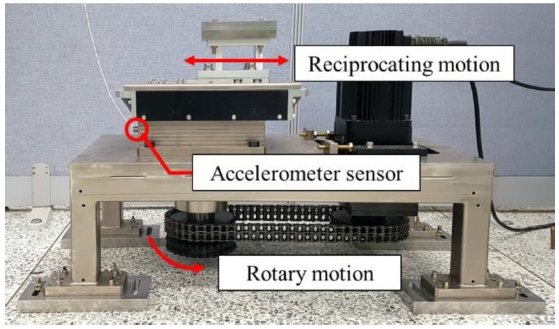
Fig. 2의 Bottom Incurl 공정 왕복운동 기구를 기반으로 테스트베드를 제작하였다. 실제로 제작한 테스트베드를
Fig. 3에 나타내었다. 제작된 테스트베드는 실제 성형기와 동일한 크기와 형상 그리고 구동 메커니즘을 가지고 있으며 정상 및 고장 캠의 교체가 가능하여 의도적으로 유발한 고장상태 데이터의 획득 또한 가능하다. 테스트베드를 사용하여 성형기에서 발생하는 캠의 마모고장을 진단하기 위한 데이터 생성 실험을 수행하였다. 정상상태와 고장상태의 데이터를 각각 수집하기 위해서
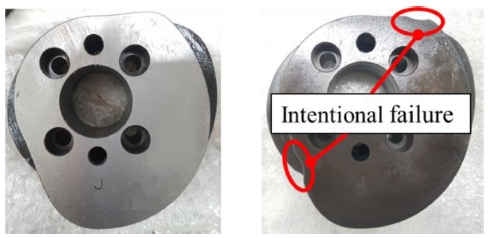
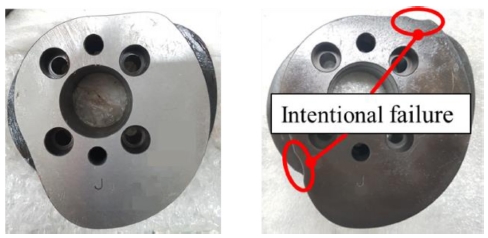
Fig. 4에서 보여주는 바와 같이 정상시편과 형상 변형을 가정한 고장 시편 두 가지를 제작하고 각 실험에 대한 테스트베드에 적용하여 데이터 수집하였다.
4
Fig. 3Test bed of bottom incurl process (a) Normal cam and (b) Abnormal cam
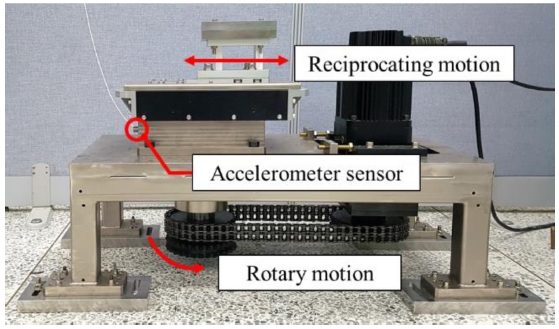
Fig. 4Intentional cam failure for abnormal vibration detection experiment
3.3 데이터 수집 플랫폼
데이터 수집 플랫폼은 고장 진단 시스템의 중요한 구성요소 중 하나이다. 테스트베드의 왕복운동으로 야기되는 고속의 진동신호를 신속하고 정확하게 획득하기 위하여 이 연구에서는 National Instrument사의 CompactDAQ (cDAQ-9133)를 데이터 수집 플랫폼으로 선정하였으며
Table 2에 설명하였다. 또한, National Instrument사의 프로그래밍 언어인 LabVIEW를 사용하여 데이터를 수집 및 분석하는 방법을 직접 프로그래밍하여 사용하였다. CompactDAQ는 다양한 형태의 신호를 수집하기 위한 독립적 데이터 획득 모듈을 지원하며 이 연구에서는 가속도계로부터 측정된 진동데이터를 수집하기 위한 모듈로
Table 2의 NI 9234모듈을 사용하였다. NI 9234는 4채널의 BNC 커넥터를 가지고 있어 동시에 4개의 가속도계로부터 여러 부분의 데이터를 수집할 수 있는 아날로그 입력 모듈이다. 가속도 신호를 수집하는 트랜스듀서(Transducer)로
Table 2의 KISTLER사 범용 세라믹 전단형 가속도계 8702B50 모델을 사용하였다. 실제 시스템에서는 다양한 고장을 동시에 진단하기 위하여
Table 2의 모듈 이외에도 댜앙한 모듈을 설치하여 고장 진단 시스템을 구성하게 된다.
4. K-NN 분류기를 이용한 고장 진단 알고리즘
4.1 K-NN 분류기
종이용기 성형기는 종이용기를 생산하는 데 필요한 산업용 기계로, 종이용기의 생산성 확보를 위해 성형기의 효율적인 고장 진단이 필수적이다. 보다 정확한 고장 진단을 위해 과거에 발생하였던 성형기 고장 이력을 파악하고 이 때 발생한 신호, 수치, 경향성 등을 분석하면 비슷한 현상이 발생하였을 때 성형기에 발생한 고장을 진단할 수 있다. 따라서 주어진 입력 데이터들을 어떤 기준에 따라 몇 개의 그룹으로 나누고, 각 데이터가 어떤 그룹에 해당하는지를 판별하는 패턴인식(Pattern Recognition) 기법을 종이용기 성형기의 고장 진단에 적용하고자 한다. 패턴 분류는 모수적인(Parametric) 방법과 비모수적인(Non-Parametric) 방법으로 나뉘는데, 모수적 방법은 추정하고자 하는 데이터 집합의 확률분포의 형태를 먼저 가정한 후 분류가 진행되는 방법이고 비모수적인 방법은 데이터 분포를 가정하기 어렵거나 비선형 구조를 가지는 경우에 유용한 방법이다. 각 데이터에 대한 데이터 분포를 정확히 알 수 있다면 베이즈 분류기(Bayes Classifier)와 같은 모수적인 방법에 의하여 최적의 분류결과를 얻을 수 있지만 데이터 분포가 비선형적이라면 적절한 결정경계를 찾는데 실패하여 성능의 저하를 초래하게 된다. 따라서 데이터의 분포 형태에 따라 성능이 크게 좌우되지 않는 비모수적 방법을 이용하여 고장 진단을 수행하는 것이 바람직하다고 판단하였다.
5 비모수적인 방법 중 하나인 K 근접 이웃 분류기를 이용하여 성형기의 고장을 진단하고자 하였다.
K 근접 이웃 분류기는 머신러닝 기법의 일종으로 데이터간의 거리를 분류에 사용하는 알고리즘이다. 또한, K-NN은 기존의 통계적인 방법이 아닌 비모수적인 방식으로 클래스 라벨이 존재하는 다수의 트레이닝 데이터를 사용하여 벡터 공간상의 K개의 가장 가까운 데이터를 분석하여 어떤 케이스에 속하는지 분류해 낸다. 입력 데이터의 분류 출력은 K개의 가장 근접한 데이터에서 최대 다수가 되는 클래스로 분류된다. 만약 K의 값이 1이라면 데이터는 단순하게 가장 가까운 데이터의 클래스로 귀속된다.
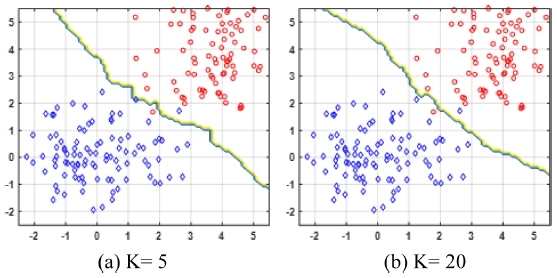
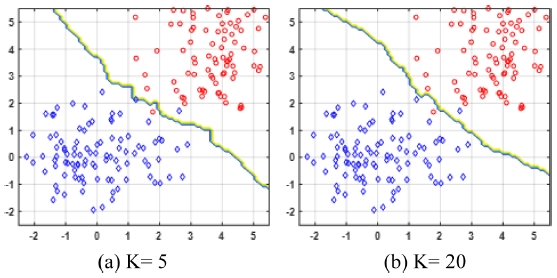
Fig. 5는 (0,0), (4,4)를 평균으로 하여 가우시안(Gaussian) 분포를 갖는 2차원 데이터 그룹을 보여준다. 한 그래프 내 2개의 그룹은 임의로 100개의 샘플을 추출하여 각 평균값에 가까운 분포로 K값에 따라 분류한 예이다.
Figs. 3(a)와
3(b)의 비교를 통해 K값의 차이에 따라 변경되는 2개의 클래스의 결정경계를 확인할 수 있다.
Fig. 5Decision boundary according to K
K-NN 분류기는 데이터 간의 거리를 계산함에 있어서 다양한 거리계산법을 사용하며 일반적으로
식(1)의 유클리디안 거리를 사용한다. 그러나 분류기 성능의 향상을 위해 1차 노름 및 내적 등의 다양한 거리계산법이 사용된다.
분류기를 제작하기 위해 사용되는 데이터는 3.2절에서 설명된 테스트 베드를 통해 수집된다. 캠의 고장을 진단하기 위해서는 고장과 정상 두 가지 클래스 라벨을 가진 데이터를 수집한다. 그리고 분류기는 성형기의 두 가지 구동속도인 250 rpm과 300 rpm 각각의 경우에 대해 두 가지 분류기를 구성한다. 그리고 각각의 분류기를 구성하기 위하여 속도별로 Normal Cam 1과 2 두 가지의 정상캠과 Abnormal Cam 1과 2의 고장캠을 설치하여 성형기의 정상상태와 고장상태의 데이터를 수집하였다. 그리고
Fig. 3에 Mass라고 표기된 위치에 3 kg와 6 kg의 무게추를 추가하여 다른 부품의 노후된 상황을 가정한 데이터를 수집하였다.
Table 3에 데이터 수집이 어떤 방법으로 수행 되었는지 표기하였다.
Table 3Experimental setup for data acquisition
Table 3
|
Class |
Cam |
Speed |
Mass (kg) |
Number |
|
1 |
Normal |
250 |
3, 6 |
Normal cam 1 |
|
300 |
3, 6 |
Normal cam 2 |
|
2 |
Abnormal |
250 |
3, 6 |
Abnormal cam 1 |
|
300 |
3, 6 |
Abnormal cam 2 |
데이터는 분류기를 제작하기 위한 트레이닝 데이터와 분류기에 투입하여 성능을 테스트하기 위한 테스트 데이터를 각각 50개를 수집하였다. 수집된 진동신호는 정확한 분류를 위해 특성을 나타낼 수 있도록 통계적인 신호처리 과정을 거쳐 특성추출을 진행하였다.
4.3 진동 특징 추출
데이터는 수학적인 기법을 사용하여 분류에 사용하기 적합한 데이터로 변경한다. 일반적으로 가속도데이터를 사용하기 위하여
Table 4에 표기된 다양한 통계적 특성을 활용하여 데이터를 프로세싱하게 된다.
6 이 중에서 데이터를 대표하는 특징을 선정하여 사용한다.
7 수집된 특성은 데이터 별로 1차원의 벡터로 만들어 각 벡터 사이의 거리를 계산하는데 사용한다.
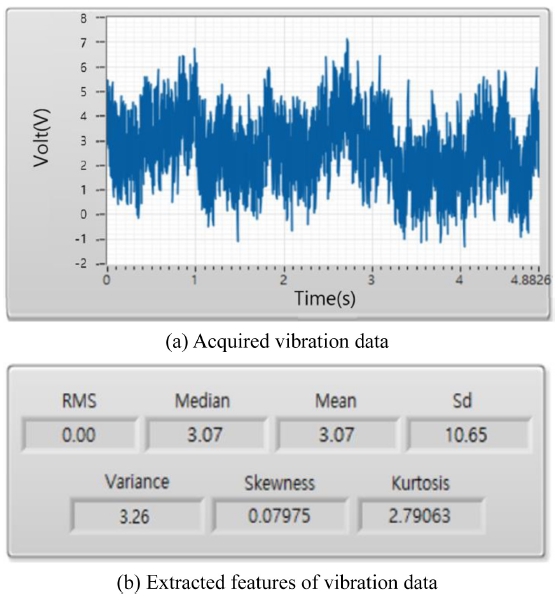
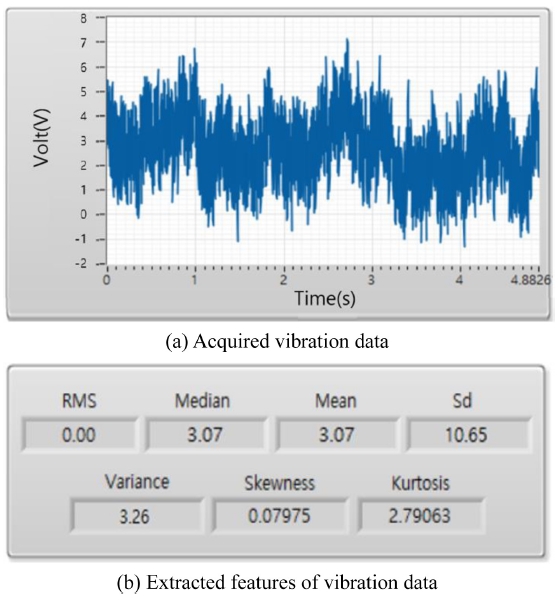
Fig. 6(a)에서와 같이 진동 데이터를 수집한 후,
Fig. 6(b)의 자체제작 프로그램을 통해 진동 데이터로부터 진동 특성 데이터가 수집된다.
Table 4Features for K-NN classification
Table 4
|
Feature |
Mathematical expression |
|
RMS |
frms=limT→∞1T∫0Tft2dt
|
|
Mean |
x=1n⋅∑ni=1xi
|
|
Median |
PX≤m≥12∧PX≥m≥12
|
|
Variance |
σ2=1n∑ni=1Xi-X¯⃑2
|
|
Standard deviation |
σX=EX2-EX2
|
|
Skewness |
Skew=1n∑ni=1Xi-X¯σ3
|
|
Kurtosis |
Kurt=1n∑ni=1Xi-X¯σ4
|
Fig. 6Vibration data and extracted features
5. 분류 결과 분석
K-NN으로 제작된 분류기에 수집된 데이터를 입력하여 분류를 수행하였다.
8 분류기 제작에 사용된 트레이닝 데이터를 분류기에 다시 입력하여 분류율을 확인하는 학 습오차 테스트로 분류기의 성능을 확인하였다. 그리고 트레이닝 데이터와 별도로 수집한 테스트 데이터를 입력하여 분류를 수행하고 분류기가 고장을 제대로 분류하는지 확인하였다.
분류를 수행한 결과 K-NN 분류기에서 설정한 K값에 따라 분류율이 달라짐을 확인할 수 있다. 트레이닝 데이터 분류 시 각각 다른 K값을 사용하여 분류를 수행하였고
Tables 5부터
7에 분류 결과를 나타내었다.
Table 6에서 K값이 5일 때 92.5%의 분류율을 보여 가장 뛰어난 성능임을 확인하였고, 이를 사용해 실제 테스트 데이터를 입력하여 분류율을 확인하였다.
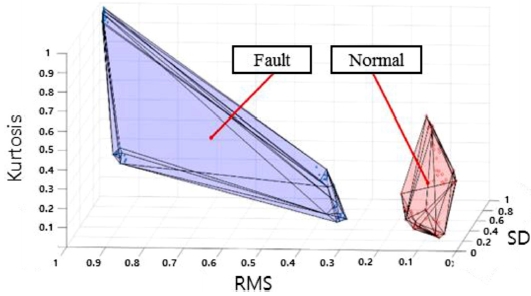
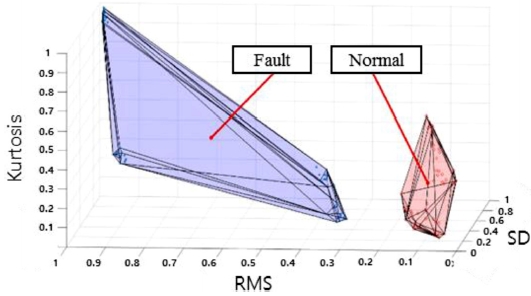
Fig. 7에서 제작한 분류기에 사용된 대표적인 3가지 데이터인 RMS, 표준편차, 첨도를 3차원공간 상에 표현하여 간략하게 데이터가 어떻게 분포되어 있는지 확인할 수 있다.
Table 5 Classification result (K = 1)
Table 5
|
Input |
Data |
250 rpm |
300 rpm |
|
Training data |
Normal : 50 |
53 |
46 |
|
Fault : 50 |
47 |
54 |
|
Normal data |
Normal : 50 |
47 |
42 |
|
Fault : 0 |
3 |
8 |
|
Fault data |
Normal : 0 |
4 |
9 |
|
Fault : 50 |
46 |
41 |
Table 6 Classification result (K = 5)
Table 6
|
Input |
Data |
250 rpm |
300 rpm |
|
Training data |
Normal : 50 |
52 |
47 |
|
Fault : 50 |
48 |
53 |
|
Normal data |
Normal : 50 |
48 |
42 |
|
Fault : 0 |
2 |
8 |
|
Fault data |
Normal : 0 |
5 |
10 |
|
Fault : 50 |
45 |
40 |
Table 7 Classification result (K = 10)
Table 7
|
Input |
Data |
250 rpm |
300 rpm |
|
Training data |
Normal : 50 |
57 |
53 |
|
Fault : 50 |
43 |
47 |
|
Normal data |
Normal : 50 |
41 |
39 |
|
Fault : 0 |
9 |
11 |
|
Fault data |
Normal : 0 |
5 |
10 |
|
Fault : 50 |
45 |
40 |
Fig. 7 Classified data distribution
제작된 분류기에 실제 고장 데이터인 테스트 데이터를 입력하여 분류를 수행하여 성능을 확인한 데이터를
Table 8에 표기하였다. 분류기에 입력한 테스트 데이터는 정상 데이터 50개와 고장데이터 50개를 입력하였다. 분류기의 성능을 높이기 위하여 트레이닝 데이터와 테스트 데이터를 0에서 1 사이의 값으로 정규화(Normalize)하여 분류기에 입력하였다.
Table 9에서 정규화된 데이터로 분류를 수행하였을 때 모든 데이터를 정확하게 분류하는 것을 확인할 수 있었다.
Table 10에서 각 케이스별 분류율을 확인할 수 있다. 분류된 데이터는 종이용기 성형기 가동 중에도 실시간으로 캠의 마모가 발생하였는지 파악할 수 있는 자료가 되며, 성형기의 가동을 중단하지 않아도 주기적으로 얻은 데이터를 통해 점검이 가능하므로 캠의 마모로 인한 고장을 사전에 예방할 수 있다. 또한 장비 중단 시간을 줄일 수 있고 고장을 미리 파악함으로써 성형기를 정비하는 시간과 비용을 절약할 수 있게 된다.
Table 8 Classification result (K = 5)
Table 8
|
Input |
Data |
250 rpm |
300 rpm |
|
Training data |
Normal : 50 |
52 |
47 |
|
Fault : 50 |
48 |
53 |
|
Normal data |
Normal : 50 |
45 |
42 |
|
Fault : 0 |
5 |
8 |
|
Fault data |
Normal : 0 |
2 |
10 |
|
Fault : 50 |
48 |
40 |
Table 9 Classification result by Normalize (K = 5)
Table 9
|
Input |
Data |
250 rpm |
300 rpm |
|
Training data |
Normal : 50 |
50 |
50 |
|
Fault : 50 |
50 |
50 |
|
Normal data |
Normal : 50 |
50 |
50 |
|
Fault : 0 |
0 |
0 |
|
Fault data |
Normal : 0 |
0 |
0 |
|
Fault : 50 |
50 |
50 |
Table 10 Classification rate (K= 5)
Table 10
|
Input |
Data |
250 rpm (%) |
300 rpm (%) |
|
Normal data |
Normal : 50 |
100 |
100 |
|
Fault : 0 |
100 |
100 |
|
Fault data |
Normal : 0 |
100 |
100 |
|
Fault : 50 |
100 |
100 |
6. 결론
본 논문에서는 종이용기 성형기 캠 구동부의 진동 신호를 통해 정상 및 고장 여부를 진단하기 위하여 머신러닝 방법 중 하나인 K-NN 분류기를 사용하여 정상 및 고장 데이터를 분류하는 알고리즘이 개발되었다. 사용한 소프트웨어는 MATLAB이며, CompactDAQ 모듈을 이용하여 가속도계 센서로부터 진동 데이터를 수집하였다. 수집된 진동 신호의 일부는 분류기의 학습 데이터로 사용되어 정상과 고장 상태 분류를 위한 결정경계를 설정하며, 나머지 데이터들은 학습된 결정경계에 따라 정상과 고장 상태로 분류할 테스트 데이터로 사용된다. 진동 신호의 분포 특성을 통해 분류된 테스트 데이터를 이용하여 고장 여부를 파악할 수 있었으며 분류기의 K값을 변화시킴으로써 보다 정확하고 오분류율이 낮아진 분류 성능을 확인하였다.
ACKNOWLEDGMENTS
본 연구는 2015년도 산업통상자원부(산업기술혁신사업)에서 지원한 다품종 포장 종이용기 생산을 위한 스마트 자동화 시스템개발(No. 10060265) 사업을 통해 수행 되었습니다.
REFERENCES
- 1.
Lee, T. H., “A Study on Diagnosis and Prognosis for Machining Center Main Spindle Unit,” Journal of the Korean Society of Manufacturing Process Engineers, Vol. 15, No. 4, pp. 134-140, 2016.
10.14775/ksmpe.2016.15.4.134
- 2.
Shin, J. and Lee, T. Y., “A Study on the Diagnosis of the Centrifugal Pump by the Intelligent Diagnostic Method,” Transactions of the Korean Society of Machine Tool Engineers, Vol. 12, No. 4, pp. 29-35, 2003.
- 3.
Jang, J., Ha, C., Chu, B., and Park, J., “Development of Fault Diagnosis Technology based on Spectrum Analysis of Acceleration Signal for Paper Cup Forming Machine,” Journal of the Korean Society of Manufacturing Process Engineers, Vol. 15, No. 6, pp. 1-8, 2016.
10.14775/ksmpe.2016.15.6.001
- 4.
Kim, T., Jeon, Y., and Lee, M. G., “A Study on Failure Diagnosis System for a Hydraulic Pump in Injection Molding Machinery Using Vibration Analysis,” Journal of the Korean Society of Manufacturing Technology Engineers, Vol. 22, No. 3, pp. 343-348, 2013.
10.7735/ksmte.2013.22.3.343
- 5.
Kim, C. G., Hong, S. H., Kee, S. K., and Kee, C. D., “Development of Rotating Machine Vibration Condition Monitoring System based upon Windows NT,” Journal of the Korean Society for Precision Engineering, Vol. 17, No. 7, pp. 98-105, 2000.
- 6.
Hur, H. M., Park, J. H., and You, W. H., “Analysis on the Vibration Characteristics of High Speed Train according to Track Structure,” Journal of the Korean Society for Precision Engineering, Vol. 29, No. 6, pp. 593-599, 2012.
10.7736/KSPE.2012.29.6.593
- 7.
Lee, D. H., Lee, W. Y., and Moon, K. H., “Characteristics of Vibration Condition Indicator with Gear Tooth Damage,” Journal of the Korean Society for Precision Engineering, Vol. 32, No. 7, pp. 611-617, 2015.
10.7736/KSPE.2015.32.7.611
- 8.
Kim, C. H., Choi, S. H., Joo, W. J., and Kim, G. B., “Classification of Surface Defect on Steel Strip by KNN Classifier,” Journal of the Korean Society for Precision Engineering, Vol. 23, No. 8, pp. 80-88, 2006.
Biography
- Seolha Kim
M.S. candidate in the Department of Mechanical System Engineering, Kumoh National Institute of Technology. Her research interest is robotics.
- Jaeho Jang
He received the M.S. degrees in mechanical system engineering from the Kumoh National Institute of Technology. He is currently researching and developing a paper cup forming machine at Hyunjin Co., Ltd.
- Baeksuk Chu
Associate Professor in the Department of Mechanical System Engineering, Kumoh National Institute of Technology. His research interest includes robotics, mechatronics, intelligent control and reinforcement learning.
Citations
Citations to this article as recorded by

- A Study on 3D Printing Conditions Prediction Model of Bone Plates Using Machine Learning
Song Yeon Lee, Yong Jeong Huh
Journal of the Korean Society for Precision Engineering.2022; 39(4): 291. CrossRef