ABSTRACT
The purpose of this study was to suggest the method for automated locomotion modes (Level Walking, Stair Ascent, Stair Descent) detection based on the Radial Basis Function Support Vector Machine (RBF-SVM) for the hip gait assist robot. The universal hip gait assist robot had a limit in detection of the walking intention of users because of the limited sensors’ quantity. Through the offline training, using MATLAB, we trained the collected gait data of users wearing the hip gait assist robot and obtained the parameter of the RBF-SVM model. In the online test, using LabVIEW, we developed the algorithm for the locomotion modes decision of individuals using the optimized parameter of the RBF-SVM. Finally, we executed the gait test for three terrains through the walking environment’s test platform. As a result, the locomotion modes decision rate for three terrains was 98.5%, 99%, and 98% respectively. And the decision delay time of algorithm was 0.03 s, 0.03 s, and 0.06 s respectively.
-
KEYWORDS: Locomotion modes, Hip gait assist robot, Radial basis function support vector machine
-
KEYWORDS: 보행 모드, 고관절 보행 보조 로봇, 방사형 기저 함수 서포트 벡터 머신
1. Introduction
고령화 사회에 진입함에 따라 고령 인구의 생활 개선 및 재활 훈련을 위해 휴머노이드 로봇, 청소 로봇, 외골격 로봇, 의족등 다양한 로봇이 개발되고 있다. 그 중 고관절 외골격 로봇은 사람에게 장착시켜서 구동하는 로봇으로 고령자의 일상생활을 개선해주는 데에 쉽게 도움을 줄 수 있는 로봇이다. 상용화된 고관절 보행 보조 외골격 로봇으로는 Honda사의 Walking Assist Device가 있으며,
1 해당 로봇은 평지에서 보행을 할 때 보행자의 보행 동작을 고려하여 보행 시 허벅지의 근력을 보조해준다. 아직까지는 다양한 환경(계단 오르막, 계단 내리막 등)에 사용하게 될 경우, 지형 판단 알고리즘의 오류가 발생할 수 있어 낙상 등 사고로 번질 위험이 크기 때문에 이러한 환경에 사용하는데 제약이 되고 있다.
이러한 로봇을 가지고 다양한 지형에서 사용하기 위해서는 안전성을 보장해줘야 하며, 보행 지형 판단 알고리즘의 판단 정확도가 높아야 한다. 최근에는 센서류(엔코더, 가속도계, 자이로스코프, Force Sensing Resistor (FSR), Electromyography (EMG)등)를 활용한 Threshold 기법이나 인공지능 기법 알고리즘을 개발하는 방식으로 나뉘어져서 연구개발이 이루어지고 있다.
센서 데이터를 활용하여 Threshold 기법에 따라 보행 환경을 판단하는 대표적인 연구 사례는 다음과 같다. University of Illinois에서 개발한 Ankle-Foot Orthosis는 발목 부근에 IMU 센서를 장착하여 세 지형(LW, SA, SD)의 O-ptimized Threshold에 따라 보행 환경을 판단한다.
2 Prosthetic Legs를 개발하는 분야에서는 Residual Thigh에 EMG 센서를 장착하고, Ground Reaction Force/Moment를 측정하여 LW, SA, SD, Sit, Stand에 대한 의도 파악시스템을 개발하였으며,
3 IMU 센서 및 인솔 센서를 통해 Heuristic Threshold Rules를 활용하여 Walking Stride의 4가지 구간을 판단하는 알고리즘을 구축하였다.
4 SAMSUNG에서 개발한 고관절 보행 보조 외골격 로봇은 IMU 센서가 등판에 장착되어 있으며, Threshold Rule을 통한 Foot Contact Estimation 활용 및 고관절의 각도를 측정하여 퍼지 추론 시스템을 사용하여 세 지형에 대해 판단하였다.
5 인공지능 기법을 활용한 대표적인 연구 사례는 University of Padova에서 재활 로봇에 SVM 머신러닝 기법과 EMG 데이터를 활용하여 보행 모드를 분류하였다.
6 보행 외골격 로봇인 Assistive Device for Paraplegics (AIDER) 시스템에서는 ZMP와 IMU 센서를 활용하여 SVM 기법을 통해 보행 환경 판단 알고리즘을 구축하였다.
7
본 논문에서는 고관절 보행 보조 외골격 로봇 플랫폼에 풀바디 형태의 외골격 로봇 플랫폼보다 적은 수의 센서(모터의 홀센서, IMU 센서)를 가지고 RBF-SVM 머신 러닝 기법을 활용하여 세 지형(평지, 계단 오르막, 계단 내리막)에 대한 판단 알고리즘을 개발하고자 한다.
논문의 구성은 다음과 같다: 2장에서는 각 지형에 대한 보행 개념 및 SVM의 이론을 설명, 3장에서는 고관절 보행 보조 외골격 로봇에 대한 설명, 4장에서는 RBF-SVM 트레이닝 관련 설명, 5장에서는 RBF-SVM을 활용하여 구축된 알고리즘 실험 및 결과 내용을 다루며, 마지막 6장에서는 실험 결과에 대한 토의와 Future Work를 다룬다.
2. Preliminaries
2.1 Gait Analysis
사람은 대표적인 지형인 평지, 계단 오르막 그리고 계단 내리막에서 보행을 할 때에
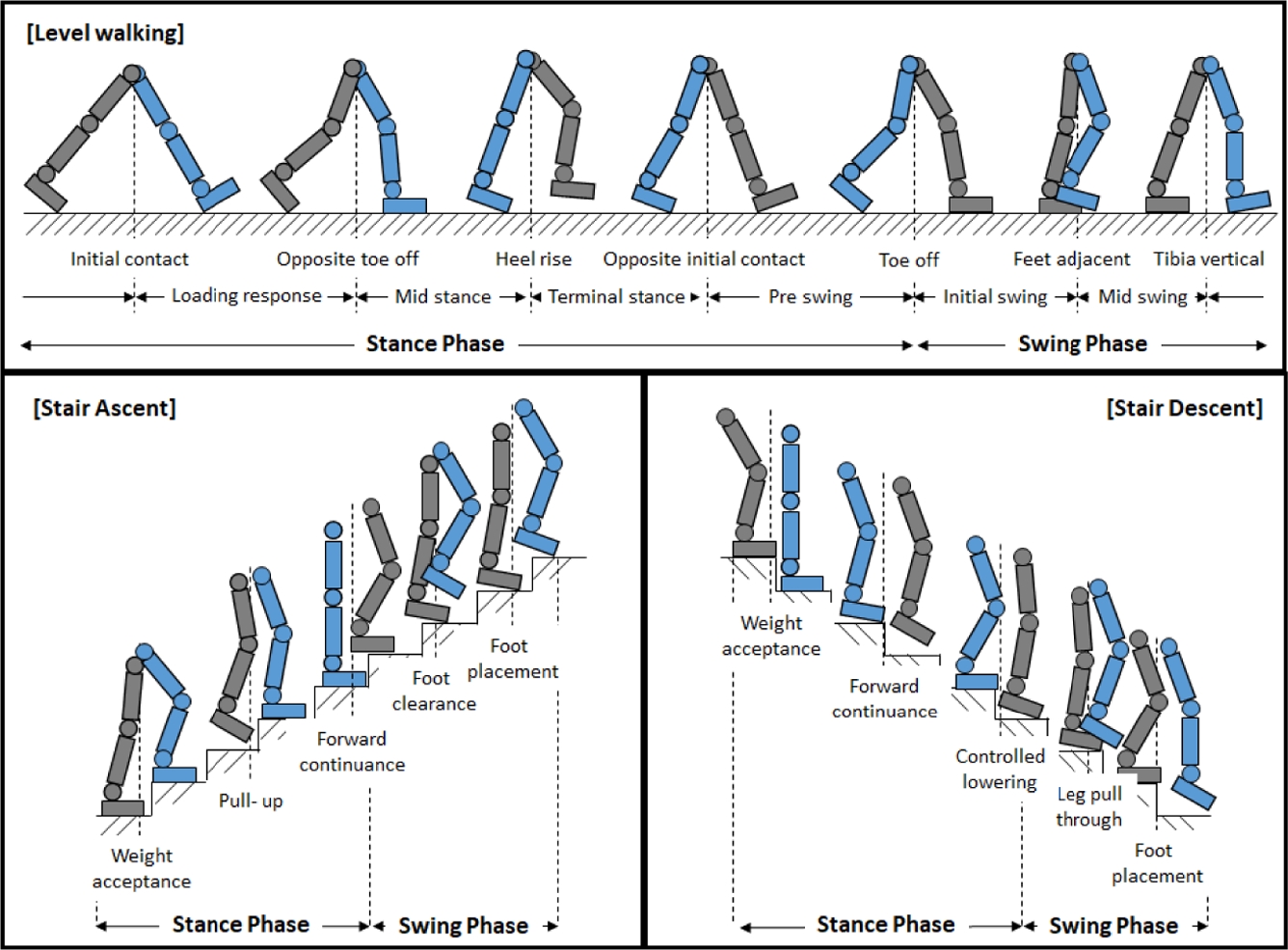
Fig. 1과 같이 보행 동작을 구분 지어 보행을 한다. 평지에서는 총 7단계의 Gait Cycle로 나뉘어져 있으며, 한쪽 다리가 지면에서 떨어져 있는지 아닌지에 따라 4단계인 Stance Phase (Loading Response, MID-Stance, Terminal Stance, Pre-Swing), 3단계인 Swing Phase (Initial Swing, Mid-Swing, Terminal-Swing)로 이루어져 있다.
8 이때 Loading Response에서 Initial Contact가 일어난다. 계단 오르막에서는 총 5단계로 3단계(Weight Acceptance, Pull-Up, Forward Continuance)인 Stance Phase, 2단계(Foot Clearance, Foot Placement)인 Swing Phase가 일어난다. 계단 내리막에서도 3단계(Weight Acceptance, Forward Continue, Controlled Lowering)인 Stance Phase, 2단계(Leg Pull Through, Foot Placement)인 Swing Phase로 이루어져 있다.
9 이처럼 계단 오르막 및 내리막에서는 Foot Placement 구간에 Initial Contact가 일어난다.
Fig. 1Gait cycle at level walking, stair ascent and stair descent
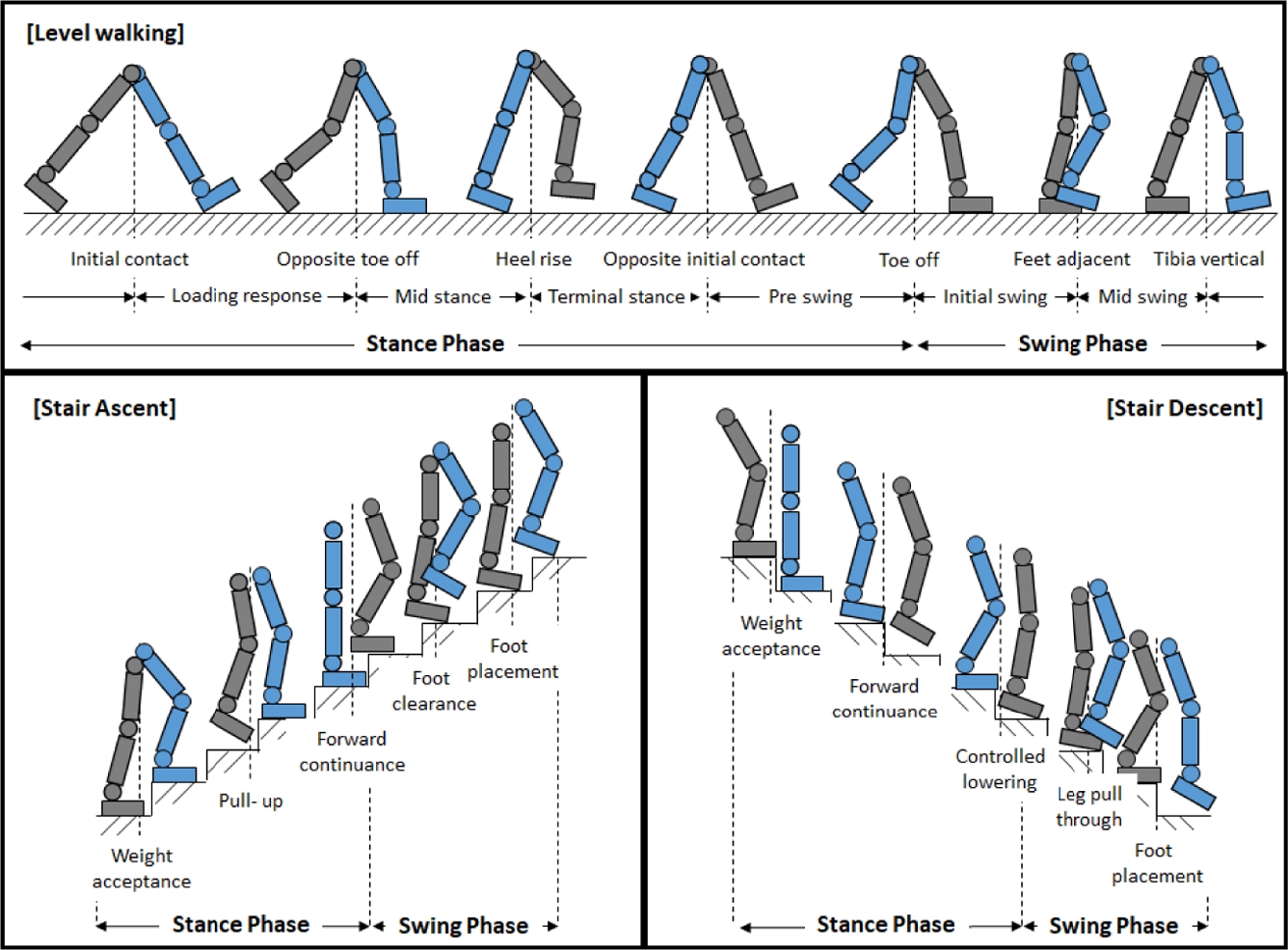
인체의 보행은 좌우의 다리를 대칭으로 움직이며, Stance, Swing Phase를 반복하면서 보행을 한다. 이때 보행의 시작점을 알리는 Initial Contact는 보행에 있어 중요한 지표로 활용된다.
10
SVM은 머신 러닝 기법 중 지도 학습에 해당되며 패턴을 분류하거나 회귀하는 기법으로 사용된다. 이 중 분류 기법으로 사용하기 위해서는 분류하고자 하는 Support Vectors의 거리 차가 최대가 되도록 Hyper-Plane을 구해야 한다.
11 Hyper-Plane으로 분류된 데이터는 +1/-1로 나누어지게 된다. 단순한 패턴을 가진 데이터는 주로 선형 분류 기법으로 분류될 수 있지만 데이터 수가 많아지게 되면, 패턴이 복잡해지게 되어 비선형적인 문제로 고려해야 된다. Radial Basis Function-Support Vector Machine(RBF-SVM) 기법은 매개변수 C와 Gamma를 조정하여 비선형적인 문제를 해결할 수 있게 된다. 따라서 본 연구에서는 비선형적인 요소에 특화된 기법을 고려해야하므로 RBF-SVM을 사용하고자 한다. RBF의 커널 함수는
식(1)과 같다.
xi, xj는 Input 데이터이며, σ는 양의 정수로 RBF 커널의 표준편차를 나타낸다.
3. Design of Hardware
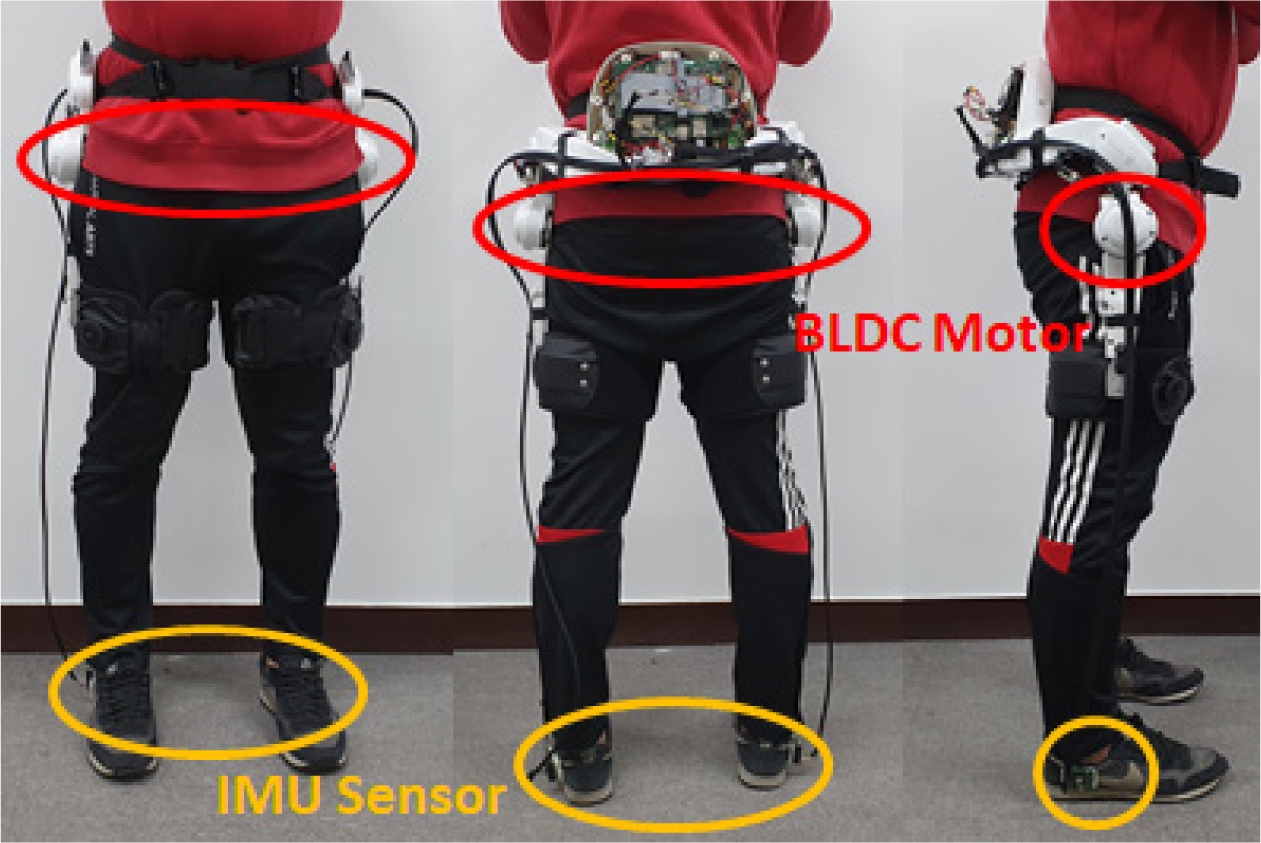
Hip Gait Assist Robot의 형태는
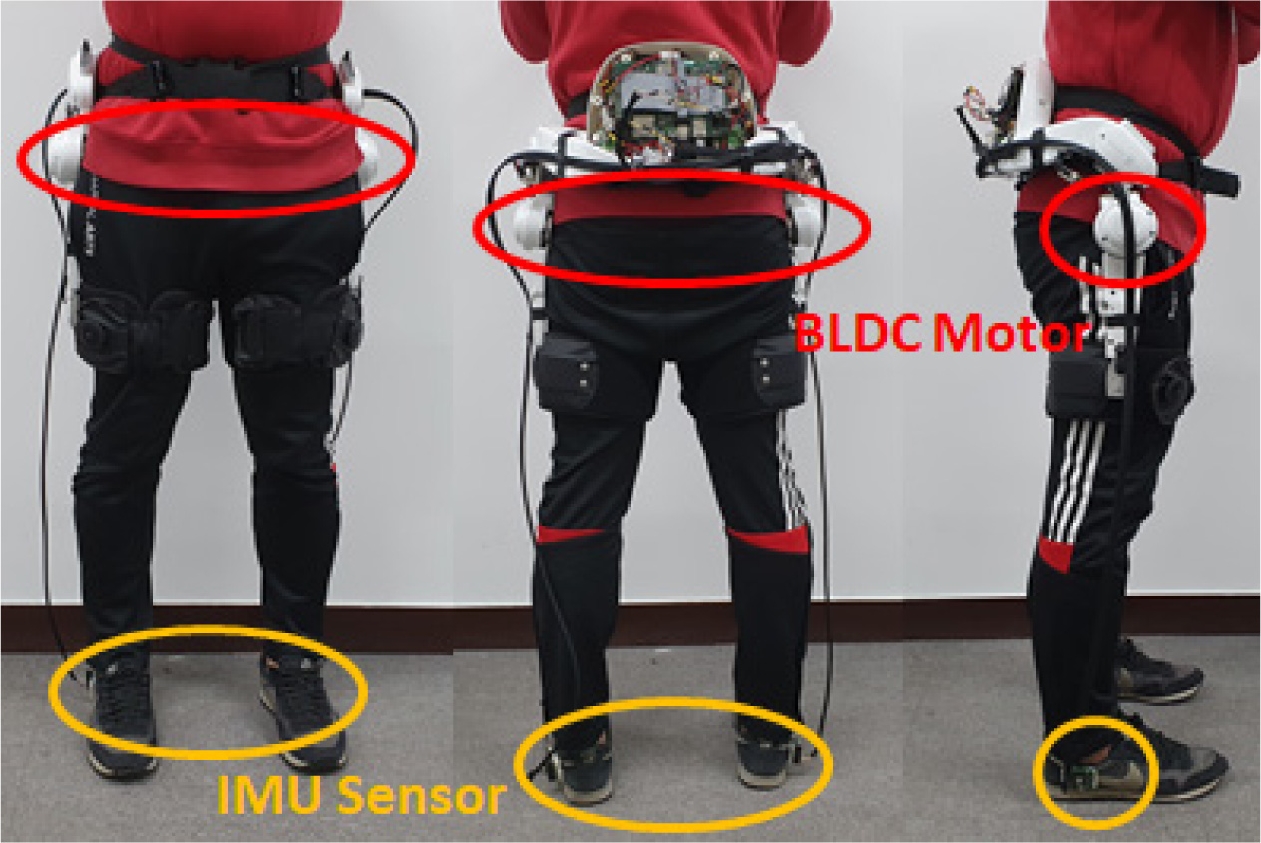
Fig. 2와 같으며, 양쪽 고관절에 2개의 60W BLDC 모터와 기어비가 100 : 1인 하모닉 기어를 장착하여 사람의 허벅지가 Flexion/Extension 방향으로 움직일 때마다 토크를 지원하여 보행을 보조해주는 형태이다. 사용자가 외골격 로봇을 입기 위해 허리 부근에 버클을 장착하였으며, 보행 시 허벅지가 움직일 때마다 로봇이 따라 움직일 수 있도록 로봇 링크에 Harness를 장착하였다. 고관절의 Active 자유도는 Sagittal Plane에서의 Flexion/Extension Motion인 1자유도이며, 보행 시 자연스러운 움직임을 만족시키기 위해 Frontal Plane에서 Abduction/Adduction Motion을 가능하게 해주는 Passive 자유도가 있다. 외골격 로봇의 고관절 Range of Motion (ROM)은 125/-50 Degree for Flexion/Extension이며, 5/-5 Degree for Abduction/Adduction이다. 모터의 홀 센서를 통해 고관절의 Flexion/Extension 각도를 측정하였으며, IMU 센서는 Initial Contact 시 발목의 각도 정보를 손쉽게 획득하기 위해 발목의 복숭아뼈 밑부분에 부착하여 족관절의 Dorsiflexion/Plantarflexion 각도를 측정하였다. IMU 센서의 Sampling Rate는 100 Hz이다. 모터의 Rated Torque는 16.4 Nm이며, 배터리의 가동 시간은 최대 2시간, 로봇의 무게는 배터리 무게를 포함하여 3.5 kg이다.
Fig. 2 The hip gait assist robot
4. SVM Training and Test Algorithm
SVM Training 및 Test Algorithm은
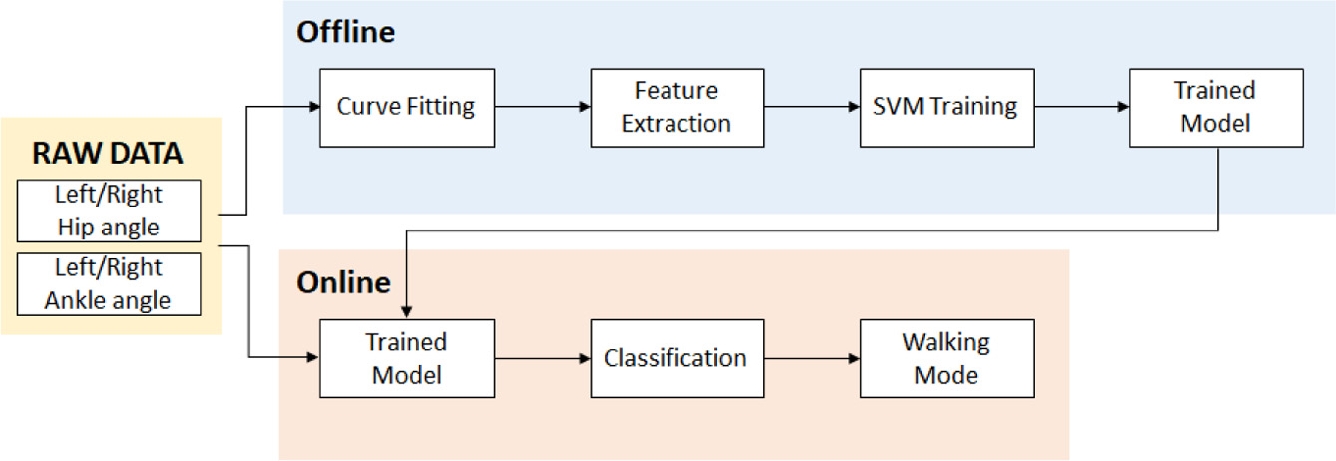
Fig. 3과 같다. Offline Training에서는 MATLAB을 이용하였고, Online Test에서는 LabVIEW를 통해 알고리즘으로 구현하였다. SVM 알고리즘은 데이터의 양이 많을수록 분류하고자 하는 판단율이 증가하게 된다. 하지만 사용하고자 하는 데이터의 수가 증가할수록 Real Time단의 연산 처리 속도가 느려지게 되기 때문에 실시간으로 데이터를 축적하면서 사용하는데 제한이 된다. 이러한 문제를 해결하기 위해 Offline Training 과정을 다음과 같이 진행하였다.
Fig. 3 Offline training and online test algorithm
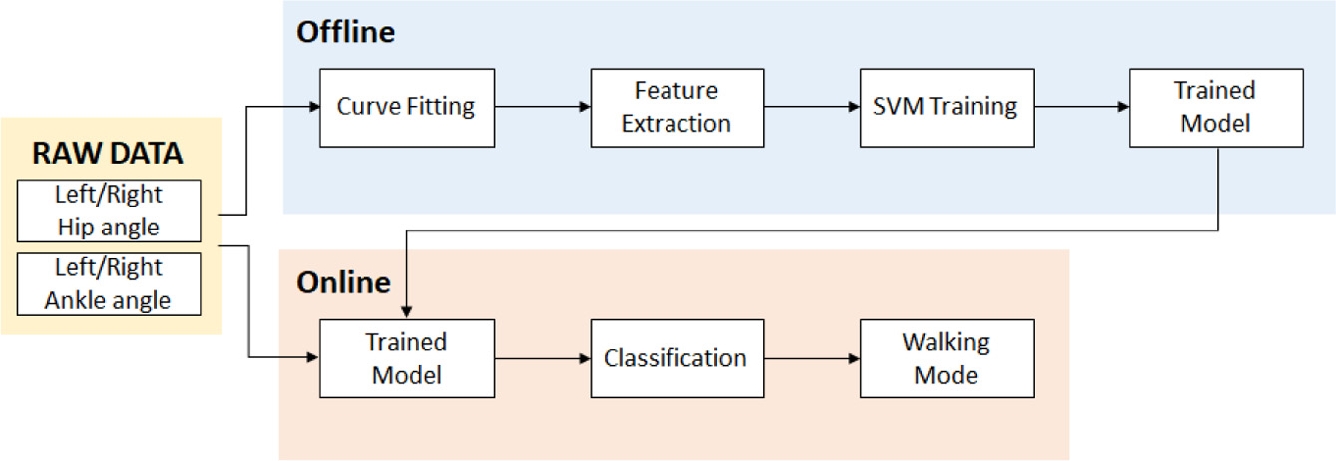
(1) 세 지형에 대한 오른쪽/왼쪽 고관절 및 족관절의 각도 데이터를 수집한 뒤 커브 피팅을 진행하였다.
(2) 수집된 데이터를 분류하고자 Feature Extraction을 통해 SVM 기법의 X1 및 X2축 값을 설정하였다. X1은 각 지형에 대한 Initial Contact 지점에 대한 족관절 각도이며, X2는 Initial Contact 지점 시 양쪽 고관절의 각도 차를 나타낸다.
(3) X1, X2의 각도 데이터를 통해 SVM Training을 진행하였다. 그 뒤, 최적화된 모델의 파라미터를 도출하였다.
Online Test에서는 최적화된 모델의 파라미터를 활용하여 알고리즘을 개발하였으며, RAW 데이터가 실시간으로 들어오게 되면 SVM 기법의 Class에 따라 데이터를 분류하여 3가지 지형에 대해 보행 모드를 판단한다.
4.1 Data Collection and Analysis
사람마다 다리길이, 보폭, 보행 속도 등 보행과 관련된 파라미터가 다양하다. 기존 보행 분석 분야에서는 각 관절의 각도나 속도 등을 측정하여 사람의 보행을 분석하였다.
12
본 논문에서는 성인 남자 한 사람을 대상으로 하여 세 지형에 대해 Hip Gait Assist Robot을 착용한 상태에서 각각 222, 312, 312 걸음걸이를 하였으며, Sagittal Plane상에서의 오른쪽/왼쪽 고관절 및 족관절 각도를 수집하였다. 수집된 데이터의 Sampling Rate는 100 Hz이며, 해당 정보는 다음
식(2)와 같이 명시하였다.
θRH, θLH, θRA, θLA는 각각 오른쪽, 왼쪽 고관절, 오른쪽, 왼쪽 족관절의 각도를 나타낸다.
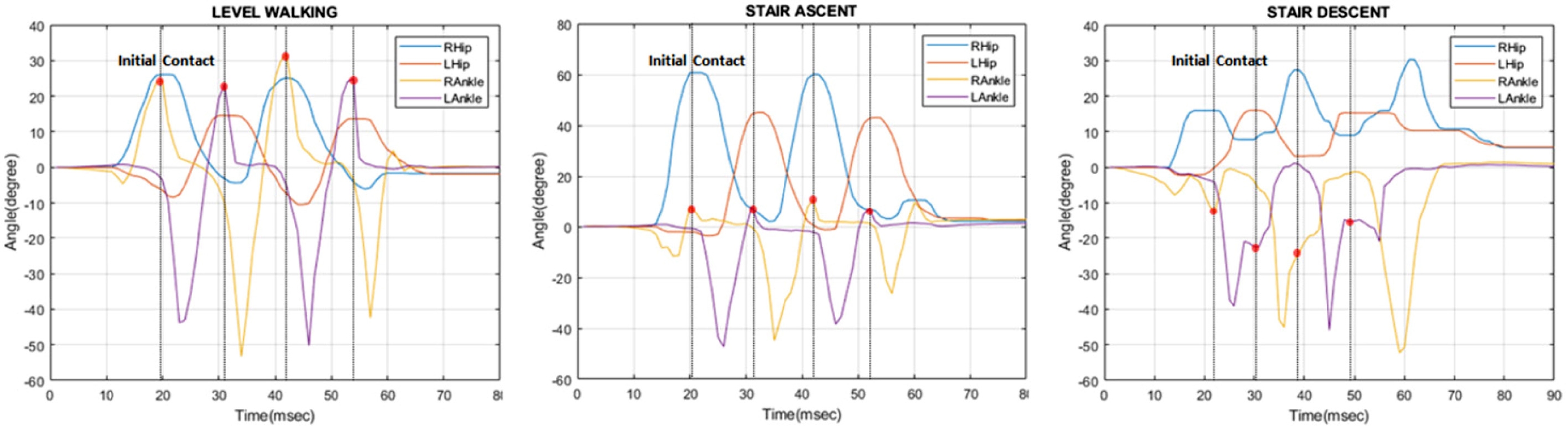
Fig. 4는 각 지형에 대한 보행의 대표적인 그림이며, 오른쪽 고관절 각도와 왼쪽 고관절 각도가 어느 정도 대칭적인 움직임을 나타내지만 각도 차가 발생하는 것을 볼 수 있다. 이러한 특징은 사람마다 다르게 나타나는 특징이라고 보며, 외골격 로봇의 보행 알고리즘을 다루는 데에 중요한 인자라고 본다. 또한 보행 시 발을 앞으로 내딛는 다리를 주된 다리라고 명칭하였으며, 주된 다리의 고관절 각도가 최댓값을 가질 경우, 보행 시작점인 Initial Contact 지점이라고 가정하였다.
Fig. 4Example of the collected right hip, left hip, right ankle and left ankle data when wearing the hip gait assist robot on different terrains (Left: level walking, mid: stair ascent, right: stair descent)
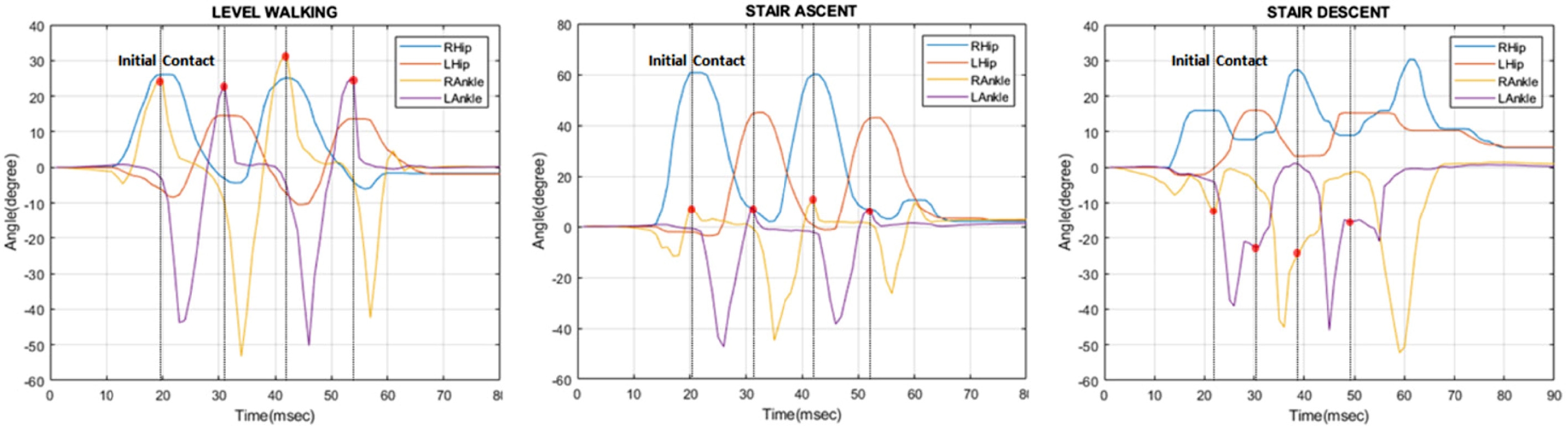
각 지형의 보행 데이터를 분석한 결과, 평지 및 계단 오르막에서는 Initial Contact 지점에 발뒤꿈치 부분부터 땅에 닿기 때문에 주된 다리의 고관절 각도는 최댓값을 가지며, 이 시점에서의 족관절 각도는 Dorsiflexion에서 Plantarflexion으로 바뀌는 지점인 극댓값을 나타낸다. 반면에 계단 내리막에서는 Initial Contact 지점에서 발 끝부분이 먼저 땅에 닿기 때문에 Plantarflexion 각도를 나타낸다. 다음과 같은 특징을 활용하여, Curve Fitting과 Feature Extraction을 진행하였다.
4.2 Curve Fitting and Feature Extraction
각 센서를 통해 수집된 고관절 및 족관절의 각도 데이터는 시계열에 따른 RAW 데이터로, 비슷한 시간대에서 중복된 각도 데이터를 나타내며, 노이즈 또한 발생되기 때문에 불필요한 데이터가 많아지게 된다. SVM의 주요 인자를 선별하기 위해서는 이러한 불필요한 데이터를 줄일 필요가 있다. 수집된 각도 데이터는 데이터의 양이 많기 때문에 실시간으로 데이터를 처리하게 되면 하드웨어의 성능이 느려지게 되는 문제점이 발생한다. 이러한 문제점을 해결하고자 MATLAB을 통해 Offline 훈련을 진행하였으며, 불필요한 데이터의 수를 줄이고자 커브 피팅을 사용하였다. 사용한 커브 피팅 함수는 3차 보간법인 Pchip 방법이며, 이를 통해 평지, 계단 오르막, 계단 내리막에 대해 각각 2382, 8107, 7853개에 대한 데이터를 확보하였다. 해당 데이터는 지형에 따라 반복적으로 실험하여 수집된 각도를 배열로 정리한 값이다.
각 지형에 대한 4개의 변수, 즉 양쪽 고관절 및 족관절 각도를 이용하여 SVM의 주축인 X1, X2를 설정하였다. X1은 보행 시 내딛는 다리를 기준으로 Initial Contact 지점을 나타내며, 다음
식(3)과 같이 설정하였다.
X2는 Initial Contact 지점에서의 양쪽 고관절의 각도 차를 나타낸다.
Feature Extraction을 통해 도출된 배열 값 X를 RBF-SVM Training에 사용하였다.
4.3 RBF-SVM Training
SVM의 Binary Classification는 Multi-Class Classification으로 연장될 수 있으며,
13 Multi-Class Classification보다 최대 Margin을 계산하는데 있어 용이하여 Class를 분류하는데 유리하다. 이러한 장점을 활용하고자 본 논문에서는 SVM의 Binary Classification을 이용하였다.
식(5)를 토대로 평지 vs. 계단 오르막, 계단 오르막 vs. 계단 내리막, 평지 vs. 계단내리막에 대해 각각 503, 688, 629개의 데이터를 사용하여 SVM Training을 하였다.
SVM 기법을 활용하여 훈련하기 위해서는 Decision Boundary-Condition을 구해야 한다. 이때 라그랑지 함수를 이용하여 Support Vector와 Hyper-Plane의 최대 거리를 구하기 위한 최적화 문제를 다루게 된다. 주어진 훈련 데이터는 (xi, ti), i = 1,...,N이며, 데이터 xi는 비선형성을 나타내므로 비선형 매핑 함수 ϕ : xi → ϕ(xi)를 이용하여 Input Space에서 Feature Space로 변환하였다.
Subject to ti(<w, ϕ(xi)> + b) ≤ 1 - ξi, ξi ≥ 0, i = 1,...,N
w와 b는 Hyperplane의 파라미터이다. <w, ϕ(xi)>는 내적을 나타내며, C는 상수이다. ξi는 Slack Variables이며, ti는 {-1, 1}로 구성된다.
위
식(6)은 Constrained Model로 Margin-Based Loss Function을 이용하여 Model을 다음
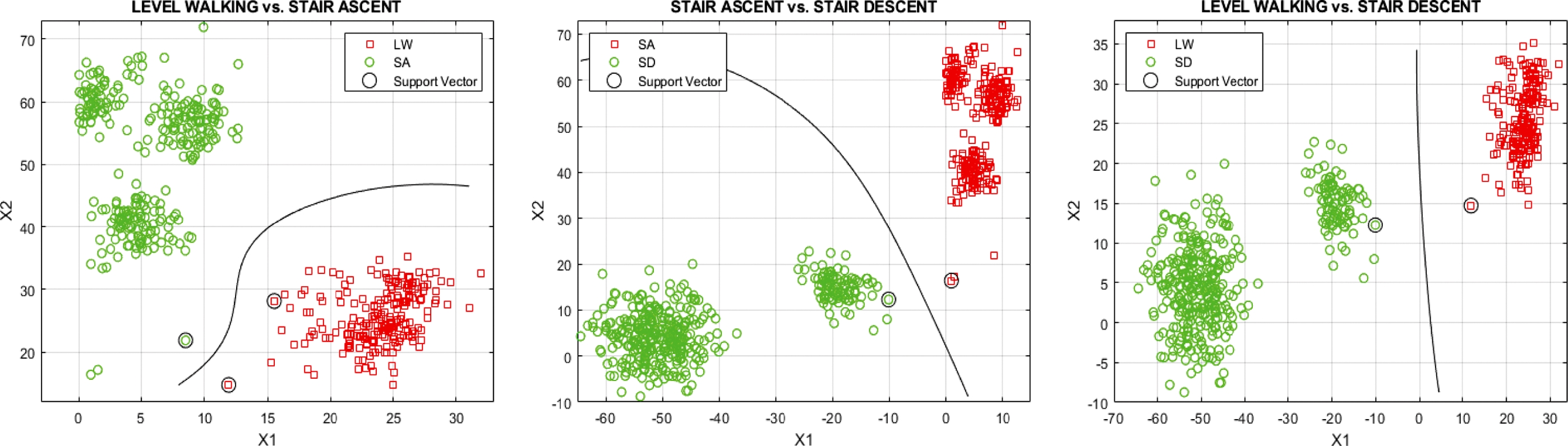
Fig. 5와 같이 표현할 수 있다.
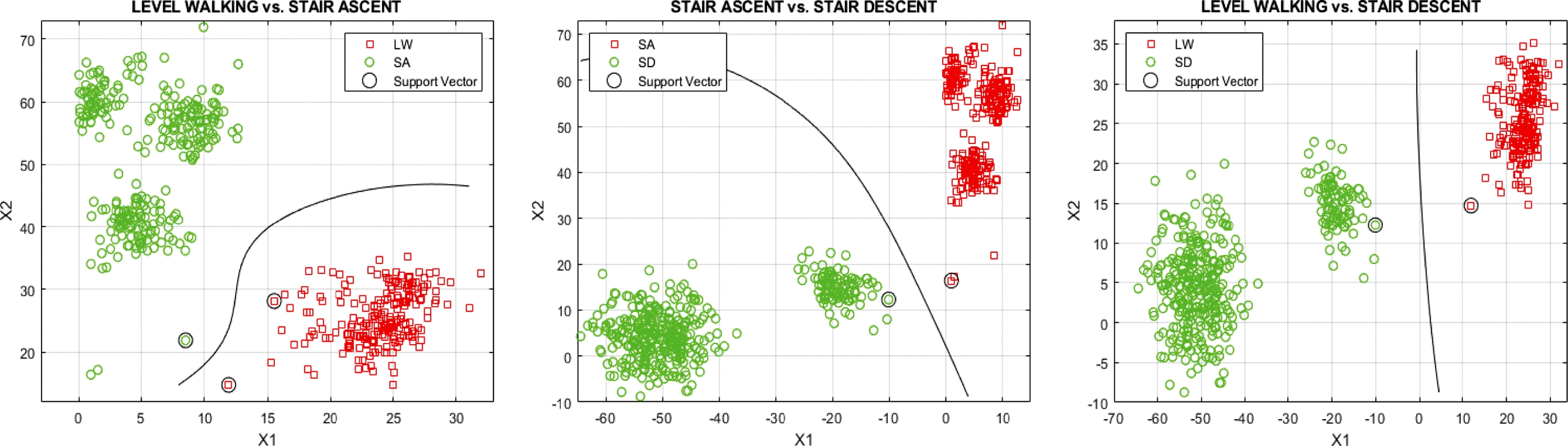
Fig. 5Binary classification plot by the radial basis function-support vector machine (RBF-SVM) (Left: level walking vs. stair ascent, mid: stair ascent vs. stair descent, right: level walking vs. stair descent)
Karush-Kuhn-Tucker (KKT)에 근거하여,
14 식(7)에 대한 SVM 트레이닝은 다음 Dual Optimization Problem으로 해결할 수 있다.
Subject to ∑j=1Ntiαi=0,0≤α≤C,i=1,…,N
식(8)은 커널 함수
K(
xi,
xj) =
ϕ(
xi) ·
ϕ(
xj)에
식(1)을 대입하여, 가우시안을 이용한 RBF-SVM으로 변환할 수 있다.
Subject to ∑j=1Ntiαi=0,0≤α≤C,i=1,…,N
αi는 라그랑지 승수이며, αi*를 Dual Optimization Problem의 최적화된 Support Vectors라고 정의하고자 한다. S는 Support Vector의 집합이다.
식(9)를 트레이닝한 결과, 최적화된 Hyper-Plane의 파라미터인
w*와 식은 다음
식(11)과 같다. 이때 최적화된 Hyper-Plane을
H*(
w*,
b*)라고 가정한다.
Fig. 5는 MATLAB을 통해 RBF-SVM 트레이닝을 한 결과이며, Kernel Scale (
σ2)과 박스 제약 조건에 따라 시뮬레이션에 나타나는 Hyper-Plane의 궤적과 Support Vector의 수가 달라지게 된다. 최적화된 Hyper-Plane, 즉 최대 거리를 나타내기 위하여 Kernel Scale (
σ2)을 각각 15.5996, 32.3599, 38.9448 그리고 박스 제약 조건을 100으로 설정하였다. 이때 RBF-SVM 트레이닝을 하는 과정에서 데이터 셋이 Overfitting 일어나지 않도록 교차 검증을 10으로 설정하여 트레이닝시켰다. 그 결과는
Table 1과 같다. 훈련한 결과, 세 지형(평지vs. 계단 오르막, 계단 오르막 vs. 계단 내리막, 평지 vs. 계단 내리막)에 대한 정확도는 각각 100, 99.9, 100%로 평균 99.66%의 정확도를 나타냈다. 실제 Hip Gait Assist Robot에 적용하고자 정확도가 높은 RBF-SVM의 파라미터
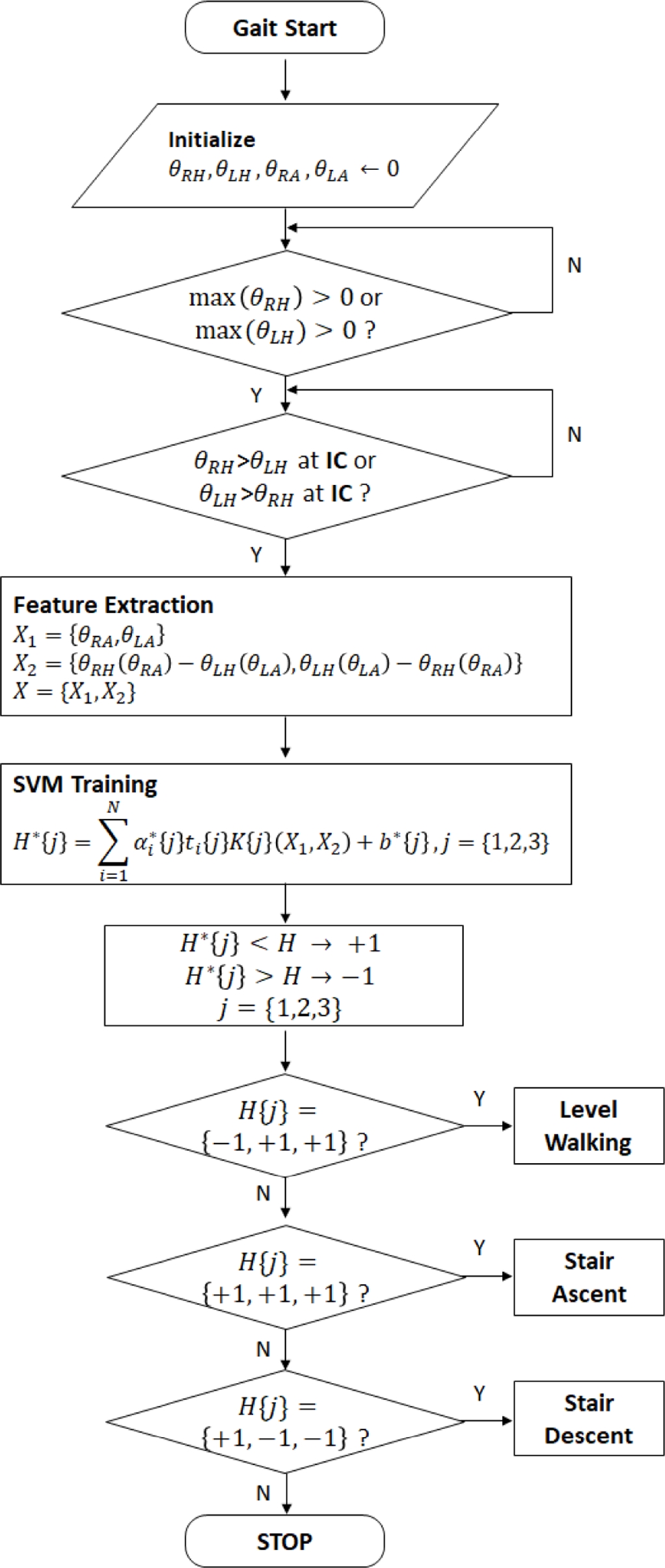
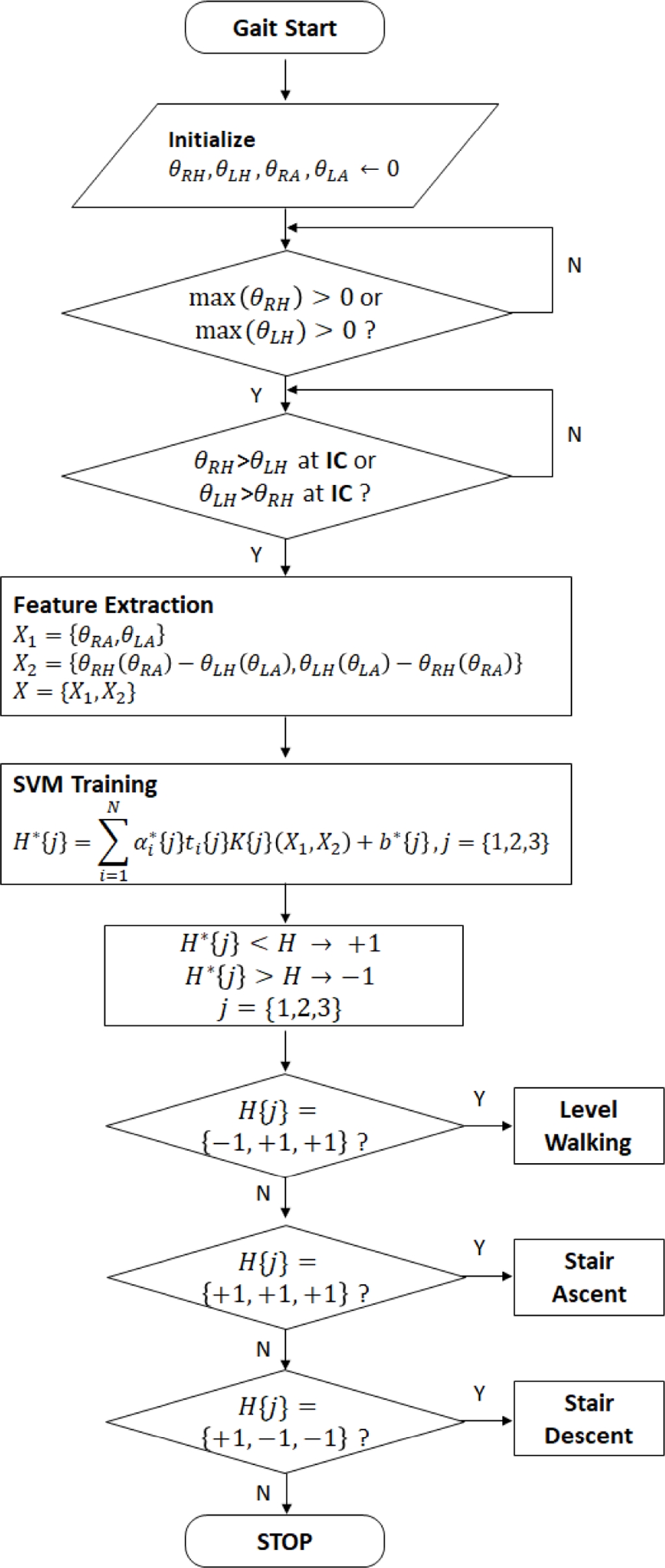
식(11)을 활용하여 LabVIEW 내 알고리즘으로 구축하였으며, 순서도는 다음과 같다. 외골격 로봇을 착용한 상태에서 고관절 및 족관절의 보행 데이터를 수집하여 Initial Contact 지점을 파악하며, SVM Training의 주요 인자를 선별하여 Binary Classification을 통해 SVM Training을 시킨다. 도출된 최적화된 파라미터(
w*,
b*,
σ*), 양쪽 고관절 및 족관절 데이터를 통해 Boundary Condition
H*{
j},
j = {1,2,3}을 계산하게 된다. 도출된 Boundary Condition은 각 지형의 Hyper-Plane과 비교하게 되며, Hyper-Plane을 기준으로 해당 값이 크면 +1, 작으면 -1로 판단된다. 즉, 평지일 경우에는 {-1,+1,+1}, 계단오르막에서는 {+1,+1,+1}, 계단내리막에서는 {+1,-1,-1} 로 구분하게 되며, 이를 통해 보행 환경을 판단한다(
Fig. 6).
Table 1Confusion matrix between estimation class and actual class
Table 1
|
Estimation class |
|
LW (%) |
SA (%) |
SD (%) |
Actual
class |
LW |
100 |
0.1 |
0 |
|
SA |
0 |
99.9 |
0 |
|
SD |
0 |
0 |
100 |
Fig. 6Algorithm flowchart for SVM in LabVIEW
5. Experiment
5.1 Protocol
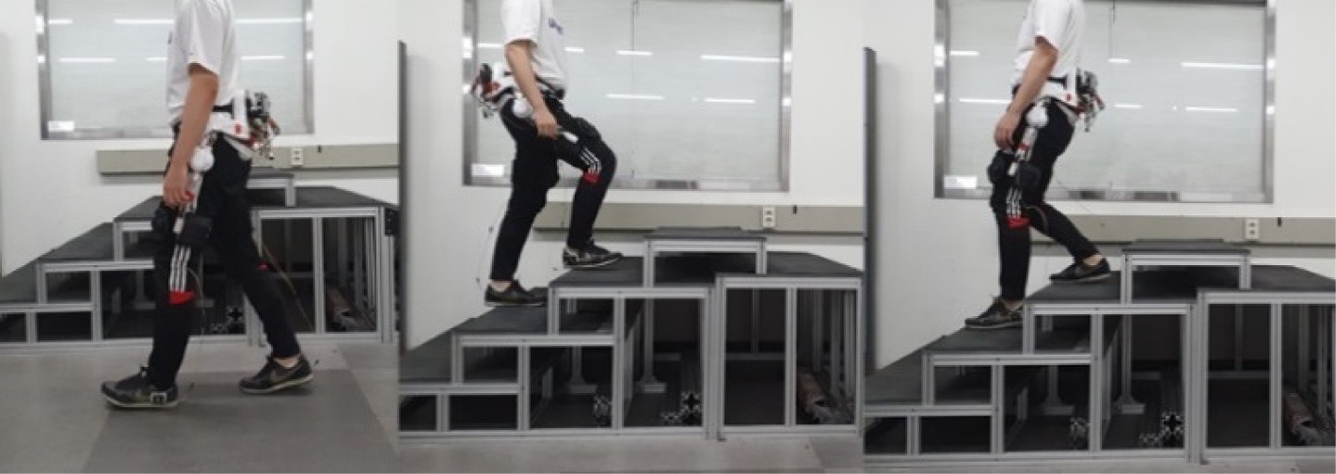
세 지형에 대한 보행 환경 판단 알고리즘을 증명하기 위해 성인 남자 한 사람을 대상으로 Hip Gait Assist Robot을 착용한 상태에서 실험을 진행하였다. 성인 남자에 대한 프로토콜은 나이 31세, 신장 1.73m, 몸무게 76 kg 이며, 세 지형에 대한 실험 환경은
Fig. 7과 같다. 계단의 총 너비는 0.158m, 총 높이 0.078m, 한 계단의 길이는 0.346 m인 보행 환경 플랫폼에서 보행 환경 판단 알고리즘을 평가하고자 하며, 실험의 원활한 진행을 위해 다음과 같은 실험 조건을 정의하였다.
Fig. 7Locomotion modes and walking test platform (Left: LW, mid: SA, right: SD)
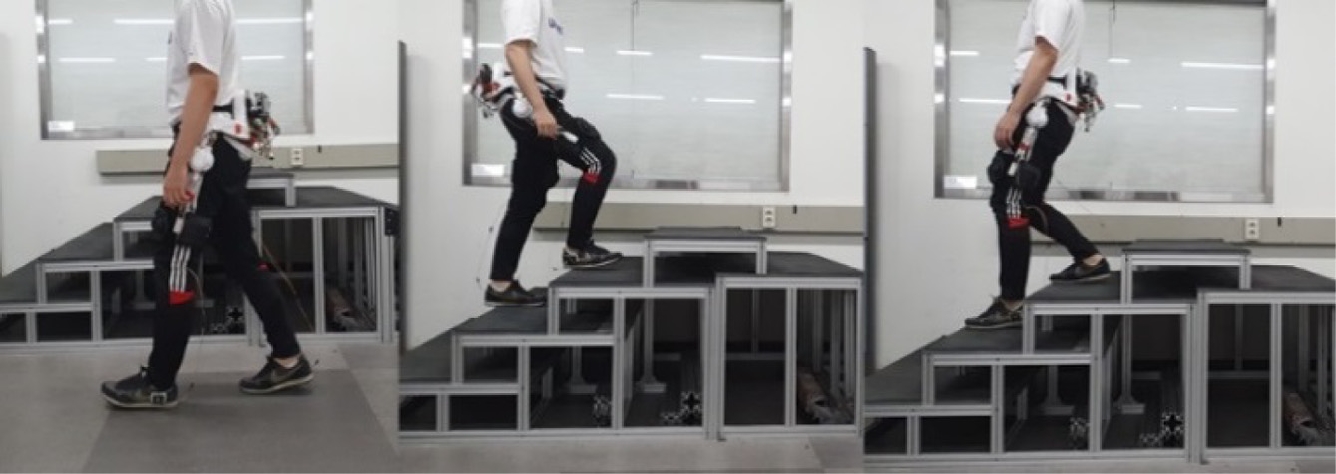
(1) Hip Gait Assist Robot을 착용한 상태에 두 다리는 바로 선 상태에서 보행을 시작한다. 평지에서 3걸음을 걷고 나서 4개의 계단을 오르며, 제자리를 돌아 4개의 계단을 내려간 뒤, 제자리에 선다(
Fig. 7).
(2) 제자리를 도는 과정에서 발생하는 각도는 멈춰있는 상태로 가정한다.
(3) 보행 시 주된 다리의 Initial Contact 지점이 바뀔 때마다 보행 모드가 달라지게 되는데, 이때 족관절의 복숭아뼈 부근에 IMU 센서를 부착한 상태에 따라 발생하는 노이즈 현상에 대해서는 무시한다.
이와 같은 환경에서 총 10번의 실험을 반복해서 진행하여 알고리즘의 정확도와 딜레이를 측정하고자 한다.
5.2 Performance Measure
Hip Gait Assist Robot에 적용된 보행 환경 판단 알고리즘을 통해 세 가지 지형에 대한 판단 정확도와 딜레이 시간 오차를 확인하고자 다음
식(12)와 같은 식을 통해 평가를 진행하였다.
식(12)는 보행 환경 판단 알고리즘의 정확도를 판단하는 식으로 전체 보행 데이터 수 대비 정확하게 보행 환경을 판단한 데이터 수로 계산된다. 이때 지형에 대해 정확하게 판단되었는지 확인하기 위하여 Hip Gait Assist Robot에 구축되어 있는 버튼을 이용하여 보행 환경이 바뀌는 구간 및 Initial Contact 지점을 파악하여 신호를 주었다. 이 신호를 기준으로 하여 알고리즘으로 보행 환경을 판단한 데이터와 얼마나 일치하는지 계산하였다.
식(13)을 통해서는 보행 환경 판단 알고리즘이 정확하게 판단해야 하는 시간과 뒤늦게 판단된 시간과의 오차를 통해 계산되는 식이다.
5.3 Result
앞서 5.1장인 실험 프로토콜을 통해 보행 환경 플랫폼을 구축하였으며, 연속된 보행을 하게 될 경우 Hip Gait Assist Robot에 구축되어있는 보행 환경 판단 알고리즘이 제대로 판단되는지 평가하고자 실험을 진행하였다.
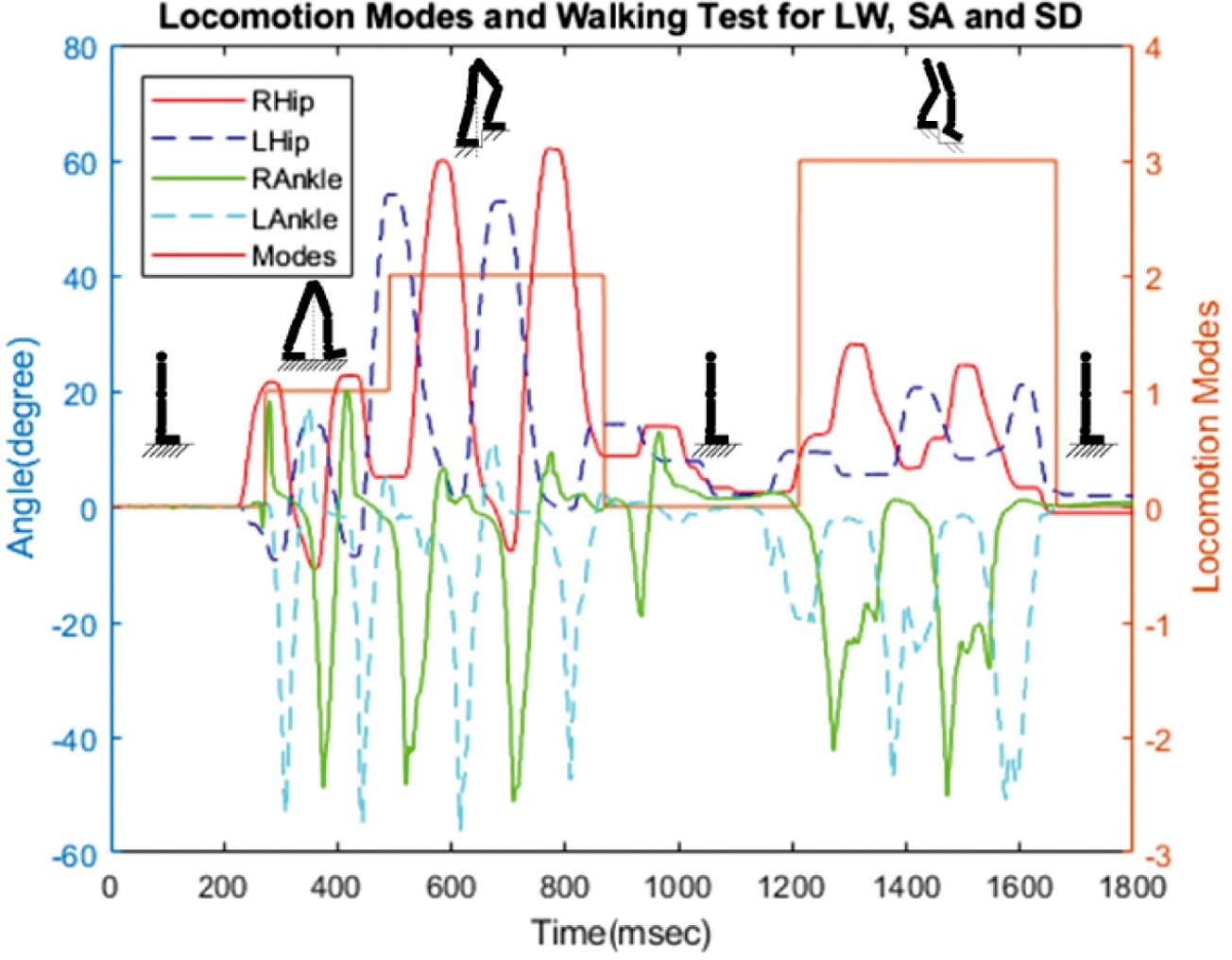
보행 환경 판단 알고리즘의 평가 결과는
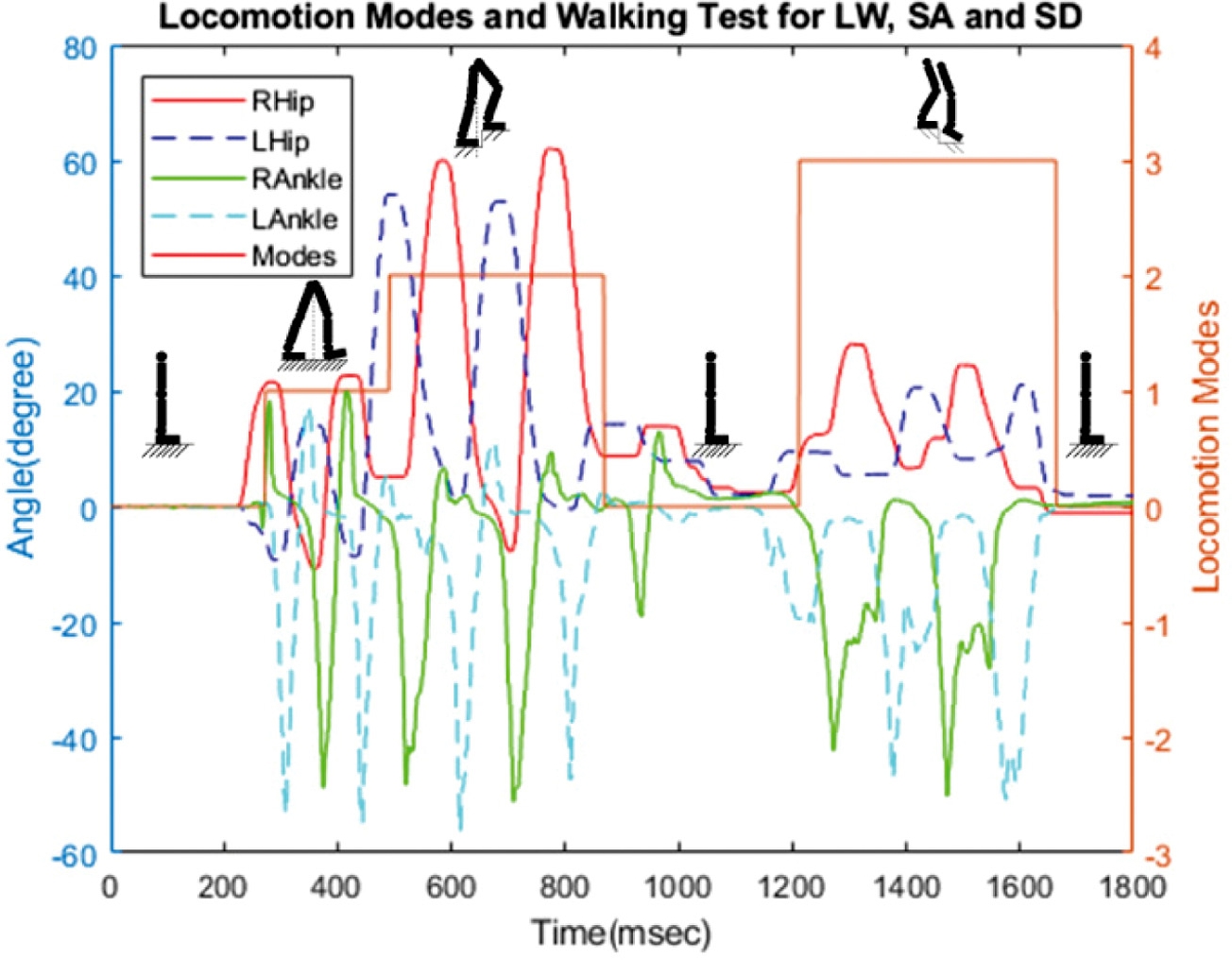
Fig. 8과 같다. 두 다리가 바로 선 상태(ST), 보행 모드로는 0으로 인식하였으며, ST에서 출발하여 주된 다리의 IC 지점, 고관절의 각도가 극댓값을 가지는 지점에서 평지 구간(LW), 보행 모드 1로 인식하였으며, 보폭 3걸음 후 계단 오르막 구간(SA)인 IC지점에서 보행 모드 2로 바뀌었으며, 4개의 계단을 오른 후 제자리를 돌았다. 이때 제자리 도는 구간에는 ST 상태, 보행모드 0으로 규정하였다. 계단 내리막 구간(SD), 보행모드 3으로 인식하면서 4개의 계단을 내려간 뒤 두 다리가 바로 선 상태에서 멈추었다. 각 지형에 대한 보행 판단 알고리즘의 정확도는 98.5, 99, 98%이며, 알고리즘의 딜레이 시간은 0.03, 0.03, 0.06 s을 나타냈다.
Fig. 8Locomotion modes and walking test data for LW, SA and SD (Locomotion modes: 0–ST/1–LW/2–SA/3–SD)
6. Discussion
본 연구에서는 일반인을 대상으로 하여 Hip Gait Assist Robot을 착용한 상태에서 세 지형의 판단 알고리즘을 연구하였다. 세 지형에 대한 보행을 동작 분석하여 RBF-SVM의 분류 기법에 활용하기 위해 주요 인자를 선별하였으며, 이를 가지고 훈련하여 최적화 모델의 파라미터를 도출하였다. 최적화된 모델의 파라미터를 통해 세 지형에 대한 보행 환경 판단 알고리즘을 구축하였고, 이를 가지고 보행 환경 플랫폼에 테스트하여 좋은 성능을 나타내는 것을 확인하였다.
본 연구를 통해 3가지 지형에 대한 판단 알고리즘의 정확도가 다소 높게 나오는 것을 확인할 수 있었으며, 이러한 이유는 앞의 5.1장에서 가정한 환경 조건과 테스트를 진행한 실험자가 한 사람이기 때문이라고 보고 있다. 이 뿐만 아니라 지형에 따라 알고리즘의 딜레이 시간이 발생하게 되며, 딜레이가 길어질수록 알고리즘의 지형 판단 정확도가 떨어지는 것을 확인할 수 있었다.
차후의 연구로는 고관절 및 족관절의 각도 데이터뿐만 아니라 속도 정보를 수집하고자 하며, 3가지 지형뿐만 아니라 경사도가 있는 오르막길 및 내리막길에 대한 보행 환경을 추가하여 보행 환경 판단 알고리즘을 구축하고자 한다. 또한 인공지능 기법 알고리즘의 신뢰성을 높이고자 보행 데이터 수를 증가시켜 줄 수 있는 보행 시뮬레이션을 구축하고자 한다.
ACKNOWLEDGMENTS
본 과제(결과물)는 교육부와 한국연구재단의 재원으로 지원을 받아 수행된 사회맞춤형 산학협력 선도대학(LINC+) 육성 사업의 연구 결과입니다.
이 성과는 정부(과학기술정보통신부)의 재원으로 한국연구재단의 지원을 받아 수행된 연구임(No. NRF-2018R1D1A1B07050021).
REFERENCES
- 1.
Kusuda, Y., “In Quest of Mobility-Honda to Develop Walking Assist Devices,” Industrial Robot: An International Journal, Vol. 36, No. 6, pp. 537-539, 2009.
10.1108/01439910910994597
- 2.
Li, Y.D. and Hsiao-Wecksler, E. T., “Gait Mode Recognition Using an Inertial Measurement Unit to Control an Ankle-Foot Orthosis during Stair Ascent and Descent,” Proc. of the ASME 5th Annual Dynamic Systems and Control Conference Joint with the JSME 11th Motion and Vibration Conference, pp. 743-752, 2012.
10.1115/DSCC2012-MOVIC2012-8651
- 3.
Zhang, F., Dou, Z., Nunnery, M., and Huang, H., “Real-Time Implementation of an Intent Recognition System for Artificial Legs,” Proc. of the Annual International Conference on Medicine and Biology Society, pp. 2997-3000, 2011.
- 4.
Gorsie, M., Kamnik, R., Ambrozic, L., Vitiello, N., Lefeber, D., et al., “Online Phase Detection Using Wearable Sensors for Walking with a Robotic Prosthesis,” Sensors, Vol. 14, No. 2, pp. 2776-2794, 2014.
10.3390/s140202776
- 5.
Jang, J., Kim, K., Lee, J., Lim, B., and Shim, Y., “Online Gait Task Recognition Algorithm for Hip Exoskeleton,” Proc. of the IEEE/RSJ International Conference on Intelligent Robots and Systems, pp. 5327-5332, 2015.
10.1109/IROS.2015.7354129
- 6.
Ceseracciu, E., Reggiani, M., Sawacha, Z., Sartori, M., Spolaor, F., et al., “SVM Classification of Locomotion Modes Using Surface Electromyography for Applications in Rehabilitation Robotics,” Proc. of the 19th International Symposium in Robot and Human Interactive Communication, pp. 165-170, 2010.
10.1109/ROMAN.2010.5598664
- 7.
Qiming, C., Hong, C., Chaobin, Z., Rui, H., and Hongliang, G., “Intention Recognition for Exoskeleton,” Proc. of the 2nd International Conference on Advanced Robotics and Mechatronics, 2017.
- 8.
Whittle, M. W., “Gait Analysis: An Introduction,” Butterworth-Heinemann, 2014.
- 9.
McFadyen, B. J. and Winter, D. A., “An Integrated Biomechanical Analysis of Normal Stair Ascent and Descent,” Journal of Biomechanics, Vol. 21, No. 9, pp. 733-744, 1988.
10.1016/0021-9290(88)90282-5
- 10.
- 11.
Steidl, G., “Supervised Learning by Support Vector Machines,” Handbook of Mathematical Methods in Imaging, pp. 959-1013, 2015.
10.1007/978-0-387-92920-0_22
- 12.
Harris, G. F. and Wertsch, J. J., “Procedures for Gait Analysis,” Archives of Physical Medicine and Rehabilitation, Vol. 75, No. 2, pp. 216-225, 1994.
- 13.
Long, Y., Du, Z. J., Wang, W. D., Zhao, G. Y., Xu, G. Q., et al., “PSO-SVM-Based Online Locomotion Mode Identification for Rehabilitation Robotic Exoskeletons,” Sensors, Vol. 16, No. 9, p. 1408, 2016.
10.3390/s16091408
- 14.
Burges, C. J., “A Tutorial on Support Vector Machines for Pattern Recognition,” Data Mining and Knowledge Discovery, Vol. 2, No. 2, pp. 121-167, 1998.
10.1023/A:1009715923555
Biography
- Dong Bin Shin
Ph.D. candidate in the Department of Mechatronics Engineering, Hanyang University. His research interest is Wearable & Rehabilitation Robots
- Seung Chan Lee
Ph.D. candidate in the Department of Mechatronics Engineering, Hanyang University. His research interest is Wearable & Rehabilitation Robots
- Seung Hoon Hwang
Ph.D. candidate in the Department of Mechatronics Engineering, Hanyang University. His research interest is Wearable & Rehabilitation Robots
- In Hyuk Baek
Ph.D. candidate in the Department of Mechatronics Engineering, Hanyang University. His research interest is Manipulation Robots
- Joon Kyu No
Ph.D. candidate in the Department of Mechatronics Engineering, Hanyang University. His research interest is Wearable & Industrial/Military Robots
- Soon Woong Hwang
Ph.D. in the Korea Institute of Manufacturing Innovation. His research interest is Wearable & Rehabilitation Robots, Optimum Design, Performance Indices, Multibody Dynamics, Under-actuated Mechanism Design and Control
- Chang Soo Han
Professor in the Department of Robotics Engineering, Hanyang University. His research interest is medical service robot, future combat robot, field robot, wearable robot, path planning, construction automation robot