ABSTRACT
Electroadhesion has many advantages over other adhesion methods such as pneumatic, hydraulic, magnet, etc. The applications include electrostatic chucks and grippers. Recently, electroadhesion has been adopted for robots working in limited environments. The electro-adhesive climbing robots can be used for inspection and exploration in a variety of conditions. The electroadhesion robots often have a limited adhesion force. In this paper, we propose a novel pad structure improving the adhesion force. An additional insulating layer prevents the discharge from the high voltage application and increases the adhesion force per unit area. The electroadhesion forces were compared for the different pad materials and electrode structures and were partly confirmed as the theoretical model. The proposed pad was used for a climbing robot wheel. The climbing robot weighs approximately 3 kg and can manage to 3 kg of extra weight on metal walls. Experiments showed a 90-degree gradability for the climbing robot.
-
KEYWORDS: Climbing robot, Electroadhesion, Electrostatic force, Interdigitated electrode
-
KEYWORDS: 등반로봇, 정전흡착, 정전기력, 교차형 전극
1. 서론
현재 흡착력에 기반한 다양한 로봇 구동 방식에 대한 연구가 진행되고 있다. 흡착 방식으로는 공압,
1-3 유압,
3 그리고 자석
4 등이 주로 사용되고 있다. 공압 방식은 유리처럼 매끈한 재질에서는 강한 흡착력을 발휘하지만 거친 재질에서는 흡착력의 감소와 소음 문제가 발생한다. 유압 방식의 경우 거친 재질에서 강한 흡착력을 갖지만 매끈한 재질에서 흡착력이 감소하며 제작 비용이 높은 단점이 있다. 자석 방식의 경우 자석의 특성상 적용가능한 벽면의 재질이 매우 제한적이다. 정전흡착(Electroadhesion) 방식의 로봇 구동은 위에서 언급한 문제점들에 대한 해결책으로 주목받고 있다. 흡착력 증가를 위한 정전흡착 패드 설계 및 정전흡착 액추에이터 구현을 위한 연구가 다양한 로봇 시스템에서 진행되고 있다. 예를 들어 상용 제트 엔진의 곡선부처럼 안전이나 비용 문제로 작업자가 직접 하기 힘든 검사를 위한 등반로봇
5이나 다양한 형태와 재질을 갖는 물체의 안전한 그립을 위한 소프트 그리퍼
6,7 등에서 정전흡착의 활용도가 높아지고 있다. 정전흡착 방식의 등반로봇은 다른 흡착 방식의 적용이 힘든 시스템과 제한적인 작업 환경에서 활용될 수 있으며, 특히 차지하는 공간이 작아 검사 및 탐사 작업의 용도로 사용될 때 강점을 갖는다.
5 그러나 정전흡착 방식은 다른 흡착 방식에 비해 상대적으로 흡착력이 작용 면적에 영향을 받기 때문에 정전흡착 패드로 구동할 로봇의 크기와 무게에 제약이 있다. 아직 정전흡착 패드 설계에 따른 발생 흡착력의 이론적 분석 모델이 정확하지 않아실제로 발생하는 흡착력이 이론적 예상값과 많은 차이가 있다.
8
정전흡착 방식의 등반로봇 제작에서 중요한 요소는 정전기 유도 현상을 일으키는 정전흡착 패드의 설계 및 로봇의 하중과 모멘트값을 고려한 기구 설계 등이 있다. 본 논문에서는 흡착력을 개선하기 위해 절연체가 추가된 흡착 패드 구조를 제안하고 이를 활용하여 등반로봇 시작품을 구현하였다.
2. 정전흡착 패드 원리 및 구조
정전흡착은 전위차를 갖는 두 평면 사이에 발생하는 정전기적 인력으로 정의된다. 정전흡착 시스템의 액추에이터는 일반적으로 패드 형태의 구조를 가지며
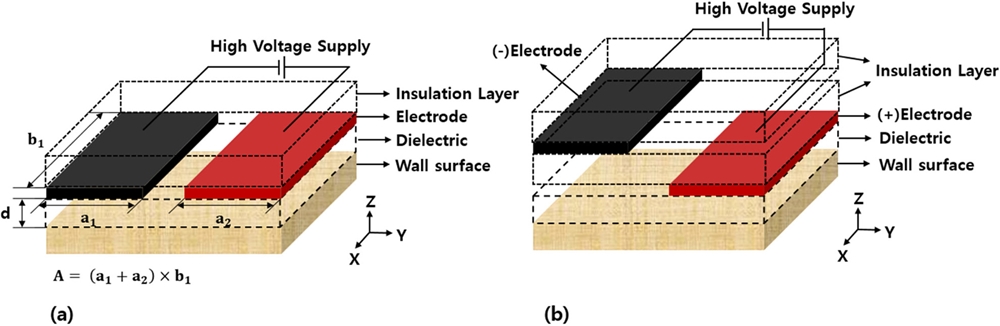
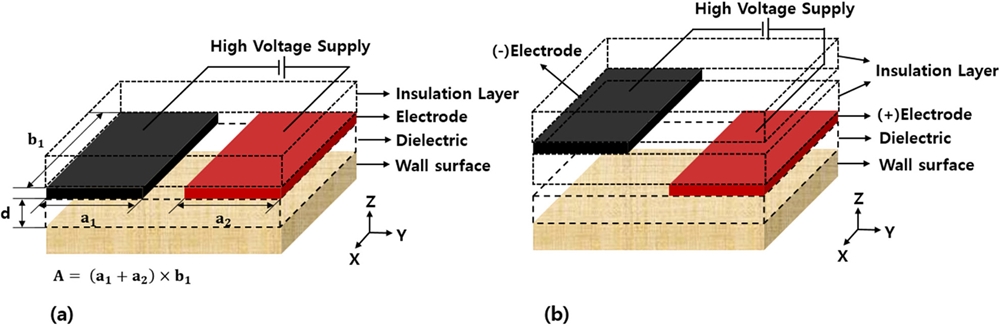
Fig. 1(a)와 같이 절연체(Insulator), 전극(Electrode), 유전체(Dielectric)로 구성된다.
9 이러한 구조의 정전흡착 패드의 경우 고전압 인가에 따른 전극 사이의 방전 현상을 방지하기 위해 전극간 간격을 충분히 보장해야 한다. 이로 인해 단위 면적당 흡착력이 낮아져 목표 흡착력을 얻기 위해서는 흡착 패드의 크기가 증가하게 된다. 이는 로봇의 경량화 또는 소형화와 관계없이 패드의 크기 증가 때문에 좁은 공간에서의 이동이 제한 받게 된다. 이후 2.2절에서 언급되듯 패드 구조의 개선을 통해 패드 크기를 감소시켰다.
Fig. 1 Structure of electroadhesion pad (a) One insulation layer type and (b) Dual insulation layer type
2.1 정전흡착 패드 원리
정전흡착 패드는 기본적으로 커패시터의 정전기 유도 현상을 이용하여 흡착력을 발생시킨다. 커패시터는 전하를 저장하는 장치이고 전하가 저장된 평행판 도체 사이에는 정전기력이 발생한다. 정전기력은 축적된 전하의 양에 비례하고 전극 간의 간격에 반비례한다. 커패시터에 저장되는 전하량은 커패시터의 정전용량 C와 인가전압 V에 비례한다.
이때 정전용량은 전극의 면적 A와 전극 사이 물질의 유전상수 ε에 비례하며 극 사이의 거리 d에 반비례한다.
전자 흡착 패드 구조
Fig. 1에서 전극과 벽면을 한 쌍의 평행판으로 생각하면 전체 패드를 2개의 병렬 커패시터로 모델링이 가능하다. 서로 다른 전극을 가진 두 도체판 사이의 축적되는 전하량은 같으므로 각각의 전극판은 부호가 반대인 동일한 크기의 표면전하밀도를 갖게 된다.
Fig. 1(a)와 같이 흡착 패드가 벽면에 이상적으로 밀착되어 있는 경우 전극의 면적
A, 전극과 벽면 사이의 거리
d, 인가전압
V, 진공 상태의 유전율
ε0, 사용된 필름의 비유전율
εr이면 정전에너지
W는 다음
식(3)과 같다.
정전에너지를 평행판으로 인식되는 정전흡착 패드의 극과 벽면 사이의 거리
d에 대해서 미분함으로써 흡착력(
F)을 얻을 수 있다. 이때 흡착력은
Fig. 1의 구조에서
z축으로 작용하며 다음
식(4)와 같다.
실제로 흡착 패드와 벽면 사이가 이상적으로 밀착되지 못하고 간극이 있는 경우
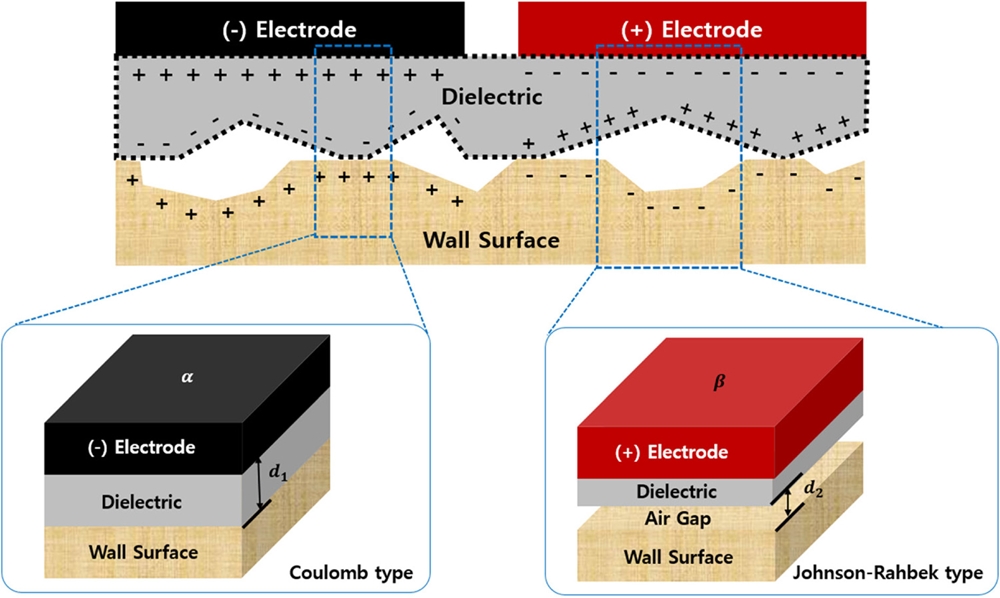
Fig. 2와 같이 패드의 유전체의 두께 이외에 공기층이 형성된다. 이와 같은 환경에서 패드와 벽면 사이의 흡착력을 쿨롱 힘과 존슨-라벡 힘으로 분리하여
Fig. 2와 같이 표현할 수 있다.
10
Fig. 2Electrostatic induction between pad and wall.11 (Adapted from Ref. 11 on the basis of OA) The Coulomb type and the Johnson-Rahbek type. Depending on the presence or absence of an air layer, it is divided into the Johnson-Rahbek type and the Coulomb type
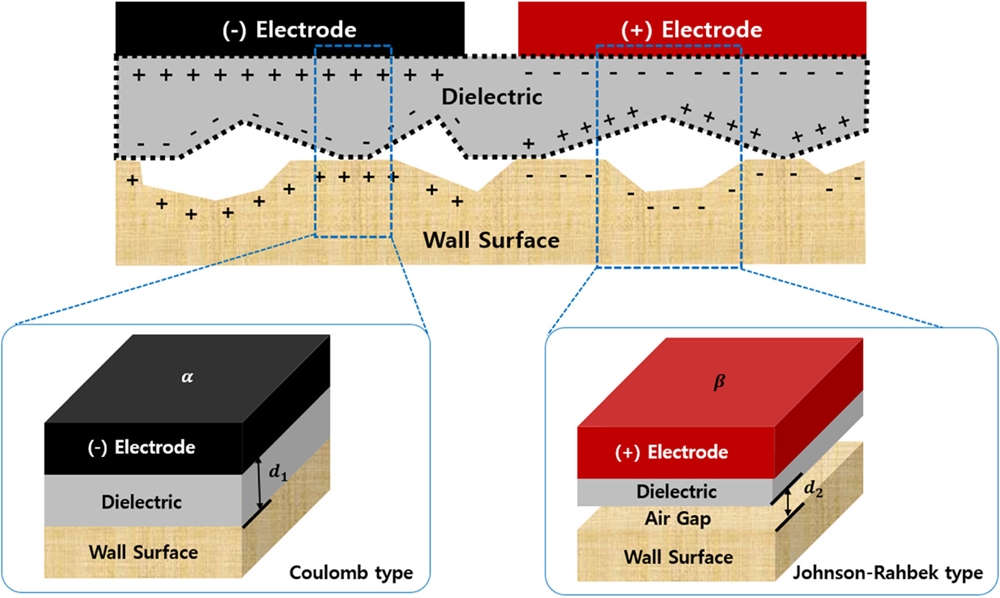
여기서 d1은 패드의 극과 벽면 사이, 즉 유전체의 두께를 의미하며, d2는 유전체와 벽면 사이의 공기층의 두께를 의미한다. α와 β는 쿨룽 힘과 존슨-라벡 힘이 작용하는 면적이다.
2.2 정전흡착 패드 구조
기존의 정전흡착 패드는
Fig. 1(a)와 같이 (+)와 (-)의 두 전극이 수평 상태에서 서로 교차되어 반복되는 구조이다. 전극으로는 높은 전하밀도를 갖는 구리, 알루미늄 혹은 탄소 성분과 같은 재료들이 사용된다. 실제로 은이나 금의 전기 전도율이 더 높지만 경제성을 고려하여 구리와 알루미늄 등을 사용하여
Fig. 1(b)와 같은 형태의 패드를 구현하였다.
강한 흡착력을 발생시키기 위해서는 패드 전극면과 벽면의 간격을 최소로 유지하면서 전하의 이동을 막아야 한다. 정전기력을 유지하기 위해서는 절연율이 높으며 두께가 얇은 PET 계열의 필름을 유전층(Dielectric Layer) 및 절연층(Insulation Layer)으로 사용한다.
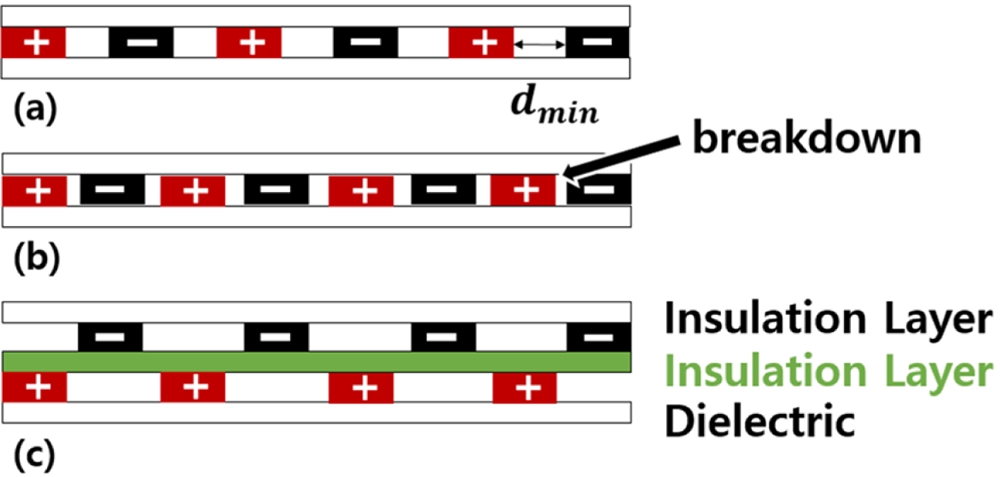
Fig. 1(a)와 같은 단일 절연 정전 흡착 패드의 경우 축전 전하량을 극대화하기 위해 전극과 전극의 간격을 줄이면 고전압 인가 시 공기층을 통해 누설전류 및 방전이 일어난다. 패드 제작 과정상 전극 사이에 절연 필름을 맞붙여서 완벽하게 밀폐시키기 어렵기 때문에 절연 필름에 비해 유전율이 낮은 공기층이 형성되어 최대인가전압이 낮아지기 때문이다. 이런 문제를 방지하기 위해서는 전극과 전극 사이를 충분히 이격시키거나 인가전압의 감소가 필요하지만 패드의 단위 면적당 흡착력은 감소하게 된다.
12
본 연구에서는
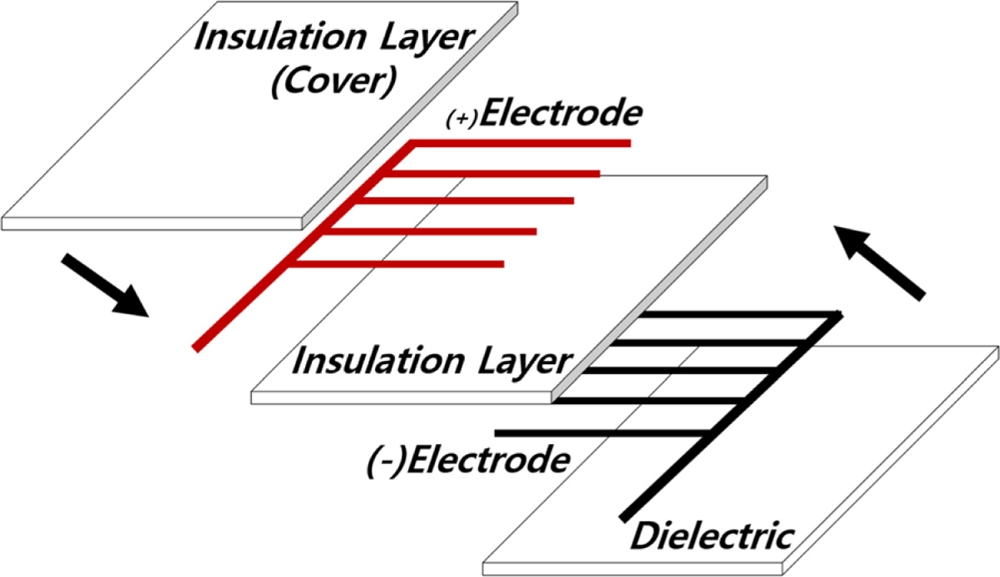
Fig. 1(b)와 같은 이중 절연 흡착 패드 구조를 제안하여 공기층을 통한 패드 내부 전극 간의 방전을 방지하고 흡착력의 밀도를 개선하고자 하였다. 제안된 패드는 이중 절연 구조를 가지며 교차로 배열된 (+) 전극층(Electrode Layer)과 (-) 전극층 사이에
Fig. 3과 같이 절연층을 추가적으로 삽입하여 제작하였다.
식(4)를 통해 절연층의 추가로 전극과 벽면 간의 거리 d가 절연 필름의 두께만큼 증가하여 흡착력이 감소할 수 있지만
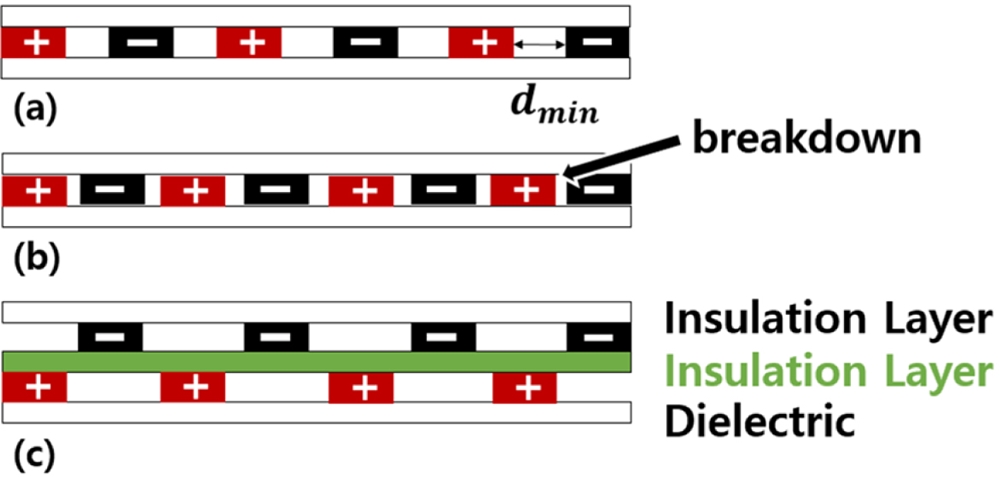
Fig. 4(c)와 같이 (+) 전극과 (-) 전극간 거리의 최소화가 가능하여 제안된 패드에서 전극의 면적 A를 증가시키는 것이 가능해진다. 전극 사이의 거리 증가로 인한 흡착력의 감소보다 전극 면적 증가에 의한 흡착력 증가 폭이 더 높기 때문에 기존의 단일 절연 패드
Fig. 4(a)보다 높은 단위 면적당 흡착력을 확보할 수 있다.
12 Fig. 4(b)와 같이 전극과 전극 사이의 최소거리
dmin보다 가깝게 전극을 배치시킬 경우 낮은 인가전압에서도 방전이 발생하게 된다. 흡착 패드의 제작에 있어서 전극을 구리와 알루미늄 같은 도체를 사용하는 경우 반발력에 의해서 전하가 전극의 모서리 부분에만 집중되어 패드 전체에 고른 흡착력을 얻을 수 없다. 따라서 전극을 병렬로 다수 배치하여 축적되는 전하량을 늘리고 패드 전체적으로 균일한 흡착력 분포를 얻기 위해
Fig. 3과 같은 빗살 구조의 전극을 배치하여 패드를 제작하였다.
Fig. 3Form of each layer of electroadhesion pad
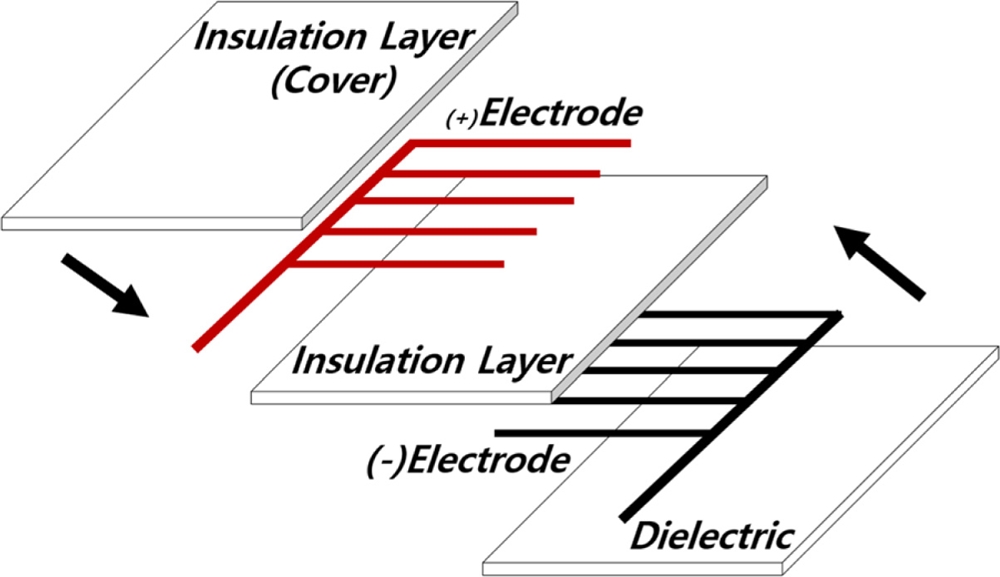
Fig. 4Distance between electrodes in the electroadhesion pad (a) One insulation structure (b) One insulation structure (Breakdown) and (c) Dual insulation structure
본 연구에서는 레이저 가공(Laser Cutting) 기법이나 스크린 인쇄(Screen Printing)을 통하지 않고 주변에 손쉽게 구할 수 있는 알루미늄 테이프와 폴리이미드(Polyimide) 재질의 필름을 수작업으로 접착하여 제작하였다. 절연층을 추가한 패드에 공급전압 10 kV 기준 전극 사이의 거리 5 mm 간격으로 실험을 진행하였다.
접촉면이 도체인 경우는 대전 현상이, 부도체인 경우 유전 분극이 일어나 벽면과 흡착이 이루어진다. 금속 재질 벽면의 경우 비교적 많은 양의 내부의 자유 전자 이동에 따라 정전흡착 패드전극의 반대 전하가 벽면에 정렬되면서 강한 흡착력을 가진다. 패드에서 발생한 전기장이 크고 많은 자유 전하를 보유하고 있는 금속일수록 더 강한 힘으로 서로를 끌어당기게 된다. 부도체의 경우 자유 전자가 상대적으로 적기 때문에 도체에 비해서 정전흡착 패드에서 발생한 전기장이 크더라도 벽면에서 발생하는 반대 전하가 적기 때문에 흡착력이 감소한다.
3. 정전흡착 패드 흡착력 실험
3.1 실험 환경 및 설정
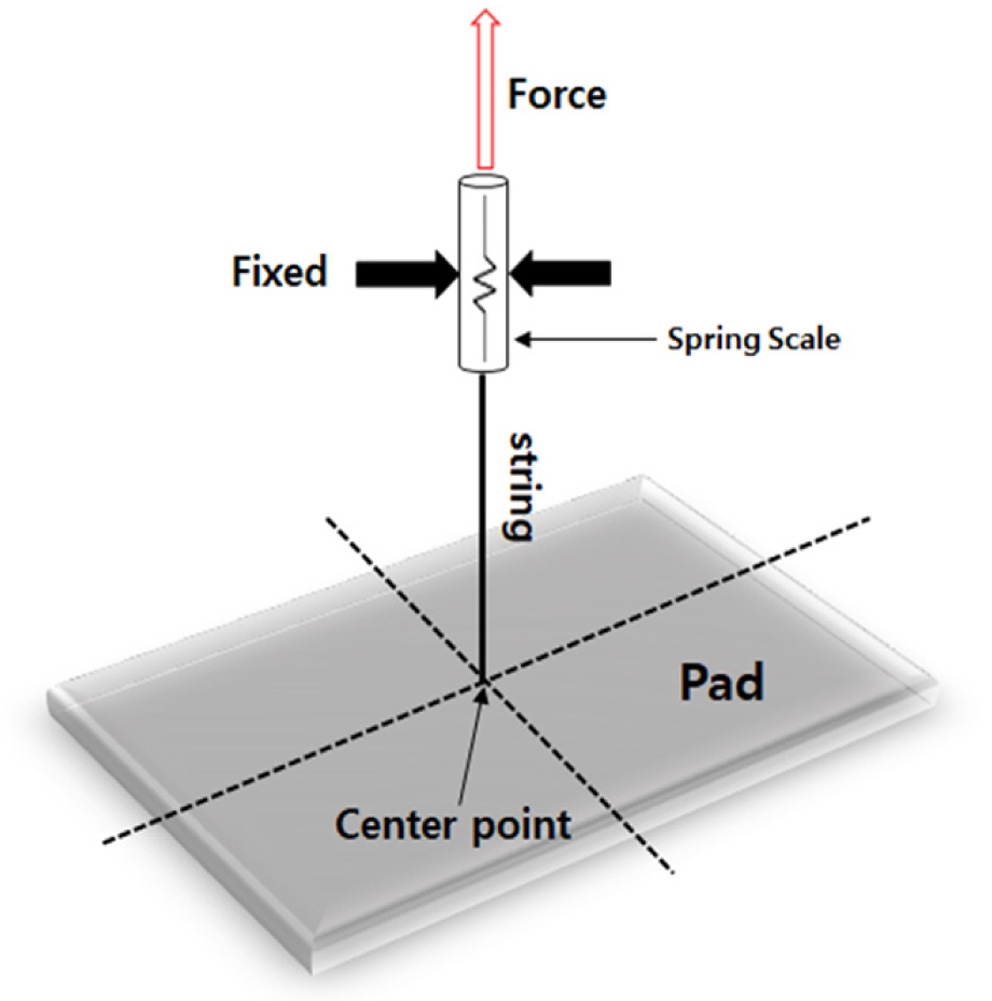
제작한 정전흡착 패드를 이용하여 극의 재질, 극의 너비, 극의 인가전압에 대한 흡착력 실험을 진행하였다. 각 실험에서의 흡착력 측정법은
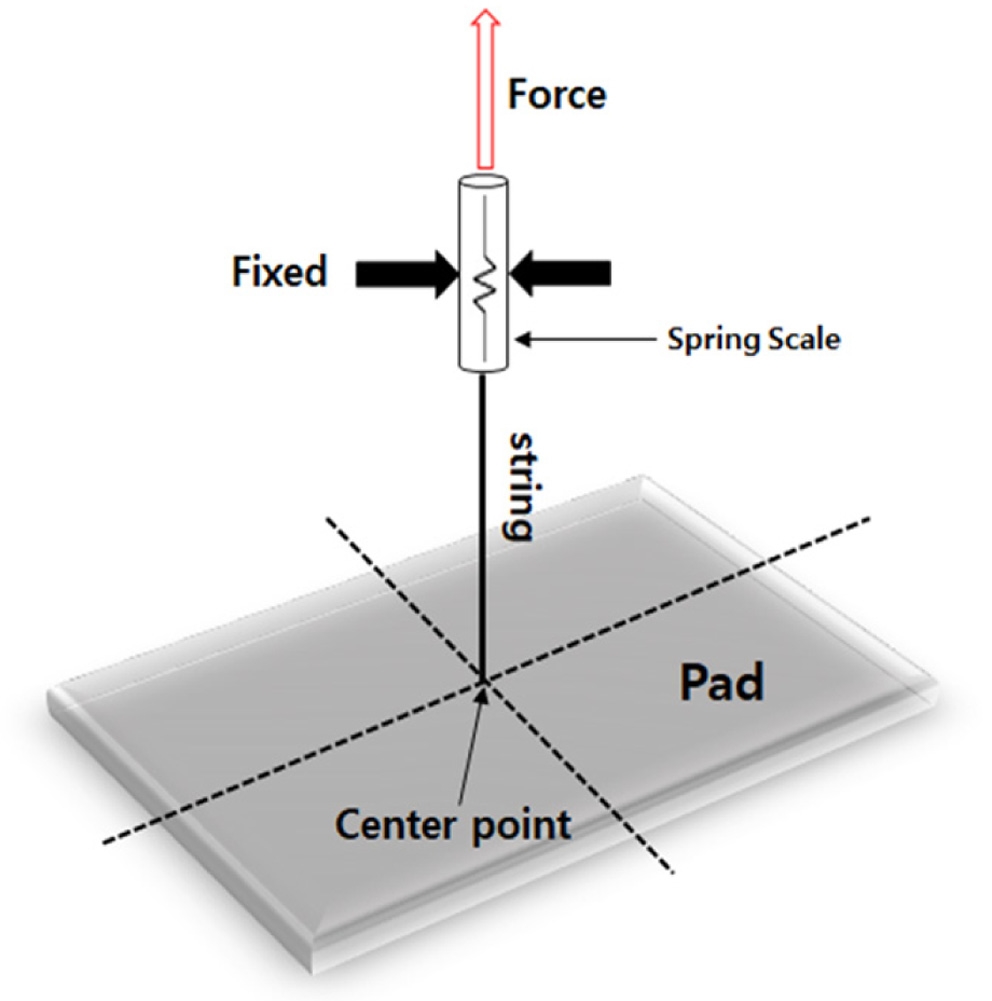
Fig. 5와 같이 정전흡착 패드와 부착 벽면의 수직으로 작용되는 힘을 심포(SHIMPO)사의 푸쉬풀게이지(Push-Pull Gage) FGIN-20을 이용하여 측정하였다. 패드에 사용된 유전체와 벽면의 마찰력을 통해 전단력을 알 수 있다. 이는
식(4) 또는
식(5)에 유전체와 부착 표면의 마찰계수를 통하여 힘의 관계식을 표현할 수 있다.
13 하지만 실제 실험을 통한 전단 흡착력이 마찰계수가 적용된
식(4) 혹은
식(5)를 통한 이론적 수치보다 크게 나타나는데 이는 진공이 아닌 환경에서의 패드와 벽면 혹은 기판(Substrate) 사이의 흡입력과 반데르발스 힘이 추가되었기 때문이다.
14
Fig. 5Measurement of holding force between the attachment face and the electroadhesion pad
본 실험에서는 직류 전원 장치와 DC-DC 변환기를 이용하여 2에서 10 kV까지의 증폭된 전압을 인가 후 2 kV 단계별 흡착력을 실험하였다.
3.2 이중 절연 정전흡착 패드 흡착력 실험
3.2.1 사용된 정전흡착 패드
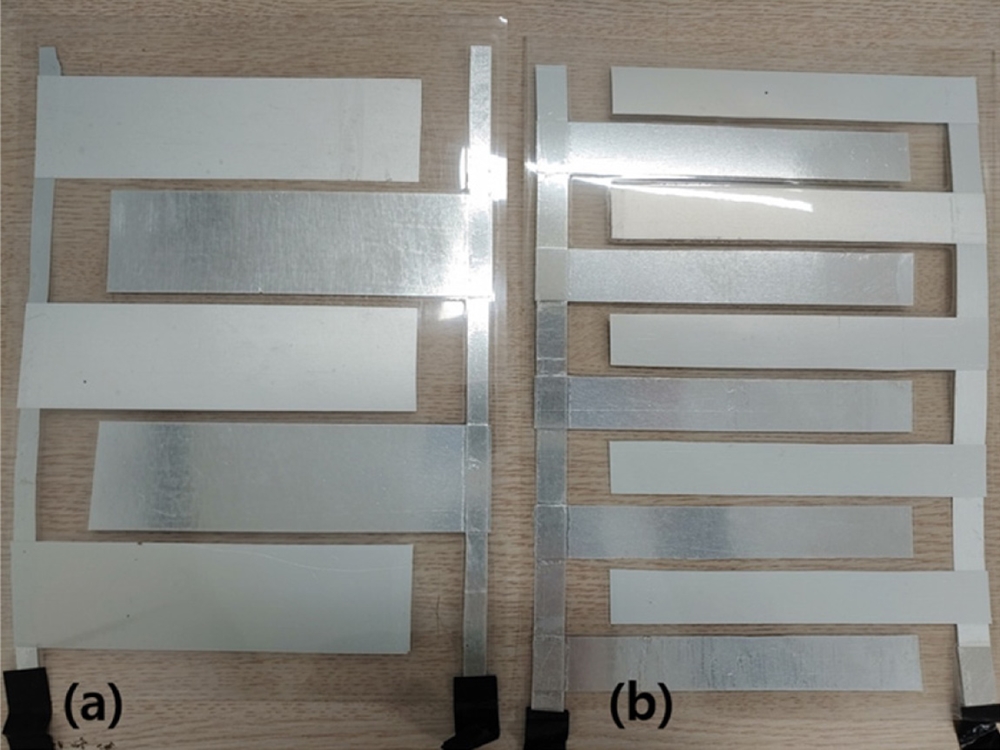
정전흡착 패드의 크기는
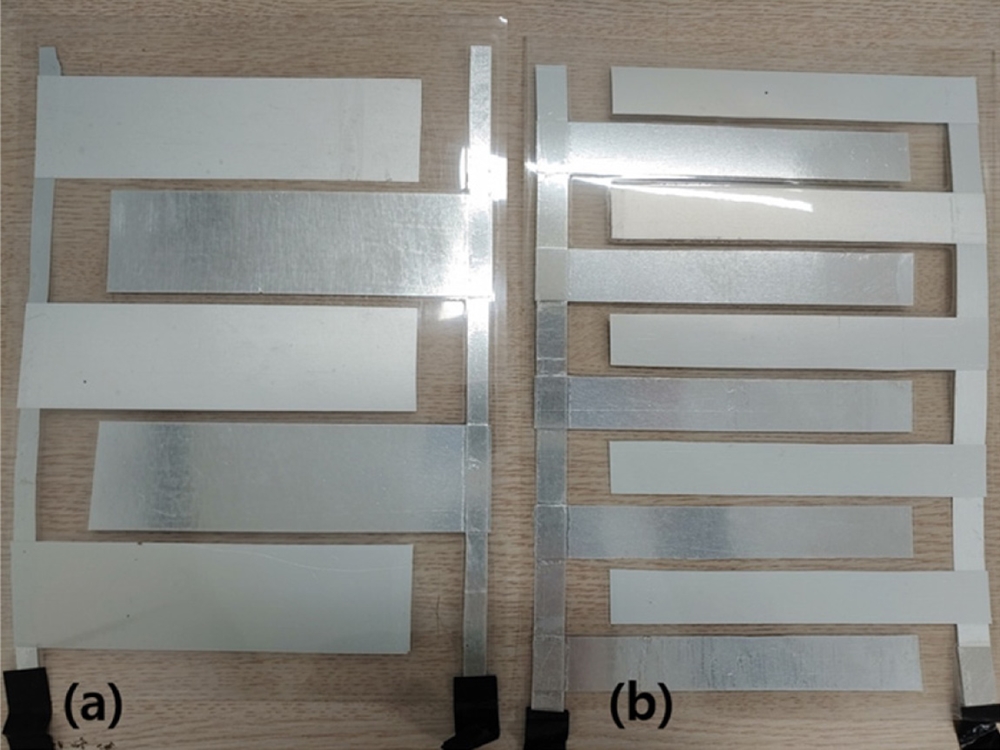
Fig. 6(a)의 경우 5개 빗 형태의 줄로 구성되어 있다. 정전흡착 패드
Fig. 6(b)의 경우 10개 빗 형태의 줄로 구성되어 있다. 두 정전흡착 패드 내 극의 면적은 40,800 mm
2으로 동일하다.
Fig. 6Electroadhesion pad used in adsorption experiment (a) Interdigitated electrode of 5 lines and (b) Interdigitated electrode of 10 lines
3.2.2 극의 재질에 대한 흡착력 실험
정전흡착 패드의 전극이 많은 전하량을 축적할 수 있는 재료일 때 높은 흡착력을 발휘한다. 전극에 고전압 공급을 통하여 높은 전기장을 발생시키기 위한 재료로 전도체 또는 반도체 재료가 적합하다. 이를 바탕으로 구리,
13,15-17 알루미늄,
12,18 카본 혹은 카본과의 혼합물,
19,20 금속 합금,
21 전도성 흑연,
22 탄소가 혼합된 재료
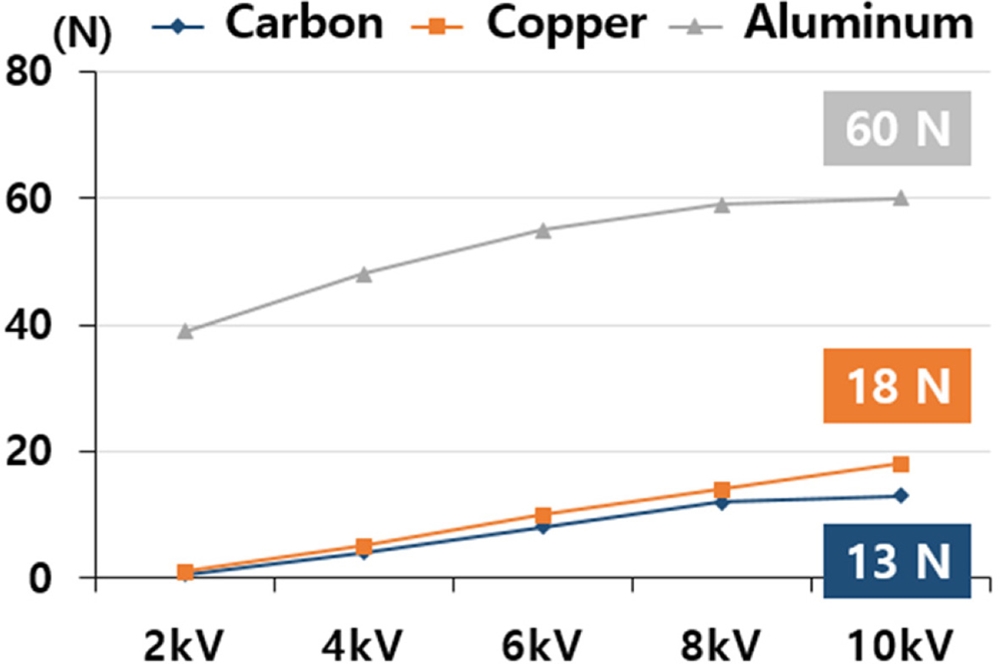
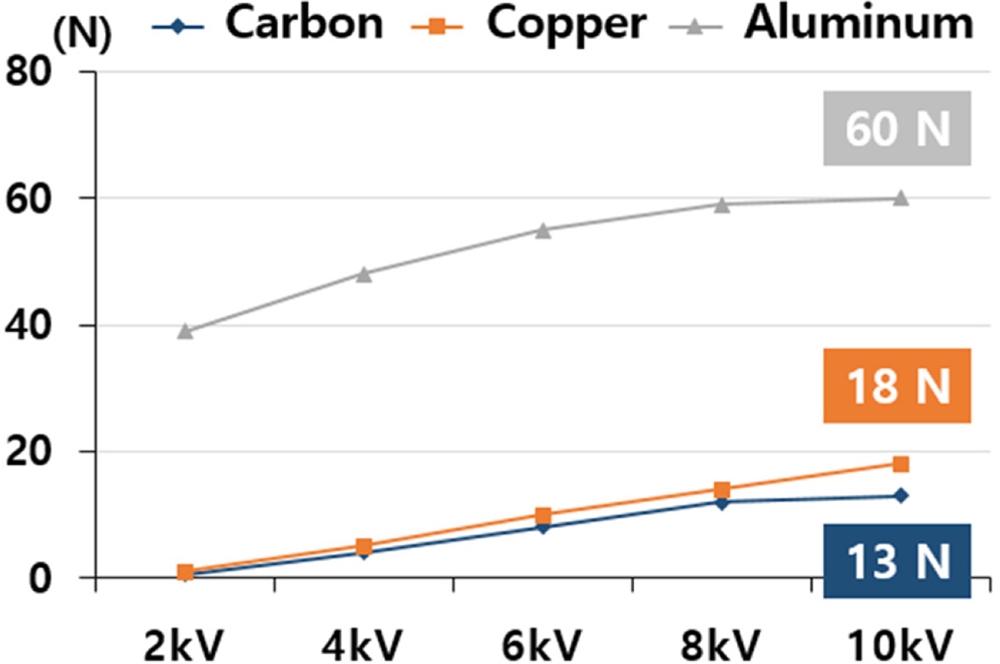
20,23 등의 재료를 사용하여 제작된 패드를 기반으로 다양한 비교 실험이 진행되었다. 하지만 재료의 성능 비교에 대한 명확한 데이터가 부족하며 같은 재료에 대한 실험값의 오차가 존재한다. 본 논문에서는 정전흡착 패드의 전극으로 적합한 재료 중에서 구하기 쉽고 비용적인 측면에서 효율 좋은 카본, 구리, 알루미늄을 재료로 선정하여 실험을 진행하였다.
Fig. 7에서 세 가지 재질에 대해서 인가전압을 10 kV까지 증가시키면서 흡착력을 비교하였으며 부착면의 재질은 알루미늄 판을 사용했다. 인가전압 10 kV의 경우 알루미늄이 구리보다 3.3배, 카본보다 4.6배 강한 흡착력을 보였다.
Fig. 7Electrode material influence on adhesion force
3.2.3 극의 너비에 대한 흡착력 실험
각 패드에 동일 전압을 인가 후 흡착력을 측정했으며
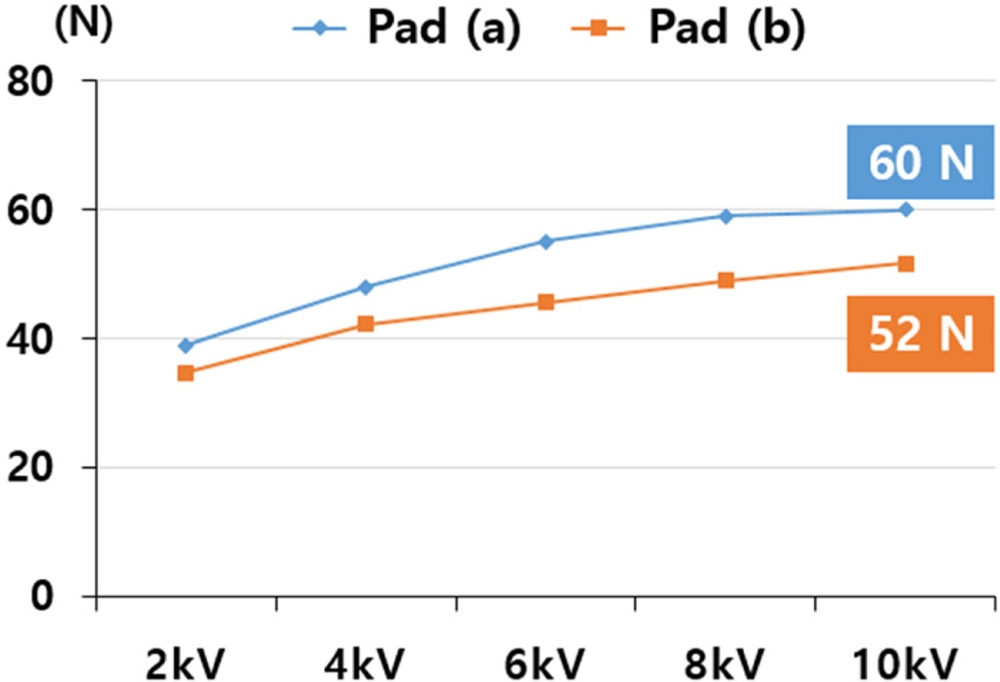
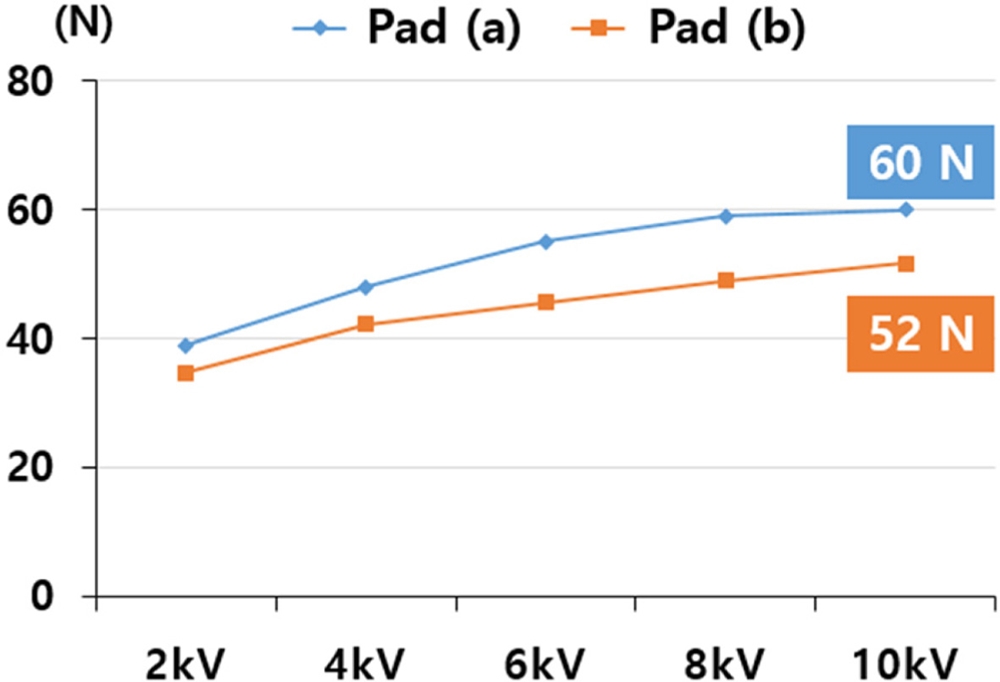
Fig. 8을 통해 전체 패드 크기가 같고 각 전극의 면적의 합이 같은 경우 4.8 mm의 두꺼운 너비의 전극을 가진 패드(a)가 인가전압 10 kV일 때 8 N 더 높은 흡착력을 보였다. 알루미늄 재질 전극이므로 전하의 반발력 때문에 전극 모서리 부분으로 흡착력이 집중되어 2.4 mm 전극 두께를 가진 패드(b)가 같은 면적 대비 더 고르고 강한 흡착력을 발휘할 것이라는 예상과는 다른 결과값을 보였다. 이는 교차형 전극 너비가 작을수록 흡착력이 절대적으로 강해지는 것이 아니고 최적의 전극 너비값이 존재한다고 예상된다.
Fig. 8Applied voltage of the electrode influence on adhesion force
3.2.4 극의 인가전압에 따른 흡착력 실험
인가전압에 따른 흡착력 실험은 이론적인 측면에서
식(4)에 부합한다. 하지만 이는 약 2 kV 이하에서의 실험 결과에만 적용된다는 것을 확인할 수 있었고 2 kV 이상의 10 kV까지의 흡착력 실험값 데이터 곡선은 로그함수 곡선을 그리는 경우가 확인
15되었다. 실험 패드(a)와 (b) 또한
Fig. 8에서의 흡착력값을 통해 동일한 경향을 확인했으며 2 kV 이상의 전압에서는 증가된 전압 대비 흡착력 증가율이 감소함을 볼 수 있었다.
Table 1Electroadhesion forces measured at an applied voltage of 10 kV
Table 1
|
Electrode material |
Adhesion force [N] |
|
Aluminum foil [Pad (a)] |
60 |
|
Aluminum foil [Pad (b)] |
52 |
|
Copper foil |
18 |
|
Conductive carbon tape |
13 |
Table 2Parameters of electroadhesion pads used in the experiment
Table 2
|
Size [mm × mm] |
210 × 297 |
|
Electrode width [mm] |
48 |
|
Electrode length [mm] |
170 |
|
Electrode distance [mm] |
5 |
|
Electrode material |
Aluminum foil
copper foil
conductive carbon tape |
|
Insulation material |
Transparency OHP film |
|
Dielectric material |
Polyimide film |
|
Electrode thickness [μm] |
30-50 |
|
Insulation thickness [μm] |
100 |
|
Dielectric thickness [μm] |
100 |
4. 등반로봇 하드웨어
정전흡착 패드로 구동되는 등반로봇은
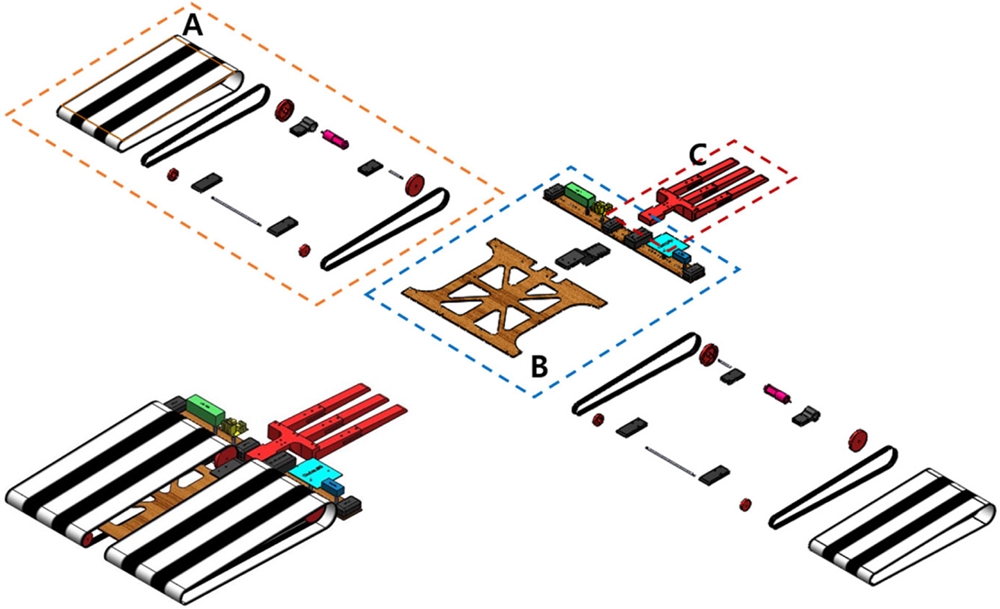
Fig. 9와 같이 크게 제어부와 프레임을 포함하는 몸체부, 모터와 연결된 바퀴 및 정전흡착 패드가 적용된 구동부, 등반로봇의 벽면 이동 시 발생하는 모멘트값 상쇄를 위한 꼬리부로 구성된다. 정전흡착력이 응용된 많은 등반로봇은 거의 유사한 형태로 설계되었으며 실제로 등반로봇으로써 동작이 검증된 구조이다.
Fig. 9와 같이 개선된 패드의 흡착 성능 및 등반 능력 확인이 용이한 트랙 형태의 등반 로봇을 채택하였다. 본 논문에서 적용된 등반로봇은
Table 3에 기재된 각 요소의 재료들에 의하여 약 3 kg 무게로 90° 이하의 경사에서의 등반 능력 확인을 목표로 한다.
Fig. 9 Structure of climbing robot (a) A: Driving part, (b) B: Body part and (c) C: Tail part
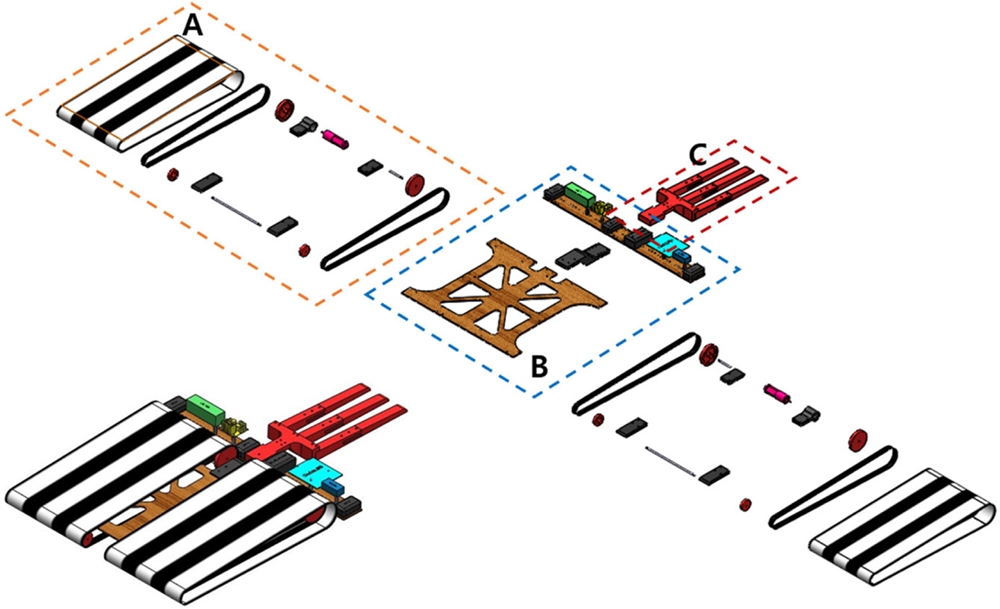
Table 3 Material combination of climbing robot
Table 3
|
Body part [mm × mm] |
MDF [320 × 480] |
|
Driving part [mm × mm] |
Polylactic acid filament [320 × 380] |
|
Tail part [mm × mm] |
Polylactic acid filament [120 × 315] |
4.1 몸체부
프레임 및 전체적인 하드웨어를 경량화하면 보다 안정적인 로봇의 이동이 가능하고 등반로봇의 가용 중량을 늘릴 수 있다. 프레임은 벽면 부착 후 이동 시 발생하는 모멘트를 감당하기 위해 로봇의 가로보다 세로의 길이가 길어지도록 프레임의 가로는 320, 세로는 380 mm가 되도록 설계하였다. 몸체부에 4개의 바퀴, 2개의 DC모터, 블루투스 모듈, 제어부에
Fig. 9(b)처럼 모터드라이브, 제어기(Cortex-M3), 배터리, 정전압 회로, DC-DC 컨버터, DC-DC 변환 모듈(Lm2596), DC-DC 변환 정전압 회로(7805, 7812 레귤레이터)를 부착했다. 9 V 출력 배터리 3개를 통해 모터 드라이버, 제어기, 정전흡착 패드에 전력 공급을 해주기 위해 DC-DC 변환 모듈과 DC-DC 변환 정전압 회로를 사용하였다. DC-DC 변환 모듈은 공급되는 18 V를 12 V로 스텝 다운 출력시켜 모터 드라이버에 공급한다. DC-DC 변환 정전압 회로는 5, 15 V를 각각 제어기, 정전흡착 패드로 공급한다.
등반로봇의 바퀴는
Fig. 10(b)와 같이 로봇이 벽면을 이동 시 발생되는 모멘트를 감소시키기 위해 모터가 연결된 5 cm, 모터가 연결되지 않은 앞바퀴를 3 cm로 작게 설계하였다. 또한 정전흡착 패드가 최대한 많은 면적이 닿을 수 있도록 트래드밀과 같은 형태로 제작되어 바퀴와 정전흡착 패드가 합쳐질 수 있게 설계하였다. 이때 정전흡착 패드가 트래드밀 구조의 벨트와 같은 역할을 한다. 정전흡착 패드의 높은 흡착력을 위해 몸체부에 위치한 저전압-고전압 변환 DC-DC 컨버터가 패드에 전원을 고전압을 공급한다. DC-DC 컨버터는 인가전압 0-15 V 범위에서 구동되며 최대출력전압 10 kV를 가진다. 이때 등반로봇의 패드는
Fig. 8의 패드(a)의 실험값보다 높은 흡착력을 필요로 하기 때문에 가로 297, 세로 400 mm의 면적이 부착면과 맞닿는 정전흡착 패드 2개를 제작하였다.
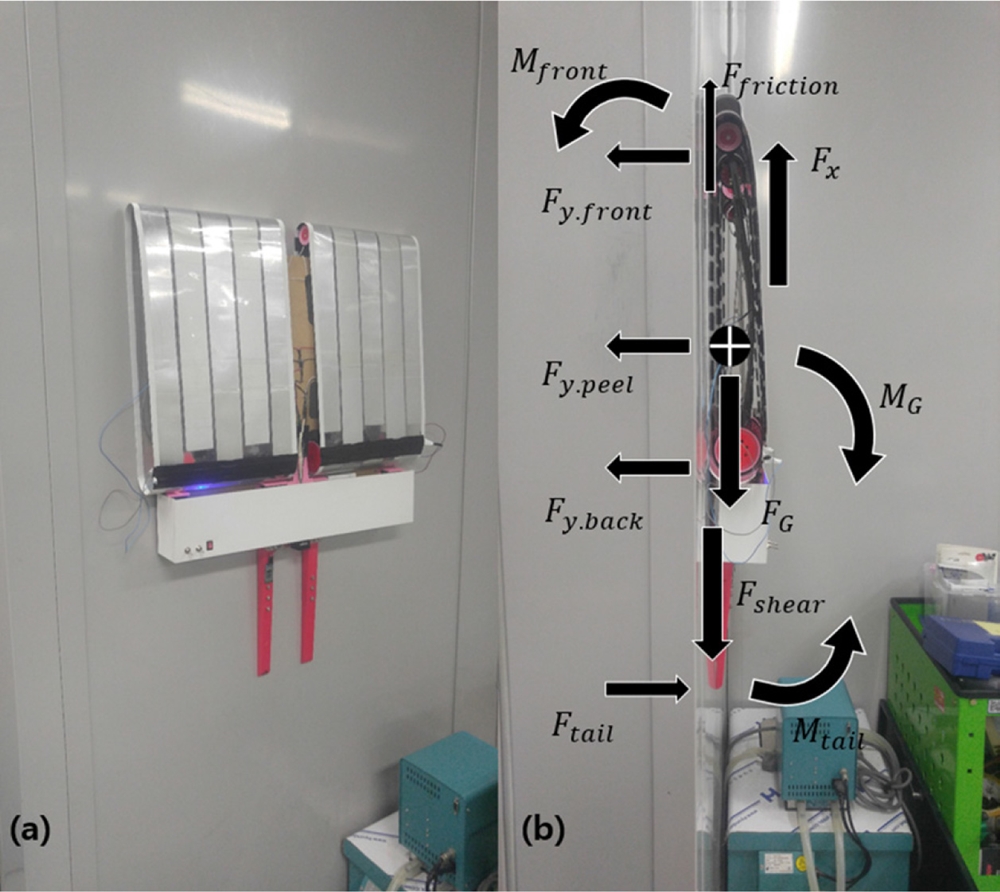
Fig. 10Climbing robot with double insulation electroadhesion pads (a) Front and (b) Free body diagrams
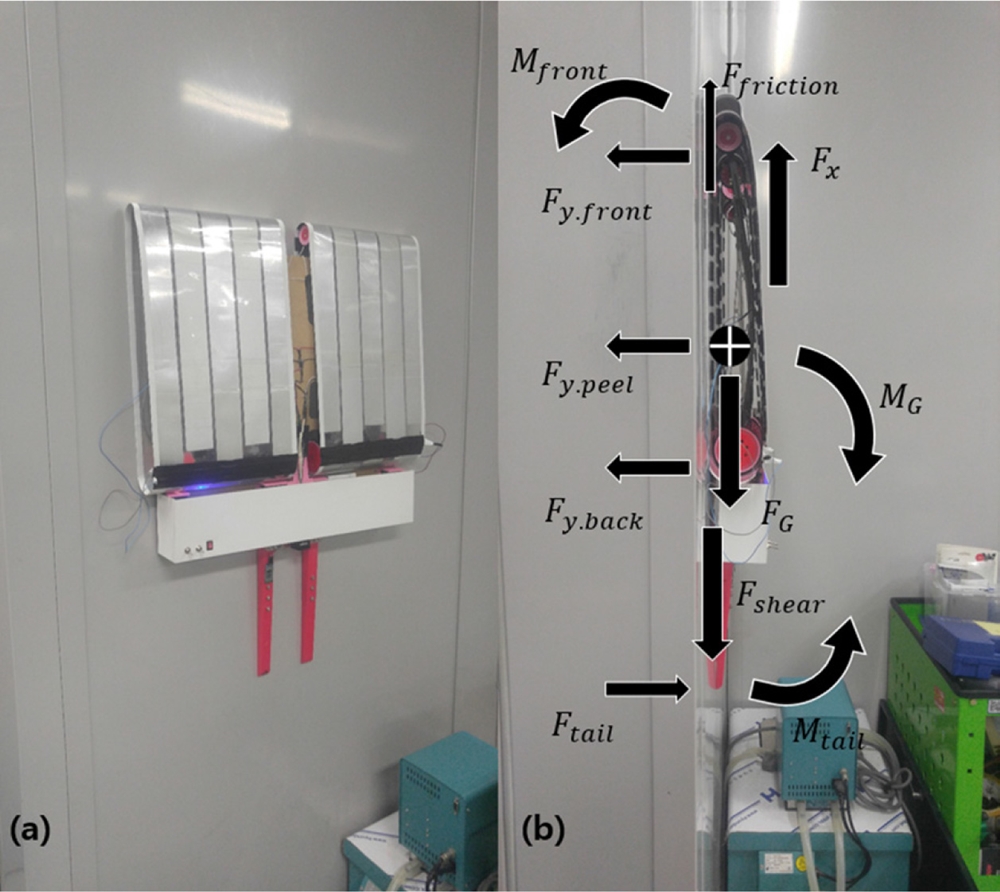
Table 4System parameters for prototype climbing robots
Table 4
|
Weight [kg] |
About 3 |
|
Size [mm × mm] |
480 × 795 |
|
Power supply voltage [kV] |
10 |
|
Maximum force [N] |
About 60 |
|
Velocity [mm/s] |
24(Max) |
|
Power consumption [W] |
3 |
4.3 꼬리부
수직 이상의 벽면에서 이동 시 발생하는 모멘트를 해결하기 위해
Fig. 10(b)처럼 등반로봇 하부에 모멘트 상쇄를 위한 꼬리부를 만들었다. 꼬리부는 등반로봇의 하부에 300 mm 이상의 길이의 포크 모양의 꼬리 형태로 위치시켜 무게중심이 벽면에 가까워지게 하며 동시에 로봇의 이동방향의 반대 방향인 꼬리쪽에 가까워지도록 하였다.
Fx는
x축의 흡착력,
Fy는
y축에 대한 흡착력,
Ffriction 벽면과 로봇간 마찰력,
FG 로봇 중량,
Ftail 꼬리부의 지지 반력을 의미한다. 이때
식(6)부터
식(8)까지를 만족해야 모터 구동에 의한 등반을 이룰 수 있으며
Fig. 10(b)처럼 90° 경사에서
Fx는 0에 가까우며
Fy의 힘에 의존한다.
5. 결론
정전흡착 패드가 적용된 등반로봇을 낮은 경사면부터 순차적으로 구동시키는 실험을 진행하였다. 정격 회전수 6,900 rpm, 감속기 감속비 1/742인 DC 모터를 사용하였으므로 적용 정격 회전수 9.2 rpm, 모터와 연결된 뒷바퀴의 크기가 5 cm로 최대 24 mm/s 속도로 구동하였다. 이때 금속 재질의 벽면 환경에서 등반로봇 구동 및 이동 가능한 각이 가장 높음을 확인하였다.
Fig. 10(a)에서 보이듯 금속 재질의 90° 경사에서의 이동은 10 kV의 공급전압에서 가능함을 보였으나 비금속 재질의 경우 등반 로봇의 이동 시 힘의 불안정함을 보이며 미끄러짐 혹은 추락의 위험성이 존재하였다.
유사한 형태의 등반로봇들 대부분은 약 1 kg 내외 혹은 마이크로 로봇의 규모를 갖는다. 또한 공급전압은 수백 볼트의 비교적 낮은 전압이나 약 6 kV 정도의 제한을 보였다. 그러나 본 논문에서 제안된 중간 필름 정전흡착 패드는 3 kg 이상의 등반로봇에 적용되었다. 이는 추가적인 로봇의 경량화를 통해 로봇 이외의 적재물 탑재 또는 중, 대형의 등반로봇이 90° 이상 각도에서의 등반 가능성을 보인다.
본 논문은 기존의 정전흡착 패드의 단점을 보완하고 흡착력을 개선하기 위한 새로운 패드 구조를 제안하였고 실제 패드 제작과 실험을 통해서 10 kV 고전압 인가 시 발생되던 방전 문제 해결 및 흡착력 성능을 확인하였다. 첫째로 같은 조건에서의 재질별 흡착력 실험을 통해 알루미늄 재질의 전극을 적용했다. 둘째 전극의 너비 및 인가전압에 따른 흡착력 경향을 확인하였다. 셋째로 개발된 정전 흡착 패드를 등반로봇에 적용하여 정전흡착 패드를 통한 정전흡착식 등반로봇을 구현하였다. 등반로봇의 패드에 공급전압이 10 kV 이상일 때 금속 재질의 벽면에서는 등반이 가능함을 보였지만 비금속 재질의 벽면에서는 등반 시흡착력의 불안정함을 보여 추락의 위험성을 보였기에 하드웨어의 경량화 및 추가적인 개선이 필요함을 확인하였다. 앞으로의 작업은 추가적인 전극 재료 조사와 세분화된 흡착력 변수에 대한 테스트 수행을 통해 등반로봇 및 다양한 시스템에서 적용 가능한 최적의 액추에이터 개발이다.
ACKNOWLEDGMENTS
이 논문은 2019년도 교육부의 재원으로 한국연구재단의 지원을 받아 수행된 기초연구사업(No. NRF-2018R1D1A1B07045417)과 2020년도 산업통상자원부의 재원으로 한국산업기술진흥원의 지원을 받아 수행된 산업혁신 인재성장 지원사업(No. P0008458)의 연구 결과임.
REFERENCES
- 1.
Bahr, B., Li, Y., and Najafi, M., “Design and Suction Cup Analysis of a Wall Climbing Robot,” Computers & Electrical Engineering, Vol. 22, No. 3, pp. 193-209, 1996.
10.1016/0045-7906(95)00039-9
- 2.
Zhang, Y. and Nishi, A., “Low-Pressure Air Motor for Wall-Climbing Robot Actuation,” Mechatronics, Vol. 13, No. 4, pp. 377-392, 2003.
10.1016/S0957-4158(01)00047-2
- 3.
Lee, G., Kim, H., Seo, K., Kim, J., and Kim, H. S., “Multitrack: A Multi-Linked Track Robot with Suction Adhesion for Climbing and Transition,” Robotics and Autonomous Systems, Vol. 72, pp. 207-216, 2015.
10.1016/j.robot.2015.05.011
- 4.
Eich, M. and Vögele, T., “Design and Control of a Lightweight Magnetic Climbing Robot for Vessel Inspection,” Proc. of the 19th Mediterranean Conference on Control & Automation, pp. 1200-1205, 2011.
10.1109/MED.2011.5983075
- 5.
de Rivaz, S. D., Goldberg, B., Doshi, N., Jayaram, K., Zhou, J., et al., “Inverted and Vertical Climbing of a Quadrupedal Microrobot Using Electroadhesion,” Science Robotics, Vol. 3, No. 25, Paper No. eaau3038, 2018.
10.1126/scirobotics.aau3038
- 6.
Guo, J., Elgeneidy, K., Xiang, C., Lohse, N., Justham, L., et al., “Soft Pneumatic Grippers Embedded with Stretchable Electroadhesion,” Smart Materials and Structures, Vol. 27, No. 5, Paper No. 055006, 2018.
10.1088/1361-665X/aab579
- 7.
Shintake, J., Rosset, S., Schubert, B., Floreano, D., and Shea, H., “Versatile Soft Grippers with Intrinsic Electroadhesion based on Multifunctional Polymer Actuators,” Advanced Materials, Vol. 28, No. 2, pp. 231-238, 2016.
10.1002/adma.201504264
- 8.
Nakamura, T. and Yamamoto, A., “Multi-Finger Electrostatic Passive Haptic Feedback on a Visual Display,” Proc. of the World Haptics Conference, pp. 37-42, 2013.
10.1109/WHC.2013.6548381
- 9.
Ruffatto III, D., Shah, J., and Spenko, M., “Optimization of Electrostatic Adhesives for Robotic Climbing and Manipulation,” Proc. of the International Design Engineering Technical Conferences and Computers and Information in Engineering Conference, pp. 1143-1152, 2012.
10.1115/DETC2012-71384
- 10.
Watanabe, T., Kitabayashi, T., and Nakayama, C., “Relationship between Electrical Resistivity and Electrostatic Force of Alumina Electrostatic Chuck,” Japanese Journal of Applied Physics, Vol. 32, No. 2, p. 864, 1993.
10.1143/JJAP.32.864
- 11.
Guo, J., Bamber, T., Chamberlain, M., Justham, L., and Jackson, M., “Optimization and Experimental Verification of Coplanar Interdigital Electroadhesives,” Journal of Physics D: Applied Physics, Vol. 49, No. 41, Paper No. 415304, 2016.
10.1088/0022-3727/49/41/415304
- 12.
Liu, R., Chen, R., Shen, H., and Zhang, R., “Wall Climbing Robot Using Electrostatic Adhesion Force Generated by Flexible Interdigital Electrodes,” International Journal of Advanced Robotic Systems, Vol. 10, No. 1, pp. 36-45, 2013.
10.5772/54634
- 13.
Yatsuzuka, K., Hatakeyama, F., Asano, K., and Aonuma, S., “Fundamental Characteristics of Electrostatic Wafer Chuck with Insulating Sealant,” IEEE Transactions on Industry Applications, Vol. 36, No. 2, pp. 510-516, 2000.
10.1109/28.833768
- 14.
Nakamura, T. and Yamamoto, A., “Modeling and Control of Electroadhesion Force in DC Voltage,” ROBOMECH Journal, Vol. 4, No. 1, pp. 18-28, 2017.
10.1186/s40648-017-0085-3
- 15.
Koh, K. H., Sreekumar, M., and Ponnambalam, S., “Experimental Investigation of the Effect of the Driving Voltage of an Electroadhesion Actuator,” Materials, Vol. 7, No. 7, pp. 4963-4981, 2014.
10.3390/ma7074963
- 16.
Jeon, J. U. and Higuchi, T., “Electrostatic Suspension of Dielectrics,” IEEE Transactions on Industrial Electronics, Vol. 45, No. 6, pp. 938-946, 1998.
10.1109/41.735338
- 17.
Heath, C. J., Bond, I. P., and Potter, K. D., “Integrating Electrostatic Adhesion to Composite Structures,” Industrial and Commercial Applications of Smart Structures Technologies, Vol. 9433, Paper No. 94330D, 2015.
10.1117/12.2084073
- 18.
Griffiths, G. and Studley, M., “Wall Climbing Robots Using Electro-Adhesion Technology,” Field Robotics, pp. 381-387, 2011.
10.1142/9789814374286_0044
- 19.
Germann, J., Schubert, B., and Floreano, D., “Stretchable Electroadhesion for Soft Robots,” Proc. of the IEEE/RSJ International Conference on Intelligent Robots and Systems, pp. 3933-3938, 2014.
10.1109/IROS.2014.6943115
- 20.
Prahlad, H., Pelrine, R. E., Wong-Foy, A., Kornbluh, R. D., and McCoy, B. K., “Materials for Electroadhesion and Electrolaminates,” US Patent, 20130010398A1, 2013.
- 21.
Ruffatto, D., Shah, J., and Spenko, M., “Optimization and Experimental Validation of Electrostatic Adhesive Geometry,” Proc. of the IEEE Aerospace Conference, pp. 1-8, 2013.
10.1109/AERO.2013.6496943
- 22.
Germann, J., Dommer, M., Pericet-Camara, R., and Floreano, D., “Active Connection Mechanism for Soft Modular Robots,” Advanced Robotics, Vol. 26, No. 7, pp. 785-798, 2012.
10.1163/156855312X626325
- 23.
Cui, G., Liang, K., Guo, J., Li, H., and Gu, D., “Design of a Climbing Robot based on Electrically Controllable Adhesion Technology,” Lecture Notes in Information Technology, Vol. 22, pp. 90-95, 2012.
Biography
- Yongjin Jeong
M.Sc. candidate in the department of Advanced Convergence Technology, Korea Polytechnic University. His research interest is the control and optimization of high precision mechatronics systems.
- Kihyun Kim
Assistant Professor in the department of Mechatronics Engineering, Korea Polytechnic University. His research interests include the design of a high-performance mechatronics system.
- Heon Huh
Professor in the department of Mechatronics Engineering, Korea Polytechnic University. His research interests include digital communication theory and signal processing for electro-mechanical systems.