ABSTRACT
The munitions industry uses high-strength carbon fiber composites imported from other countries because of the lack of the information about the properties that should be satisfied by the domestic high-strength carbon fiber composites. Verification of the applicability of domestic high-strength carbon fiber composites to the munitions industry requires comparison of the fiber strength transition rate between the carbon fiber composites imported from other countries and domestically. A strand test was performed to evaluate in the unit of a fiber the mechanical properties of the imported high-strength carbon fiber composites and domestically. Additionally, a composite pressure vessel was prepared using the filament winding method to perform a hydrostatic pressure test and calculate the fiber strength in the unit of a structure. Comparison of the fiber strength results showed that the fiber strength transition rates of the domestic carbon fiber composites H2550 and H3055, were 86.35 and 74.19%, respectively. Domestic carbon fiber composite material H2550 is expected to be replaceable in the munitions industry.
-
KEYWORDS: Composite pressure vessel, Domestic high strength carbon fiber, Hydrostatic pressure test, Fiber strength transition rate
-
KEYWORDS: 복합재 압력용기, 국산 고강도 탄소섬유, 수압 시험, 섬유 강도전이율
NOMENCLATURE
Mass per unit length of the sized fiber
Tensile load at lower strain limit
Tesile load at upper strain limit
Fiber direction strength of pressure vessel
Hydrostatic test maximum load
Radius of pressure vessel
Winding thickness of pressure vessel
Radius of pressure vessel boss
Burst pressure of aluminum liner
Burst pressure of composite pressure vessel
Aluminum liner of thickness
1. 서론
탄소섬유 복합재료는 금속재료에 비하여 우수한 비강도 및 비강성 특성을 가지고 있으며, 경량효과, 연료소비율 감소 및 원가절감 효과가 뛰어나 항공, 우주, 방산 산업에서 핵심소재로 사용되고 있다.
1 2012년 새로운 한미 미사일 사정거리 개정안에 따라 한국군의 탄도 미사일 사정거리가 기존 300에서 800 km로 늘어났으며, 탄두 중량 500 kg으로 합의하여 경량효과가 뛰어난 탄소섬유 복합재료가 갖는 의미는 날로 커지고 있다.
2
탄소섬유 산업의 세계시장 규모는 2011년 기준 20억 달러로 60% 이상을 일본이 점유하고 있으며, 우리나라는 매년 2400톤의 탄소섬유를 수입에 의존하였다.
3 그러나 2013년 일본 Toray사의 고강도 탄소섬유 T700, T800에 대응하여 효성에서는 고강도 탄소섬유 H2550(T700급), H3055(T800급)를 개발하였다. 이에 최근 국내에서 개발된 고강도 탄소섬유 복합재를 적용한 항공우주용 복합소재에 대한 개발 수요가 제기되고 있다.
4 그러나 국내 생산되는 고강도 탄소섬유 복합재료는 항공우주, 군수 분야 산업의 구조재에 사용되는 탄소섬유 복합재가 갖추어야할 특성 대한 정보가 부족하여 적용하지 못하고 있는 실정이다.
5 국산 고강도 탄소섬유 복합재를 군수 분야에 적용하기 위해서는 군수 분야의 복합재의 평가 방법을 통해 국내 탄소섬유 복합재의 적용 가능성을 확인하여야 한다. 복합재 평가 방법으로 복합재 압력용기 제작 후 수압 시험을 통해 평가되고 있다. 복합재 압력용기의 성능(파열 압력)에 가장 큰 영향을 미치는 인자는 섬유 방향 인장 강도이다.
6 또한, 원주 방향의 두께는 연소관 적층 패턴 설계 시 결정되는 설계 변수로, 서로 다른 재료로 복합재 압력용기를 제작하였을 때, 성능에 영향을 미치는 중요한 인자이다.
탄소섬유 복합재를 이용한 구조물 제작 시 섬유 단위에서 최종 구조물까지 커짐에 따라 섬유의 인장 강도가 어떠한 변화를 나타내는 섬유 강도의 크기효과(Size Effect)를 확인하는 것은 중요하다.
7 섬유 강도의 크기효과에 대한 비교방법 중 하나인 섬유 강도전이율(Fiber Strength Transition Rate)은 섬유 단위에서의 강도와 최종 구조물에서의 섬유 강도를 비율로 나타낸 것이다. 이에 국내 탄소섬유 복합재를 군수 분야에 적용하기 위해서는 복합재 압력용기 수압 시험을 통해 국내외 탄소섬유 복합재의 강도전이율 비교가 필요하다.
본 논문에서는 국내외 고강도 탄소섬유 복합재를 섬유 단위에서의 기계적 물성을 측정하였고, 필라멘트 와인딩 공법을 적용한 복합재 압력용기 제작 및 수압 시험을 수행하여, 국내외 고강도 탄소섬유 복합재의 섬유 강도전이율을 비교하였다.
2. 탄소섬유 복합재 스트랜드 시험 평가
탄소섬유 복합재의 스트랜드 시험은 탄소섬유 ASTM D 4018에 의거하여 스트랜드 시편 제작 및 시험을 수행하였다.
8 일본 Toray의 고강도 탄소섬유 복합재 T700, T800과 효성의 고강도 탄소섬유 복합재 H2550, H3055의 섬유 단위에서의 기계적 물성을 평가하였다.
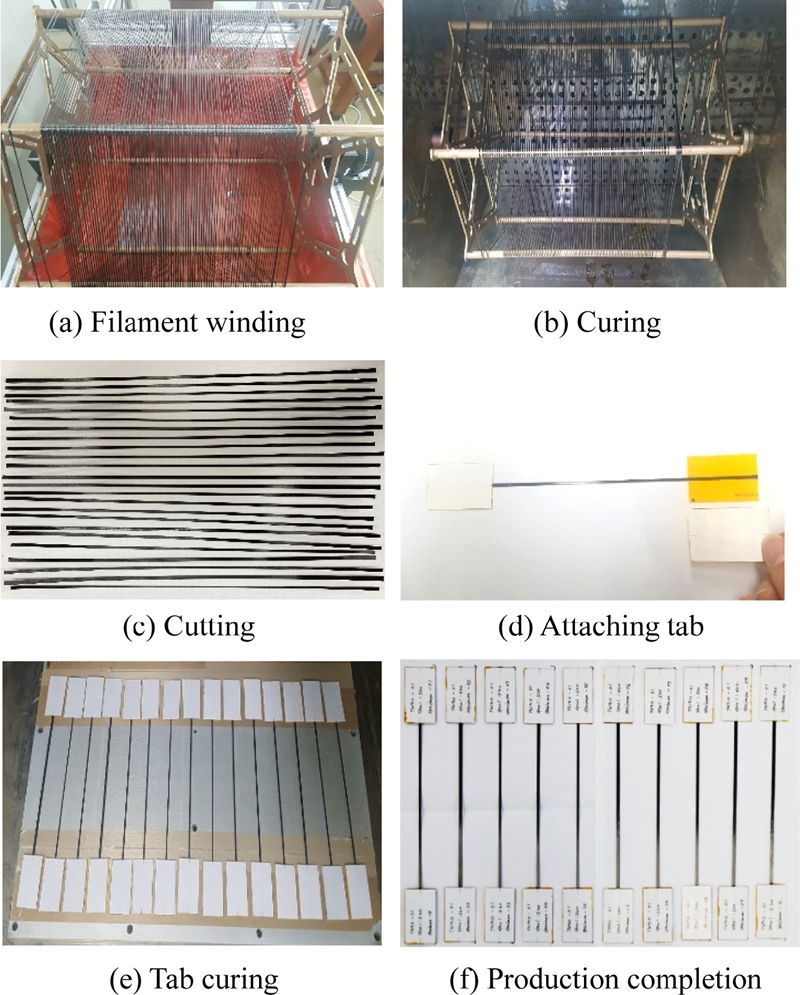
Fig. 1(a)와 같이 스트랜드 시편은 최종 구조물인 복합재 압력 용기의 제작 방법인 필라멘트 와인딩 공법을 이용하여 제작하였고, 40 N의 장력이 유지되도록 하였다. 필라멘트 와인딩 완료 후
Fig. 1(b)와 같이 환경챔버에서 상온에서 1
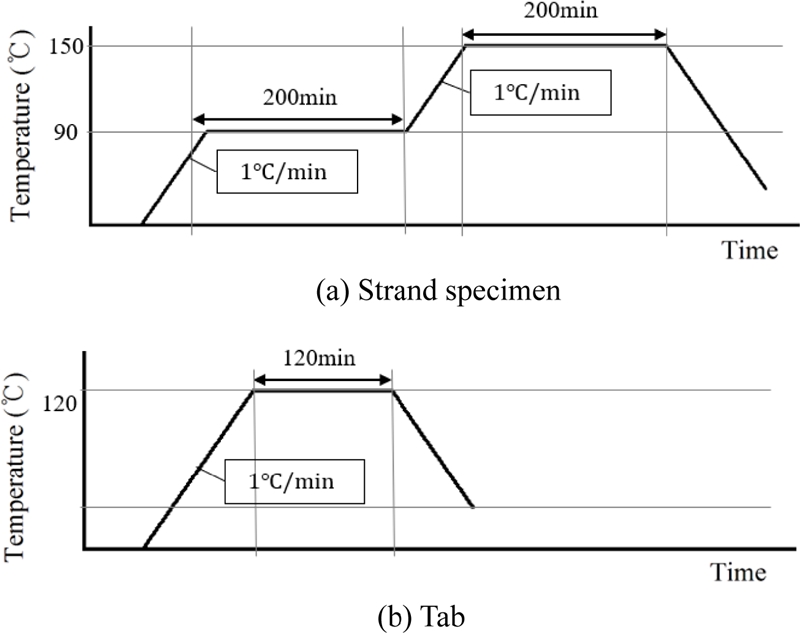
oC/min의 속도로 승온하였으며, 90과 150
oC에서 200분씩 유지하여 성형하였다. 성형이 완료되면 시편의 길이를 250 mm로 절단하여 선별하였다.
Fig. 1(c)는 선별된 시편을 보여준다. 스트랜드 시편에 탭 제작을 위해
Fig. 1(d)와 같이 시편 양단에 50 mm의 잡지 종이와 FM73 접착제를 사용하여 탭을 부착하여,
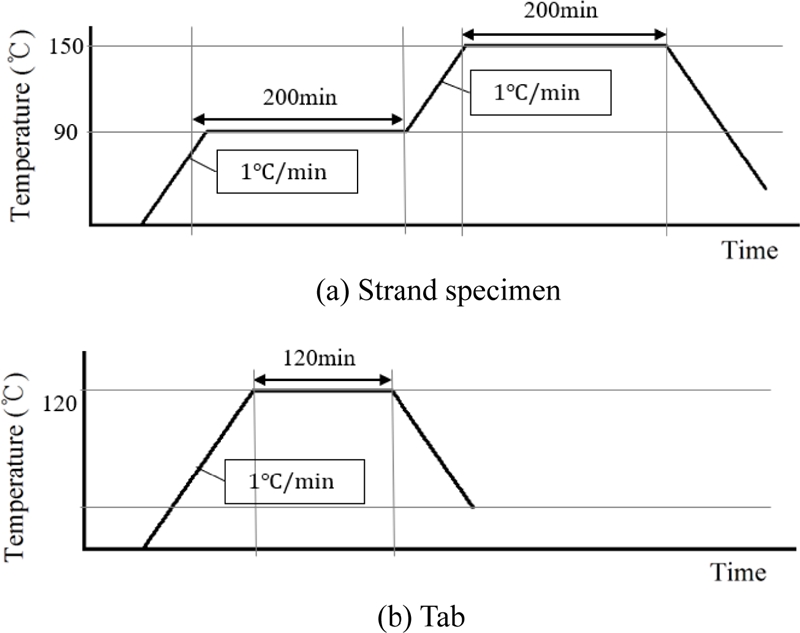
Fig. 2와 같이 상온에서 1
oC/min의 속도로 승온하였으며, 120
oC에서 120분 유지하여 탭을 경화하여 50개의 시편 제작을 완료하였다.
Fig. 1(f)는 제작이 완료된 스트랜드 시편을 보여준다.
Fig. 2는 필라멘트 와인딩된 탄소섬유 복합재 및 스트랜드 시편 탭의 성형 사이클을 보여준다.
Fig. 1Strand specimen manufacturing process
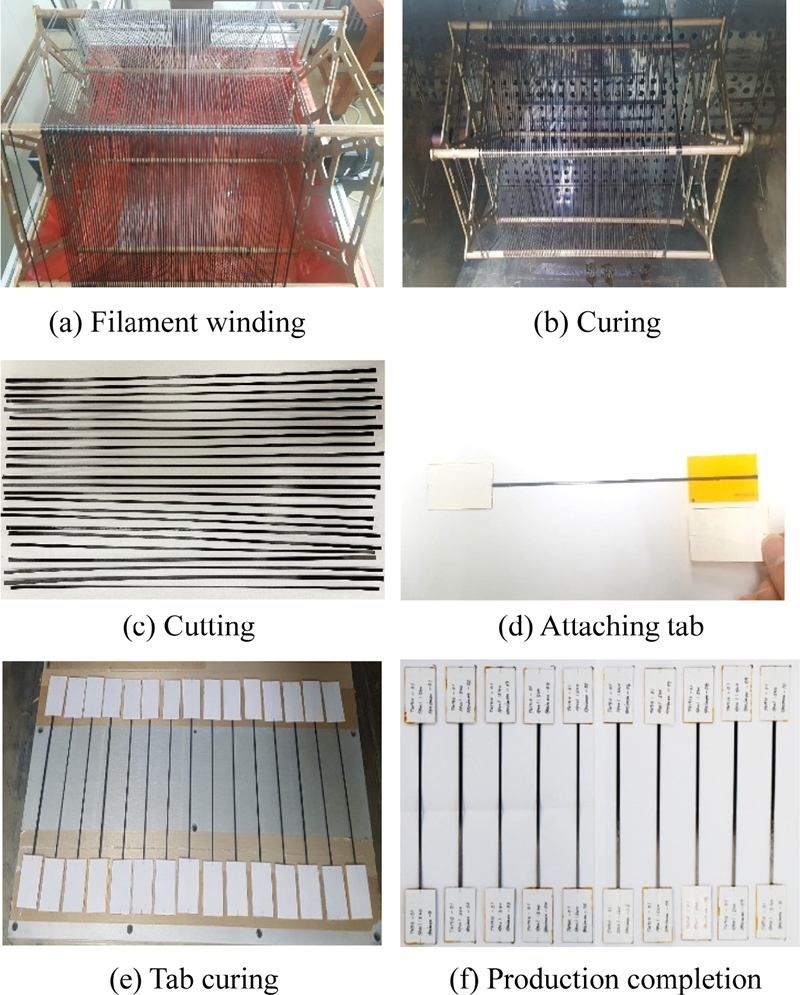
Fig. 2Curing cycles of strand specimen and tab
2.2 탄소섬유 복합재 스트랜드 시험
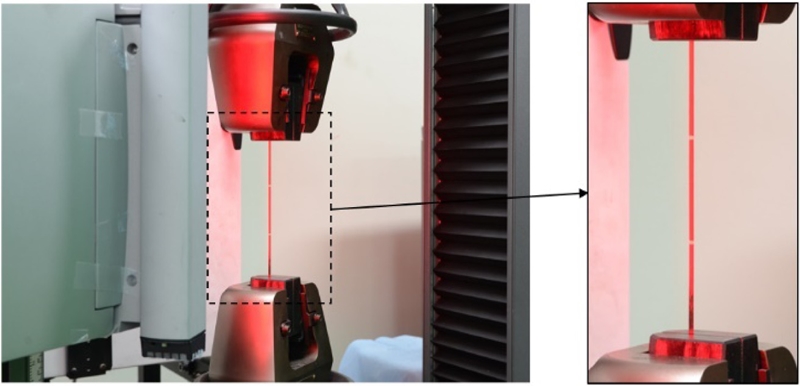
탄소섬유 복합재 스트랜드 인장시험은 Instron 5982 만능재료시험기와 비접촉식 비디오 신율계를 사용하여 하중과 변형률을 측정하였다. 이때, ASTM D 4018 규정에 의거하여 500 mm의 표점거리를 표시하여 2.0 mm/min의 속도로 50개의 시편을 사용하여 시험을 수행하였다.
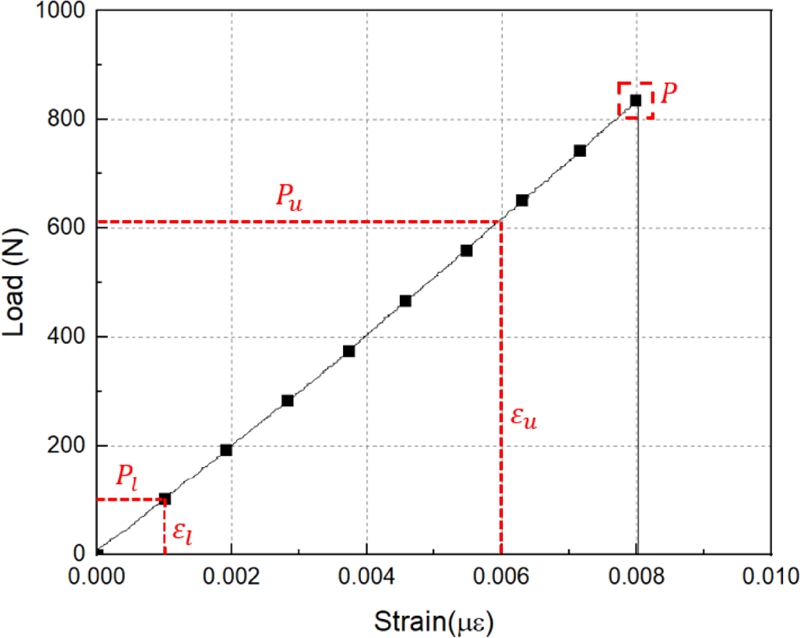
식(1)은 스트랜드 시편의 인장 강도,
식(2)는 탄성 계수 식을 보여준다.
P는 최대 하중,
ρf는 섬유 밀도,
MUL은 단위 길이당 섬유 질량,
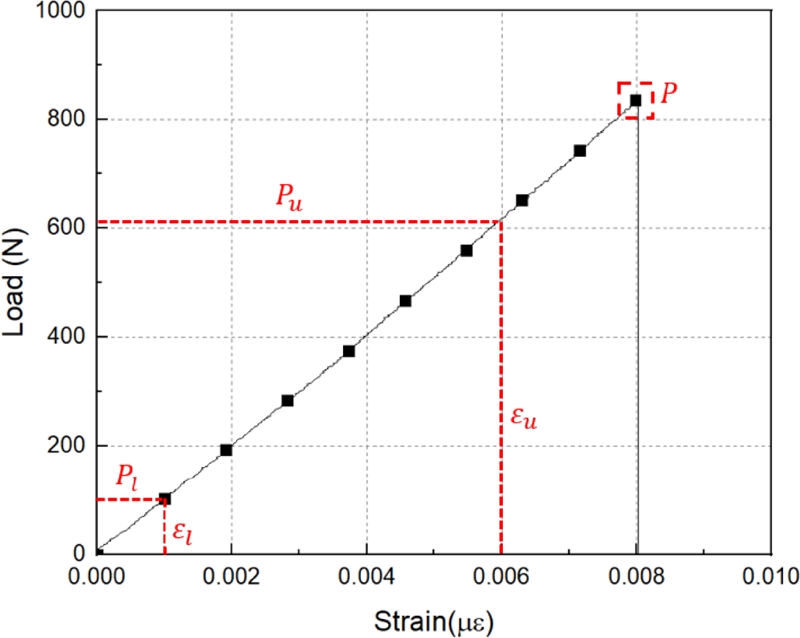
Pu는 변형률 상한의 인장 하중,
Pl은 변형률 하한의 인장 하중,
εu는 변형률 상한,
εl은 변형률 하한을 나타낸다.
Figs. 3과
4는 스트랜드 시험과 스트랜드 시험 결과 개략도를 보여준다.
Fig. 3Strand test
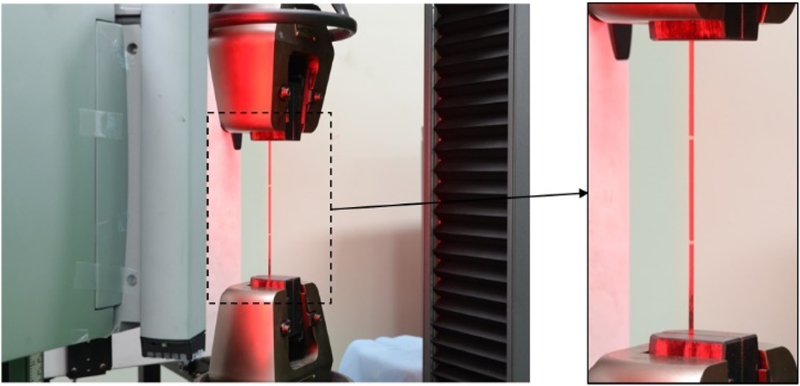
Fig. 4Schematic diagram of strand test
스트랜드 인장시험 결과 T700, T800 탄소섬유의 경우, 각각 4,744.63, 5,438.78 MPa의 인장 강도와 229.11, 286.54 GPa의 탄성 계수를 확인하였고, H2550과 H3055 탄소섬유의 경우 각각 4,883.33, 5,490.37 MPa의 인장 강도와 238.61, 278.07 GPa의 탄성 계수를 확인하였다. 인장 강도와 탄성 계수의 상대표준편차가 5% 이내로 발생하여 스트랜드 인장시험의 신뢰성을 확인하였다.
Table 1은 스트랜드 시험 결과를 보여준다.
Table 1Result of strand test
Table 1
|
Fiber |
Tensile strength
[MPa] |
CV
[%] |
Elastic modulus
[GPa] |
CV
[%] |
|
H2550 |
4,744.63 |
3.98 |
238.61 |
1.55 |
|
T700 |
4,883.33 |
4.38 |
229.11 |
1.79 |
|
H3055 |
5,490.37 |
3.38 |
278.07 |
1.93 |
|
T800 |
5,438.78 |
2.84 |
286.54 |
2.21 |
3. 6.8 L 복합재 압력용기 수압 시험 평가
군수 분야 복합재 평가 방법인 복합재 압력용기의 수압 시험을 수행하기 위해 알루미늄 라이너에 고강도 탄소섬유 복합재를 필라멘트 와인딩하여 6.8 L 복합재 압력용기를 제작하였다.
3.1 복합재 압력용기 제작
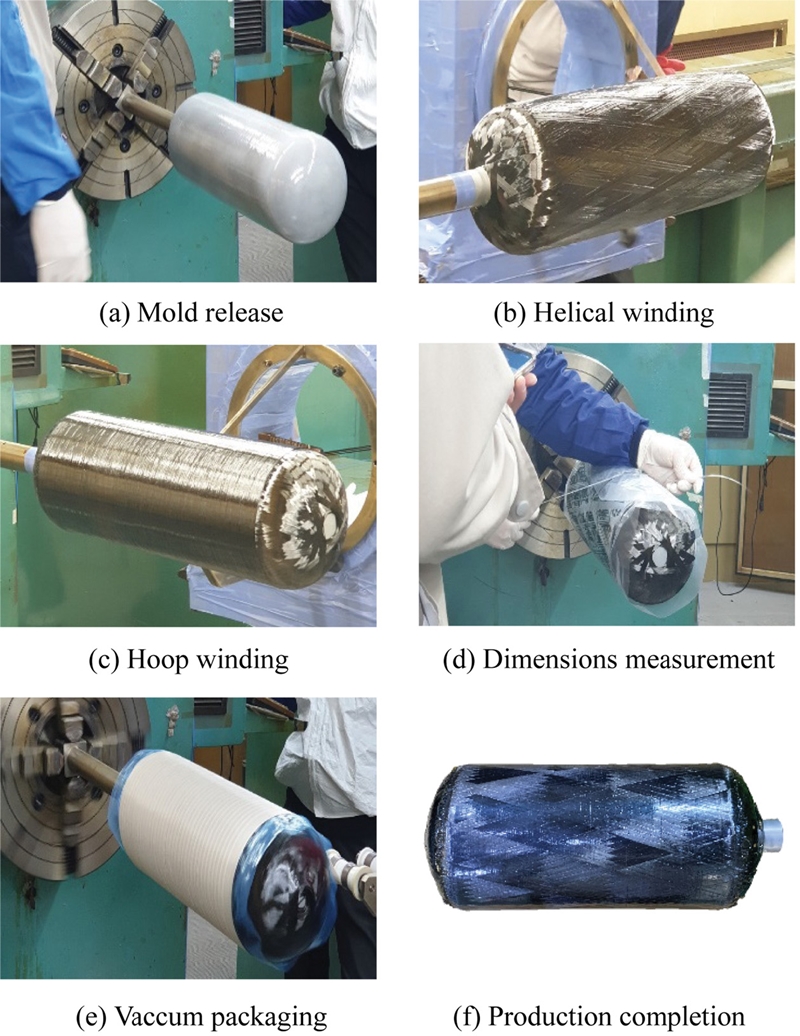
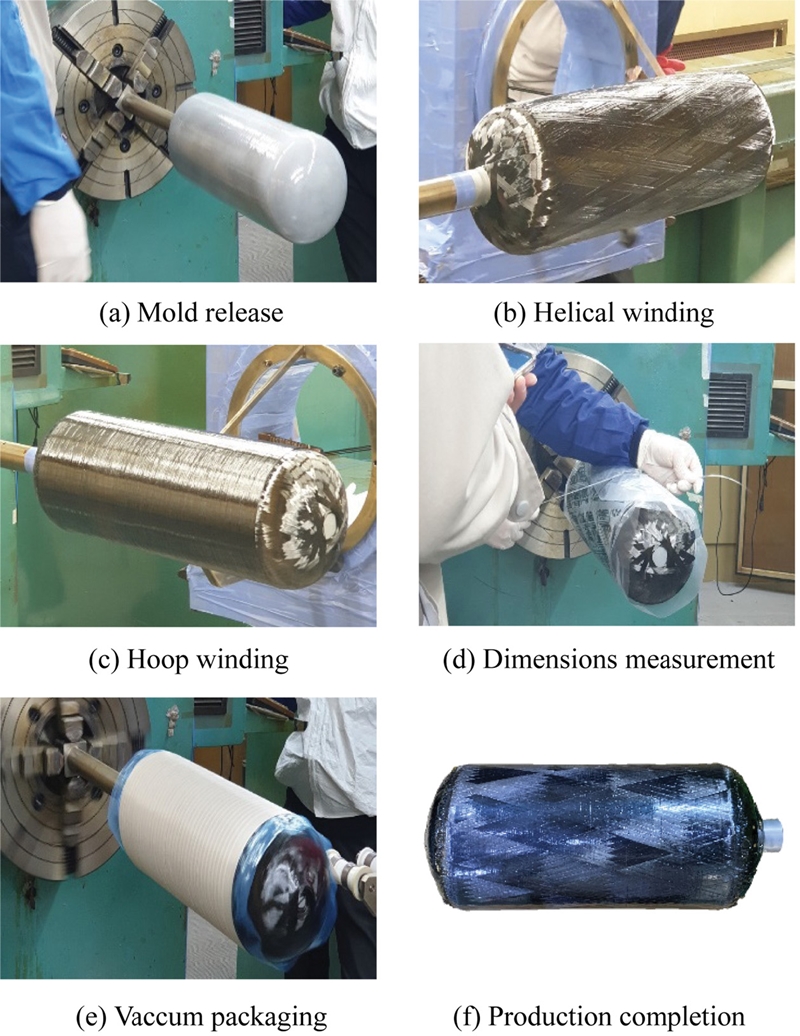
복합재 압력용기 제작 방법은
Fig. 4(a)와 같이 알루미늄 라이너에 이형제를 도포하고, 필라멘트 와인딩 공법인
Figs. 5(b)와
5(c) 같이 헬리컬 와인딩과 후프 와인딩을 하였다. 이때, 섬유 강도전이율 평가를 위해 필라멘트 와인딩 후
Fig. 5(d)와 같이 압력용기 실린더부의 지름을 측정하였다.
Fig. 5(e)와 같이 진공포장 후 오토클레이브에서 성형하였다. 복합재 압력용기는 스트랜드 시편과 동일한 성형 사이클로 성형하였다.
Fig. 5(f)는 성형이 완료된 복합재 압력용기를 보여준다.
Fig. 5Composite pressure vessel manufacturing process
3.2 복합재 압력용기 수압 시험
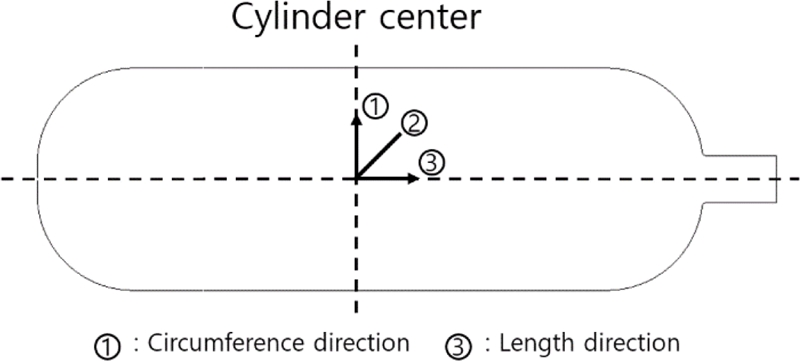
복합재 압력용기 수압 시험에 앞서 누수 시험을 진행하여, 복합재 압력용기의 제작 건전성을 확인하였다. 압력용기 실린더부의 원주 방향으로 3축 스트레인 게이지 2개 부착하여 복합재 압력용기 수압 시험의 건전성을 확인하였다.
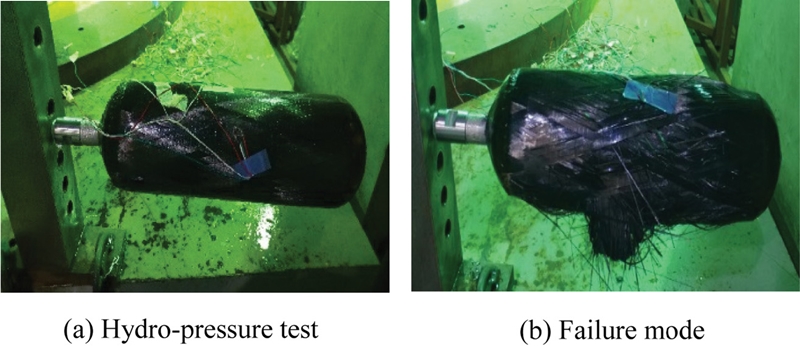
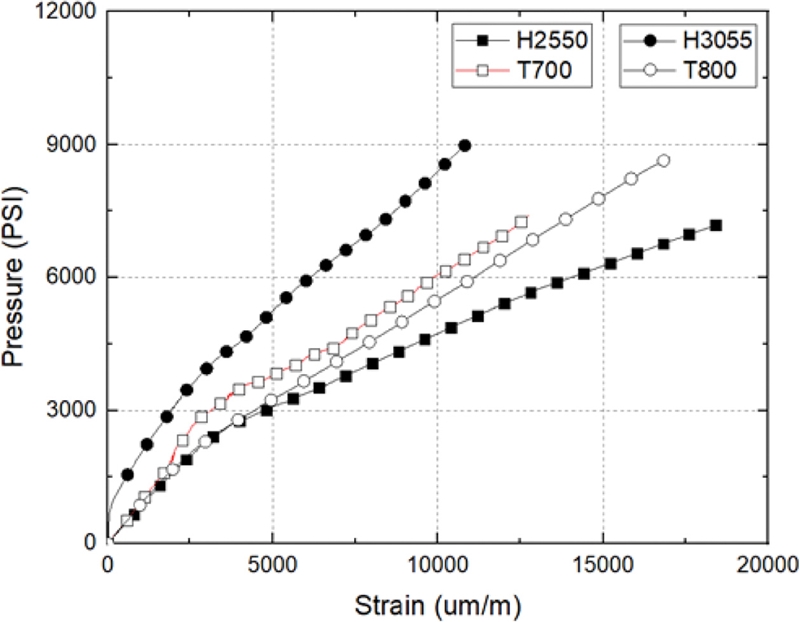
Fig. 6은 스트레인 게이지 부착 위치를 보여준다. T700, T800 소재의 복합재 압력용기는 각각 2, 5조, H2550, H3055 소재의 압력용기는 각각 20, 15조에 대해 수압 시험을 수행하였다. 복합재 압력용기 수압 시험 결과 H2550 소재의 압력용기는 50.43 MPa, T700 소재의 압력용기는 50.94 MPa, H3055 소재의 압력용기는 60.54 MPa, T800 소재의 압력용기는 60.13 MPa 압력이 발생하였고, 압력용기의 실린더부에서 파손이 발생하는 것을 확인하였다.
Fig. 7은 복합재 압력용기의 수압 시험과 파손 형상,
Fig. 8은 수압 시험 변형률-압력 선도를,
Table 2는 수압 시험 결과를 보여준다.
Fig. 6Strain gauge attachment position
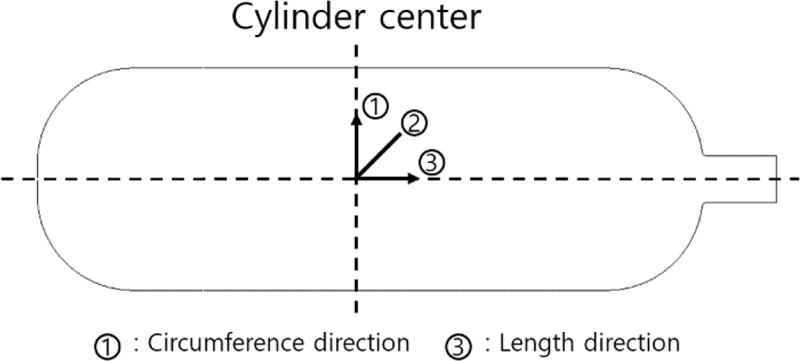
Fig. 7Hydro-pressure test of composite pressure vessel and failure mode
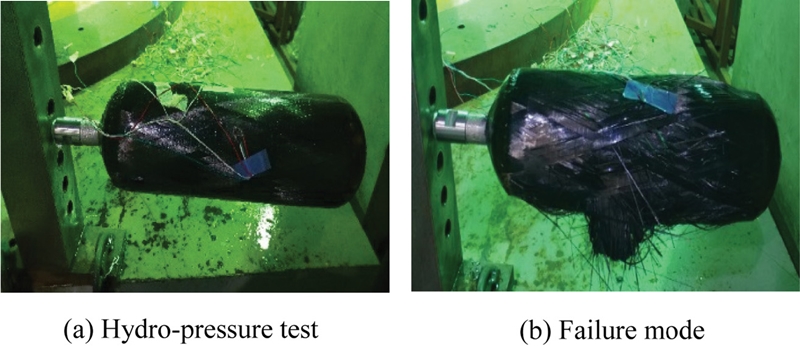
Fig. 8Hydrostatic test for composite pressure vessel
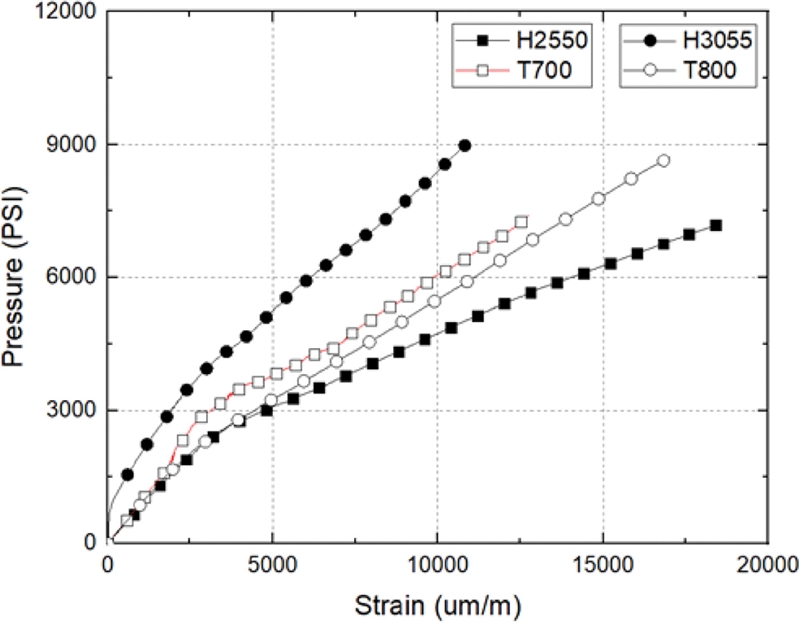
Table 2Result of hydro-pressure test
Table 2
|
Materials |
No. |
PHydro-burst [MPa] |
CV [%] |
|
H2550 |
20 |
50.43 |
4.36 |
|
T700 |
2 |
50.94 |
4.42 |
|
H3055 |
15 |
60.54 |
6.58 |
|
T800 |
5 |
60.13 |
2.40 |
3.3 복합재 압력용기 섬유 강도 평가
복합재 압력용기 수압 시험을 통해 고강도 탄소섬유 복합재의 섬유 방향 강도를 도출하였다. 섬유 방향 강도 도출식은
식(3)과 같으며,
9 σfiber는 섬유 강도,
Pburst는 복합재 압력용기의 파열압,
rc는 압력용기 실린더 반지름,
α는 복합재 압력용기 와인딩 각도,
Vf는 섬유 체적률
thoop는 압력용기 후프와인딩 두께이다. 복합재 압력용기의 파열압
Pburst은 수압 시험 파열압에서 알루미늄 파열압
PAL을 빼서 구할 수 있으며, 이때 알루미늄 파열압은 알루미늄 항복응력
σAL)yield과 알루미늄 라이너 두께
tALliner 그리고 라이너 반지름
RLiner을 이용하여 도출할 수 있다. 복합재 압력용기 와인딩 각도
α는
식(6)과 같이 압력용기 보스부의 반지름
r0과 압력용기 실린더부의 반지름
rc을 이용하여 도출할 수 있다.
Table 3은 복합재 압력용기 파열압 및 후프와인딩 두께를 보여준다.
Table 3Variables for fiber strength evaluation
Table 3
|
Materials |
Pburst [MPa] |
thoop [mm] |
|
H2550 |
40.77 |
1.17 |
|
T700 |
50.94 |
1.34 |
|
H3055 |
51.91 |
1.43 |
|
T800 |
50.98 |
0.98 |
고강도 탄소섬유 복합재 섬유 강도평가 결과, Toray의 T700, T800 탄소섬유의 경우, 섬유 방향 인장 강도가 각각 4,458.21, 6,014.92 MPa, 효성의 H2550과 H3055 탄소섬유의 경우 각각 4,122.66, 4,068.96 MPa로 도출되었다. H3055 소재와 T800 소재로 제작한 복합재 압력용기 섬유 방향 강도 평가 결과 H3055로 제작된 후프와인딩 두께가 약 50% 더 큰 것으로 확인되어 유사한 수압 시험 파열 압력에서 섬유 방향 강도가 더 낮게 도출된 것으로 확인하였다.
Table 4는 복합재 압력용기의 섬유 방향 강도 평가 결과를 보여준다.
Table 4Result of fiber direction strength for composite materials pressure vessel
Table 4
|
Materials |
Fiber direction strength [MPa] |
Materials |
Fiber direction strength [MPa] |
|
H2550 |
4,122.66 |
H3055 |
4,174.68 |
|
T700 |
4,458.21 |
T800 |
6,014.92 |
4. 섬유 강도전이율 평가
국내외의 탄소섬유 복합재의 섬유 단위에서의 강도와 복합재 압력용기 수압 시험에서 도출한 섬유 강도를 비교하여 강도전 이율을 평가하였다.
4.1 강도전이율
탄소섬유 복합재의 강도전이율 평가식은
식(7)과 같다. STR(%)은 강도전이율을 나타내며,
σfiber copv와
σfiber strand는 각각 복합재 압력용기 수압 시험에서 도출한 탄소섬유 복합재의 섬유 강도와 스트랜드 단위에서의 탄소섬유 복합재의 섬유 강도를 나타낸다.
탄소섬유 복합재의 강도전이율 평가 결과 H2550, T700 소재의 강도전이율은 각각 86.35, 91.29%로 확인하였고, H3055, T800 소재의 강도전이율은 각각 74.19, 110.59%로 확인하였다. H2550는 T700 섬유와 비교하였을 때, 유사한 강도전이율 갖는 것을 확인하여 군수 분야 적용이 가능할 것으로 판단된다. 그러나 H3055는 T800과 비교하였을 때, 강도전이율의 차이가 매우 큰 것으로 확인하였고, 원사의 직경을 줄인다면 T800과 유사한 강도전이율을 가져 군수 분야 적용이 가능할 것으로 판단된다.
Table 5는 섬유 강도전이율 결과를 보여준다.
Table 5Result of fiber strength transition
Table 5
|
Materials |
STR [%] |
Materials |
STR [%] |
|
H2550 |
86.35 |
H3055 |
74.19 |
|
T700 |
91.29 |
T800 |
110.59 |
5. 결론
본 논문에서는 국내 탄소섬유 복합재의 섬유 강도전이율을 평가에 대해 연구를 수행하였으며 다음과 같은 결론을 얻었다.
(1) 국내 고강도 탄소섬유 복합재 H2550, H3055 소재와 국외 고강도 탄소섬유 복합재 T700, T800을 이용하여 스트랜드 시편을 제작하여 스트랜드 시험을 수행하였다. 스트랜드 시험 결과, T700과 T800의 인장 강도는 4,883.34, 5,438.78 MPa, H2550과 H3055의 인장 강도는 각각 4,774.63, 5,490.37 MPa로 확인하였다.
(2) 필라멘트 와인딩 공법을 적용하여 국내외 탄소섬유 복합재 압력용기를 제작하였다. 복합재 압력용기 수압 시험을 수행하여 탄소섬유 복합재의 섬유방향 강도에 대해 평가하였다. T700, T800 탄소섬유의 경우, 섬유 방향 인장 강도가 각각 4,458.21, 6,014.92 MPa, 효성의 H2550과 H3055 탄소섬유의 경우 각각 4,122.66, 4,068.96 MPa로 도출되었다.
(3) 국내외 탄소섬유 강도전이율 평가 결과, 국외 섬유 T700과 T800 섬유의 섬유 강도전이율은 각각 91.29, 110.59%로 확인하였고, 국내 섬유 H2550과 H3055 소재의 섬유 강도전이율은 각각 86.35, 74.19%로 확인하였다.
(4) 섬유 강도전이율 비교 결과, T700 섬유는 H2550 섬유로 대체하여 군수 분야 적용이 가능할 것으로 판단된다. 그러나 T800 섬유는 H3055 섬유로 대체하기 어려울 것으로 판단되나, H3055 섬유 원사의 직경을 줄인다면 군수 분야 적용이 가능할 것으로 판단된다.
ACKNOWLEDGMENTS
본 연구는 민군협력진흥원(ICMTC)의 재원으로 인장 강도 6.4 GPa급 초고강도 PAN계 탄소섬유 개발의 지원을 받아 수행한 연구과제입니다.
이 논문은 2018년도 한밭대학교 대학회계 연구비를 지원받아 작성되었습니다.
REFERENCES
- 1.
Im, J., Shin, K., and Hwang, T., “Effect of Temperature on Interlaminar Fracture Toughness of Filament-Wound Carbon/Epoxy Composites,” Transactions of the Korean Society of Mechanical Engineers A, Vol. 39, No. 5, pp. 491-497, 2015.
10.3795/KSME-A.2015.39.5.491
- 2.
- 3.
- 4.
Choi, I. H., “Characteristic Evaluation of Domestic Carbon Fiber Composite Materials,” Korea Aerospace Research Institute, 2017.
- 5.
Ji. Y. S., “2018 Carbon Fiber and Carbon Fiber Processing Materials Industry Ecosystem Survey,” INI Research & Consulting, 2018.
- 6.
Hwang, T., Doh, Y., and Kim, H., “Size Effect on Tensile Strength of Filament Wound CFRP Composites,” Composites Research, Vol. 24, No. 5, pp. 1-8, 2011.
10.7234/kscm.2011.24.5.001
- 7.
Hwang, T. K., Hong, C. S., and Kim, C. G., “Probabilistic Fiber Strength of Composite Pressure Vessel,” Composite Research, Vol. 16, No. 6, pp. 1-9, 2003.
- 8.
ASTM D4018-17, “Standard Test Method for Properties of Continuous Filament Carbon and Graphite Fiber Tows,” 2004.
- 9.
Hwang, T. K., Park, J. B., and Kim, H. G., “Evaluation of Fiber Material Properties in Filament-Wound Composite Pressure Vessels,” Composites Part A: Applied Science and Manufacturing, Vol. 43, No. 9, pp. 1467-1475, 2012.
10.1016/j.compositesa.2012.04.005
Biography
- Sang Hyup Lee
M.Sc. candidate in the Department of Mechanical Engineering, Hanbat National University. His research interest is Composite Material Mechanics.
- Nam Hoon Kim
B.S. candidate in the Department of Mechanical Engineering, Hanbat National University. His research interest is Composite Material Mechanics.
- Kwang Bok Shin
Professor in the Department of Mechanical Engineering, Hanbat National University. His research interest is Composite Material Mechanics.