ABSTRACT
In this paper, we present a simple and robust fabrication method for mushroom-shaped microstructures using diverse polymers with various modulus of elasticity. Through the repeated replica molding process, we fabricated the same PDMS mushroom structure negative mold as the prepared silicon master mold. To evaluate the fabricating stability of the fabricated PDMS negative mold, the mushroom-shaped structures were replicated from the mold using six types of polymer resins with different elastic modulus and we measured superhydrophobic properties on the samples. All the fabricated samples exhibited superhydrophobicity, and we proved the structural stability of the proposed replication method through the measured SEM images, contact angles on the samples, and theoretical analysis based on the structural shape.
-
KEYWORDS: Replica molding, Mushroom-shaped structure, Superhydrophobic, Elastic modulus, Polymer resin
-
KEYWORDS: 레플리카 몰딩, 버섯 모양 구조, 초소수성, 탄성 계수, 고분자 수지
NOMENCLATURE
Scanning electron microscope
Diameter of mushroom t ip
Diameter of mushroom pillar
Distance between the pillars
Contact angle of cassie state droplet on the structured surface
Contact angle of droplet on the flat surface
Fractional component of solid surface
Fractional component of air gap
1. 서론
자연계에서 볼 수 있는 미세 버섯 구조 표면에서 나타나는 초소수성 성질이나 건식접착 성질은 청정이송시스템, 소프트 로봇시스템, 디스플레이, 의료 산업 등 다양한 응용 분야에 적용되고 있다. 이에 많은 연구진들이 이와 같은 기능성 마이크로/나노 크기의 미세 버섯 구조 표면을 제작하기 위해 다양한 공정 기법을 제시하고 있다.
1-8 그 중에도 레플리카 몰딩 공정 기법은 저비용으로 간단하게 대면적으로 제작할 수 있다는 장점 때문에 이러한 버섯 구조 표면 제작에 많이 활용되고 있다. 그러나 독특한 기능을 지니는 미세 버섯 모양 구조는 일반 마이크로 기둥 구조와 다르게 구조 상단에 뿌리 기둥보다 지름이 크고 평평한 모양의 얇은 팁이 있기 때문에 레플리카 몰딩 공정으로 제작 시 몰드로부터 고분자 구조를 분리할 때 더욱 큰 힘이 필요하게 된다. 이로 인해 분리되는 과정에서 팁을 포함한 구조가 파손되거나, 분리된 직후에 개별 미세구조가 빠르게 튕겨져 나오며 인접한 구조끼리 붙게 되는 등 공정상의 여러 결함이 발생할 수 있다.
7 이러한 결함을 발생시키는 데에는 버섯 모양 구조가 지니는 팁의 직경이나 구조의 높이, 재질의 탄성 계수 등이 영향을 미칠 수 있다.
4,7,9,10 특히, 실리콘 마스터를 몰드로 사용하여 레플리카 몰딩 과정을 진행하는 경우, 제작된 실리콘 마스터의 역상 형태의 버섯 모양 언더컷 형상으로 인하여 미세 버섯 구조 표면과 같이 팁 구조를 갖는 고분자 표면들은 일반적으로 PDMS처럼 탄성 계수가 낮은 재질로 한정되어 제작되었다. 이는 다양한 재료를 이용한 미세 버섯 구조의 제작에 대한 한계점으로 작용되며 결국 다양한 표면으로의 응용가능성이 좁아지는 결과를 초래한다.
이에 본 연구에서는 레플리카 몰딩 공정을 반복적으로 수행하여 미세 버섯 구조와 같은 언더컷 구조 표면의 제작 한계를 해소하기 위한 방법을 제시하고자 한다. 먼저 연구에 사용할 PDMS 고분자 미세 버섯 구조 표면을 제작하였고 PDMS뿐만 아니라 다양한 레진을 이용한 미세 버섯 구조의 효과적인 복제를 위하여 기존의 실리콘 마스터 몰드가 아닌 PDMS를 이용한 레플리카 몰드를 제작하였다. 이를 통해 탄성 계수가 다른 여러 레진을 사용하여 복제한 샘플 표면을 제작하였다. 또한 일반적인 고분자 레진뿐만 아니라 SiO2 나노 파티클이 포함되어 유연하지 않고 Brittle한 고분자 레진으로도 대면적으로(1 × 1 cm2) 미세 버섯 구조를 팁 손상 없이 성공적으로 복제하였다. 복제한 표면이 기존의 버섯 구조와 동일하게 제작되었는지 확인하기 위해 주사 전자 현미경(Scanning Electron Microscope, SEM)으로 촬영한 이미지를 비교하였다. 또한 복제한 표면이 기존의 버섯 구조와 동일한 구조적 효과를 가지는지 판단하기 위해 구조 표면의 젖음성 특성을 측정하고 이론적으로 분석하였다.
2. 본론
2.1 다양한 고분자를 이용한 온전한 머쉬룸 형상의 마이크로 구조 제작
본 연구에서는 음각 형태의 버섯 구조를 지니는 실리콘 마스터를 제작하고 이를 이용하여 여러 차례의 고분자 복제 공정을 거쳐 최종적으로 음각 형태의 PDMS 몰드를 제작하였다.
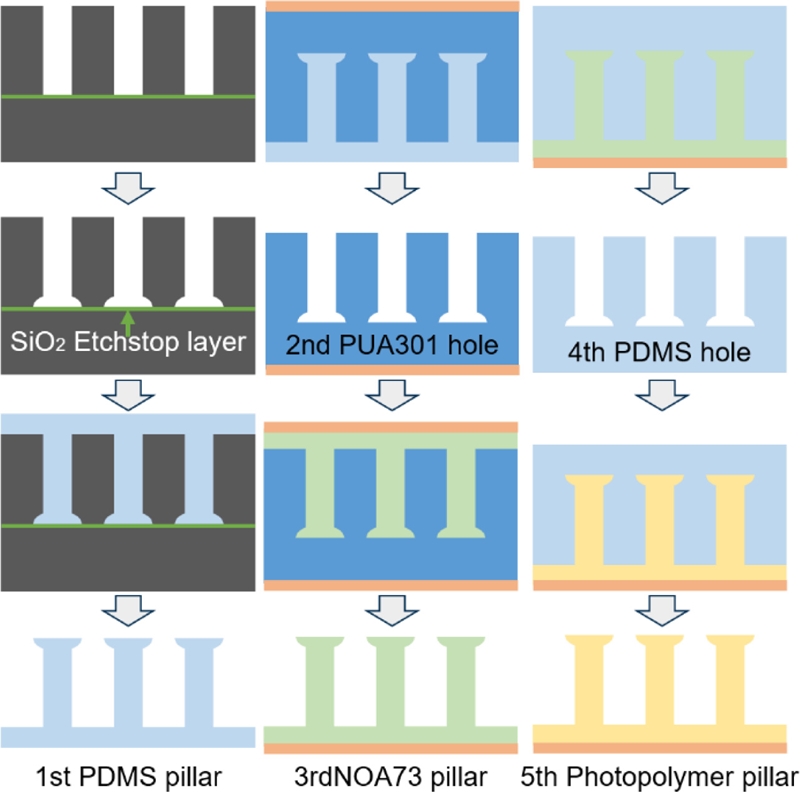
Fig. 1에서와 같이, 먼저 식각 저지층(SiO
2 Etchstop Layer)이 있는 실리콘 웨이퍼에 포토리소그래피 공정을 통해 원하는 크기의 패턴을 형성하고 이를 식각 마스크로 하여 건식 식각 공정을 통해 원기둥 형상의 마이크로 필라 구조를 제작한다. 이때, 식각 저지층까지 마이크로 필라 구조를 형성하고 이후의 과도 식각 과정을 통해 밑면이 평평하고 넓은, 전체적으로 버섯 모양인 구조의 역상(음각) 실리콘 마스터 몰드를 제작하였다. 과도 식각 과정은 기존의 건식 식각 과정에서 수직 방향으로 진행되는 식각층이 식각 저지층에 도달했을 때 식각 저지층을 식각하지 못하면서 오히려 주변의 실리콘을 수평 방향으로 식각하며 들어가는 언더컷 현상을 말한다. 이를 응용하여
Fig. 1과 같이 음각 형태의 버섯 구조를 지니는 실리콘 마스터를 제작할 수 있다.
Fig. 1Illustrated schemes of repeatable replication process for mushroom-shaped microstructure using diverse polymers
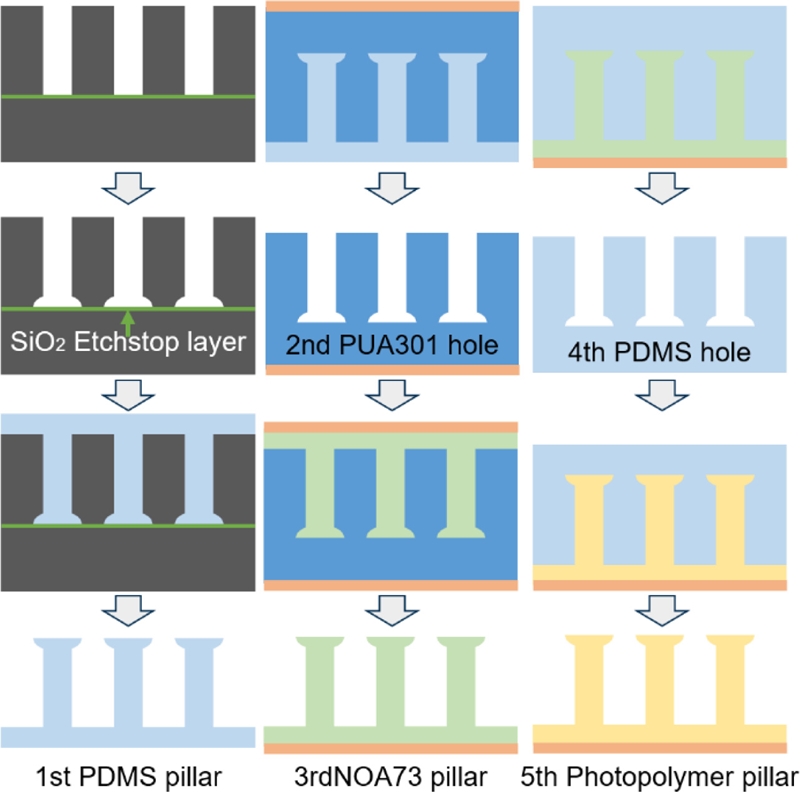
제작한 실리콘 마스터 위에 PDMS 주재료와 경화제를 10 : 1로 혼합한 중합체를 40 g 정도 부은 후 70
oC에서 2시간 동안 열경화 과정을 거치면 PDMS 고분자 버섯 구조를 제작할 수 있다. 제작된 PDMS 버섯 구조를 재차 몰드로 하여 광경화성 수지인 Polyurethane Acrylate (PUA) 레진을 도포한 후 PET 필름을 Substrate로 사용하고, 자외선을 조사하여 경화시킨 뒤 떼어내면 실리콘 마스터와 같은 구조인 2차 버섯 구조 역상 패턴을 얻을 수 있다. 2차 PUA 몰드의 표면에 미세하게 경화되지 않고 남은 레진을 UV를 장시간 조사하여 완전 경화시킨 후 이를 몰드로 사용할 수 있다. 그러나 PUA 몰드도 PDMS에 비해 탄성 계수가 높아 높은 탄성 계수를 갖는 레진의 몰딩은 높은 확률로 결함이 발생했다. 따라서 상대적으로 낮은 탄성 계수를 갖는 NOA73 레진을 2차 PUA 몰드에 도포한 후 PET 필름을 덮은뒤 자외선을 조사하여 경화시킨다. 2차 PUA 역상 구조와 경화된 NOA73 구조를 분리하면 1차 PDMS 버섯 구조와 동일한 구조의 3차 NOA73 버섯 구조를 얻을 수 있다. 이를 마찬가지로 완전 경화 과정을 거친 뒤 마지막으로 3차 NOA73 버섯 구조 표면으로부터 PDMS를 다시 복제하면 4차 PDMS 버섯 구조 역상을 제작할 수 있는데,
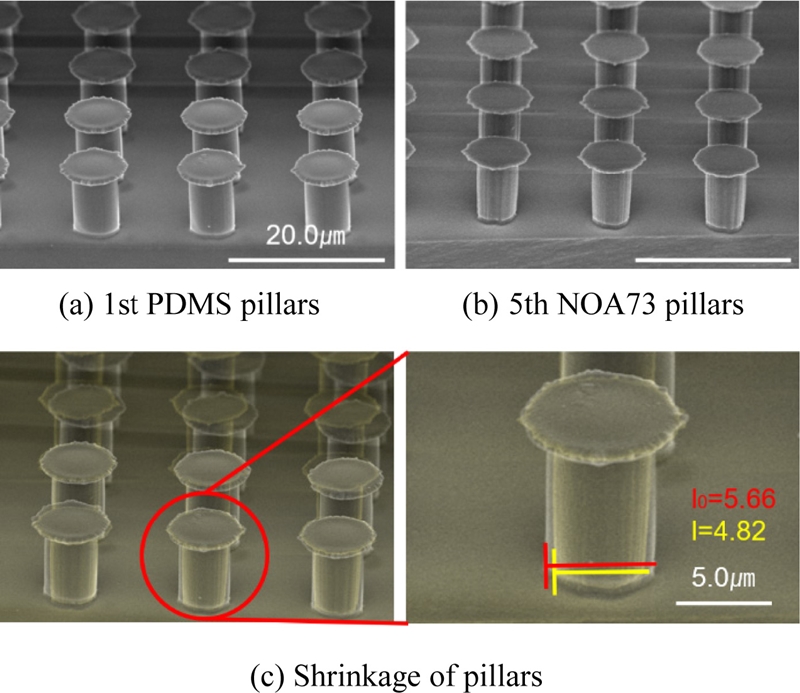
Fig. 2(b)는 4차 PDMS 몰드를 통해 제작한 NOA73 5차 버섯 구조 표면이다. 제작된 4차 PDMS 몰드는 수차례 재사용이 가능하였으며, NOA73 이외에도 PDMS를 몰드로 사용하는 다양한 레진을 사용하여 버섯 구조를 제작할 수 있다. 각 단계별 제작 과정 중에 버섯 구조 형상을 지니는 대표적인 표면의 SEM 사진이
Fig. 2에 정리되어 있다.
Fig. 2SEM images of (a) 1st PDMS pillars, (b) 5th NOA73 pillars and (c) Shrinkage of pillars
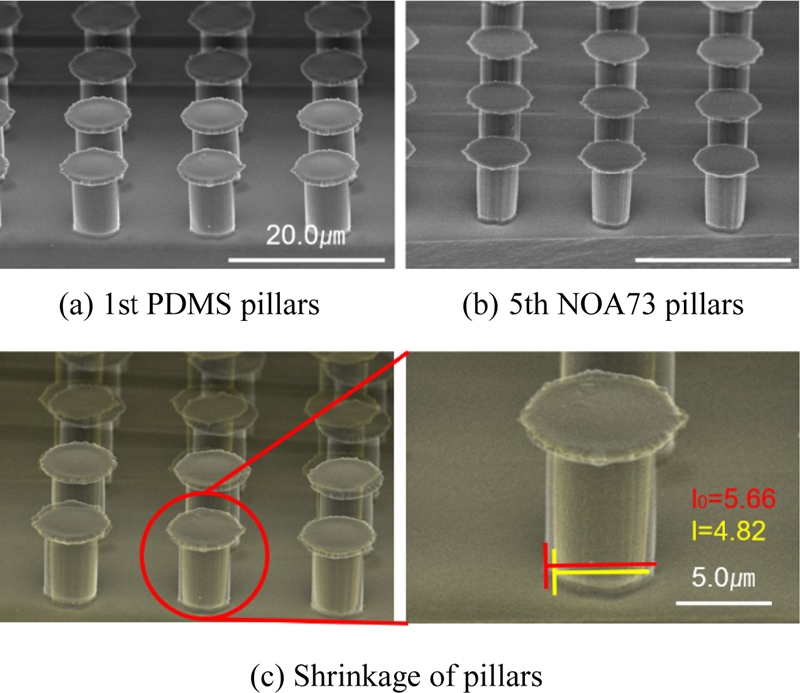
Fig. 2(c)는 복제 공정을 반복적으로 수행하는 과정에서 구조의 수축이 발생한 것을 시각적으로 확인하기 위해
Figs. 2(a)와
2(b)를 겹쳐 놓은 모습이다. 이미지상에서 구조의 뿌리 직경을 측정한 결과 뿌리 직경은 약 13.9%의 수축이 있었으나, 상단 팁의 직경은 거의 유사하여 기존 버섯 구조의 젖음성 성질을 유지하는 것에 큰 차이가 없을 것으로 보여진다.
PDMS 패턴과 5차 NOA73 패턴의 전체적인 형상에서는 차이를 보이지 않으며 이를 통해 다양한 고분자를 이용하여 여러번의 복제 공정을 거치면서도 대면적으로 버섯 구조 패턴이 성공적으로 제작되었음을 알 수 있다.
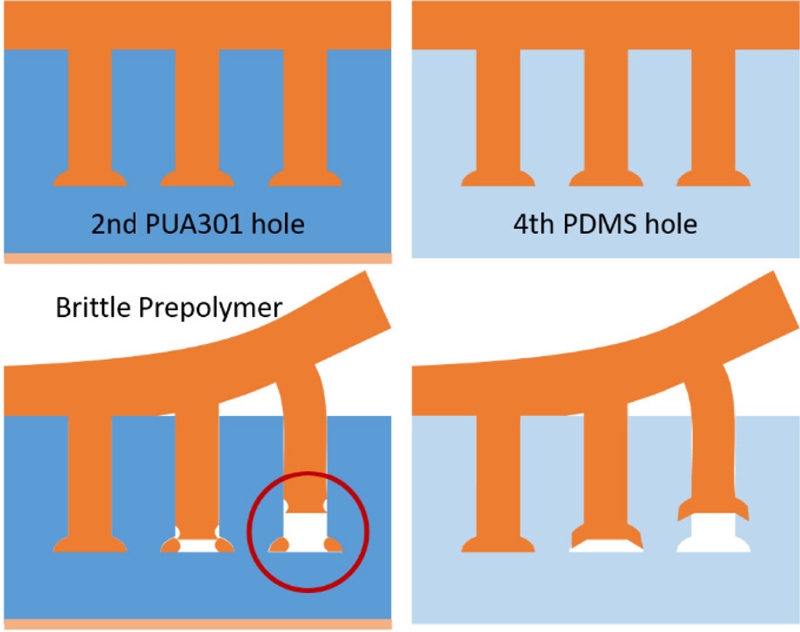
먼저 제작한 실리콘 마스터 몰드는 언더컷 구조를 갖고 있어 유연하지 않은 재질의 고분자를 이용하여 복제 공정을 수행하면 고분자 경화 이후 이형 시 버섯 구조의 가장 윗부분인 팁이 파손될 수 있다. 실리콘 마스터 몰드뿐만 아니라,
Fig. 3에서 볼 수 있듯이, 강성이 높은 고분자 재료인 2차 PUA 몰드에서도 Brittle한 고분자 레진으로 버섯 구조 제작 시 팁이 파손될 수 있다. 최종 형상에서 팁이 파손된 고분자 구조는 처음 설계했던 기능을 상실하기에 공정상의 실패로 간주된다. 즉, 실리콘 마스터와 2차 PUA 몰드와 같은 탄성 계수가 높은 물질로 이루어진 버섯 구조의 음각 몰드에서는 PDMS와 같이 탄성 계수가 낮은 고분자 물질의 복제만 가능하게 된다.
7,8 이는 물질의 다양성을 제공하지 못하는 단점으로 지적된다. 이를 극복하기 위해 본 논문에서는 탄성 계수가 낮은 4차 PDMS 음각 몰드를 제작하였고
Fig. 3에서와 같이 이를 이용하여 최종 구조물을 제작할 때, 다양한 고분자 물질을 사용하더라도 팁 부분이 손상되지 않고 온전히 이형되는 것을 확인할 수 있다.
Fig. 3Schematic illustration showing the difference in replication process using 2nd PUA 301 mold and 4th PDMS mold
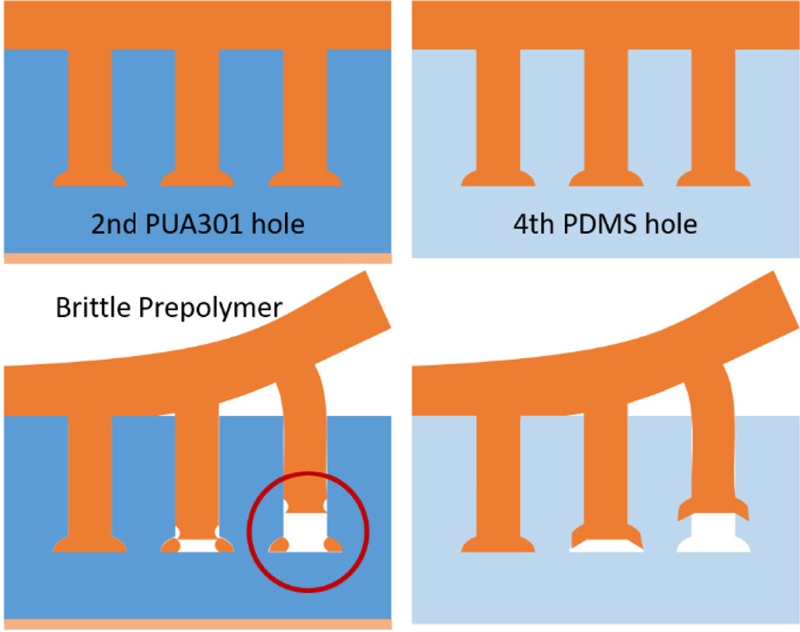
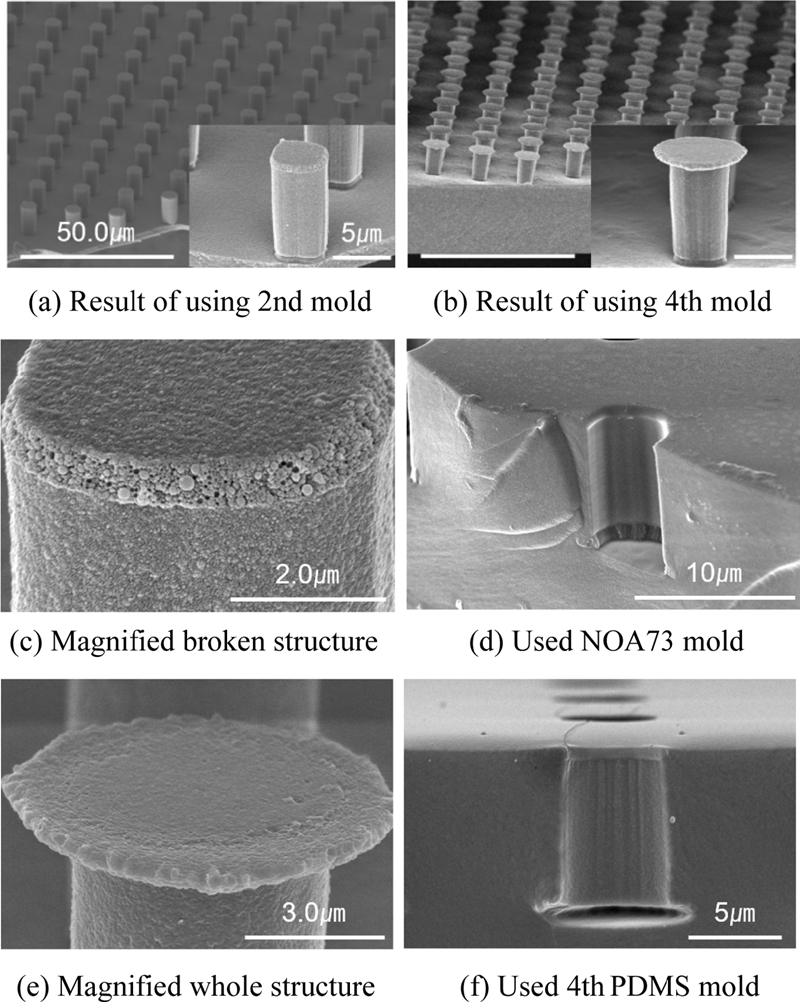
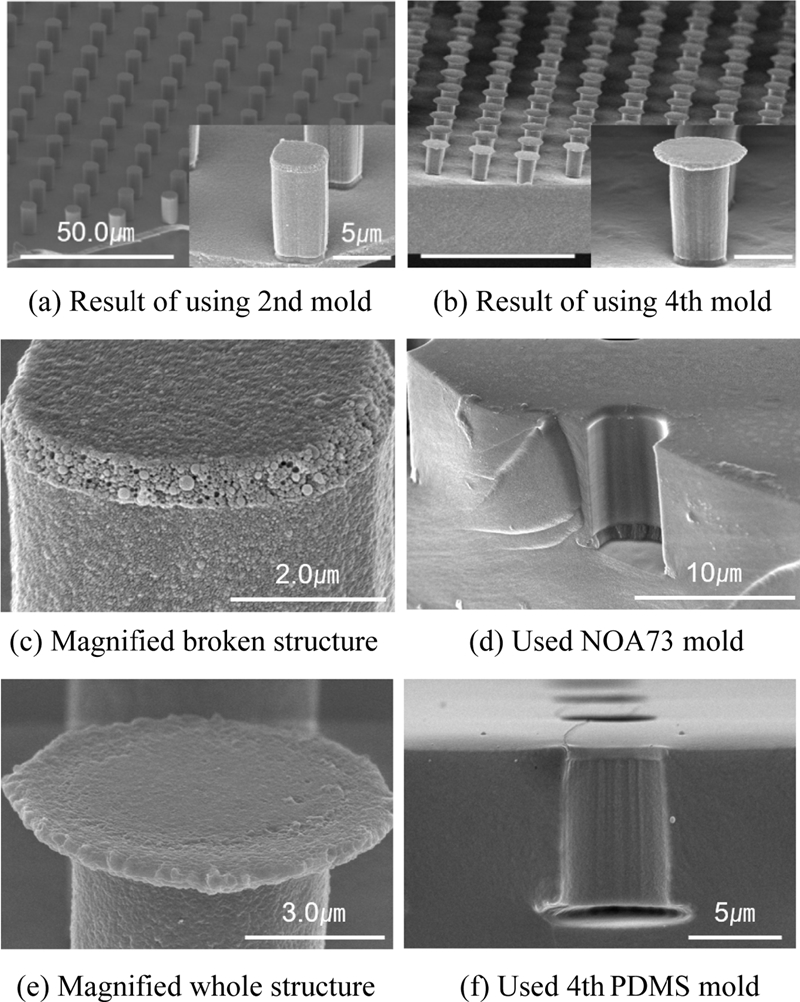
Fig. 4에 정리된 SEM 사진은 SiO
2 나노 파티클이 포함된 PUA 레진으로 제작한 버섯 구조를 각각 2차 PUA 몰드와 4차 PDMS 몰드에서 제작한 결과물을 비교하여 보여주고 있다.
Fig. 4(a)는 2차 PUA 몰드로 제작한 나노 파티클 레진 버섯 구조로 거의 대부분의 팁이 파손되어 있는 것을 확인할 수 있다. 반면
Fig. 4(b)는 4차 PDMS 몰드로 제작한 같은 재질의 패턴으로 팁 손상 없는 대면적 버섯 구조를 제작할 수 있음을 보여준다.
Fig. 4(c)에서 보이는 것과 같이 파손된 팁 단면을 확대하여 살펴보면 나노 파티클이 레진과 분리되며 돌출되어 있다. 해당 PUA 레진은 SiO
2 나노 파티클이 포함되어 있어 다른 레진에 비해 유연하지 않고 이로 인해 복제 공정 과정에서 팁이 더욱 쉽게 깨질 수 있다. NOA73 몰드로 제작 시에도
Fig. 4(d)와 같이 높은 확률로 몰드에 팁이 박혀서 버섯 구조 몰드로써의 사용이 불가능하였다. 하지만
Fig. 4(e)에서 보이는 것처럼 4차 PDMS 몰드를 통해 제작하면 SiO
2 나노 파티클이 포함된 PUA 레진이라 하더라도 팁이 안정적으로 형성되고
Fig. 4(f)에서 보이는 바와 같이 사용 후의 4차 PDMS 몰드도 재사용이 가능한 상태를 유지하는 것을 확인하였다.
Fig. 4SEM images of the fabricated microstructures using (a) 2nd PUA301 mold and (b) 4th PDMS mold. The magnified SEM image of broken structure and mold are shown in (c) and (d), respectively. The magnified SEM image of whole structure and mold are shown in (e) and (f)
2.2 다양한 고분자로 제작된 머쉬룸 형상 구조 표면에서의 젖음성 비교
제작된 4차 PDMS 몰드의 제작 안정성을 증명하기 위해
Table 1에 제시된 바와 같이 PDMS를 제외하고 다양한 탄성 계수를 갖는 UV 경화성 고분자 레진을 사용하여 동일한 4차 PDMS 몰드를 통해 버섯 구조를 순차적으로 제작하였다.
11,12 기본적으로 미세 버섯 구조를 가지는 표면은 초소수성(CA > 150
o) 성질을 지니게 된다.
1-3 그러나 1차 PDMS 버섯 구조와 레플리카 몰딩 공정을 반복하여 제작한 5차 버섯 구조를 비교하면 공정 과정에서 발생한 수축으로 인해 완전히 동일하지는 않다. 이에 본 연구에서는 제작된 5차 버섯 구조 표면이 1차 PDMS 버섯 구조와 동일하게 안정적으로 초소수성 성질을 가지는지 확인하기 위해 제작된 샘플에 물방울을 떨어뜨려 접촉각을 측정하였다. 이때 재질에 따른 접촉각 차이를 확인하기 위해 제작된 6개의 샘플과 동일한 재질의 아무 구조가 없는(Bare) 샘플도 각각 제작하여 접촉각 비교 실험에 사용하였다.
Table 1Elastic modulus of six-different materials using in the experiment
Table 1
|
Polymer (Commercial name) |
Elastic modulus (E) [MPa] |
|
Polydimethylsiloxane 10 : 1 (Sylgard 184) |
2.61±0.021 |
|
Polyurethane acrylate type A (301RM) |
- 19.8 |
|
Polyurethane acrylate type B (311RM) |
> 320 |
|
Norland optical adhesive (NOA63) |
1,655 |
|
Norland optical adhesive (NOA73) |
11 |
|
Polyurethane acrylate with SiO2 particle (NDR9600) |
- |
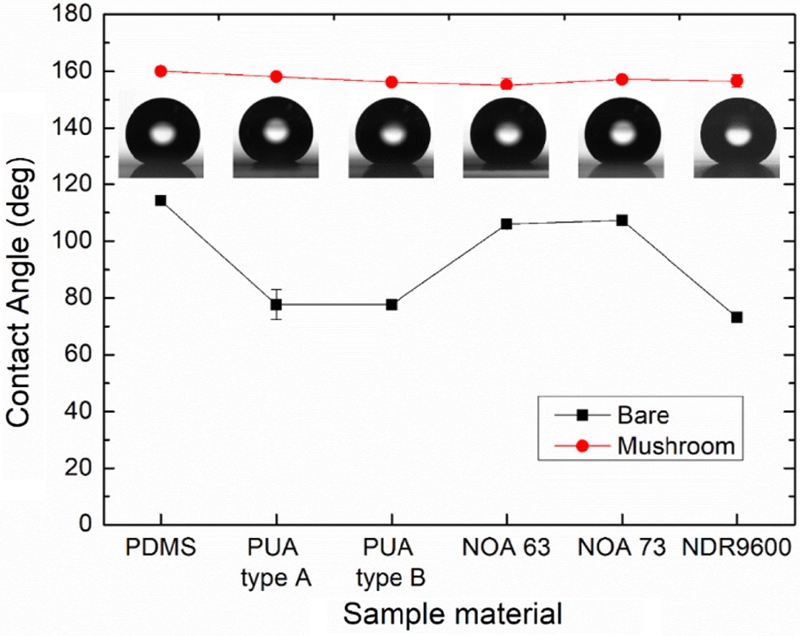
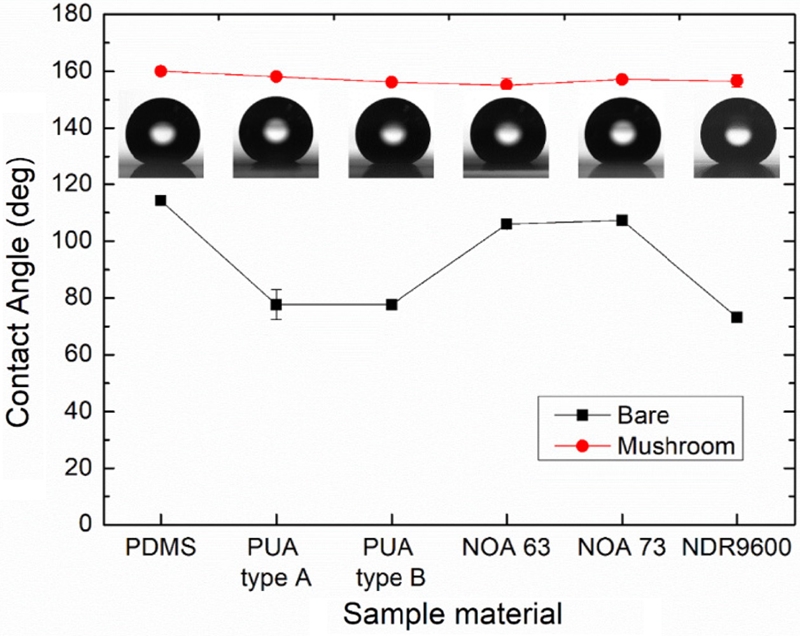
Fig. 5는 제작된 총 6개의 샘플과 같은 재질의 Bare 샘플에서의 표면상에서의 접촉각을 그래프로 표시한 것이다. 제작된 버섯 구조 표면상에 맺혀 있는 물방울의 광학 이미지를 함께 표시하였다.
Fig. 5에 보이듯이 제작된 1차 PDMS 미세 버섯 구조에 의해 접촉각이 증가하여 해당 표면에서 초소수성 성질을 지니는 것을 확인할 수 있다. 이어서 다양한 5차 버섯 구조 샘플들도 재질에 상관없이 모두 초소수성을 나타냈다. 특히 PUA 재질에서는 고유 접촉각이 PDMS와 달리 90
o보다 작더라도 버섯 구조를 형성한 표면에서는 동일한 초소수성을 나타냈다. 이는 제작된 샘플에서 접촉각에 영향을 미치는 요소로 구조가 지배적이기 때문이며 제작된 5차 구조는 1차 구조와 같은 젖음 특성을 갖는 것을 보여준다.
Fig. 5Measured contact angles of DI water on the fabricated surfaces using six-different materials
이러한 실험 결과를 해석하기 위해 이론적으로 분석하였다. 표면의 젖음성을 대표적으로 설명하는 이론으로 Cassie/Wenzel 공식이 있다. 표면상의 구조물과 액적 사이의 공기층으로 인해 젖지 않았을 때의 접촉각을 설명하는 이론이다. 본 연구에서는 구조 표면에서 초소수성을 나타내므로 Cassie 상태로 접근하였다. Cassie 상태의 방정식은 아래
식(1)과 같다.
이때
θc는 구조 위에서의 액적의 접촉각이고
θo는 이론적으로 거칠기가 없는 표면에서의 고유접촉각이다.
σ1는 구조와 액적이 접촉하고 있는 면적과 전체 사영면적의 분율을 의미하고
σ2는 액체와 접촉한 나머지 영역의 분율을 나타낸다. 이때 제작된 버섯 구조 표면에서의
σ1을 표현하면 다음
식(2)와 같다.
따라서 제작된 표면에서의 Cassie 방정식을 다시 표현하면,
이렇게 얻은 버섯 구조 표면에서의 Cassie 상태의 이론적 접촉각과 실험적으로 측정한 각 재질에서의 고유접촉각, 실험적으로 측정한 버섯 구조 표면상의 접촉각을
Table 2에 정리하였다. 이를 보면 Cassie 방정식으로 구한 접촉각보다 실험 결과가 더 큰 접촉각을 가지는 것을 알 수 있다. 그러나 Cassie 방정식에서는 일반 기둥 구조에서의 값과 버섯 구조에서의 값이 차이가 없게 된다. 따라서 버섯 구조의 팁에 의한 효과를 정확히 설명할 수 없다. 기둥 구조 표면에서 구조물과 액체 사이의 공기층은 구조와 구조 사이의 Meniscus에 의해 결정된다.
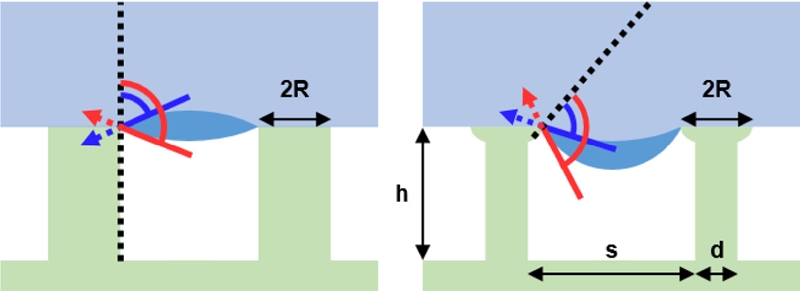
Fig. 6에 보이는 바와 같이 일반 기둥 구조에서 고유접촉각이 90°보다 크면 아래로 볼록한 Meniscus가 형성되어 액체의 모세관 힘은 위로 작용하며 공기층이 유지될 수 있지만, 90°보다 작으면 Meniscus는 위로 오목하게 되어 액체의 모세관 힘은 아래 방향으로 작용하여 Wenzel 상태가 된다.
Table 2Experimental and theoretical calculated contact angles of DI water on the fabricated surfaces using six-different materials
Table 2
|
Contact angle [o] |
#1 |
#2 |
#3 |
#4 |
#5 |
#6 |
|
Bare experimental |
114.7 |
77.7 |
74.6 |
106 |
107.3 |
73.2 |
|
Cassie model |
148.6 |
134 |
133 |
144.8 |
145.4 |
132.4 |
|
Mushroom experimental |
160.1 |
158.1 |
156.2 |
155.1 |
157.1 |
156.6 |
Fig. 6Schematic illustration for explanation of meniscus of liquids on the mushroom-shaped microstructure
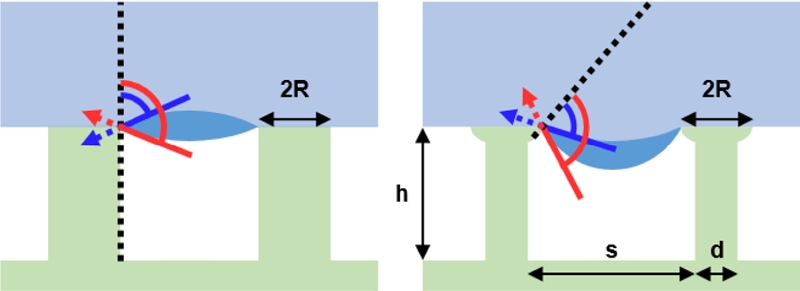
반면 버섯 구조에서는 팁에 의해 구조 끝단의 각도가 90°보다 작아지게 된다. 그에 따라 고유접촉각이 90°보다 작을 때도 Meniscus가 아래로 볼록하게 형성되어 Cassie 상태를 유지할 수 있게 된다.
2,3 이에 따라 PUA에서의 고유접촉각은 90°보다 작지만 PUA로 제작된 구조 표면에서도 Cassie 상태를 유지하며 PDMS 버섯 구조와 마찬가지로 초소수성을 나타내는 것을 확인하였다.
이러한 실험 결과를 통해 언더컷 구조를 지니는 제작된 4차 PDMS 몰드로 미세 버섯 구조가 안정적으로 제작되어 그에 따른 초소수성 성질을 갖는 표면을 다양한 탄성 계수의 재질로 제작할 수 있다는 것을 검증하였다.
3. 결론
본 연구를 통해 다양한 탄성 계수를 갖는 미세 버섯 구조의 제작 방법을 제시하였다. 실험에 사용할 미세 버섯 구조의 음각 실리콘 마스터를 MEMS 공정을 통해 제작하고 이를 반복적인 고분자 복제 공정에 사용하여 유연한 PDMS 음각 몰드를 제작하였다. 제작된 PDMS 음각 몰드의 제작 안정성을 평가하기 위해 서로 다른 탄성 계수를 갖는 5종류의 고분자 버섯 구조 샘플을 PDMS 음각 몰드를 통해 제작하고 초소수성 실험을 진행하였다. 제작된 버섯 구조는 고유접촉각에 상관없이 초소수성 성질을 나타냈다. 이는 언더컷 구조인 팁에 의해 구조각이 바뀌어 Meniscus가 변하며 Cassie 상태를 유지할 수 있는 이유에 의한 결과로 제작된 샘플의 팁이 온전히 제작되었다고 평가할 수 있다. 따라서 본 연구를 통해 건식접착이나 초소수성 성질 등을 갖는 미세 버섯 구조를 다양한 고분자를 이용하여 복제 가능한 공정 방식을 제시하였고 이를 통해 여러 분야로의 응용 가능성을 확대하였다.
ACKNOWLEDGMENTS
이 논문은 충남대학교 혁신지원사업(2019-2020) 지원을 받아 작성되었음. 이 연구는 충남대학교 연구장려 장학금에 의해 지원되었음.
REFERENCES
- 1.
Kang, S. M., Kim, S. M., Kim, H. N., Kwak, M. K., Tahk, D. H., et al., “Robust Superomniphobic Surfaces with Mushroom-Like Micropillar Arrays,” Soft Matter, Vol. 8, No. 33, pp. 8563-8568, 2012.
10.1039/c2sm25879j
- 2.
Kang, S. M., “Role of Wide Tip of Mushroom-Like Micropillar Arrays to Make the Cassie State on Superrepellent Surfaces,” RSC Advances, Vol. 6, No. 78, pp. 74670-74674, 2016.
10.1039/C6RA11224B
- 3.
Yuan, L., Wu, T., Zhang, W., Ling, S., Xiang, R., et al., “Engineering Superlyophobic Surfaces on Curable Materials based on Facile and Inexpensive Microfabrication,” Journal of Materials Chemistry A, Vol. 2, No. 19, pp. 6952-6959, 2014.
10.1039/C4TA00672K
- 4.
Yi, H., Kang, M., Kwak, M. K., and Jeong, H. E., “Simple and Reliable Fabrication of Bioinspired Mushroom-Shaped Micropillars with Precisely Controlled Tip Geometries,” ACS Applied Materials & Interfaces, Vol. 8, No. 34, pp. 22671-22678, 2016.
10.1021/acsami.6b07337
- 5.
Wang, L., Yang, X., Wang, Q., Yang, Z., Duan, H., et al., “Manufacturing of Mushroom-Shaped Structures and its Hydrophobic Robustness Analysis based on Energy Minimization Approach,” AIP Advances, Vol. 7, No. 7, Paper No. 075110, 2017.
10.1063/1.4995419
- 6.
Wang, Y., Hu, H., Shao, J., and Ding, Y., “Fabrication of Well-Defined Mushroom-Shaped Structures for Biomimetic Dry Adhesive by Conventional Photolithography and Molding,” ACS Applied Materials & Interfaces, Vol. 6, No. 4, pp. 2213-2218, 2014.
10.1021/am4052393
- 7.
Sameoto, D. and Menon, C., “A Low-Cost, High-Yield Fabrication Method for Producing Optimized Biomimetic Dry Adhesives,” Journal of Micromechanics and Microengineering, Vol. 19, No. 11, pp. 115002-115008, 2009.
10.1088/0960-1317/19/11/115002
- 8.
Sameoto, D. and Menon, C., “Direct Molding of Dry Adhesives with Anisotropic Peel Strength Using an Offset Lift-Off Photoresist Mold,” Journal of Micromechanics and Microengineering, Vol. 19, No. 11, pp. 115026-115030, 2009.
10.1088/0960-1317/19/11/115026
- 9.
Elsner, C., Zajadacz, J., and Zimmer, K., “Replication of 3D-Microstructures with Undercuts by UV-Moulding,” Microelectronic Engineering, Vol. 88, No. 1, pp. 60-63, 2011.
10.1016/j.mee.2010.08.021
- 10.
Möllenbeck, S., Bogdanski, N., Wissen, M., Scheer, H. C., Zajadacz, J., et al., “Multiple Replication of Three Dimensional Structures with Undercuts,” Journal of Vacuum Science & Technology B: Microelectronics and Nanometer Structures Processing, Measurement, and Phenomena, Vol. 25, No. 1, pp. 247-251, 2007.
10.1116/1.2433965
- 11.
Wang, Z., Volinsky, A. A., and Gallant, N. D., “Crosslinking Effect on Polydimethylsiloxane Elastic Modulus Measured by Custom‐Built Compression Instrument,” Journal of Applied Polymer Science, Vol. 131, No. 22, pp. 41050-41053, 2014.
10.1002/app.41050
- 12.
Cho, H., Kim, J., Park, H., Bang, J. W., Hyun, M. S., et al., “Replication of Flexible Polymer Membranes with Geometry-Controllable Nano-Apertures via a Hierarchical Mould-Based Dewetting,” Nature Communications, Vol. 5, No. 1, pp. 1-10, 2014.
10.1038/ncomms4137
Biography
- Joon Hyung An
M.S. candidate in the Department of Mechanical Engineering, Chungnam National University. His research interest is microfabrication.
- Ji Seong Choi
Integrated master & doctor candidate in the Department of Mechanical Engineering, Chungnam National University. His research interest is natural inspired techniques and wetting properties.
- Seong Min Kang
Assistant Professor in the Department of Mechanical Engineering, Chungnam National University. His research has been focused on multiscale design and fabrication.
Citations
Citations to this article as recorded by

- Mastering of NIL Stamps with Undercut T-Shaped Features from Single Layer to Multilayer Stamps
Philipp Taus, Adrian Prinz, Heinz D. Wanzenboeck, Patrick Schuller, Anton Tsenov, Markus Schinnerl, Mostafa M. Shawrav, Michael Haslinger, Michael Muehlberger
Nanomaterials.2021; 11(4): 956. CrossRef