ABSTRACT
The effectiveness of applying tap water method to reduce the generation of nano-sized wear particles from wheel-rail contacts in the aspect of air quality was investigated. A twin-disk rig was utilized to simulate the generation of airborne wear particles resulting from wheel-rail contacts. Slip rates ranging from 0 to 3% were continuously generated to simulate various railway vehicle dynamics. Dry and tap water application conditions (7 L/min) were tested. The mass concentration of wear particles with sizes below 560 nm generated during tests was measured using a Fast Mobility Particle Sizer (FMPS). Particles measured in the slip zone (0 to 3%) were categorized into PM0.02, PM0.03, PM0.1, and PM0.56 for analysis. Results indicated a significant decrease in mass concentration of particles with sizes above 30 nm, while those with sizes below 30 nm showed an increase. Particle reduction rate was -217.2% for PM0.02, -58.5% for PM0.03, 84.5% for PM0.1, and 90.3% for PM0.56. It should be noted that a negative reduction rate indicates an increase in the amount of particle generation. This study demonstrates that the application of tap water is effective in improving air quality by reducing the generation of nano-sized wear particles overall.
-
KEYWORDS: Train derailment, Nano-sized wear particles, Applying tap water, Air quality, Particle size distribution, Airborne wear particle
-
KEYWORDS: 열차 탈선, 나노 마모 입자, 수돗물 살수, 공기 질, 입자크기분포, 미세 마모 입자
1. 서론
철도차량 탈선의 주된 원인 중 하나는 휠(Wheel)과 레일(Rail)에서 발생한 마모(Wear)이다. 따라서, 열차 주행 중 발생하는 마모를 줄이는 것은 탈선 예방에 중요하다. 열차 주행 중 휠과 레일에서는 기계 및 열적 마모가 발생한다. 기계적 마모(Mechanical Wear)는 주로 1-10 μm 크기의 미세 마모 입자(Airborne Wear Particle) 및 10 μm 이상의 마모 파편(Debris)들을 발생시키고, 열적 마모는 주로 1 μm 이하의 나노 입자(Nano-sized Particle)를 발생시키는데[
1], 이는 휠-레일 접촉면에서 발생하는 높은 접촉열로 인한 재료의 연소(Combustion)에 의해 주로 발생한다. 접촉열은 마찰력에 의해 주로 발생하므로 열적 마모를 줄인다면 기계적 마모 또한 저감된다.
열차 주행 중 휠-레일 접촉면에서 발생하는 슬립(Slip)은 기계 및 열적 마모를 일으키는 주된 원인이다. Lee[
2,
3]에 따르면 열차 주행 중 휠-레일 접촉면에서는 끊임없이 슬립이 발생하고, 이로 인해 마찰력에 의한 기계적 마모와 마찰열에 의한 열적 마모가 끊임없이 발생한다. 발생한 미세 마모 입자들은 지하철 터널 같은 밀폐된 공간에 갇혀 공기 질을 악화시킨다. 갇힌 미세 마모 입자들은 열차 주행에 의해 발생하는 피스톤 효과[
4]에 의해 터널에서 터널로, 터널에서 승강장으로 이동하여 지하철 시스템 전체의 공기 질 저하를 야기한다. 휠-레일 접촉 유래 미세 마모 입자들은 다양한 중금속 성분을 포함하고 있다[
5-
10]. 입자가 작을수록 인체 침투율이 높고 혈액을 통해 인체 전체를 이동하여 다양한 장기에 축적되어 인체에 해로운 영향을 미칠 수 있다[
11-
13]. 따라서, 휠 및 레일의 마모 저감 및 지하철 터널에 축적된 유해한 미세 먼지 저감을 위한 미세 마모 입자 저감 연구가 필요하다.
미세 마모 입자 저감 연구는 주로 필터(Filter) 또는 집진기(Dust Collector) 개발 등 발생한 미세 마모 입자를 줄이는 후처리(Postprocessing) 기술 연구가 대부분이다. 하지만 이 방법은 설치 비용 및 유지보수 등 다양한 현실적인 문제 때문에 현재까지 큰 효과를 보지 못하고 있다. 또한, 후처리 방법으로는 지속적으로 발생하고 있는 미세 마모 입자를 제거하는데 한계가 있으므로 발생 자체를 줄일 수 있는 전 처리(Pre-processing) 기술 개발이 필요하다.
전 세계적으로 휠-레일 접촉 미세 마모 입자 발생 저감 관련 연구는 본 저자가 유일하다. Lee[
14-
16]는 Twin-disk 시험기를 활용하여 열적 마모에 착안한 물을 뿌리는 방법의 효과를 입자 수 농도(Number Concentration, Unit: #/cm
3) 관점에서 확인하였다. 이를 통해 살수 방법이 10 μm 이하 미세 마모 입자 발생 입자 수 농도 저감에 효과가 있음을 확인하였다.
공기 질의 관점에서는 입자 수 농도가 아닌 입자 질량 농도가 사용된다. 밀도(Density)가 같은 입자의 경우 입자가 작을수록 발생하는 수는 상대적으로 많지만 질량에서 차지하는 비중은 작다. 따라서, 입자 질량 농도 결과는 입자 수 농도 결과와 다른 경향을 보인다. 최근 공기 질에 대한 국민적 관심이 높아지고 있고, 작은 입자의 유해성이 알려짐에 따라 관심이 점점 작은 입자로 이어지고 있다. 이러한 이유로 최근에는 PM(Particulate Matter)10에서 PM1까지 모니터링 중이며, 향후 더 작은 입자까지 모니터링 할 것으로 예상된다(참고로, PM10은 10 μm 이하 입자들의 질량 농도 총합을 의미한다). 따라서, 본 연구에서는 수돗물 살수 방법이 1 μm 이하 미세 마모 입자 발생 저감 효과에 어떠한 영향을 미치는지를 공기 질(질량 농도)의 측면에서 확인하고자 한다. 참고로, 이하의 내용에서 수 농도는 입자 수 농도를, 질량 농도는 입자 질량 농도를 의미한다.
2. 실험 방법
2.1 Twin-disk 시험기 및 시편
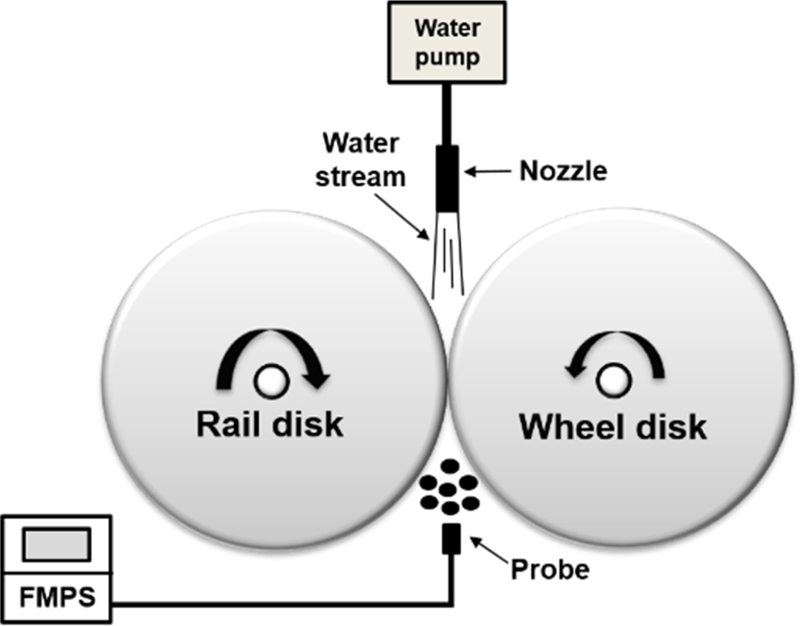
휠-레일 접촉 미세 마모 입자 발생 모사 시험은 Twin-disk 시험기(
Fig. 1)를 이용하여 수행하였다. 본 연구에 사용된 Twin-disk 시험기에 대한 자세한 정보는 참고문헌[
14-
17]을 참고하기 바란다. 두 시편의 크기는 모두 300Ø로 고탄소강(SSW-Q1R)을 이용하여 제작되었다. 휠 시편은 편평한(Flat) 트레드(Tread)를 가졌고, 레일 시편은 UIC60 헤드 프로파일(Head Profile)의 형태로 제작되었다. 시험에 사용된 시편의 화학적 구성 요소, 경도 및 초기 표면 거칠기(Initial Surface Roughness) 정보는
Tables 1 및
2에 나타나 있다.
Fig. 1Schematic of experimental setup
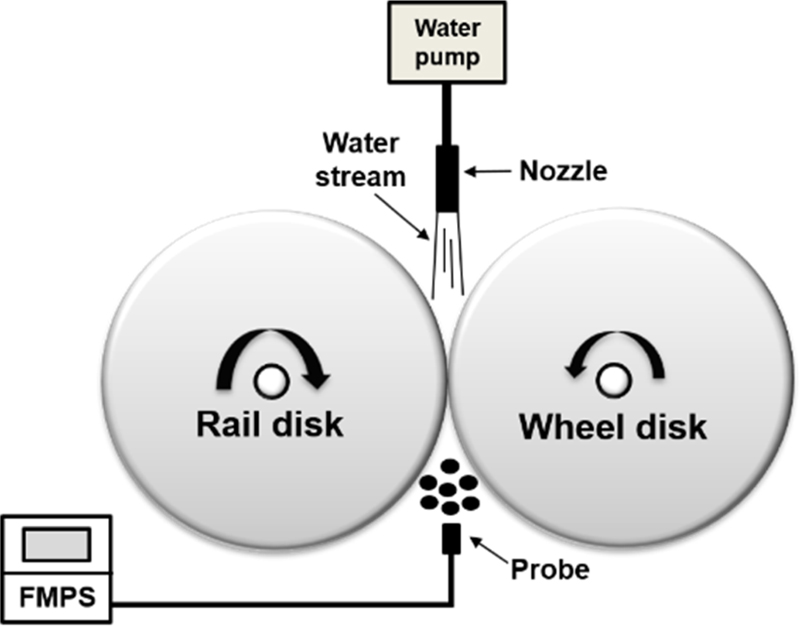
Table 1Chemical compositions of the wheel and rail disks
Table 1
|
Chemical compositions (wt %) |
|
Wheel & Rail |
|
C |
0.62 |
|
Si |
0.25 |
|
Mn |
0.80 |
|
P |
0.016 |
|
S |
0.017 |
|
Cu |
0.07 |
|
Ni |
0.04 |
|
Cr |
0.10 |
|
Mo |
0.02 |
Table 2Hardness and Initial surface roughness of the wheel and rail disks
Table 2
|
Hardness (HB) |
Initial surface roughness (Ra) |
|
Wheel |
285 |
0.24±0.05 μm |
|
Rail |
293 |
0.26±0.08 μm |
2.2 실험 셋업
Fig. 1에 실험 셋업(Experimental Setup)이 나타나 있다. 입자측정 센서인 Fast Mobility Particle Sizer (FMPS) (TSI 3091, USA)에 연결된 프로브(Probe)를 휠-레일 접촉 점(Contact Point) 바로 아래에 위치시켜 시험 중 발생한 미세 마모 입자의 질량 농도를 측정하였다. FMPS는 하전 입자의 유동성을 이용하여 6-560 nm의 입자 크기 범위를 32개의 채널(Channel)로 나누어 측정한다. 본 시험에서는 동적으로 변하는 시험 조건에서 발생하는 미세 마모 입자를 측정하기 위하여 최대 측정 속도인 1 Hz로 입자들의 질량 농도를 측정하였다.
2.3 실험 조건
미세 마모 입자 발생 모사시험은 1,300 RPM의 회전 속도 조건에서 수행되었다. 이는 차량 속도 약 73 km/h에 상응한다. 차량의 다양한 동적 조건에서의 미세 마모 입자 발생을 모사하기 위하여 슬립률을 0-3%까지 선형으로 연속적으로(Continuously) 변화시켜 실험을 진행하였다. 슬립률은
식(1)에 나타나 있다. 참고로, 0-3%의 슬립률은 구름/미끄럼 접촉(Rolling/Sliding Contact) 및 순수 미끄럼 접촉(Pure Sliding Contact) 모두를 모사할 수 있는 조건으로 직선 및 곡선 주행, 브레이킹 등 다양한 차량 동역학 조건을 포함한다. 수돗물 살수 방법의 미세 마모 입자 발생 저감 효과를 확인하기 위하여 건조 조건(Dry Conditions) 및 살수 조건(Wet Condition)에서 실험을 수행하였다. 인가 하중은 15 kN이고, 이는 최대 Hertzian 압력 약 1,200 MPa을 발생시킨다. 수돗물 살수량은 7 L/min이었다.
휠-레일 접촉 미세 마모 입자 발생 모사 시험 절차는 이전 연구들[
14-
16]과 유사하므로 본 논문에서는 간단하게 아래와 같이 제시하였다.
a) 주변 미세먼지에 대한 영향을 제거하기 위하여 15초간 주변 미세먼지 질량 농도 측정(백그라운드 구간)
b) 두 시편 접촉 후 30초 동안 두 시편의 회전 속도를 1,300 RPM까지 선형으로 증가(가속 구간)
c) 슬립률을 0-3%까지 변화시키기 위하여, 1,300 RPM에 도달 후 레일 시편 회전 속도 1,300 RPM 유지, 휠 시편 회전 속도 120초 동안 1,339 RPM까지 연속적으로(Continuously) 증가(슬립 구간)
d) 두 시편의 회전 속도를 45초간 감속 후 정지(감속 구간)
건조 및 살수 조건에서 시험은 각각 두 번씩 수행하였다. 본 연구에서 슬립률은
식(1)과 같이 정의된다.
여기서, RPMw 및 RPMr은 각각 휠 및 레일 시편의 회전 속도를 의미한다.
2.5 데이터 분석
본 연구에서 관심 있는 구간은 슬립 구간이므로, 슬립 구간에서 측정된 입자의 질량 농도를 이용하여 분석하였다. 시험 전부터 존재했던 미세 먼지의 영향을 없애기 위해 우선적으로 백그라운드 구간에서 15초 동안 측정한 각 입자 크기에서의 질량 농도 평균을 구하여 가속 구간부터 감속 구간까지 측정된 각 입자 질량 농도에서 빼 주었다. 두 번의 실험 결과의 평균값을 이용하여 분석을 수행하였다.
3. 실험 결과
3.1 입자 크기 질량 분포 분석
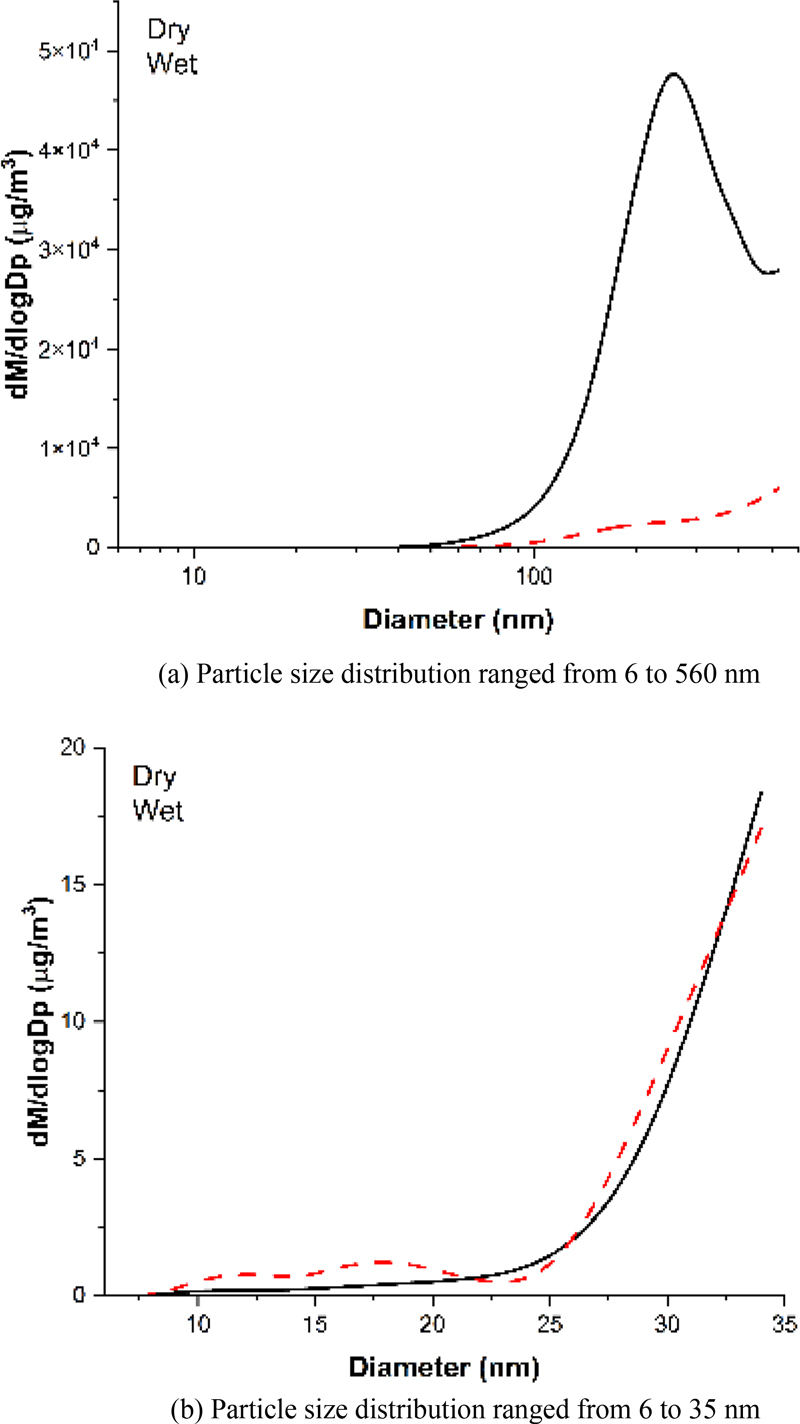
슬립 구간 전체에서 측정된 입자들의 질량 농도에 대한 평균 입자 크기 분포 결과가
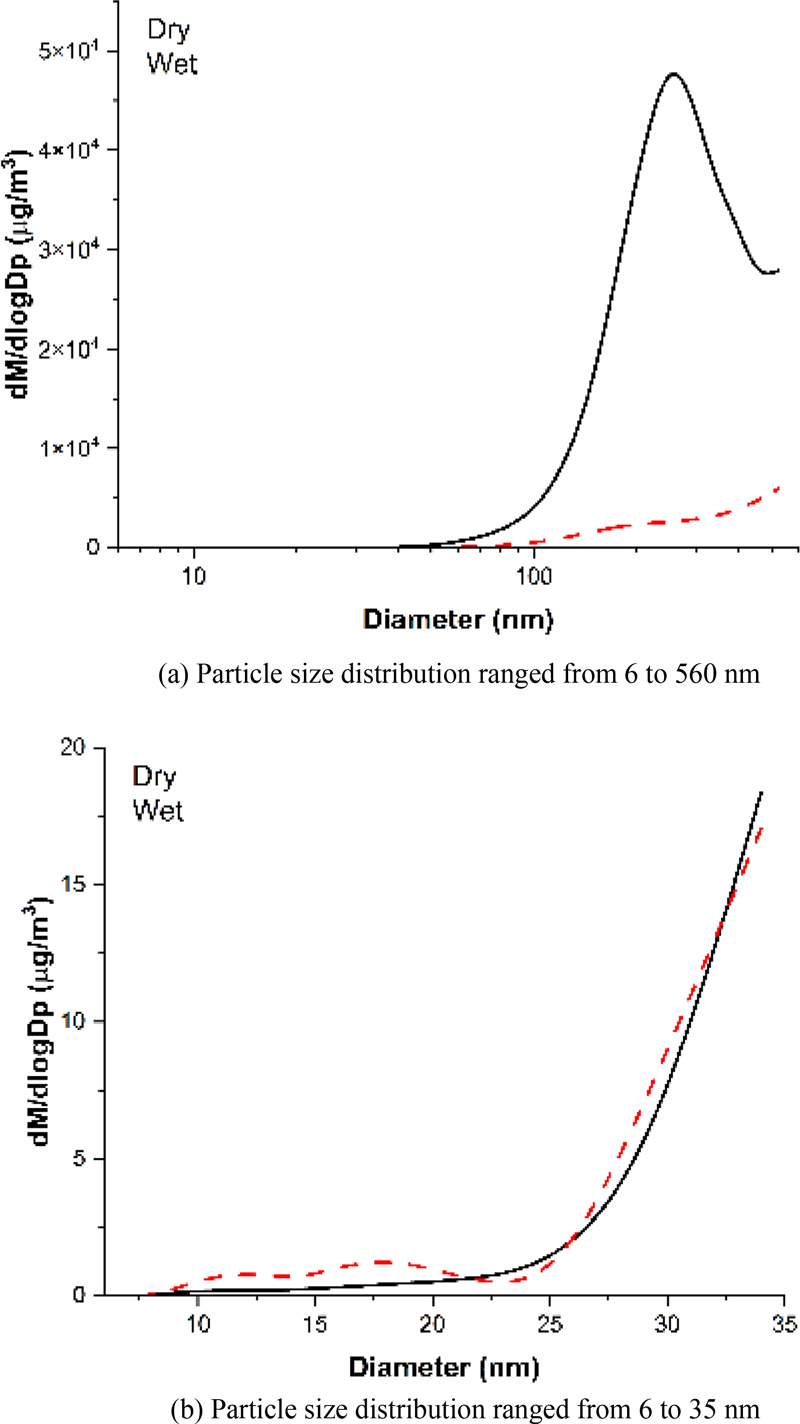
Fig. 2에 나타나 있다. 건조 및 살수 조건 모두에서 이중 모달(Bi-modal) 특성이 발생하였다. 건조 조건에서는 약 11 및 255 nm에서 피크가 발생한 데 반해, 살수 조건에서는 약 12 및 19 nm에서 피크가 발생하였다.
Fig. 2(b)를 보면 건조 조건에 비해 살수 조건에서 약 30 nm 이하의 입자 크기에서 질량 농도가 더 크게 나타났는데, 이는 높은 마찰열에 의해 발생한 수증기 및 수돗물에 포함된 미네랄 크리스탈의 영향으로 판단된다[
15,
16,
18].
Fig. 2Average particle size mass distribution (M: mass concentration, Dp: particle diameter)
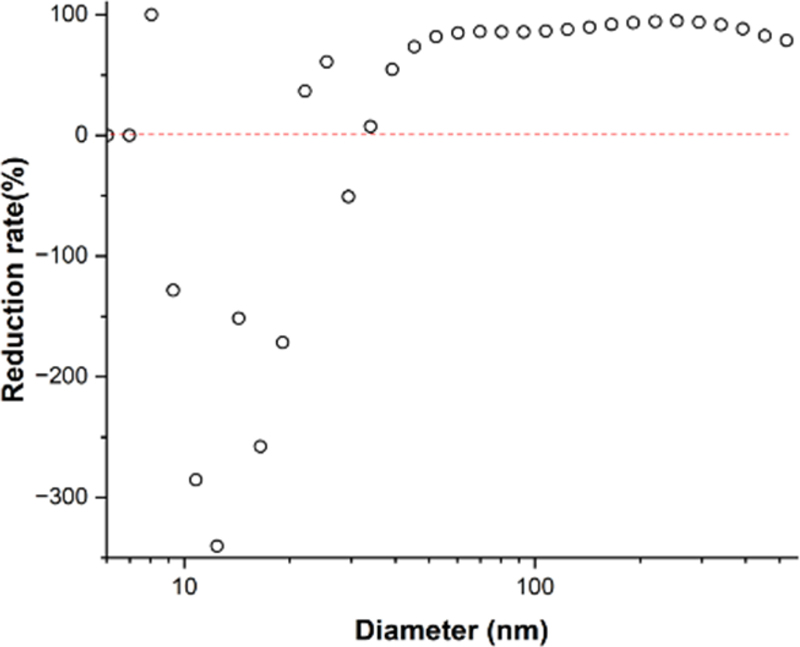
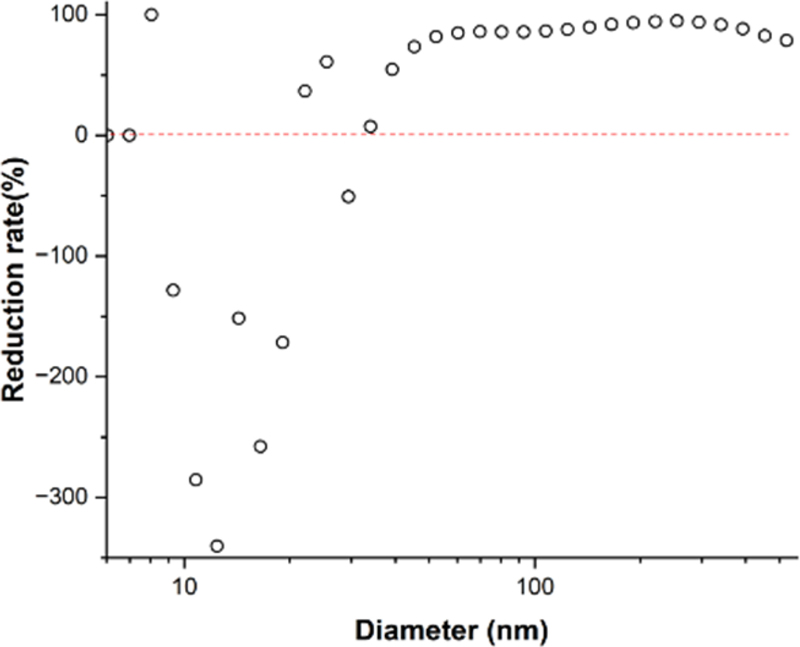
살수에 따른 질량 농도 감소율(
Fig. 3)을 보면 약 30 nm 이하의 입자에서는 질량 농도가 오히려 증가하였고, 이상의 입자에서는 질량 농도가 감소한 것을 알 수 있다(참고로, 양의 감소율은 살수에 따른 발생량 감소로 인한 질량 농도 감소를 의미한다). 감소율은 입자가 커짐에 따라 증가하다가 약 400 nm 이상에서는 다시 감소하였다. 약 50-160 nm 입자에서는 질량 농도 감소율이 80% 이상, 160-400 nm 입자에서는 90% 이상의 질량 농도 감소를 보였다. 살수 조건에서는 입자 크기 증가에 따른 질량 농도 증가가 건조 조건에 비해 월등히 작음을 알 수 있는데, 이를 통해 살수 방법이 입자 발생 저감에 효과가 있음을 나타낸다고 할 수 있다. 살수 시 접촉면에 물 윤활 층이 생겨 접촉 조건이 달라지고, 이는 마찰력 감소로 인한 마찰열 감소로 이어진다. 결과적으로 기계적 및 열적 마모가 적게 발생하여 질량 농도 저감현상(즉, 입자 발생량 저감)으로 이어진 것으로 판단된다.
Fig. 3Reduction rate of particle mass concentration at each particle size for all slip rate range
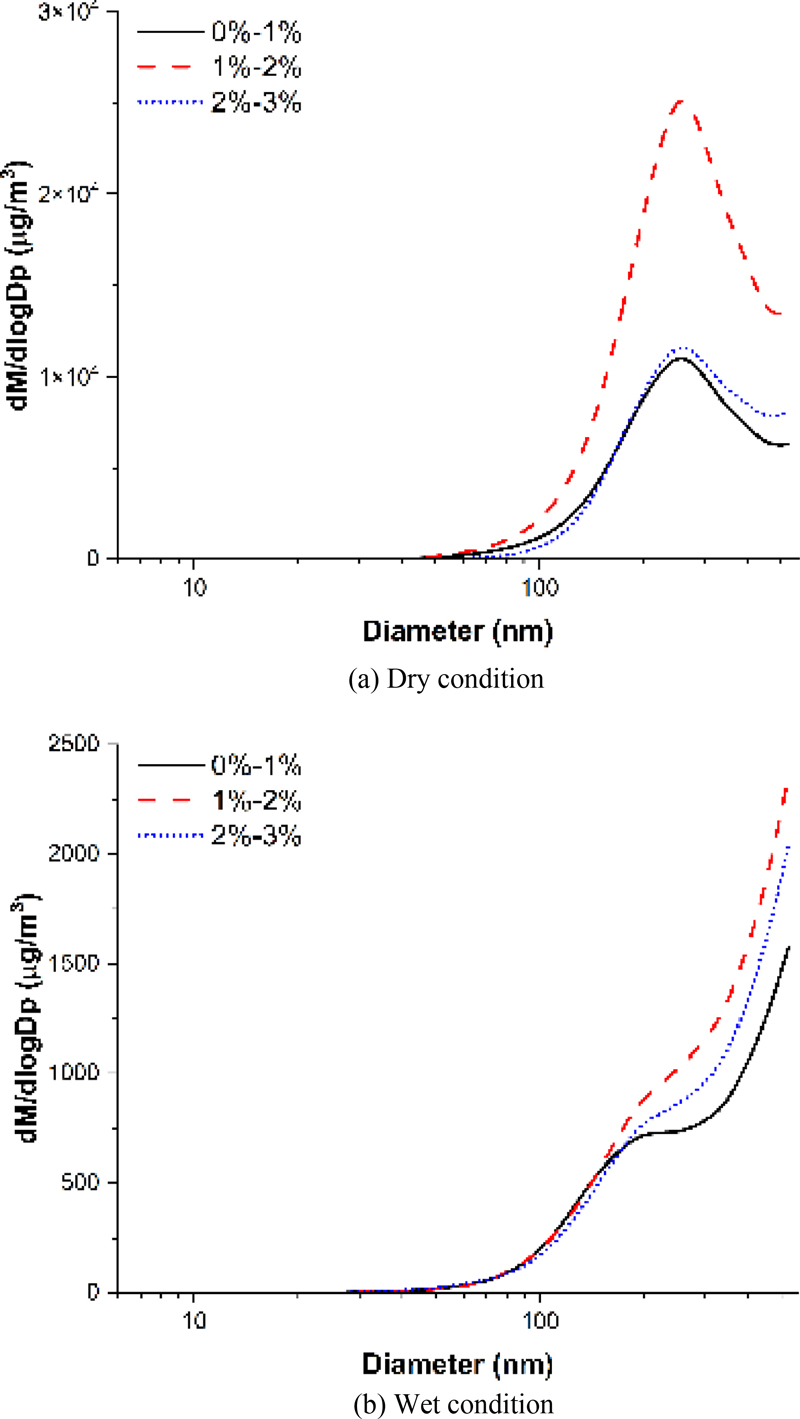
각 1% 슬립률 구간에서의 입자 크기 분포가
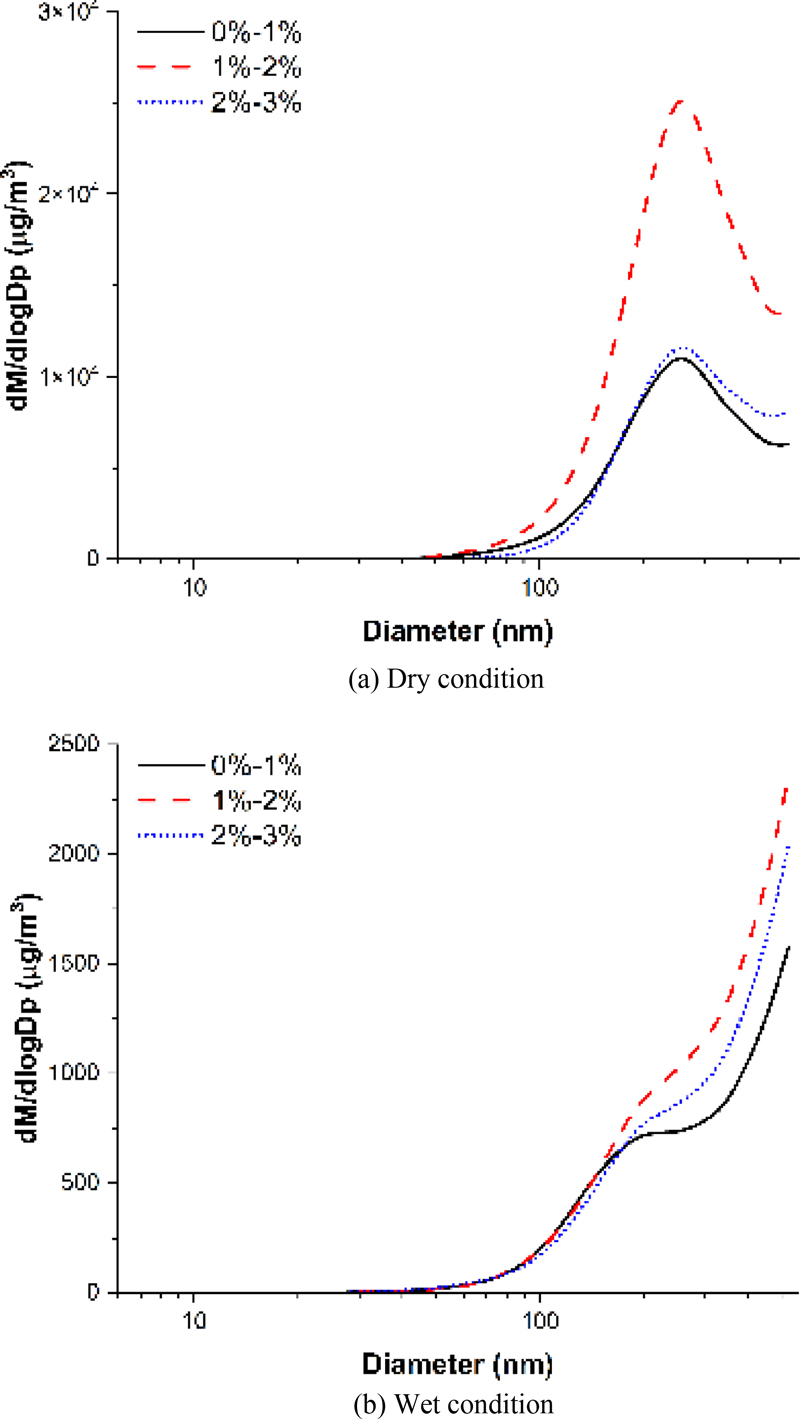
Fig. 4에 나타나 있다. 본 논문에서 0-1% 슬립률 구간은 저 슬립(Low Slip) 구간, 1-2% 구간은 중간 슬립(Medium Slip) 구간, 그리고 2-3% 슬립률 구간은 고 슬립(High Slip) 구간으로 정의한다. 건조 조건에서는 세 슬립 구간 모두에서 이중 모달 특성이 발생하였다. 저슬립 구간에서는 피크가 약 19 및 255 nm에서, 나머지 두 구간에서는 약 11 및 255 nm에서 피크가 발생하였다. 살수 조건에서는 저 슬립 구간에서는 삼중 모달(Tri-modal) 특성이, 나머지 두 구간에서는 이중 모달 특성이 나타났다. 피크는 저 슬립 구간에서는 약 12, 16, 220 nm에서 발생하였고, 나머지 구간에서는 모두 약 12 및 19 nm에서 발생하였다.
Fig. 4Particle size mass distribution at each 1% slip rate range for dry and wet conditions (M: mass concentration, Dp: particle size)
각 슬립 구간에서 계산된 질량 농도 감소율이
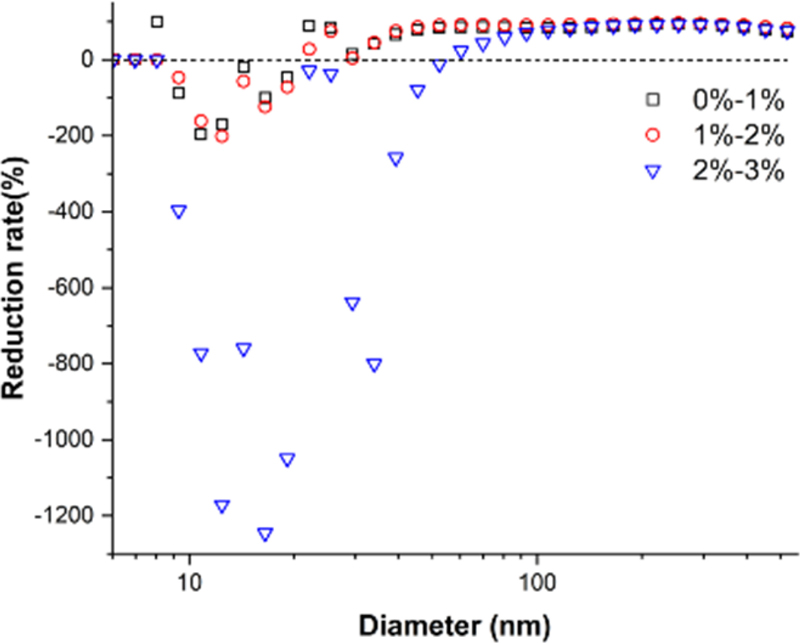
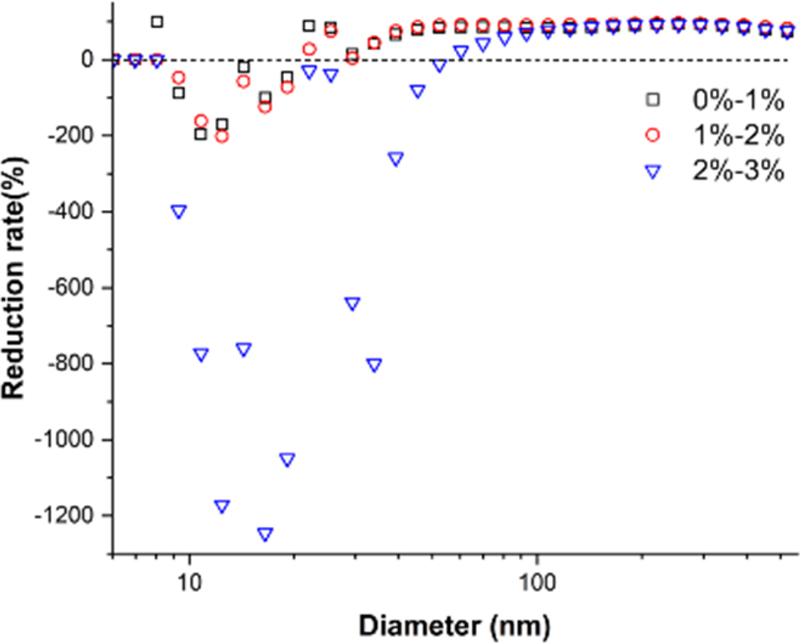
Fig. 5에 나타나 있다. 저 슬립 및 중간 슬립 구간에서의 감소율은
Fig. 3의 전체 슬립 구간 감소율과 거의 비슷한 결과가 나타났으나, 고슬립 구간에서는 약 50 nm 입자 크기까지 음의 감소율이 최고 약 -1,300%까지 나타났다. 고 슬립 구간에서는 상대적으로 높은 슬립에 의해 마찰력 및 마찰열이 높게 발생할 수 있다. 이는 살수 된 수돗물을 더 많이 기화 시킬 수 있을 것이고, 이렇게 발생한 수증기 및 미네랄 크리스털이 더 많이 측정되어 높은 음의 감소율로 나타났을 것으로 판단된다.
Fig. 5Reduction rate of particle mass concentration at each particle size at each 1% slip rate range
3.2 슬립률에 따른 질량 농도 분석
Figs. 3 및
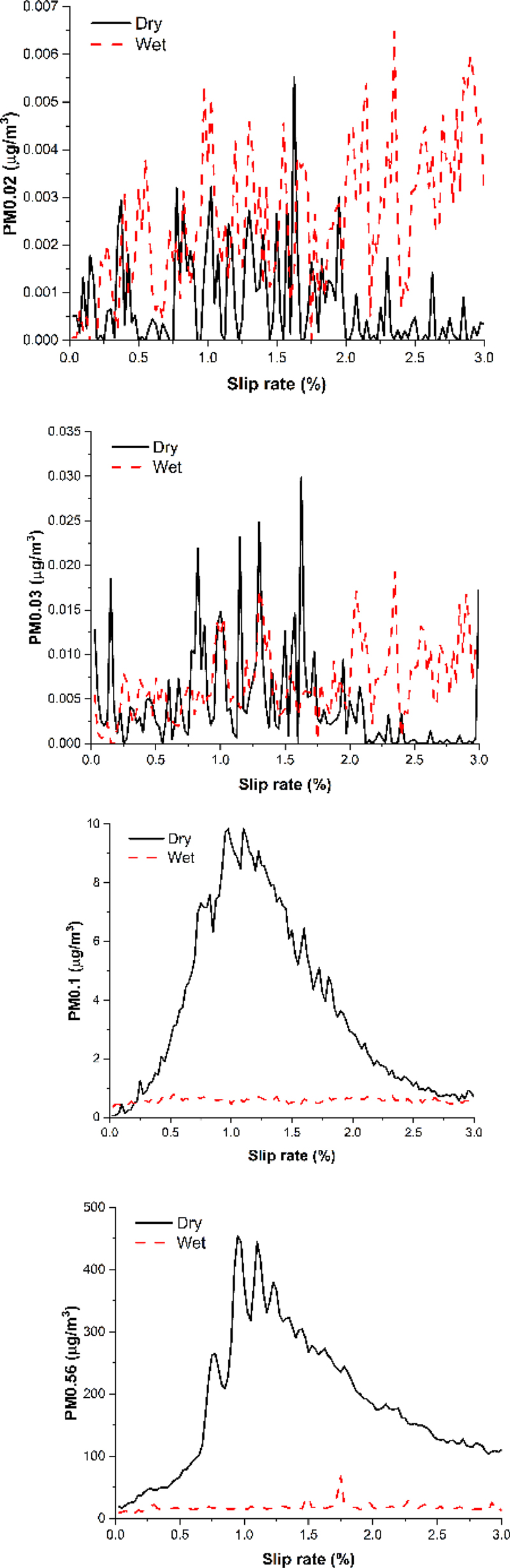
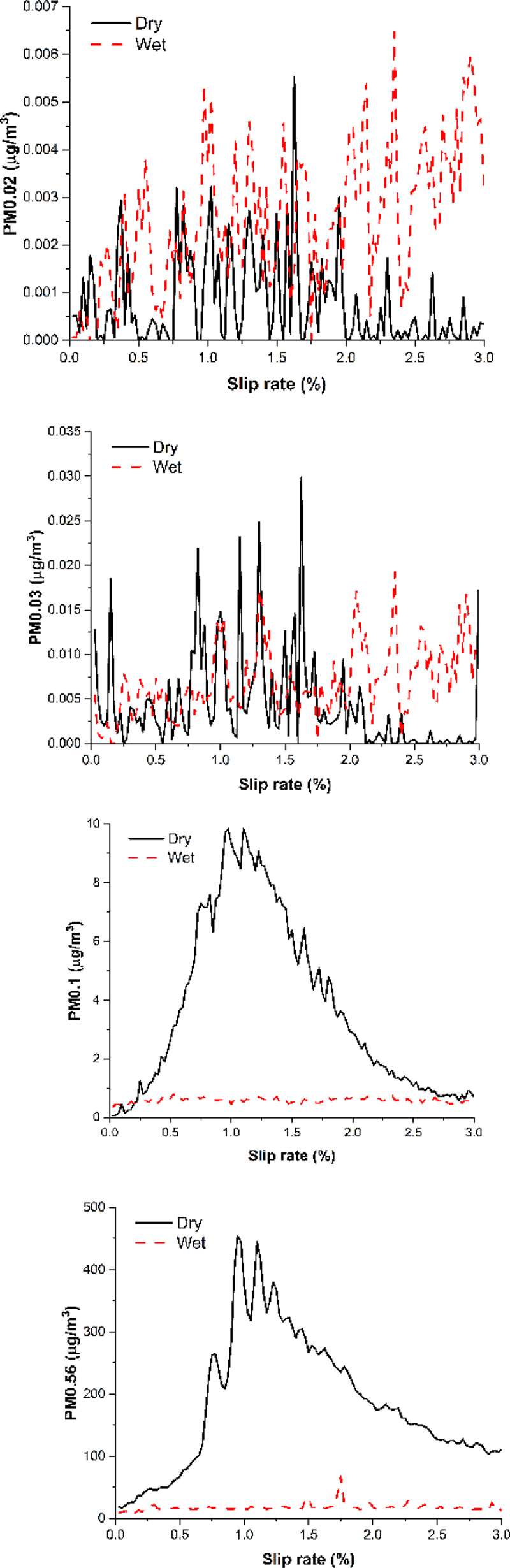
5에 기초하여 슬립률 증가에 따른 건조 및 살수 조건에서의 질량 농도 발생 경향 확인을 위하여 PM0.02, PM0.03, PM0.1, PM0.56의 결과를 슬립률의 함수로
Fig. 6에 나타냈다.
Figs. 3 및
5에서 확인했듯이 음의 감소율이 나타난 30 nm 이하의 질량 농도인 PM0.02 및 PM0.03의 경우 살수 조건의 질량농도 값이 대체로 전반적으로 더 높게 나타났다. 특히, 2-3% 구간에서는 질량 농도 차이가 더 크게 나타나 최대 -1,300%의 감소율로 이어졌다는 것을 알 수 있다. PM0.1 및 PM0.56의 경우 전반적으로 건조 조건의 질량 농도가 더 높게 나타나 양의 감소율로 이어졌음을 알 수 있다.
Fig. 6Average mass concentration of PM0.02, PM0.03, PM0.01, and PM0.56 with slip rate
다양한 입자 크기에서의 질량 농도 총합 및 감소율 계산 결과를
Table 3에 나타냈다. 전체 질량 농도에서 작은 입자들이 차지하는 비율이 상당히 낮음을 알 수 있다. PM0.56의 경우 100-560 nm 입자들이 질량 농도에서 차지하는 비율은 약 98%였다. 감소율의 경우 20 nm 이하에서는 살수 조건에서 약 200% 이상의 질량 농도 증가를 했고, 560 nm 이하에서는 살수 조건에서 약 90% 정도의 질량 농도 감소를 했다. 음의 감소율의 경우 실제 발생한 마모입자가 아닌 수증기 및 미네랄 크리스털이 많이 차지하는 것으로 예상되는 바 이를 제거할 수 있는 장치를 이용한 실험을 통해 질량 농도에 대한 수증기의 효과를 확인할 필요가 있다.
Table 3Total sum of average mass concentration (μg/m3) of PM0.02, PM0.03, PM0.01, and PM0.56 and their reduction rates
Table 3
|
PM0.02 |
PM0.03 |
PM0.1 |
PM0.56 |
|
Dry |
0.098 |
0.533 |
452.2 |
22211.8 |
|
Wet |
0.310 |
0.845 |
70.2 |
2145.6 |
|
Reduction rate |
-217.2% |
-58.5% |
84.5% |
90.3% |
4. 결론
본 논문에서는 살수 방법의 미세 마모 입자 발생 저감에 미치는 효과를 공기 질 측면, 즉 질량 농도 관점에서 분석해 보았다. 질량 농도 관점에서의 분석 결과는 수 농도 관점에서의 분석 결과[
14-
16]와 유사하게 나타났다. 살수 시 아주 작은 입자에서는 수증기 및 미네랄 크리스털의 영향으로 예상되는 음의 감소율을 보였으며, 큰 입자에서는 발생 저감 효과가 두드러지게 나타났다. 따라서, 본 논문을 통해 질량 농도를 이용하여 공기질 측면에서 분석을 수행하여도 살수 방법의 공기 질 개선 효과 검증이 가능함을 알 수 있었다.
ACKNOWLEDGMENTS
이 논문은 한국철도기술연구원 기본사업인 “철도 시설의 폐기물 발생 저감 및 재자원화 기술 개발(PK2402C2)”의 연구 결과를 활용하여 작성되었음.
REFERENCES
- 1.
Zimmer, A. T., Maynard, A. D., (2002), Investigation of the aerosols produced by a high-speed, hand-held grinder using various substrates, The Annals of Occupational Hygiene, 46, 663-672.
- 2.
Lee, H., Namgung, H.-G., Kwon, S.-B., (2018), Effect of train velocity on the amount of airborne wear particles generated from wheel-rail contacts, Wear, 414-415, 296-302.
10.1016/j.wear.2018.08.023
- 3.
Lee, H., (2019), Generation of airborne wear particles from wheel-rail contacts during rolling/sliding and pure sliding contact, Wear, 426-427, 1797-1806.
10.1016/j.wear.2018.12.093
- 4.
Pan, S., Fan, L., Liu, J., Xie, J., Sun, Y., Cui, N., Zhang, L., Zheng, B., (2013), A review of the piston effect in subway stations, Advances in Mechanical Engineering, 5.
10.1155/2013/950205
- 5.
Karlsson, H. L., Nilsson, L., Möller, L., (2005), Subway particles are more genotoxic than street particles and induce oxidative stress in cultured human lung cells, Chemical Research in Toxicology, 18(1), 19-23.
10.1021/tx049723c
- 6.
Pope III, C. A., Thun, M. J., Namboodiri, M. M., Dockery, D. W., Evans, J. S., Speizer, F. E., Heath Jr., C. W., (1995), Particulate air pollution as a predictor of mortality in a prospective study of U.S. adults, American Journal of Respiratory and Critical Care Medicine, 151(3), 669-674.
10.1164/ajrccm.151.3.7881654
- 7.
Dockery, D. W., Pope , C. A., Xu, X., Spengler, J. D., Ware, J. H., Fay, M. E., Ferris Jr., B. G., Speizer, F. E., (1993), An association between air pollution and mortality in six U.S. cities, The New England Journal of Medicine, 329(24), 1753-1759.
10.1056/NEJM199312093292401
- 8.
Abbasi, S., Jansson, A., Olofsson, U., Sellgren, U., (2013), Particle emissions from rail traffic: A literature review, Critical Reviews in Environmental Science and Technology, 43(23), 2511-2544.
10.1080/10643389.2012.685348
- 9.
Martins, V., Moreno, T., Minguillon, M. C., van Drooge, B. L., Reche, C., Amato, F., de Miguel, E., Capdevila, M., Centelles, S., (2016), Origin of inorganic and organic components of PM2.5 in subway stations of Barcelona, Spain, Environmental Pollution, 208, 125-136.
10.1016/j.envpol.2015.07.004
- 10.
Abbasi, S., Wahlström, J., Olander, L., Larsson, C., Olofsson, U., Sellgren, U., (2011), A study of airborne wear particles generated from organic railway brake pads and brake disks, Wear, 273(1), 93-99.
10.1016/j.wear.2011.04.013
- 11.
Bigert, C., Alderling, M., Svartengren, M., Plato, N., de Faire, U., Gustavsson, P., (2008), Blood markers of inflammation and coagulation and exposure to airborne particles in employees in the Stockholm underground, Occupational and Environmental Medicine, 65(10), 655-658.
10.1136/oem.2007.038273
- 12.
Karlsson, H. L., Nilsson, L., Moller, L., (2005), Subway particles are more genotoxic than street particles and induce oxidative stress in cultured human lung cells, Chemical Research in Toxicology, 18(1), 19-23.
10.1021/tx049723c
- 13.
Karlsson, H. L., Ljungman, A. G., Lindborm, J., Moller, L., (2006), Comparison of genotoxic and inflammatory effects of particles generated by wood combustion, a road simulator and collected from street and subway, Toxicology Letters, 165(3), 203-211.
10.1016/j.toxlet.2006.04.003
- 14.
Lee, H., (2020), Generation of airborne wear particles from the wheel-rail contact under wet conditions using a twin–disk rig, Wear, 448-449.
10.1016/j.wear.2020.203236
- 15.
Lee, H., (2020), The effect of water lubricant on reducing the generation of airborne wear particles from wheel-rail contacts under various train velocities, Tribology International, 150.
10.1016/j.triboint.2020.106393
- 16.
Lee, H., (2021), Reducing the nanoparticles generated at the wheel-rail contact by applying tap water lubricant at subway train operational velocities, Scientific Reports, 11.
10.1038/s41598-021-02037-0
- 17.
Lee, H., (2018), Estimation of adhesion coefficient using dynamic adhesion model, Journal of the Korean Society for Railway, 21(4), 331-341.
10.7782/JKSR.2018.21.4.331
- 18.
See, S. W., Balasubramanian, R., (2006), Physical characteristics of ultrafine particles emitted from different gas cooking methods, Aerosol and Air Quality Research, 6(1), 82-92.
10.4209/aaqr.2006.03.0007
Biography
- HyunWook Lee
Senior Researcher in the Department of Transportation Environmental Research, Korea Railroad Research Institute and Professor in the Transportation System Engineering, University of Science and Technology. His research interests are wear, friction, wheel-rail contact, airborne wear particles, vehicle dynamics, and vibration.
- YuJin Lee
M.S. candidate in the Transportation System Engineering, University of Science and Technology. Her research interest is airborne wear particles generated from the wheel-rail contact.