ABSTRACT
A study investigated hydrogen permeability in sulfur-cured NBR composites filled with carbon black (CB) and silica, using volumetric analysis across pressures ranging from 1.2 to 92.6 MPa. Both pure NBR and MT CB- and silica-filled NBR exhibited a single sorption mechanism that followed Henry’s law, indicating hydrogen absorption into the polymer chains. In contrast, HAF CB-filled NBR displayed dual sorption behavior, adhering to both Henry’s law and the Langmuir model, which suggests additional hydrogen adsorption at the filler interface. Hydrogen diffusivity in NBR followed Knudsen diffusion at low pressures and bulk diffusion at high pressures. In HAF CB-filled NBR, permeability decreased exponentially with increasing density, while in MT CB- and silica-filled NBR, it declined linearly. The strong polymer-filler interactions in HAF CB significantly influenced permeability. Permeability trends closely correlated with hardness, tensile strength, and density, allowing for the establishment of quantitative relationships between these physical and mechanical properties. These findings indicate that analyzing these properties can predict hydrogen permeability, positioning NBR composites as promising sealing materials for high-pressure hydrogen storage in refueling stations and fuel cell vehicles.
-
KEYWORDS: Hydrogen permeation, Nitrile butadiene rubber polymer, Hydrogen uptake, Diffusivity, Correlation, Filler
-
KEYWORDS: 수소 투과, 니트릴 부타디엔 고무, 수소 장입량, 확산도, 상관관계, 충전재
1. 서론
수소 경제 활성화를 위해서는 조기에 수소 인프라 구축이 필수적으로 선행되어야 한다. 이에 따라, 고압 수소와 직접 접촉하는 재료 및 부품의 사용이 증가할 것으로 예상되며, 이러한 환경에서의 신뢰성을 확보하기 위해 수소 저항성을 갖춘 소재의 개발과 안정성 확보가 시급한 과제로 떠오르고 있다. 특히, 고분자 소재의 활용이 더욱 확대될 것으로 전망되며, 이는 수소 환경에서 씰링 부품으로 널리 사용된다. 이러한 고분자 소재는 고압 수소에 직접 노출되어 수소 가스를 밀폐하는 중요한 역할을 한다
[1-
16]. 수소충전소(Hydrogen Refueling Stations, HRS)와 수소연료전지차(Hydrogen Fuel Cell Vehicles, HFCV)에서 O-링 씰, 가스켓, 제어 밸브, 커넥터, 비금속 파이프라인 등이 주요한 고분자 재료의 적용 분야로 꼽힌다
[17-
36].
한편, 수소(H
2)는 고분자 막에 빠르게 침투하여 일정 시간이 지나면 장입량이 평형 수준에 도달한다. 그러나 고압 상태에서 대기압으로 감압될 경우, 급격한 압력 강하로 인해 고분자 내부에서 수소의 과포화가 발생할 수 있다
[37,
38]. 수소가 확산 속도보다 빠르게 방출되면, 고분자 내에서 기포가 형성되며 미세 균열, 팽창, 파손, 그리고 수소 취성과 같은 돌이킬 수 없는 손상을 유발할 수 있다. 이러한 손상은 수소충전소 및 수소 연료전지 차량에서 O-링 씰의 파단이나 블리스터(Blister) 현상을 초래하고, 가스 누출을 유발하여 폭발 사고로 이어질 위험이 있다
[37].
또한, 고압 환경에서 발생할 수 있는 수소 가스 누출은 두 가지 주요 원인으로 구분된다
[38]. 첫째, 씰과 그루브 홈 사이의 접촉 불량으로 인해 발생하는 틈새 누출이며, 둘째, 씰링 고분자 자체를 통한 가스 투과 현상이다. 이러한 누출을 방지하고 평가하기 위해서는 적절한 측정 방법을 활용하여 O-링 소재의 수소 투과도를 정밀하게 분석해야 한다.
HFCV에 사용되는 타입 4 탱크의 국제 표준에 따르면, 70 MPa와 55
oC 조건에서 허용되는 H
2 투과량은 46 cm
3(std)/h∙m
3 이하로 규정되어 있다
[39]. 또한, ISO 19880-5는 87.5 MPa에서 디스펜싱 호스를 통한 H
2 투과량이 500 cm
3(std)/h∙m
3 이하이어야 한다고 명시하고 있다
[40]. 이에 따라, H
2 고압 용기 및 제어 밸브와 같은 수소 설비를 설계할 때, O-링의 적절한 씰링 재료는 실사용 환경에서 검증된 수소 투과 데이터베이스를 바탕으로 신중하게 선택해야 한다.
H
2 투과도, 확산도, 용해도는 적합한 씰링 재료를 설계하거나 선택하는 데 핵심적인 매개변수로 작용한다
[41]. 따라서, 수소 투과도 매개변수를 측정하기 위한 효과적이고 정확하며 신뢰할 수 있는 기술이 필수적이다. 이를 위해 다양한 수소 투과 측정 기법이 활용되는데, 대표적으로 차압법, 부피 분석법, 압력 분석법, 질량 분석법, 가스 크로마토그래피법 등이 있다
[42-
49]. 본 연구에서는 수소 투과도를 효과적으로 측정하기 위해 수위 변화의 밝기 알고리즘을 활용한 부피 분석법을 개발하였다.
또한 수소 인프라 설비의 안전성을 확보하기 위해서는 누출 예방뿐만 아니라 수소 농도를 실시간으로 감지할 수 있는 센싱 기술도 필수적이다. 수소 농도를 감지하는 센서로는 전기화학 센서
[50-
59], 반도체 센서
[60-
68], 촉매 센서
[69-
75] 등이 있으며, 각각의 원리와 특징이 다르다.
전기화학 센서는 수소가 전극과 반응하면서 발생하는 전류 변화를 측정하여 높은 민감도를 가진다. 반도체 센서는 수소가 반도체 표면에 흡착되면서 전도도를 변화시키며, 저렴하고 내구성이 뛰어난 것이 특징이다. 촉매 센서는 수소와 산소가 반응하여 발생하는 열을 측정하는 방식으로, 이를 통해 수소 농도를 감지한다. 이 외에도 금속 산화물 센서나 광학 센서 등 다양한 종류의 센서가 존재하며, 각 센서는 사용 환경과 요구되는 민감도에 따라 적절하게 선택해야 한다.
수소 투과를 방지하기 위해 다양한 첨가제를 함유한 수소 저항성 고무가 개발되었다. 고무 매트릭스 화합물은 탄소 블랙(CB), 실리카, 가교제(황 또는 과산화물), 플라스틱제, 활성제 등 다양한 강화 필러를 포함할 수 있다. 대표적으로, 아크릴로니트릴 부타디엔 고무(NBR), 에틸렌 프로필렌 디엔 트라이폴리머(EPDM), 플루오로엘라스토머(FKM) 등이 있으며, 이들 고무는 고압 수소 환경에서 내구성을 유지하는 특성이 있다. 특히, NBR은 우수한 내열성, 화학적 저항성, 저온 특성, 넓은 온도 범위에서의 유연성, 그리고 H
2 차단 특성을 갖추고 있어 HFCV 및 HRS와 같은 수소 인프라에서 씰, 튜브, 가스켓 소재로 널리 사용된다
[76-
78]. 따라서, CB 입자 크기와 실리카가 함유된 NBR 고무는 실리카와 황/과산화물 가교제가 포함되어 HRS에서 최대 93 MPa의 고압을 견디는 가스 씰용 O-링 재료의 후보로 고려될 수 있다
[79-
80].
본 연구는 CB와 실리카 필러가 포함된 황가교된 NBR 복합체의 H2 투과 특성에 초점을 맞추고 있다. 필러(충진제) 종류와 함량이 서로 다른 NBR 복합체에서 H2 가스 투과성에 미치는 영향을 조사함으로써, 고분자의 수소 흡착 및 확산 현상과 필러가 유발하는 수소 투과 메커니즘을 해석하는 것을 목표로 한다.
NBR 복합체의 H
2 흡수, 확산 계수 및 투과도는 부피 분석과 확산 분석 프로그램을 활용하여 정밀하게 측정할 수 있으며
[81-
84], 세 가지 필러로 충진된 NBR 복합체의 H
2 투과도를 연구하여 노출 압력, 필러 함량, 필러 유형이 미치는 영향을 분석하였다. 또한, 수소 투과는 고분자의 물리적 및 화학적 특성과 밀접한 관련이 있다. 많은 연구가 이러한 상관관계를 명확히 하고 이를 적절한 이론과 연결하기 위해 진행되었다. 특히, 투과 특성은 고분자의 자유 부피(Free Volume)에 의존하며
[85-
89], 이는 유리/고무 상전이, 결정성과 비결정성 비율, 가교 밀도, 밀도 등의 요소에 의해 영향을 받는다. 또한, 인장 강도와 경도와 같은 역학적 특성도 가스 투과성과의 상관관계를 가질 수 있다.
본 연구의 주요 목적은 투과 특성과 관련된 물리적·역학적 물성 간의 상관 관계를 규명하는 것이다. 이를 바탕으로, 추가적인 실험 없이 필러가 포함된 NBR 복합체로 구성된 고무의 투과 매개변수를 예측할 수 있는 방법을 제시하고자 한다.
2. 시료 배합비 및 배합방법
수소에 대한 고분자의 내구성을 향상시키기 위해, 일반적으로 고무 매트릭스에는 보강재로서 CB (Carbon Black)와 실리카(Silica) 필러가 첨가된다
[8-
10]. 특히, 카본블랙은 입자 크기에 따라 수소 기체에 대한 영향이 달라지는 특성을 지닌다
[11]. 본 연구에서는 이 두 종류의 필러를 함유한 NBR 복합체를 대상으로, 수소 투과도와 물리적 및 역학적 물성 간의 상관관계를 분석하고자 하였다. 이를 위해, 필러가 포함되지 않은 Pure NBR 시편 1종을 포함하여, 입자크기가 서로 다른 두 종류의 CB을 각각 20, 40, 60 phr의 농도로 첨가한 시편 6종과, 동일한 함량으로 실리카를 첨가한 시편 3종을 제작하였다. 제작된 시편의 화학 조성은
Table 1에 나타내었다.
Table 1 Chemical compositions of sulfur-crosslinked NBR composites filled with HAF CB, MT CB, and S fillers
Table 1
|
Composites |
NBR |
ZnO |
St/A |
HAF N330 |
MT N990 |
Silica S-175 |
Si-69 |
PEG |
S |
TBBS |
|
Pure NBR |
100 |
3.0 |
1.0 |
|
|
|
|
|
1.5 |
0.7 |
|
NBR H20 |
100 |
3.0 |
1.0 |
20 |
|
|
|
|
1.5 |
0.7 |
|
NBR H40 |
100 |
3.0 |
1.0 |
40 |
|
|
|
|
1.5 |
0.7 |
|
NBR H60 |
100 |
3.0 |
1.0 |
60 |
|
|
|
|
1.5 |
0.7 |
|
NBR M20 |
100 |
3.0 |
1.0 |
|
20 |
|
|
|
1.5 |
0.7 |
|
NBR M40 |
100 |
3.0 |
1.0 |
|
40 |
|
|
|
1.5 |
0.7 |
|
NBR M60 |
100 |
3.0 |
1.0 |
|
60 |
|
|
|
1.5 |
0.7 |
|
NBR S20 |
100 |
3.0 |
1.0 |
|
|
20 |
1.6 |
0.8 |
1.5 |
0.7 |
|
NBR S40 |
100 |
3.0 |
1.0 |
|
|
40 |
3.2 |
1.6 |
1.5 |
0.7 |
|
NBR S60 |
100 |
3.0 |
1.0 |
|
|
60 |
4.8 |
2.4 |
1.5 |
0.7 |
본 연구에서 사용된 NBR 고무의 주성분은 Kumho Petrochemical 그룹에서 생산한 34 wt%의 아크릴로니트릴을 포함한 KNB 35 L (Kumho NBR)이다. CB는 Orion Engineer Carbon에서 제공하는 두 종류의 CB를 사용했으며, 각각 고마모로(High Abrasion Furnace, HAF, N330)와 중온로(Medium Thermal Furnace, MT, N990)에서 준비되었다. HAF와 MT의 입자 크기는 각각 28-36 nm와 250-350 nm이며, HAF의 비표면적은 76 m2/g, MT는 8 m2/g이다. 실리카는 Solvay에서 제공하는 Zeosil® 175로, 비표면적은 175 m2/g이다. 충전제는 각각 20, 40, 60 phr로 충전되었다. 여기서 phr 은 Parts per Hundred Rubber의 약자로 고무의 무게가 100 g 일때 충전제의 중량을 의미한다. 편의상 충전제가 포함된 NBR 복합체는 NBR Hx, NBR My, NBR Sz로 명명되었고, 여기서 x, y, z는 각각 HAF, MT, 실리카의 p h r 함량을 나타낸다. 예를 들어, NBR S40은 실리카 40 phr이 포함된 NBR 복합체이다.
NBR 복합체는 두 개의 Banbury 로터를 갖춘 내부 믹서와 8인치 개방 롤 밀 두 대를 사용하여 두 단계로 혼합하여 준비된다. 첫 번째 단계(마스터배치)에서는 NBR 고무와 CB, 침전 실리카와 같은 강화 필러, ZnO와 스테아르산 같은 가공 보조제를 내부 믹서(3L Kneader, Moriyama Co., Sanda, Japan)를 사용하여 혼합한다. 충전 계수는 0.8로 고정되었으며, 믹서의 시작 온도는 80oC로 설정하였다. 로터 속도는 30 rpm으로 설정되었다. NBR 고무는 3L Kneader에 투입되어 3분 동안 교반한 후, 강화 필러와 가공 보조제를 추가하고 10분 동안 더 혼합했다. 두 번째 혼합 단계에서는 개방 롤 밀을 사용하여 마스터배치 복합체에 경화제와 촉진제를 추가하였다. 믹서의 롤 간 틈은 3 mm로 설정되었으며, 마스터 배치는 롤에 추가되어 1분 동안 혼합되었다. 이후 황과 TBBS를 추가하고, 약 2분 동안 혼합하였다. 믹서의 틈을 열고, 완성된 배치는 시트 형태로 절단되었다. 혼합 시간은 모든 복합체에서 동일하게 유지되었다. 확산 측정을 위한 3 mm 두께의 가황체 시트는 최적 경화 시간을 얻기 위해 진동 디스크 유변계를 사용하여 150oC에서 압축 성형으로 준비되었다. 사용된 원통형 고무 시료의 지름은 약 12 mm, 두께는 약 3 mm이다.
3. 수소 장입량 및 확산도 측정 및 분석
3.1 부피 분석법에 의한 수소 장입량 측정 원리
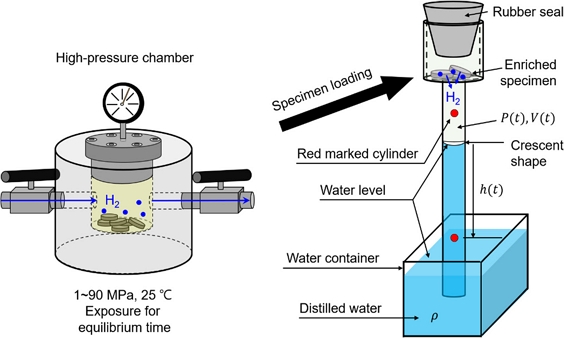
감압 후 고분자에서 방출되는 수소 기체량은
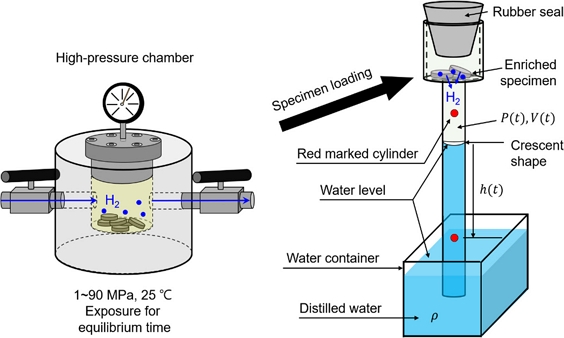
Fig. 1의 개발한 실린더 내의 포집방법을 이용하여 물의 수위의 변화량을 이미지 밝기 분석프로그램을 이용하여 실시간으로 측정함으로써 얻는다.
Fig. 1의 고압 수소용기에 고분자 시편을 넣고 가압을 하면 수소 기체가 고분자 시편 내부로 용해되어 확산하여 들어가는 현상이 발생한다. 이러한 용해-확산 현상이 평형상태에 도달하기 위해 충분한 24시간 동안 수소를 충전한 후, 대기압으로 감압을 하게 되면 고분자 시편 내부로 용해되었던 고압의 수소가 시편 외부로 서서히 방출된다. 이때, 수소 기체는 물에 잘 용해되지 않는 특성을 갖고 있으므로, 이를 활용하여
Fig. 1 오른쪽에 나타낸 장치를 구성하였다. 고분자 시료는 자체 제작한 실린더의 윗부분, 비어 있는 공기 공간에 삽입하고 실리콘 고분자로 밀봉하였다. 시료에서 방출된 수소는 실린더 내부의 물을 아래로 밀어내며,
Fig. 1의 실린더 중앙에 보이는 초승달 모양 (Crescent Shape)의 수위(h)가 점진적으로 하강하게 된다.
Fig. 1A procedure for evaluating H2 uptake and diffusivity using volumetric measuring system with cylinder and image analysis algorithm
이 수위 변화를 측정하여 방출된 수소의 양을 정량화하기 위해, 먼저 감압 후 시간에 따른 실린더 내부 압력 P(t)를 계산하였다. 이는 U자관 마노미터 원리에 따라 대기압과 수주압[ρgh(t)]의 차이로 나타낼 수 있다.
여기서
P0(
t)는 대기압,
ρ는 25
oC에서의 물의 밀도,
g는 중력가속도,
h(
t)는 측정된 수위이다. 또한,
h(
t)의 감소만큼 방출된 수소의 부피는 증가하게 된다. 따라서, 방출된 수소의 부피(Δ
V)를 구한 후 이상기체 상태 방정식(
PV =
nRT)에 적용하면, 수소의 몰수 (Δ
n)는
식(2)를 통해 얻을 수 있다
[90,
91].
여기서
R은 기체상수(8.20544 × 10
⁻5m
3·atm/(mol·K)),
T(
t)는 실린더 내부의 시간에 따른 온도이고,
A는 실린더 내부 단면적이다. 시료에서 방출된 수소에 의한 수위 변화를
식(2)를 이용하여 분석함으로써, 방출된 수소의 몰 수를 산출하였다. 이를 바탕으로, 최종적으로 단위 시료 질량(1 g)당 방출된 수소 기체의 질량(μg)
C(
t)를
식(3)을 통해 계산하였다
[90,
91].
여기서 mH2는 2.016 [g/mol]으로, 수소 기체의 1몰에 해당하는 질량이고, msample[g]은 사용된 시료의 질량이다.
앞에서 서술한 기본 원리를 이용하여 측정효율을 높이기 위해 수소 측정 기술을 보다 더 개선하였다.
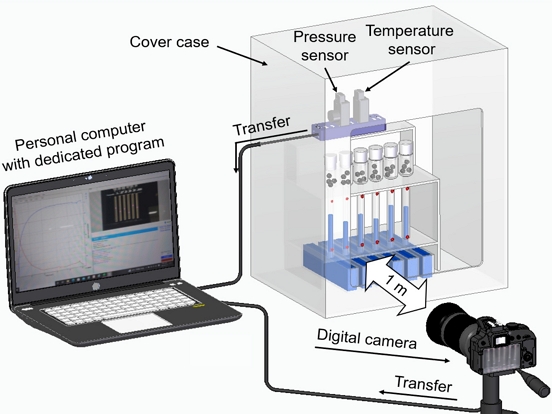
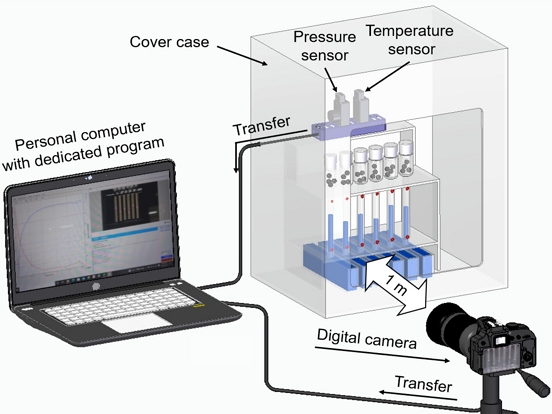
Fig. 2는 6개의 채널에서 간섭없이 동시에 수위 측정을 위해 개발된 수위 센싱 시스템을 보여준다. 이는 6개의 유리 실린더, 1개의 온도 센서(UA10, DEKIST Co., Ltd., 용인, 한국), 1개의 압력 센서(UA52, DEKIST Co., Ltd.), 1대의 디지털 카메라(D800, Nikon Co., 도쿄, 일본) 및 개발된 프로그램을 운영하는 컴퓨터로 구성된다. 증류수가 채워진 용기에 부분적으로 잠긴 유리 실린더는 시료에서 방출된 수소로 인한 수위변화를 측정하는 데 사용되었다. USB형 온도 센서와 압력 센서를 이용하여 얻은 온도와 압력은 수소로 충전한 시료에서의 수소 장입량을
식(2)와
식(3)을 이용하여 계산하는 데 사용된다.
Fig. 2Developed water level sensing system using image analysis algorithm for simultaneous measurement of six channels from six specimens
3.2 수소 장입량 및 확산도 분석 프로그램
감압후 H
2 탈착이 Fick의 확산 과정(Fickian Diffusion Process)을 따른다고 가정하면, 방출된 H
2의 농도 C
E(t)는
식(4)와 같이 계산되었다
[92-
94].
여기서
βn은 0차 Bessel 함수 J
0(β
n)의 근으로,
β1 = 2.40483,
β2 = 5.52008,
β2 = 8.65373, …,
β50 = 156.295이다.
식(4)는 두 개의 합을 포함하는 무한급수 전개식이다. 이 식은 원통형 샘플에 대한 Fick의 두 번째 확산 방정식의 해에 해당한다. 여기서 C
E = 0일 때 t = 0이고, C
E = C
∞일 때 t = ∞이다. C
∞는 무한 시간에서의 포화된 H
2 농도, 즉 H
2 방출량(장입량)이다. D는 확산 계수이고, ρ와 l은 각각 원통형 시료의 반지름과 두께이다.
식(3)에서 얻은 상대적인 수소의 질량을
식(4)에 넣고 계산하여 수소의 장입량과 확산도를 구한다.
식(4)는 항이 무한히 많은 무한급수 전개이기 때문에 전용 확산도 분석 프로그램
[81-
84]을 이용하여 계산을 해야 한다.
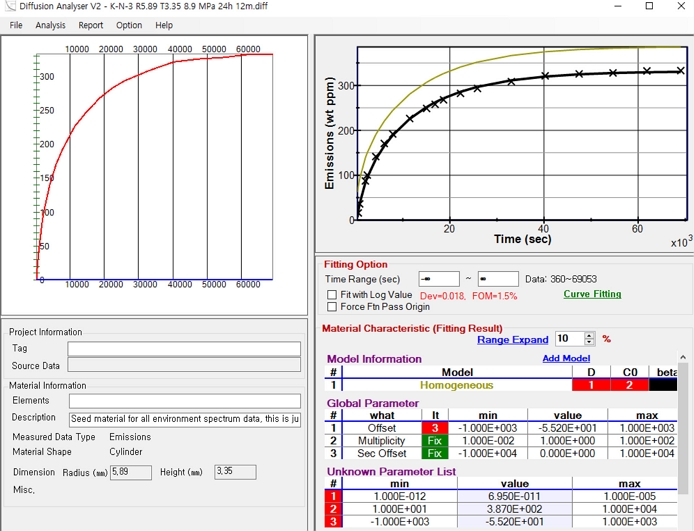
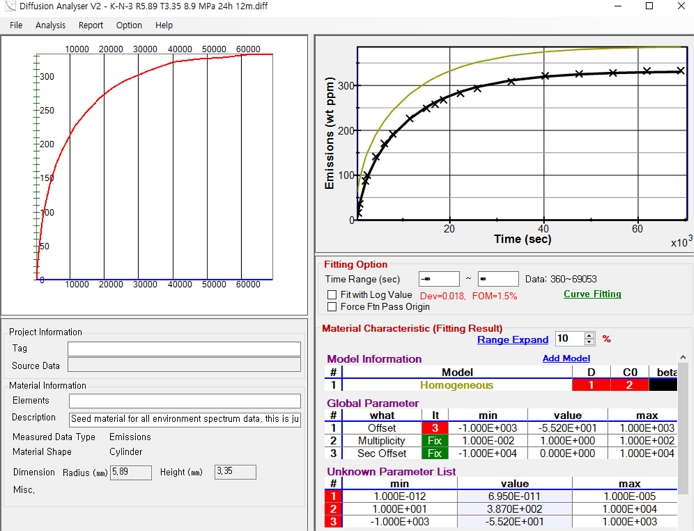
Fig. 3는 확산도 분석 프로그램을 이용하여 분석한 8.9 MPa 수소 충전한 NBR 복합체에서 수소의 장입량(
C∞)과 확산도(
D)의 분석 예시를 보여준다. 왼쪽 아래에 원통형 모양 시료의 반경(Radius)과 두께(Thickness or Height)를 입력한 후, 오른쪽 중간에 위치한 Curve Fitting을 실행하여 오른쪽 아래에 보인 것과 같이
식(3)에서 구한 각 시간에서의 방출 수소량을
식(4)에 대입하여 최소 자승법으로 각 매개변수를 최적화하여 계산하면 수소 확산계수와 수소 장입량 값을 얻을 수 있다. 즉, D = 6.950 × 10
-11 m
2/s, C
∞ = 387 wt·ppm의 값을 얻을 수 있다. 오른쪽 맨아래 값은 Offset 값이며, 이것은 시간지연 동안 빠져나간 wt·ppm 단위의 수소량을 나타낸다. 위의 방법으로 8.9 MPa 압력에서 수소를 충전한 NBR 시료의 수소 장입량 (C
∞), 확산도(D) 그리고 Offset (55.2 wt·ppm) 값을 나타내었다.
Fig. 3A diffusion analysis program for determining H2 uptake and diffusivity using Eq. (4) in NBR composites charged at 8.9 MPa
4. 측정 결과 및 분석
4.1 압력에 따른 수소 장입량 측정 결과 및 분석
Pure NBR 과 9종의 NBR 복합체에 대해 1.2-92.6 MPa 압력에서 충전한 후 실린더 수위의 이미지 분석 알고리즘을 이용하여 감압 후의 수소 장입량과 확산도를
Fig. 2에서 보인 평가장치를 이용하여 측정하였다. 그 측정 결과를
Fig. 3의 확산도 분석 프로그램에 이용하여 수소 장입량과 확산도를 구하였고, 그 결과를 총 Pure NBR과 9종의 NBR 복합체에 대해 압력 변화에 대한 수소 장입량을
Fig. 4에 나타내었다.
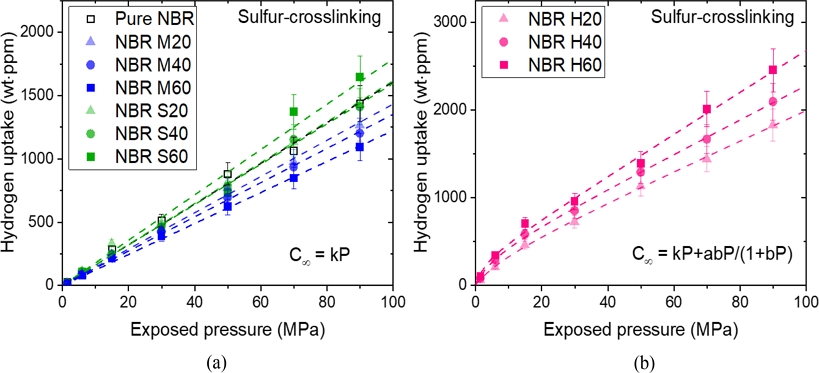
Fig. 4(a)는 Pure NBR, NBR M20, NBR M40, NBR M60, NBR S20, NBR S40, NBR S60의 압력에 따른 수소 장입량 결과를 보여준다.
Fig. 4(b)는 압력에 따른 NBR H
20, NBR H40, NBR H60에서 수소 장입량의 결과이다.
Fig. 4H2 uptake versus exposure pressure for sulfur-crosslinked NBR composites in the NBR-M, NBR-S, and NBR-H series
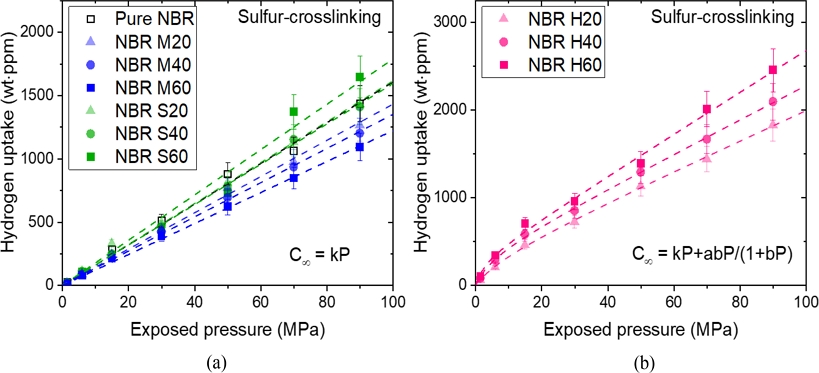
Fig. 4(a)에서 볼 수 있듯이, Pure NBR, MT CB 가 포함된 NBR M-series, 실리카가 포함된 NBR S-series의 수소 장입량은 92.6 MPa까지 압력에 비례하며 Henry의 법칙
[95]을 만족하는 것으로 나타났으며 이는
식(5)와 같이 표현된다.
여기서 k는 Henry 상수, P는 압력이다. Henry의 법칙을 적용한 결과는
Fig. 4에서 파란색 선으로 표시된 수소 흡수량 기울기로 나타나며, 이는 수소가 해리되지 않고 분자 형태로 고분자 내부로 확산됨을 의미한다. 이 현상은 수소 분자가 고분자 매트릭스에 흡수되기 때문으로 해석된다.
반면
Fig. 4(b)에서 보듯이 NBR H-series의 수소 장입량은 어떤 압력 이상에서 Henry 법칙에서 벗어나는데 이는 카본 블랙 필터 표면에 흡착된 수소에 기인한다. 따라서 모든 카본 블랙 충전제가 포함된 NBR 복합체에서 이중 흡착이 관측된다. 시료가 압력이 증가함에 따라 90 MPa 까지의 수소 장입량은 이중 모드 흡착 행동은
식(6)과 같이 표시된다
[95,
96].
여기서
C∞는 총 수소 장입량을 나타낸다. 첫 번째 항은 메트릭스의 수소 흡수를 설명하는 헨리 법칙을 나타내며, 헨리 법칙 계수
K가 포함된다. 두 번째 항은 충전제의 수소 흡착과 관계되는 Langmuir 모델
[35,
36]을 나타낸다. 여기서
a는 최대 흡착량(또는 용량 매개변수),
b는 흡착 평형 상수(또는 Langmuir 구멍 친화도 매개변수)이다.
식(6)에 따른 총 10종의 시료에 대한 피팅을 하여 구한
k,
a,
b, R
2을
Table 2에 나타내었다. 여기서 R
2은 제곱연관계수(Sqaured Correlation Coefficient)이고, 그 값이 0.98 이상으로 실험값이
식(6)과 잘 부합함을 보여준다.
Table 2Fitting results of the sorption model for sulfur-crosslinked NBR Neat and NBR composites filled with HAF CB(H), MT CB(M) and S fillers according to Eq. (7)
Table 2
|
Composites |
k |
a |
b |
R2
|
|
Neat |
16.1 |
0 |
0 |
0.99 |
|
H20 |
17.1 |
307 |
0.098 |
0.99 |
|
H40 |
19.4 |
355 |
0.170 |
0.99 |
|
H60 |
23.8 |
311 |
0.310 |
0.99 |
|
M20 |
14.3 |
0 |
0 |
0.99 |
|
M40 |
13.5 |
0 |
0 |
0.99 |
|
M60 |
12.2 |
0 |
0 |
0.98 |
|
S20 |
16.1 |
0 |
0 |
0.99 |
|
S40 |
15.9 |
0 |
0 |
0.98 |
|
S60 |
17.8 |
0 |
0 |
0.99 |
4.2 압력과 충전제에 따른 확산도 측정 결과 및 분석
순수 NBR과 황 가교로 제조된 9개의 필러가 포함된 NBR 복합체의 수소 확산도는 23
oC에서 충전 압력을 변화시키면서 측정되었다
[81]. 순수 NBR과 필러가 포함된 NBR 복합체에서 수소 확산도는 모든 시료에 대해서 압력에 의존적인 것으로 나타났다.
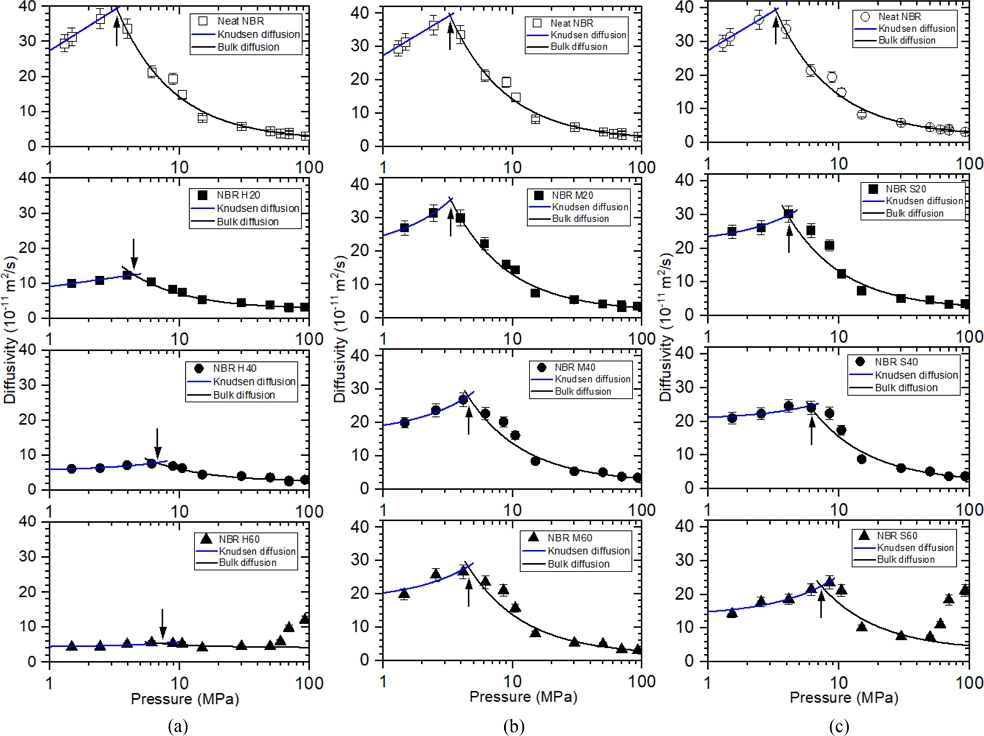
Figs. 5(a)-
5(c)에 순수 NBR를 포함한 필러를 포함한 NBR 복합체에서는 모두 압력 의존적 확산도는 화살표로 표시된 피크에서 두 가지 기여로 나눌 수 있다. 이 기여는 낮은 압력에서의 Knudsen 확산(파란선)과 높은 압력에서의 벌크 확산(검은선)으로 나누어진다. 즉, 3-8 MPa 이하에서 Knudsen 확산이 일어나고, 그 이상의 압력에서는 벌크 확산이 발생하는 것으로 설명되며, 이는 다른 연구에서 프랙탈 이론으로 분석되었다
[97].
Fig. 5H2 diffusivity (D) versus pressure for (a) nbr h series, (b) nbr m series and (c) nbr s series. The blue line indicates that the slope of H2 uptake proportional to pressure is a Knudsen diffusion fit. The black line is the result of bulk diffusion. The last three points for NBR H60 and S60 are excluded from bulk diffusion fitting because of deviation. The arrow positions for (a), (b) and (c) shift to the high-pressure side with increasing filler content. Three identical graphs for neat NBR results displayed at the top of each figure are inserted for comparison with filled-NBR composites [92] (Adapted from Ref. 92 on the basis of OA)
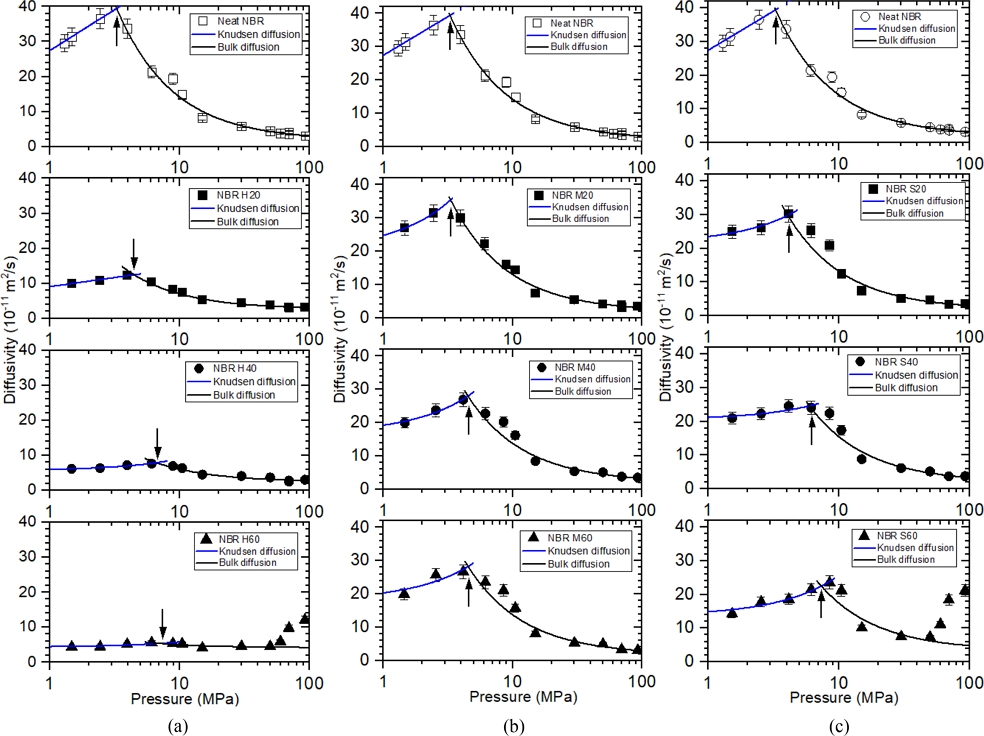
Knudsen 확산은 압력이 증가함에 따라 점진적으로 증가한다. 낮은 압력에서 일어나는 Knudsen 확산은 일반적으로 확산하는 기체 분자의 평균 자유 경로가 길거나 기체 밀도가 낮을 때 발생한다. Knudsen 확산도(D
K,pm)는
식(7)과 같이 쓸 수 있다
[98].
여기서 ϕ는 압력 의존적인 기공률(Porosity), τ는 필러 추가로 인한 구불구불 정도(Tortuosity), dc는 기공 직경(Pore Diameter), υ는 기체 분자의 평균 속도이다.
Fig. 5에서 Pure NBR 과 CB 와 실리카로 배합한 NBR 복합체의 벌크 확산 계수는 3-8 MPa의 임계 압력 이상에서 압력에 반비례하는 것으로 나타났다. 이는 수소 분자의 평균 자유 경로(λ)와 관련이 있다. 벌크 확산은 λ 값이 기공 직경보다 작은 경우에 지배적이며, 이는 큰 기공 또는 고압 가스 확산에서 종종 관측된다. 벌크 확산 계수(D
B)는
식(8)과 같이 쓸 수 있다
[99].
여기서 μ는 확산 분자의 점도(kg∙/s 단위), P는 인가된 압력이다. 벌크 확산도에 대한 실험 데이터는
Fig. 5에서 검은색 선에 해당되고, 이는
식(8)에 의한 분석결과에 해당된다. 크누센 확산 영역에서는 확산도가 압력에 비례하는데, 이는 압력이 증가함에 따라
식(7)에서 기공도가 증가했기 때문이다.
식(8)에 따르면, 압력 증가로 인해 벌크 확산 계수가 감소한 것은 λ가 감소했기 때문이다. 두 확산 기여도의 검은색 화살표로 표시된 교차 지점은 충전제 함량이 증가함에 따라 고압 측으로 이동하며, 이는 충전제 도입으로 인한 확산성 감소와 관련이 있을 수 있다.
그러나
Fig. 5 에서와 같이 압력이 92 MPa까지 증가함에 따라 시료의 확산도는 92.6 MPa에서 거의 일정해졌으며, 약 5 × 10
-11 m
2/s에서 수렴했다. 벌크 확산 압력 영역인 92.6 MPa에서 수소 분자의 평균 자유 경로가 감소하는 것이 확산도 거동에서 필러의 함량이나 종류보다 더 중요한 요소가 될 수 있다.
한편 수소 용해도(S)는 다음 관계식을 사용하여 압력에 대한 C
∞ 기울기로부터 얻을 수 있다
[91,
92].
식(10)에서와 같이 투과도 P는 용해도 S와 확산 계수 D를 곱한 값으로 구했다.
Figs. 6(a)-
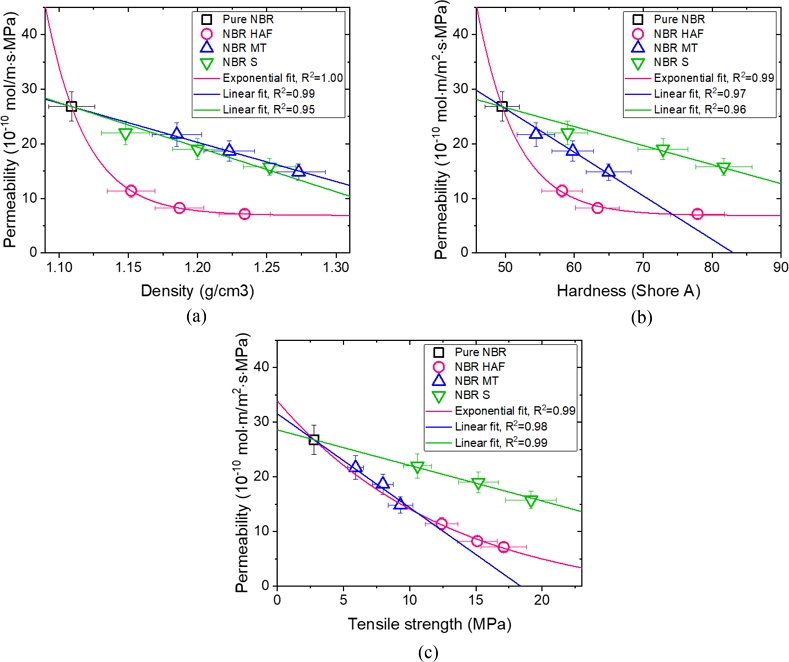
6(c)는 순수 NBR과 황으로 가교된 혼합 NBR 복합체에 대해 밀도, 경도, 인장 강도와의 투과도와 의 상관관계를 각각 보여준다.
Fig. 6(a)에서 보듯이, 실리카와 MT-CB이 포함된 NBR 복합체의 밀도와 투과도 간의 음의 선형 관계(P = -밀도)는 밀도가 증가함에 따라 투과도가 선형적으로 감소함을 보여준다. 이는 다른 상호작용이나 추가 매개변수의 도입 없이 발생한다는 것을 의미한다. 그러나 HAF-CB 혼합 NBR 복합체의 경우에 밀도가 증가함에 따라 투과도는 지수함수형태로 감소했다. 즉, P = ~exp(-밀도)을 따른다. HAF-CB 혼합 NBR 복합체에서의 효과 크기는 실리카와 MT-CB를 혼합한 NBR 복합체보다 컸다. 이는 추가적인 효과가 작용함을 의미하는데, 즉, HAF-CB 혼합 NBR 복합체에서 강한 고분자-필러 상호작용 또는 CB 인터페이스에서의 H
2 흡착이 투과도 거동의 원인으로 작용했음을 의미한다.
Fig. 6Correlations between permeability and (a) density, (b) hardness, and (c) tensile strength for NBR composites blended with CB and silica. The data for pure NBR were included to show consistency with the fits for filled blended NBR composites. The pink lines indicate fits with an exponential decay and the R2 values are squared correlation coefficient. The blue and yellow lines indicate negative linear fits with R2 values
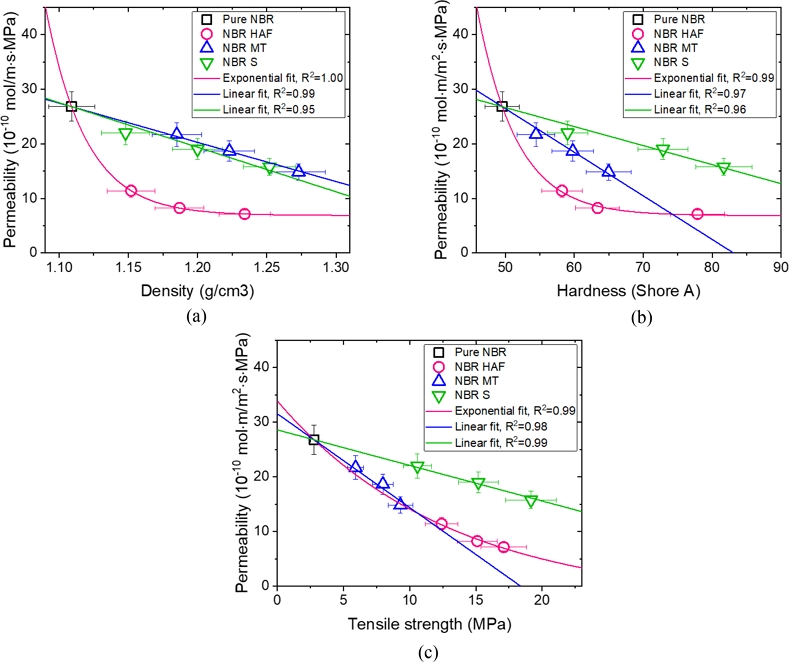
Figs. 6(b)에서의 투과도와 경도,
6(c)에서의 투과도와 인장강도의 관계는 6(a)에서의 투과도와 밀도 간의 관계와 형태가 매우 유사하다. 이 세 가지 경향은 동일한 원인에서 비롯된 것일 수 있다. 이러한 물리적 및 역학적 물성과의 투과도와의 상관관계 연구를 통해 해당하는 관계식을 얻을 수 있다. 따라서 이의 상관식을 기반으로 HRS와 HFCV에서 고압 수소 용기 씰에 사용되는 혼합 NBR 복합채 후보의 H
2 투과특성을 예측할 수 있다.
또한, CB가 포함된 NBR 복합체의 투과도와 물리적·역학적 물성 간의 상관관계를 해석하기 위해서는 자유 부피 개념을 도입할 수 있다. 자유 부피는 고분자 체인 자체가 차지하지 않는 전체 부피로 정의된다. 따라서 확산하는 분자가 그곳에서 존재하고, 이는 고분자 체인 사이에 존재하는 간격이나 기공에 해당한다. 고분자의 물리적/화학적 매개변수와 밀도는 고분자의 자유 부피에 큰 영향을 미칠 수 있다. 자유 부피 이론에 따르면
[87-
89], 확산도(D)와 투과도(P)는
식(11) 및
식(12)와 같이 표현된다.
여기서 FFV는 자유 부피 분율(FFV = V
f/VSP), VSP는 고분자의 비체적(cm
3/g)이고, 이는 1/ρ로 표현된다. ρ는 고분자 밀도(g/cm
3), ai, b
i, c
i, d
i는 주어진 침투물질/고분자 쌍의 매개변수들 이다.
식(11)과
식(12)에서 확산도와 투과도는 고분자의 자유 부피가 감소함에 따라 지수적으로 감소한다. 이러한 낮은 투과도 는 수소 투과 차단 특성에 긍정적인 영향을 미친다.
Figs. 6(a)-
6(c)에서 물리적·역학적 물성의 증가로 인한 투과도의 감소는 CB 필러 함량 증가에 따른 확산도의 감소와 동일하다.
식(11)과
식(12)에 따르면, 지수함수적 거동은 CB 필러 함량이 NBR 복합체의 밀도, 경도, 인장 강도를 증가시켜 자유 부피 감소를 초래했음을 시사한다. 즉, 1/FFV ~ 밀도이다. 따라서 혼합 NBR 복합체에서 밀도에 따른 확산도와 투과도의 지수함수적인 감소는 CB 필러를 추가함으로써 자유 부피가 감소한 것과 관련이 있다고 사료된다.
5. 결론
본 연구에서는 황으로 가교된 NBR 복합체의 H2 투과도를 부피 분석 기법과 전용 확산 분석 프로그램을 활용하여 연구하였다. 연구 결과는 다음과 같이 요약할 수 있다.
순수 NBR 및 MT CB, 실리카 충전재가 포함된 NBR 복합체는 92.6 MPa까지 헨리 법칙을 따르는 단일 흡착 거동을 보였다. 이는 수소가 해리되지 않은 분자 상태로 고분자 네트워크 내에 흡수되기 때문인 것으로 해석된다.
반면, HAF CB 충전재가 포함된 NBR 복합체에서는 92.6 MPa까지 헨리 법칙과 랑뮈르 모델을 동시에 만족하는 이중 흡착 거동이 관찰되었다. 이는 수소 용해도가 두 가지 기여 요인에 의해 결정되기 때문으로, 첫째는 순수 고분자 내에서의 흡수(Absorption), 둘째는 HAF CB 충전재 표면에서의 흡착(Adsorption)이다.
수소 확산도는 압력에 따라 변화하는데, 3-8 MPa 이하에서는 크누드센 확산이, 그 이상의 압력에서는 벌크 확산이 주된 기여 요인으로 작용하는 것으로 나타났다. 크누드센 확산 계수는 압력에 비례하며, 압력 증가에 따라 다공성이 증가하는 데 기여한다. 반면, 벌크 확산 계수의 감소는 압력 증가로 인한 평균 자유 경로의 감소와 관련이 있다. 또한, 충전재 함량이 증가할수록 두 확산 메커니즘이 전환되는 압력 범위가 고압 방향으로 이동하는 경향이 확인되었다.
HAF CB가 포함된 NBR 복합체에서는 밀도가 증가함에 따라 투과도가 지수함수적으로 감소하는 경향을 보였다. 반면, 실리카 및 MT CB가 혼합된 NBR 복합체에서는 밀도 증가에 따라 투과도가 선형적으로 감소하였다. 특히, HAF CB가 포함된 NBR 복합체의 경우, 실리카 및 MT CB가 포함된 복합체보다 더욱 뚜렷한 투과도 감소 효과를 보였으며, 이는 강한 고분자-필러 상호작용 또는 CB 인터페이스에서의 추가적인 수소 흡착 효과가 투과도 거동에 영향을 미친 것으로 판단된다.
투과도와 경도, 투과도와 인장 강도의 관계는 투과도와 밀도 간의 관계와 매우 유사한 경향을 나타냈다. 이러한 연구 결과를 바탕으로, 물리적 및 기계적 물성과 투과도 간의 상관 관계를 정량적으로 도출할 수 있었다.
따라서, 본 연구에서 도출된 관계식을 활용하면, 수소충전소 및 수소 연료전지차에서 사용되는 고압 수소 용기의 씰 소재로 적합한 NBR 복합체 후보의 물리적·기계적 특성을 기반으로 H2 투과 특성을 예측할 수 있다.
REFERENCES
- 1.
Nishimura, S., (2013), Fracture behavior of ethylene propylene rubber for hydrogen gas sealing under high-pressure hydrogen, Nippon Gomu Kyokaishi, 86(12), 360-366.
10.2324/gomu.86.360
- 2.
Yamabe, J., Nishimura, S., (2012), Hydrogen-induced degradation of rubber seals, in: Gaseous hydrogen embrittlement of materials in energy technologies, Elsevier, 769-816.
10.1533/9780857093899.3.769
- 3.
Jeon, S. K., Jung, J. K., Chung, N. K., Baek, U. B., Nahm, S. H., (2022), Investigation of physical and mechanical characteristics of rubber materials exposed to high-pressure hydrogen, Polymers, 14(11), 2233.
10.3390/polym14112233
- 4.
Jung, J. K., Kim, I. G., Chung, K. S., Baek, U. B., (2021), Analyses of permeation characteristics of hydrogen in nitrile butadiene rubber using gas chromatography, Materials Chemistry and Physics, 267, 124653.
10.1016/j.matchemphys.2021.124653
- 5.
Kang, H. M., Choi, M. C., Lee, J. H., Yun, Y. M., Jang, J. S., Chung, N. K., Jeon, S. K., Jung, J. K., Lee, J. H., Lee, J. H., Chang, Y. W., Bae, J. W., (2022), Effect of the high-pressure hydrogen gas exposure in the silica-filled EPDM sealing composites with different silica content, Polymers, 14(6), 1151.
10.3390/polym14061151
- 6.
Jung, J. K., Kim, I. G., Kim, K. T., (2021), Evaluation of hydrogen permeation characteristics in rubbery polymers, Current Applied Physics, 21, 43-49.
10.1016/j.cap.2020.10.003
- 7.
Aibada, N., Manickam, R., Gupta, K. K., Raichurkar, P., (2017), Review on various gaskets based on the materials, their characteristics and applications, International Journal of Textile Engineering and Processing, 3(1), 12-18.
- 8.
Kang, H., Bae, J., Lee, J., Yun, Y., Jeon, S., Chung, N., Jung, J., Baek, U., Lee, J., Kim, Y., Choi, M., (2024), The synergistic effect of carbon black/carbon nanotube hybrid fillers on the physical and mechanical properties of EPDM composites after exposure to high-pressure hydrogen gas, Polymers, 16(8), 1065.
10.3390/polym16081065
- 9.
Jung, J. K., Kim, K. T., Chung, N. K., Baek, U. B., Nahm, S. H., (2022), Characterizing the diffusion property of hydrogen sorption and desorption processes in several spherical-shaped polymers, Polymers, 14(7), 1468.
10.3390/polym14071468
- 10.
Jung, J. K., Lee, C. H., Baek, U. B., Choi, M. C., Bae, J. W., (2022), Filler influence on H2 permeation properties in sulfur-crosslinked ethylene propylene diene monomer polymers blended with different concentrations of carbon black and silica fillers, Polymers, 14(3), 592.
10.3390/polym14030592
- 11.
Lee, J. H., Kim, Y. W., Chung, N. K., Kang, H. M., Moon, W. J., Choi, M. C., Jung, J. K., (2024), Multiphase modeling of pressure-dependent hydrogen diffusivity in fractal porous structures of acrylonitrile butadiene rubber-carbon black composites with different fillers, Polymer, 311, 127552.
10.1016/j.polymer.2024.127552
- 12.
Lee, C. H., Jung, J. K., Kim, K. S., Kim, C. J., (2024), Hierarchical channel morphology in O-rings after two cycling exposures to 70 MPa hydrogen gas: a case study of sealing failure, Scientific Reports, 14, 5319.
10.1038/s41598-024-55101-w
- 13.
Lee, C. H., Jung, J. K., Jeon, S. K., Ryu, K. S., Baek, U. B., (2017), Nuclear magnetic resonance study of O-ring polymer exposed to high-pressure hydrogen, Journal of Magnetics, 22(3), 478-482.
10.4283/JMAG.2017.22.3.478
- 14.
Jung, J. K., Kim, I. G., Chung, K. S., Baek, U. B., (2021), Analyses of permeation characteristics of hydrogen in nitrile butadiene rubber using gas chromatography, Materials Chemistry and Physics, 267, 124653.
10.1016/j.matchemphys.2021.124653
- 15.
Jung, J. K., Kim, I. G., Kim, K. T., Ryu, K. S., Chung, K. S., (2021), Evaluation techniques of hydrogen permeation in sealing rubber materials, Polymer Testing, 93, 107016.
10.1016/j.polymertesting.2020.107016
- 16.
Yu, W., Dianbo, X., Jianmei, F., Xueyuan, P., (2010), Research on sealing performance and self-acting valve reliability in high-pressure oil-free hydrogen compressors for hydrogen refueling stations, International Journal of Hydrogen Energy, 35(15), 8063-8070.
10.1016/j.ijhydene.2010.01.089
- 17.
Sakamoto, J., Sato, R., Nakayama, J., Kasai, N., Shibutani, T., Miyake, A., (2016), Leakage-type-based analysis of accidents involving hydrogen fueling stations in Japan and USA, International Journal of Hydrogen Energy, 41(46), 21564-21570.
10.1016/j.ijhydene.2016.08.060
- 18.
Barth, R. R., Simmons, K. L., San Marchi, C. W., Polymers for hydrogen infrastructure and vehicle fuel systems : applications, properties, and gap analysis, (SAND2013-8904), Sandia National Lab,
https://www.osti.gov/biblio/1104755
- 19.
Jung, J. K., Lee, J. H., (2024), High-performance hydrogen gas sensor system based on transparent coaxial cylinder capacitive electrodes and a volumetric analysis technique, Scientific Reports, 14, 1967.
10.1038/s41598-024-52168-3
- 20.
Li, J., Li, Y., Zeng, W., (2024), Gas sensing technology as the key to safety warning of lithium-ion battery: Recent advance, Sensors and Actuators A: Physical, 365, 114890.
10.1016/j.sna.2023.114890
- 21.
Jung, J. K., Kim, I. G., Kim, K. T., Baek, U. B., Nahm, S. H., (2021), Novel volumetric analysis technique for characterizing the solubility and diffusivity of hydrogen in rubbers, Current Applied Physics, 26, 9-15.
10.1016/j.cap.2021.03.005
- 22.
Honselaar, M., Pasaoglu, G., Martens, A., (2018), Hydrogen refueling stations in the Netherlands: An intercomparison of quantitative risk assessments used for permitting, International Journal of Hydrogen Energy, 43(27), 12278-12294.
10.1016/j.ijhydene.2018.04.111
- 23.
Li, M., Bai, Y., Zhang, C., Song, Y., Jiang, S., Grouset, D., Zhang, M., (2019), Review on the research of hydrogen storage system fast refueling in fuel cell vehicle, International Journal of Hydrogen Energy, 44(21), 10677-10693.
10.1016/j.ijhydene.2019.02.208
- 24.
Jung, J. K., Moon, Y. I., Chung, K. S., (2020), Dielectric relaxation in a fluoroelastomer and ethylene propylene diene monomer observed by using impedance spectroscopy, Journal of the Korean Physical Society, 76(5), 416.
10.3938/jkps.76.416
- 25.
Jung, J. K., Jeon, S. K., Kim, K. T., Lee, C. H., Baek, U. B., Chung, K. S., (2019), Impedance spectroscopy for in situ and real-time observations of the effects of hydrogen on nitrile butadiene rubber polymer under high pressure, Scientific Reports, 9(1), 13035.
10.1038/s41598-019-49692-y
- 26.
Reddi, K., Elgowainy, A., Sutherland, E., (2014), Hydrogen refueling station compression and storage optimization with tube-trailer deliveries, International Journal of Hydrogen Energy, 39(33), 19169-19181.
10.1016/j.ijhydene.2014.09.099
- 27.
Jung, J. K., Lee, J. H., Jeon, S. K., Lee, C. H., Moon, W. J., (2023), H2 uptake and diffusion characteristics in sulfur-crosslinked ethylene propylene diene monomer polymer composites with carbon black and silica fillers after high-pressure hydrogen exposure reaching 90 MPa, Polymers, 15(1), 162.
10.3390/polym15010162
- 28.
Jung, J. K., Moon, Y. I., Chung, K. S., Kim, K.-T., (2020), Development of a program for analyzing dielectric relaxation and its application to polymers: Nitrile butadiene rubber, Macromolecular Research, 28(6), 596-604.
10.1007/s13233-020-8080-6
- 29.
Profatilova, I., Fouda-Onana, F., Heitzmann, M., Bacquart, T., Morris, A., Warren, J., Haloua, F., Jacques, P.-A., (2024), Detrimental impact of trace amount of tetrachlorohexafluorobutane impurity in hydrogen on pem fuel cell performance, International Journal of Hydrogen Energy, 65, 837-843.
10.1016/j.ijhydene.2024.04.055
- 30.
Menon, N. C., Kruizenga, A. M., Alvine, K. J., San Marchi, C., Nissen, A., Brooks, K., (2016), Behaviour of polymers in high pressure environments as applicable to the hydrogen infrastructure, Proceedings of the Pressure Vessels and Piping Conference, V06BT06A037.
10.1115/PVP2016-63713
- 31.
Moon, Y. I., Jung, J. K., Kim, G. H., Chung, K. S., (2021), Observation of the relaxation process in fluoroelastomers by dielectric relaxation spectroscopy, Physica B: Condensed Matter, 608, 412870.
10.1016/j.physb.2021.412870
- 32.
Jung, J. K., Baek, U. B., Lee, S. H., Choi, M. C., Bae, J. W., (2023), Hydrogen gas permeation in peroxide‐crosslinked ethylene propylene diene monomer polymer composites with carbon black and silica fillers, Journal of Polymer Science, 61(6), 460-471.
10.1002/pol.20220494
- 33.
Choi, B. L., Jung, J. K., Baek, U. B., Choi, B. H., (2022), Effect of functional fillers on tribological characteristics of acrylonitrile butadiene rubber after high-pressure hydrogen exposures, Polymers, 14, 861.
10.3390/polym14050861
- 34.
Jung, J. K., Lee, J. H., Jang, J. S., Chun, N. K., Park, C. Y., Baek, U. B., Nahm, S. H., (2022), Characterization technique of gases permeation properties in polymers: H2, He, N2, and Ar gas, Scientific Reports, 12(1), 3328.
10.1038/s41598-022-07321-1
- 35.
Moon, Y. I., Lee, H., Jung, J. K., Han, H., (2023), Direct visualization of carbon black aggregates in nitrile butadiene rubber by THz near-field microscope, Scientific Reports, 13(1), 7846.
10.1038/s41598-023-34565-2
- 36.
Kim, G. H., Moon, Y. I., Jung, J. K., Choi, M. C., Bae, J. W., (2022), Influence of carbon black and silica fillers with different concentrations on dielectric relaxation in nitrile butadiene rubber investigated by impedance spectroscopy, Polymers, 14(1), 155.
10.3390/polym14010155
- 37.
Koga, A., Uchida, K., Yamabe, J., Nishimura, S., (2011), Evaluation on high-pressure hydrogen decompression failure of rubber O-ring using design of experiments, International Journal of Automotive Engineering, 2(4), 123-129.
10.20485/jsaeijae.2.4_123
- 38.
Balasooriya, W., Clute, C., Schrittesser, B., Pinter, G., (2022), A review on applicability, limitations, and improvements of polymeric materials in high-pressure hydrogen gas atmospheres, Polymer Reviews, 62(1), 175-209.
10.1080/15583724.2021.1897997
- 39.
- 40.
ISO 19880-5, (2019), Gaseous hydrogen - Fuelling stations, Part 5: Dispenser hoses and hose assemblies.
- 41.
Fujiwara, H., Ono, H., Onoue, K., Nishimura, S., (2020), High-pressure gaseous hydrogen permeation test method-property of polymeric materials for high-pressure hydrogen devices (1), International Journal of Hydrogen Energy, 45(53), 29082-29094.
10.1016/j.ijhydene.2020.07.215
- 42.
Jung, J. K., Kim, I. G., Chung, K. S., Kim, Y. I., Kim, D. H., (2021), Determination of permeation properties of hydrogen gas in sealing rubbers using thermal desorption analysis gas chromatography, Scientific Reports, 11(1), 17092.
10.1038/s41598-021-96266-y
- 43.
Jung, J. K., Kim, I. G., Chung, K. S., Baek, U. B., (2021), Gas chromatography techniques to evaluate the hydrogen permeation characteristics in rubber: ethylene propylene diene monomer, Scientific Reports, 11(1), 4859.
10.1038/s41598-021-83692-1
- 44.
Jang, J. S., Kim, C. J., Chung, N. K., (2021), Temperature-dependence study on the hydrogen transport properties of polymers used for hydrogen infrastructure, Applied Science and Convergence Technology, 30(6), 163-166.
10.5757/ASCT.2021.30.6.163
- 45.
Jung, J. K., Kim, K. T., Chung, K. S., (2022), Two volumetric techniques for determining the transport properties of hydrogen gas in polymer, Materials Chemistry and Physics, 276, 125364.
10.1016/j.matchemphys.2021.125364
- 46.
Lee, J. H., Kim, Y. W., Jung, J. K., (2023), Investigation of the gas permeation properties using the volumetric analysis technique for polyethylene materials enriched with pure gases under high pressure: H2, He, N2, O2, and Ar, Polymers, 15(19), 4019.
10.3390/polym15194019
- 47.
Lee, J. H., Kim, Y. W., Kim, D. J., Chung, N. K., Jung, J. K., (2024), Comparison of two methods for measuring the temperature dependence of H2 permeation parameters in nitrile butadiene rubber polymer composites blended with fillers: The volumetric analysis method and the differential pressure method, Polymers, 16(2), 280.
10.3390/polym16020280
- 48.
Jung, J. K., Kim, I. G., Jeon, S. K., Chung, K. S., (2021), Characterizing the hydrogen transport properties of rubbery polymers by gravimetric analysis, Rubber Chemistry and Technology, 94(4), 688-703.
10.5254/rct.21.79880
- 49.
Jung, J. K., (2024), Review of developed methods for measuring gas uptake and diffusivity in polymers enriched by pure gas under high pressure, Polymers, 16(5), 723.
10.3390/polym16050723
- 50.
Hinojo, A., Lujan, E., Abella, J., Colominas, S., (2024), Development and characterization of electrochemical hydrogen sensors using different fabrication techniques, Fusion Engineering and Design, 204, 114483.
10.1016/j.fusengdes.2024.114483
- 51.
Seleka, W. M., Ramohlola, K. E., Modibane, K. D., Makhado, E., (2024), Conductive chitosan/polyaniline hydrogel: a gas sensor for room-temperature electrochemical hydrogen sensing, International Journal of Hydrogen Energy, 68, 940-954.
10.1016/j.ijhydene.2024.04.240
- 52.
Yadav, D., Shrivastava, A., Sircar, A., Dhorajiya, P., Muniya, A., Bhattacharyay, R. P., (2024), Development and performance evaluation of Sr2CeO₄-SrCe₀.₈₅Y₀.₁₅O₃-ᴓ based electrochemical hydrogen isotopes sensor, Fusion Engineering and Design, 200, 114189.
10.1016/j.fusengdes.2024.114189
- 53.
Ha, Y., Kwon, J., Choi, S., Jung, D., (2023), Fabrication of Pt/carbon nanotube composite based electrochemical hydrogen sulfide gas sensor using 3D printing, Journal of Sensor Science and Technology, 32(5), 290-294.
10.46670/JSST.2023.32.5.290
- 54.
Wang, C., Yang, J., Li, J., Luo, C., Xu, X., Qian, F., (2023), Solid-state electrochemical hydrogen sensors: a review, International Journal of Hydrogen Energy, 48(80), 31377-31391.
10.1016/j.ijhydene.2023.04.167
- 55.
Gorbova, E., Balkourani, G., Molochas, C., Sidiropoulos, D., Brouzgou, A., Demin, A., Tsiakaras, P., (2022), Brief review on high-temperature electrochemical hydrogen sensors, Catalysts, 12(12), 1647.
10.3390/catal12121647
- 56.
Shi, F., Geng, J., Ara, B., Wang, B., Li, X., Ma, Q., Wang, L., Fu, W., Ahmad, M., Sun, W., (2024), Flexible electrochemical sensor based on N-doped helical carbon nanotubes coated manganese oxide nanoparticles for real-time monitoring of cellular hydrogen peroxide release, Microchemical Journal, 207, 112194.
10.1016/j.microc.2024.112194
- 57.
Lee, E. G., Jung, S. W., Jo, Y. E., Yoon, H. R., Yoo, B. K., Choi, S. H., Choi, J. W., Jang, J. S., Lee, S. Y., (2022), Electrochemical hydrogen sensor assembly for monitoring high‐concentration hydrogen, Physica Status Solidi (a), 219(20), 2100782.
10.1002/pssa.202100782
- 58.
Isik, E., Tasyurek, L. B., Isik, I., Kilinc, N., (2022), Synthesis and analysis of TiO2 nanotubes by electrochemical anodization and machine learning method for hydrogen sensors, Microelectronics Engineering, 262, 111834.
10.1016/j.mee.2022.111834
- 59.
Kalyakin, A. S., Medvedev, D. A., Volkov, A. N., (2022), Electrochemical zirconia-based sensor for measuring hydrogen diffusion in inert gases, Journal of the Electrochemical Society, 169(5), 057530.
10.1149/1945-7111/ac725d
- 60.
Gao, L., Tian, Y., Hussain, A., Guan, Y., Xu, G., (2024), Recent developments and challenges in resistance-based hydrogen gas sensors based on metal oxide semiconductors, Analytical and Bioanalytical Chemistry, 416(16), 3697-3715.
10.1007/s00216-024-05213-z
- 61.
Werner, R., Prosposito, P., Böhme, A., Foitzik, A. H., (2024), Micro structured, multipurpose hydrogen alarm sensor system on semiconductor basis, International Workshop on Engineering Methodologies for Medicine and Sport, 190-197.
10.1007/978-3-031-63755-1_15
- 62.
Alaghmandfard, A., Fardindoost, S., Frencken, A. L., Hoorfar, M., (2024), The next generation of hydrogen gas sensors based on transition metal dichalcogenide-metal oxide semiconductor hybrid structures, Ceramics International, 50(17), 29026-29043.
10.1016/j.ceramint.2024.05.259
- 63.
Kafil, V., Sreenan, B., Hadj-Nacer, M., Wang, Y., Yoon, J., Greiner, M., Chu, P., Wang, X., Fadali, M. S., Zhu, X., (2024), Review of noble metal and metal-oxide-semiconductor based chemiresistive hydrogen sensors, Sensors and Actuators A: Physical, 373, 115440.
10.1016/j.sna.2024.115440
- 64.
Aljarrah, R. M., Nawar, R. A., (2023), Enhance hydrogen sulfide (H2S) gas sensor based on metal oxide semiconductor (NiO) thin films, Iranian Journal of Physics Research, 23(3), 59-65.
10.47176/ijpr.23.3.71530
- 65.
Li, W., Sokolovskij, R., Zheng, H., He, J., He, M., Wang, Q., Yu, H., (2023), Low concentration hydrogen detection properties of metal-insulator-semiconductor AlGaN/GaN HEMT sensor, Sensors and Actuators B: Chemical, 392, 134050.
10.1016/j.snb.2023.134050
- 66.
Ghosh, S., Rajan, L., (2023), II-VI semiconductor-based thin-film transistor sensor for room temperature hydrogen detection from idea to product development, in: Nanoelectronics Devices: Design, Materials, and Applications (Part I), Rawat, G., Yadav, A. B. (Eds.), Bentham Science Publishers, 182-207.
10.2174/9789815136623123010010
- 67.
Maksymovych, N. P., Fedorenko, G. V., Oleksenko, L. P., (2022), Nanosized Pd/SnO2 materials for semiconductor hydrogen sensors, Theoretical and Experimental Chemistry, 58(4), 247-253.
10.1007/s11237-022-09741-6
- 68.
Jung, J. K., Kim, I. G., Kim, K. T., Baek, U. B., Nahm, S. H., (2021), Novel volumetric analysis technique for characterizing the solubility and diffusivity of hydrogen in rubbers, Current Applied Physics, 26, 9-15.
10.1016/j.cap.2021.03.005
- 69.
Henriquez, D. D. O., Cho, I., Yang, H., Choi, J., Kang, M., Chang, K. S., Jeong, C. B., Han, S. W., Park, I., (2020), Pt nanostructures fabricated by local hydrothermal synthesis for low-power catalytic-combustion hydrogen sensors, ACS Applied Nano Materials, 4(1), 7-12.
10.1021/acsanm.0c02794
- 70.
Jang, W., Park, J. S., Lee, K. W., Roh, Y., (2018), Methane and hydrogen sensing properties of catalytic combustion type single-chip micro gas sensors with two different Pt film thicknesses for heaters, Micro and Nano Systems Letters, 6(1), 7.
10.1186/s40486-018-0069-y
- 71.
Oigawa, H., Shimojima, M., Tsuno, T., Ueda, T., (2018), Stable heating technology for catalytic combustion hydrogen gas sensor using quartz resonators, Sensors and Materials, 30(5), 1103-1114.
10.18494/SAM.2018.1906
- 72.
Liu, X., Dong, H., Xia, S., (2013), Micromachined catalytic combustion type gas sensor for hydrogen detection, Micro & Nano Letters, 8(10), 668-671.
10.1049/mnl.2013.0468
- 73.
Yuasa, M., Nagano, T., Tachibana, N., Kida, T., Shimanoe, K., (2013), Catalytic combustion-type hydrogen sensor using BaTiO₃-based PTC thermistor, Journal of the American Ceramic Society, 96(6), 1789-1794.
10.1111/jace.12217
- 74.
Han, C. H., Hong, D. W., Han, S. D., Gwak, J., Singh, K. C., (2007), Catalytic combustion type hydrogen gas sensor using TiO2 and UV-LED, Sensors and Actuators B: Chemical, 125(1), 224-228.
10.1016/j.snb.2007.02.017
- 75.
Krawczyk, M., Namiesnik, J., (2004), Application of a catalytic combustion sensor (Pellistor) for the monitoring of the explosiveness of a hydrogen-air mixture in the upper explosive limit range, Journal of Automated Methods & Management in Chemistry, 25(5), 115-122.
10.1080/14639240310001648152
- 76.
Khawaja, M., Sutton, A., Mostofi, A., (2017), Molecular simulation of gas solubility in nitrile butadiene rubber, The Journal of Physical Chemistry B, 121(1), 287-297.
10.1021/acs.jpcb.6b09690
- 77.
Fujiwara, H., (2017), Analysis of acrylonitrile butadiene rubber (NBR) expanded with penetrated hydrogen due to high-pressure hydrogen exposure, International Polymer Science and Technology, 44(3), 41-48.
10.1177/0307174X1704400308
- 78.
- 79.
Hertz Jr, D., Bussem, H., Ray, T., (1995), Nitrile rubber—past, present and future, Rubber Chemistry and Technology, 68(3), 540-546.
10.5254/1.3538754
- 80.
Liu, J. S., Wu, S. P., Chen, M. Z., Mi, Y. X., (2009), The effect of filler on the properties of silicone rubber, Materials Science Forum, 620-622, 311-314.
10.4028/www.scientific.net/MSF.620-622.311
- 81.
Jung, J. K., Kim, I. G., Jeon, S. K., Kim, K. T., Baek, U. B., Nahm, S. H., (2021), Volumetric analysis technique for analyzing the transport properties of hydrogen gas in cylindrical-shaped rubbery polymers, Polymer Testing, 99, 107147.
10.1016/j.polymertesting.2021.107147
- 82.
Lee, J. H., Jung, J. K., (2024), Development of image-based water level sensor with high-resolution and low-cost using image processing algorithm: Application to outgassing measurements from gas-enriched polymer, Sensors, 24(23), 7699.
10.3390/s24237699
- 83.
Jung, J. K., Lee, J. H., Jeon, S. K., Bae, J. W., Moon, W. J., (2023), Correlations between H2 permeation and physical/mechanical properties in ethylene propylene diene monomer polymers blended with carbon black and silica fillers, International Journal of Molecular Sciences, 24(3), 2865.
10.3390/ijms24032865
- 84.
Jung, J. K., Kim, K. T., Baek, U. B., (2022), Simultaneous three-channel measurements of hydrogen diffusion with light intensity analysis of images by employing webcam, Current Applied Physics, 37, 19-26.
10.1016/j.cap.2022.02.005
- 85.
Phalen, R. N., Wong, W. K., (2015), Polymer properties associated with chemical permeation performance of disposable nitrile rubber gloves, Journal of Applied Polymer Science, 132(6).
10.1002/app.41449
- 86.
Low, Z. X., Budd, P. M., McKeown, N. B., Patterson, D. A., (2018), Gas permeation properties, physical aging, and its mitigation in high free volume glassy polymers, Chemical Reviews, 118(12), 5871-5911.
10.1021/acs.chemrev.7b00629
- 87.
Park, J. Y., Paul, D. R., (1997), Correlation and prediction of gas permeability in glassy polymer membrane materials via a modified free volume based group contribution method, Journal of Membrane Science, 125(1), 23-39.
10.1016/S0376-7388(96)00061-0
- 88.
Thornton, A. W., Nairn, K. M., Hill, A. J., Hill, J. M., (2009), New relation between diffusion and free volume: I. Predicting gas diffusion, Journal of Membrane Science, 338(1-2), 29-37.
10.1016/j.memsci.2009.03.053
- 89.
Wang, Z. F., Wang, B., Yang, Y. R., Hu, C. P., (2003), Correlations between gas permeation and free-volume hole properties of polyurethane membranes, European Polymer Journal, 39(12), 2345-2349.
10.1016/S0014-3057(03)00181-2
- 90.
Jung, J. K., Kim, K. T., Baek, U. B., Nahm, S. H., (2022), Volume dependence of hydrogen diffusion for sorption and desorption processes in cylindrical-shaped polymers, Polymers, 14(4), 756.
10.3390/polym14040756
- 91.
Jung, J. K., Lee, J. H., Kim, Y. W., Chung, N. K., (2024), Development of portable gas sensing system for measuring gas emission concentration and diffusivity using commercial manometric sensors in gas exposed polymers: Application to pure gases, H2, He, N2, O2 and Ar, Sensors and Actuators B: Chemical, 418, 136240.
10.1016/j.snb.2024.136240
- 92.
Jung, J. K., Lee, C. H., Son, M. S., Lee, J. H., Baek, U. B., Chung, K. S., Choi, M. C., Bae, J. W., (2022), Filler effects on H2 diffusion behavior in nitrile butadiene rubber blended with carbon black and silica fillers of different concentrations, Polymers, 14(4), 700.
10.3390/polym14040700
- 93.
Crank, J., (1979), The Mathematics of Diffusion, Clarendon Press, Oxford.
- 94.
Demarez, A., Hock, A. G., Meunier, F. A., (1954), Diffusion of hydrogen in mild steel, Acta Metallurgica, 2(2), 214-223.
10.1016/0001-6160(54)90162-5
- 95.
Sander, R., Acree, W. E., Visscher, A. D., Schwartz, S. E., Wallington, T. J., (2022), Henry’s law constants (IUPAC Recommendations 2021), Pure and Applied Cheistry, 94(1), 71-85.
10.1515/pac-2020-0302
- 96.
Wang, J., Kamiya, Y., (2000), Evaluation of gas sorption parameters and prediction of sorption isotherms in glassy polymers, Journal of Polymer Science B: Polymer Physics, 38(6), 883-888.
10.1002/(SICI)1099-0488(20000315)38:6<883::AID-POLB8>3.0.CO;2-U
- 97.
Yang, Y., Liu, S., (2019), Estimation and modeling of pressure-dependent gas diffusion coefficient for coal: A fractal theory-based approach, Fuel, 253, 588-606.
10.1016/j.fuel.2019.05.009
- 98.
Knudsen, M., (1909), Die gesetze der molekularströmung und der inneren reibungsströmung der gase durch röhren, Annalen der Physik, 333(1), 75-130.
10.1002/andp.19093330106
- 99.
Welty, J., Rorrer, G. L., Foster, D. G., (2014), Fundamentals of momentum, heat, and mass transfer, Wiley.
Biography
- Ji Hun Lee
Ph.D. candidate in Korea Research Institute of Standards and Science (KRISS). His research interest is polymer materials in hydrogen energy.