ABSTRACT
Demand for high-performance bonded magnets with complex geometries is growing in electric motors, sensors, and energy devices. In lithography-based composite manufacturing (LCM), the magnetic properties of anisotropic NdFeB composites depend strongly on particle alignment during curing. This study compares the magnetic characteristics of 70 wt% NdFeB composites fabricated under magnetic-field-assisted and non-aligned conditions. An in situ alignment module was integrated into the manufacturing platform to induce directional particle orientation. The magnetic flux distribution was analyzed in ANSYS Maxwell, and particle alignment behavior was simulated by discrete element method (DEM) modeling in ANSYS Rocky. Vibrating sample magnetometry confirmed that magnetic-field-assisted processing enhances the anisotropic magnetic response, in agreement with the simulation predictions.
-
KEYWORDS: Lithography-based composite manufacturing, Anisotropic NdFeB composite, Magnetic field alignment, Particle orientation control, Discrete element method simulation, Magnetic property characterization
-
KEYWORDS: 리소그래피 기반 복합소재 제조, 이방성 NdFeB 복합체, 자장 정렬, 입자 배향 제어, 이산요소법 시뮬레이션, 자기특성 평가
NOMENCLATURE
Magnetic Torque Acting on the i-th Particle
Local Magnetic Flux Density Vector at the Centroid of the i-th Particle
Magnetic Dipole Moment Vector of the i-th Particle
1. 서론
전기모빌리티, 로보틱스, 센서 및 에너지 변환 시스템의 고도화에 따라 고성능 영구자석 부품에 대한 수요가 지속적으로 증가하고 있다[
1-
3]. 특히 복잡 형상을 가지면서도 높은 자화 성능을 유지할 수 있는 본드 자석(Bonded Magnet)에 대한 관심이 확대되고 있다[
4-
6]. 기존의 분말 압축 성형이나 사출 성형 공정은 대량 생산에는 유리하나, 형상 자유도가 제한적이며 복합체 내부 자성 입자의 배향을 정밀하게 제어하기 어렵다는 한계를 가진다[
4,
7,
8]. 이방성 NdFeB 분말을 사용하는 경우, 입자의 배향 정도는 최종 자기특성, 특히 잔류자화 및 스퀘어니스 비에 직접적인 영향을 미치므로 공정 중 배향 제어는 핵심 요소로 작용한다[
9-
11].
적층제조(Additive Manufacturing)는 복잡 형상 구현이 가능하다는 장점으로 인해 자성 복합소재 제조 분야에서 주목받고 있다. 그러나 기존의 ME (Material Extrusion) 방식은 공정 중 강한 전단력과 점도 제약으로 인해 고충진 분말 적용에 한계가 있으며, 입자의 정렬 제어가 어렵다는 문제가 있다[
1,
12]. 또한 PBF (Powder Bed Fusion) 및 DED (Directed Energy Deposition)와 같은 레이저 기반 공정의 경우, 고온 용융 및 재응고 과정에서 NdFeB의 상분해, 산화, 잔류 α-Fe 형성 등이 발생하여 자기특성이 급격히 저하될 수 있다[
13,
14]. 그 중 리소그래피 기반 복합소재 제조(Lithography-based Composite Manufacturing, LCM)는 광경화성 수지에 자성 분말을 분산시킨 슬러리를 이용하여 층별로 경화시키는 공정으로, 열 기반 공정 대비 자성 열화가 적고 비교적 균일한 미세구조 형성이 가능하다[
4,
15]. 또한 공정 중 외부 자장을 인가할 경우, 미경화 상태의 슬러리 내에서 이방성 입자가 자화 용이축 방향으로 회전 정렬될 수 있으며, 이후 광경화를 통해 해당 배향이 고정된다[
10,
11]. 이러한 자장 보조 정렬 공정은 적층제조 기반 이방성 자석 제조의 핵심 기술로 평가된다.
최근 연구에서는 자장 인가 모듈 설계 및 자속 균일성 해석, 그리고 실험적 자기특성 평가를 통해 공정의 유효성이 검증된 바 있다[
11,
16]. 그러나 대부분의 연구는 특정 조성 조건에서의 공정 구현 가능성 또는 자장 균일성 확보에 초점을 두었으며, 높은 충진율 조건에서 자장 인가 유무에 따른 정렬 거동 및 자기특성 차이를 체계적으로 비교·분석한 연구는 제한적이다. 특히 고충진(70 wt% 이상) 조건에서는 슬러리 점도 증가와 입자 간 상호작용으로 인해 입자 회전 거동이 달라질 수 있으므로, 정렬 메커니즘에 대한 입자 수준 분석이 요구된다[
17].
이에 본 연구에서는 70 wt% 이방성 NdFeB 복합 슬러리를 대상으로 자장 인가 조건과 비인가 조건을 비교하여, 입자 정렬 거동과 최종 자기특성의 차이를 분석하였다. 전자기 유한 요소해석을 통해 자속 분포를 평가하고, DEM (Discrete Element Method) 기반 입자 시뮬레이션을 활용하여 자장 인가/비인가 조건에서의 입자 배향 변화를 정량적으로 비교하였다[
16-
18]. 또한 동일 조성으로 제작된 시편의 자기특성을 VSM (Vibrating Sample Magnetometer)를 통해 측정하고, 실험 결과와 시뮬레이션 정렬 경향을 상호 비교함으로써 공정-미세구조-자기특성 간 상관관계를 규명하고자 하였다[
19].
본 연구는 리소그래피 기반 고충진 NdFeB 복합체 제조에서 자장 정렬 효과를 실험적·수치적으로 통합 분석함으로써, 적층 제조 기반 이방성 본드 자석의 성능 최적화를 위한 기초 설계 지침을 제시하는 데 목적이 있다.
2. 연구 방법
2.1 LCM 시스템 개발 및 자성분말 정렬 모듈 구성
본 연구에서는 이방성 NdFeB 복합체의 자장 정렬 효과를 분석하기 위하여 리소그래피 기반 LCM 시스템을 구축하였다.
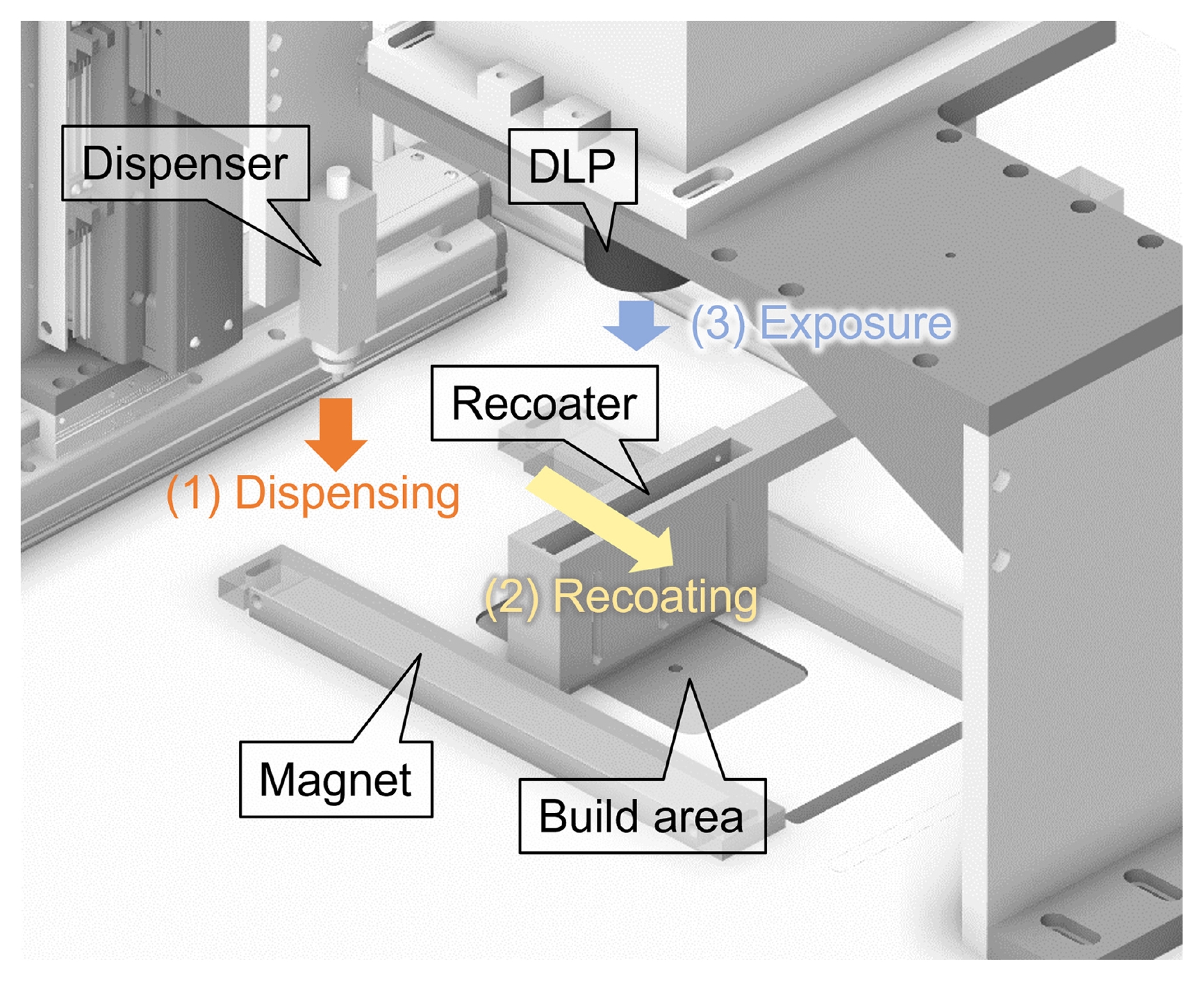
Fig. 1은 개발된 LCM 시스템의 실제 장비 사진과 공정 개략도를 함께 나타낸다. 시스템은 슬러리 디스펜싱 모듈, 리코팅 모듈, DLP 기반 광경화 모듈, 그리고 자성 정렬 모듈로 구성된다. 슬러리는 각 층 형성 시마다 새롭게 공급되며, 리코터를 통해 설정된 두께로 균일하게 도포된 후 선택적으로 UV 경화된다.
자성분말 정렬을 위해 빌드 플랫폼 양측에 영구자석을 배치하여 횡방향 균일 자장을 형성하였다. 본 연구에서 적용된 자성 정렬 모듈의 설계 개념 및 공정 구성은 기존 자기 정렬 기반 적층제조 연구를 참고하여 설정하였다[
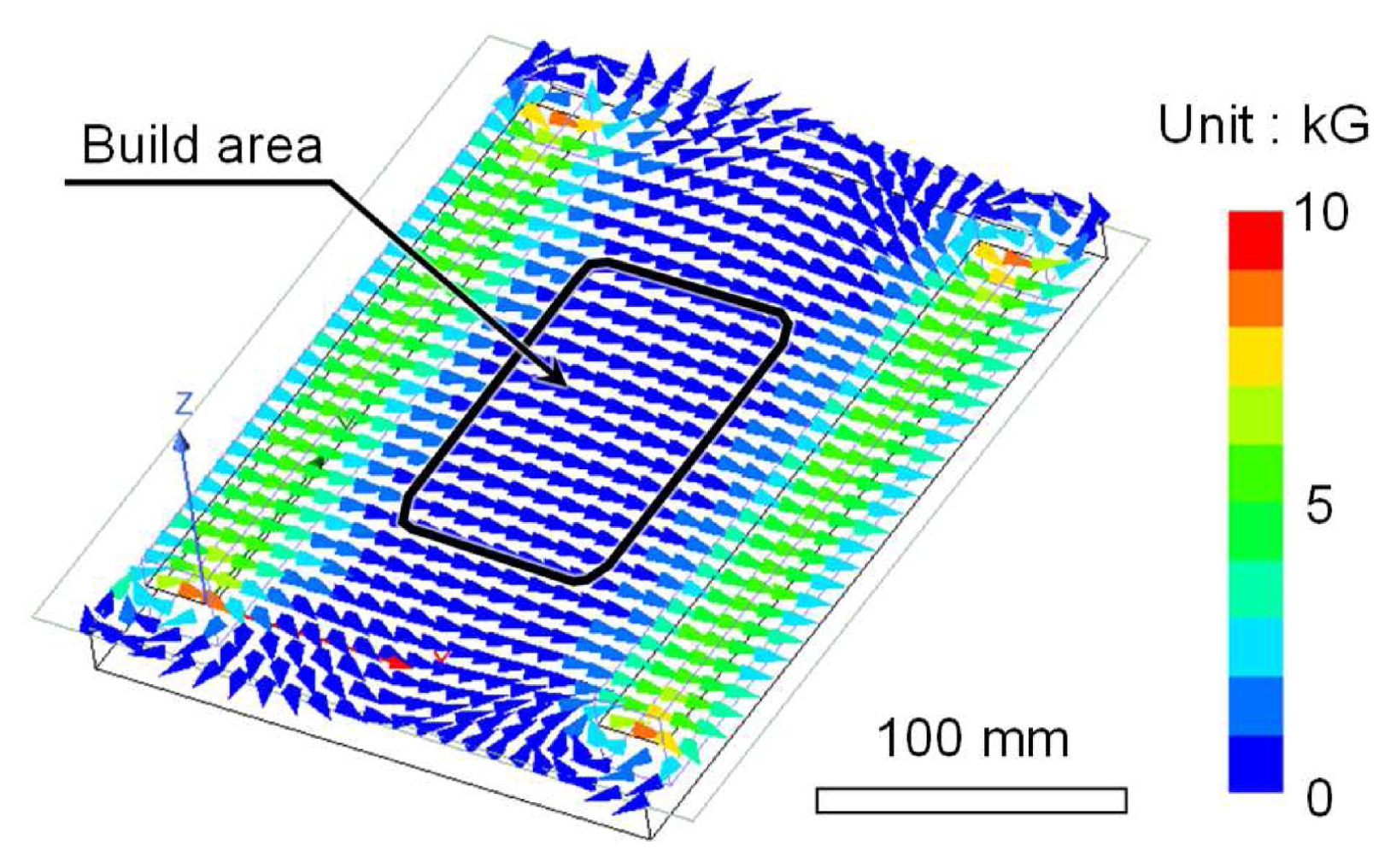
20]. 자장의 균일성 및 세기 분포는 ANSYS Maxwell을 이용한 전자기 유한요소해석을 통해 검증하였다. 시뮬레이션에 적용된 자속 밀도는 Maxwell 해석을 통해 도출된 값과 동일하게 설정하여, 실험 조건과의 정성적 비교가 가능하도록 하였다.
Fig. 2는 빌드 영역 내 자속 밀도 분포 및 벡터 방향을 컬러맵으로 나타낸 결과로, 인쇄 영역 전반에 걸쳐 비교적 균일한 자속 분포가 형성됨을 확인하였다.
실험에 사용된 복합 슬러리는 광경화성 수지에 70 wt% 이방성 NdFeB 분말(입도: 80–150 μm)을 혼합하여 제조하였다. 광개시제는 TPO-L을 사용하였으며, 점도 및 분산 안정성을 고려하여 교반 조건을 최적화하였다. 자장 인가 조건과 비인가 조건 두 가지 공정 조건으로 시편을 제작하였다.
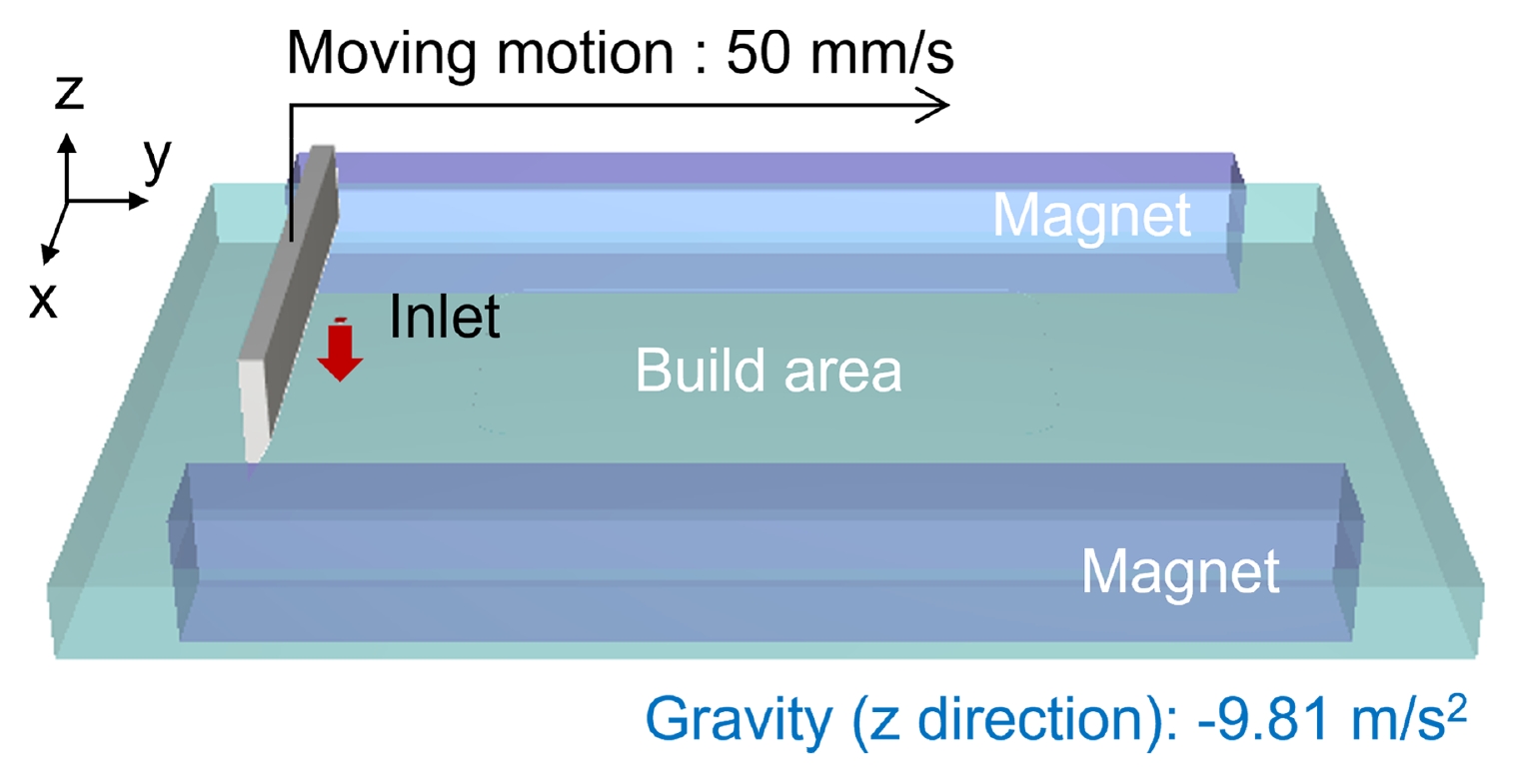
자장 인가에 따른 입자 수준의 정렬 거동을 분석하기 위하여 ANSYS Rocky 기반 DEM 해석 모델을 구축하였다.
Fig. 3은 리코팅 공정을 포함한 해석 모델의 구성과 경계조건을 나타낸다.
이방성 NdFeB 입자는 종횡비 1.75의 Sphero-cylinder 형태로 모델링하였으며, 각 입자에는 단일 자화 용이축 방향의 자기 쌍극자 모멘트를 부여하였다. Maxwell 해석을 통해 얻은 자속 밀도 분포를 배경 자기장으로 입력하였으며, 각 입자 중심에서의 국소 자속 벡터는 공간 보간을 통해 계산되었다.
입자에 작용하는 자기 토크는
식(1)과 같이 정의된다.
여기서 τi는 i번째 입자에 작용하는 자기 토크, mi는 자기 쌍극자 모멘트, Bi는 입자 중심에서의 국소 자속 밀도 벡터이다. 정렬 정도는 자기 모멘트의 자장 방향 성분을 기준으로 정량화하였다. 자장 인가 조건과 비인가 조건을 각각 독립적으로 해석하여 정렬 분포를 비교하였다.
3. 결과 및 분석
3.1 실험 결과
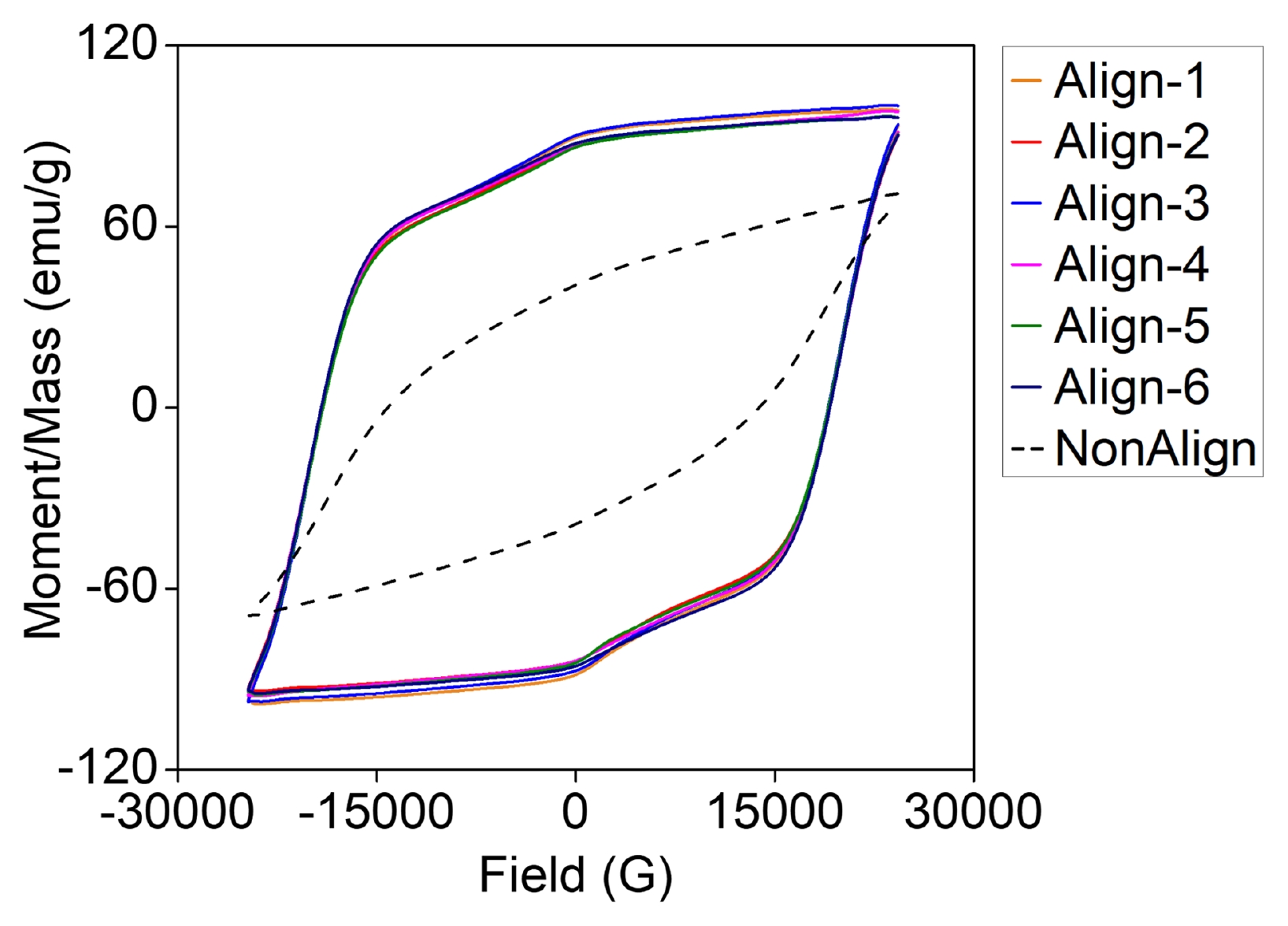
Fig. 4는 자성분말 정렬 모듈 적용 여부에 따른 VSM 히스테리시스 곡선을 나타낸다. 동일 조건에서 제작된 6개 시편의 곡선은 거의 중첩되어 나타났으며, 위치별 자기특성 편차는 관찰되지 않았다. 이는 빌드 플랫폼 전 영역에서 자장이 균일하게 작용했음을 의미한다. 이러한 경향은 본 연구자의 기존 연구에서도 일관되게 확인된 바 있다[
21]. 반면 자성 모듈을 적용하지 않은 시편은 잔류자화(Mr) 및 스퀘어니스 비가 현저히 낮게 나타났으며, 자성 모듈 적용 시 히스테리시스 루프 면적이 증가하고 이방성이 뚜렷하게 향상되었다.
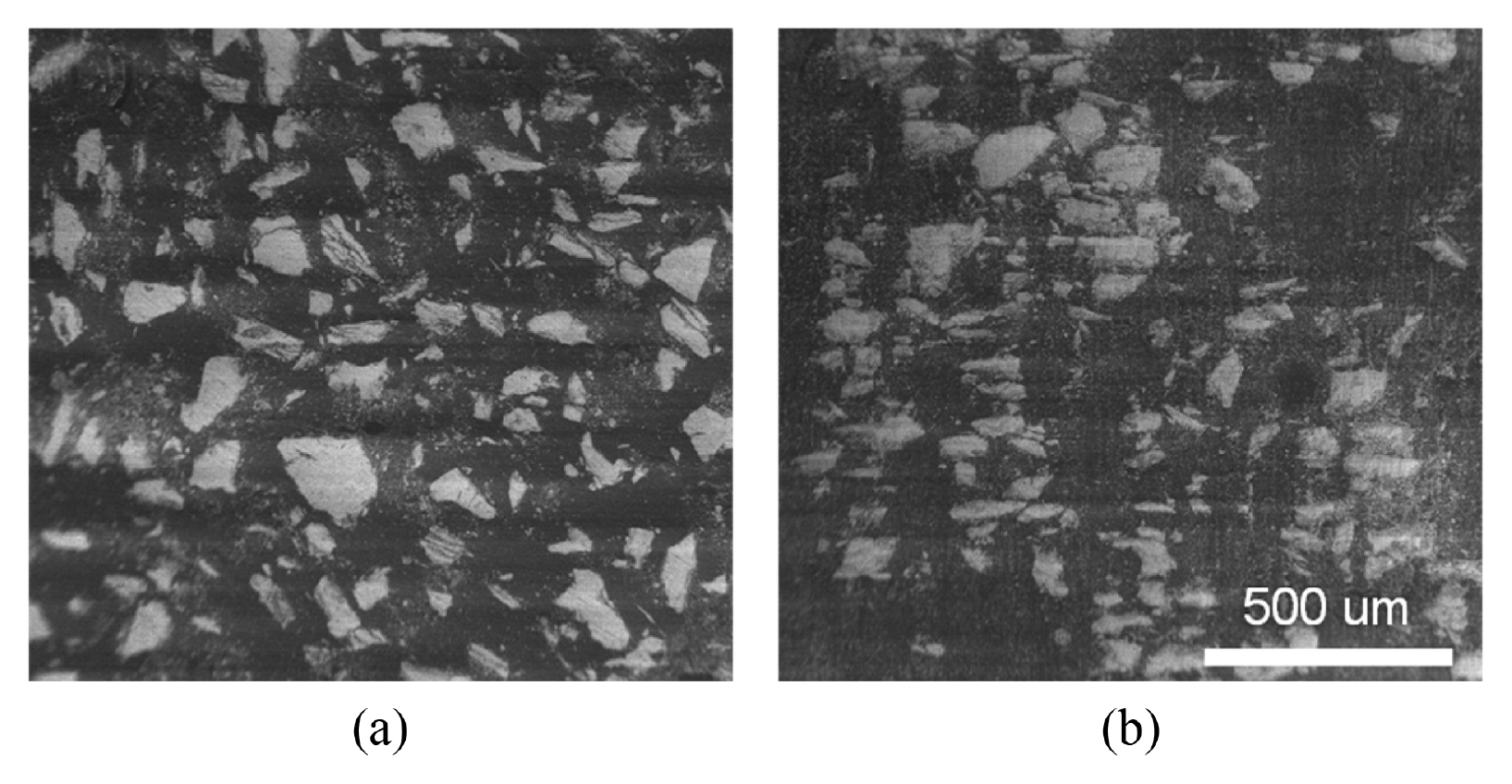
Fig. 5는 폴리싱한 파단면의 SEM 이미지를 나타낸다. 자장비인가 조건에서는 입자가 무작위로 분포하는 반면, 자장 인가 조건에서는 자장 방향을 따라 체인 형태로 정렬된 구조가 관찰되었다. 이는 자기특성 향상의 원인이 입자 배향에 있음을 정성적으로 뒷받침한다.
3.2 DEM 해석 결과 및 실험-시뮬레이션 비교
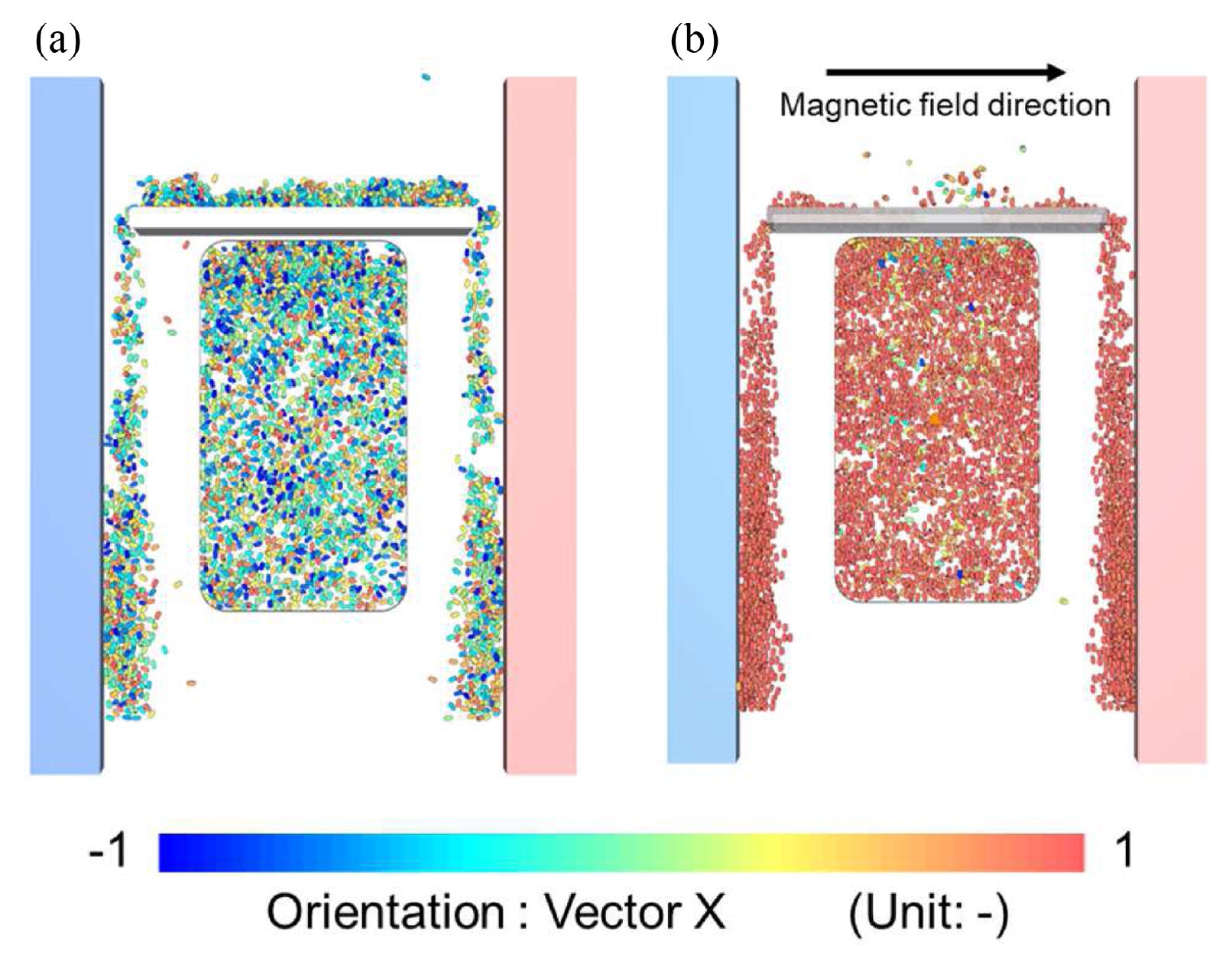
Fig. 6은 리코팅 공정 후 구간에서 DEM 해석을 통해 얻어진 입자 배향 분포를 색상으로 시각화한 결과를 나타낸다.
Fig. 6(a)는 자성분말 정렬 모듈을 적용하지 않은 조건으로, 입자들이 공정 동안 무작위 배향 상태를 유지하며 특정 방향으로의 정렬이 거의 발생하지 않음을 확인할 수 있다. 반면
Fig. 6(b)는 자성분말 정렬 모듈을 장착한 조건으로, 대부분의 입자가 외부 자장 방향을 따라 회전 정렬되었으며, 배향 분포가 한 방향으로 집중되는 뚜렷한 경향을 보였다. 이러한 결과는 자성분말 정렬 모듈이 리코팅 과정 중 이방성 NdFeB 입자의 정렬을 효과적으로 유도함을 보여준다.
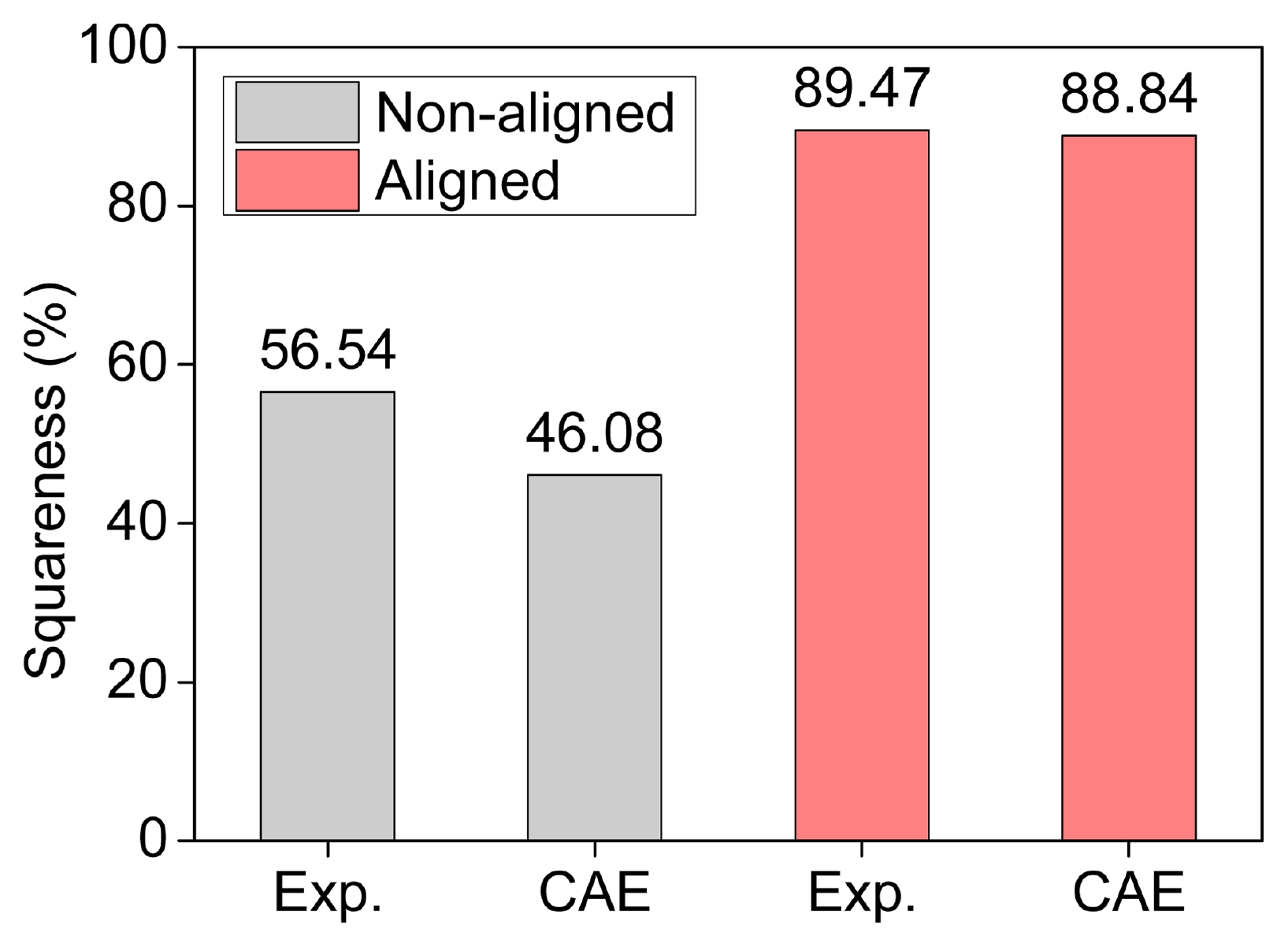
Fig. 7은 실험과 시뮬레이션 결과를 정렬 모듈 유무에 따라 정량 비교한 막대그래프이다. 실험 정렬도는 VSM 측정을 통해 얻어진 잔류자화(Mr)와 포화자화(Ms)의 비(Mr/Ms)를 기준으로 정의하였다. 반면 DEM 해석의 입자 정렬도는 각 입자의 자기 모멘트 방향과 외부 자장 방향 간의 정렬 정도를 기반으로 정의되며, 전체 입자에 대해 평균값으로 계산하였다. 총 4개의 막대(실험-무자장, 실험-자장, 시뮬레이션-무자장, 시뮬레이션-자장)로 구성되며, 자성 모듈 적용 시 정렬도가 뚜렷하게 증가하는 경향이 실험과 시뮬레이션 모두에서 유사하게 나타났다. 다만 DEM 모델은 계산 자원 한계로 인해 실제 공정 크기 및 입자 개수를 완전히 반영하지 못하였으며, 이에 따라 절대 정렬도 값에는 일부 오차가 존재한다. 그럼에도 불구하고 자장 인가 여부에 따른 정렬 경향은 실험 결과와 전반적으로 잘 일치하는 것으로 나타났다.
4. 결론
본 연구에서는 70 wt% 이방성 NdFeB 복합 슬러리를 이용하여 자장 인가 및 비인가 조건에서의 자기특성을 비교 분석하였다. LCM 공정에 자성분말 정렬 모듈을 적용함으로써 입자 배향이 유도되었으며, 이는 히스테리시스 특성의 향상으로 이어짐을 확인하였다. DEM 기반 입자 해석은 자장 인가 조건에서의 정렬 거동을 효과적으로 재현하였으며, 실험 결과와 유사한 경향을 나타냈다. 향후 연구에서는 DEM 모델의 물리적 타당성 검증을 위해 실제 공정 조건에 근접한 스케일의 해석이 필요하다. 또한 슬러리 점도, 입자 농도 및 자장 세기에 따른 리코팅 거동과 입자 정렬 특성의 상관관계를 체계적으로 분석함으로써 공정–재료–자기특성 간의 통합 최적화 연구로 확장할 예정이다. 본 연구에서는 DEM 해석 결과와 실제 공정 조건 간의 정량적 비교를 위한 무차원수 기반 유사성 검증이 수행되지 않았으며, 향후 Mason Number, Stokes Number 등의 무차원수를 활용하여 자기력, 점성력 및 유체 거동 간의 상대적 영향도를 체계적으로 평가할 필요가 있다. 더불어 입자 정렬 분포에 대한 정량적 통계 분석은 수행되지 않았으므로, 향후 연구에서는 정렬도 분포의 평균값 및 분산과 같은 지표를 활용하여 정렬 균일성을 보다 정량적으로 평가할 필요가 있다. 또한 이러한 물리 기반 해석 결과와 실험 데이터를 통합함으로써, 향후에는 AI 및 데이터 기반 분석 기법을 활용한 공정 변수-미세구조-자기특성 간 상관관계 모델링과 적층제조 공정의 데이터 기반 최적화 연구로 확장될 수 있을 것으로 기대된다.
FOOTNOTES
-
ACKNOWLEDGEMENT
본 연구는 한국기계연구원 기관 기본사업 차세대 고성능 모터 개발을 위한 3D프린팅 장비개발(NK248I)으로 수행되었습니다.
Fig. 1Developed lithography-based composite manufacturing (LCM) system and schematic illustration of the layerwise fabrication process
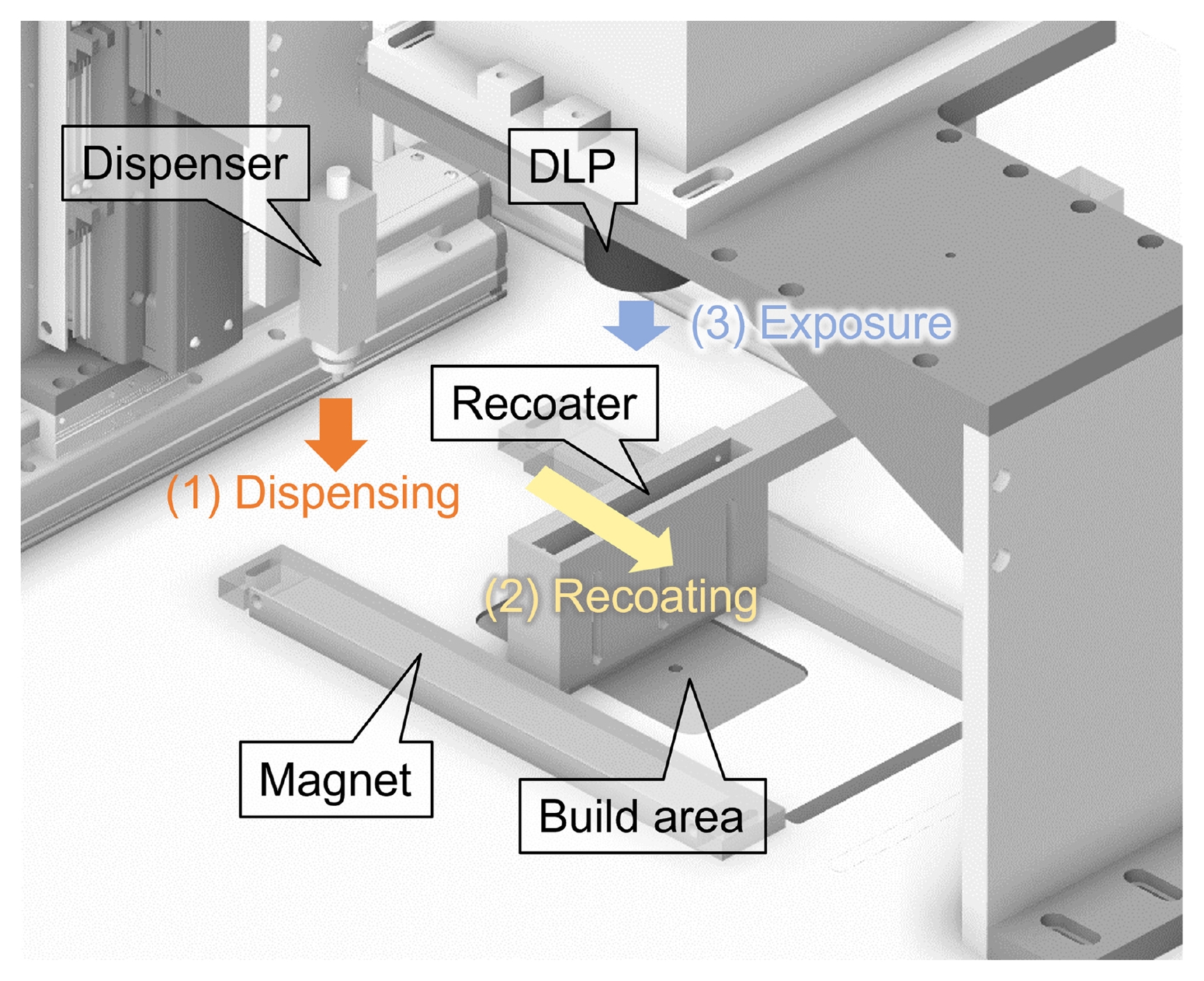
Fig. 2Finite element simulation results of magnetic flux density distribution and field uniformity in the in-situ alignment module
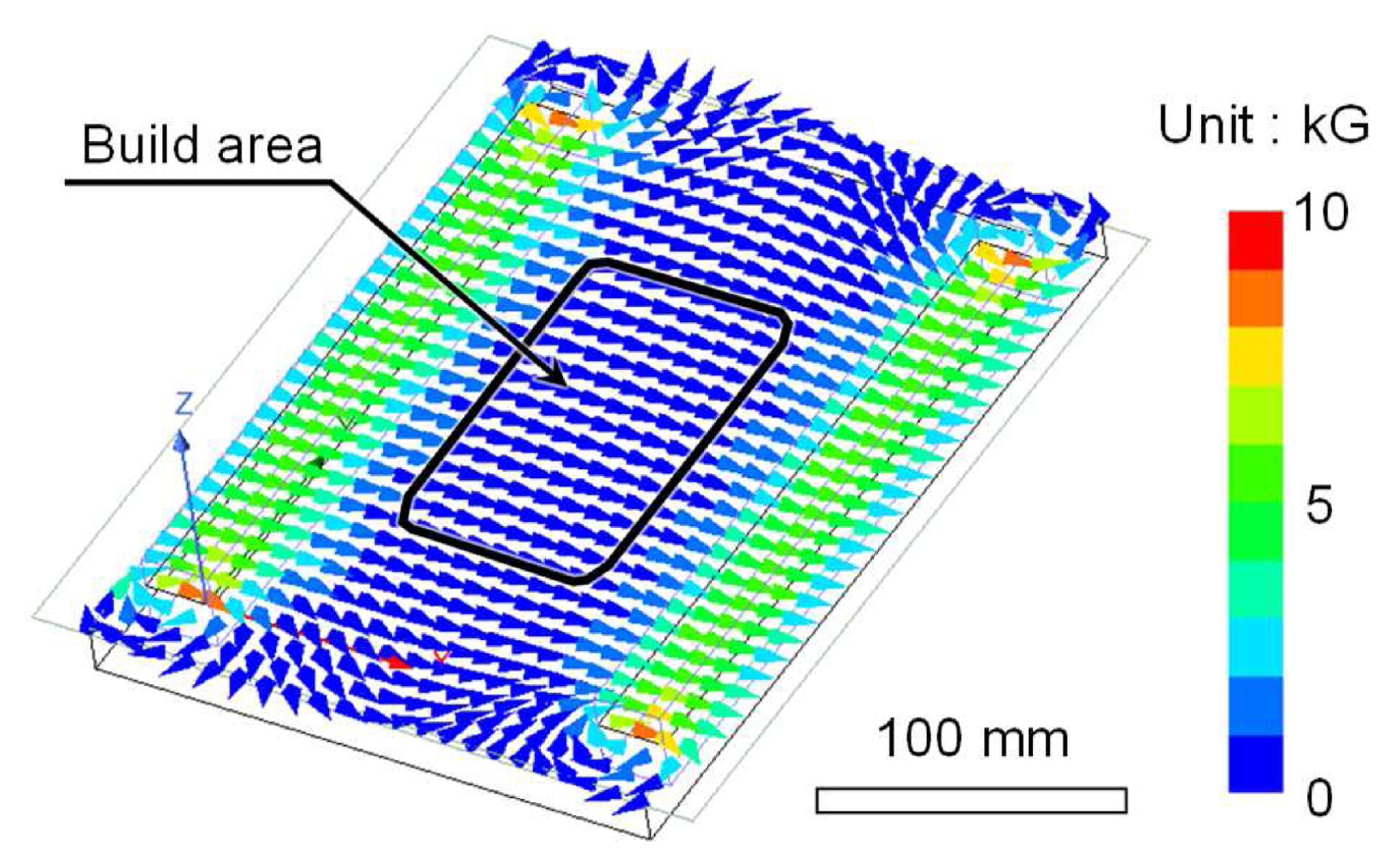
Fig. 3DEM–SPH coupled simulation setup and applied boundary conditions
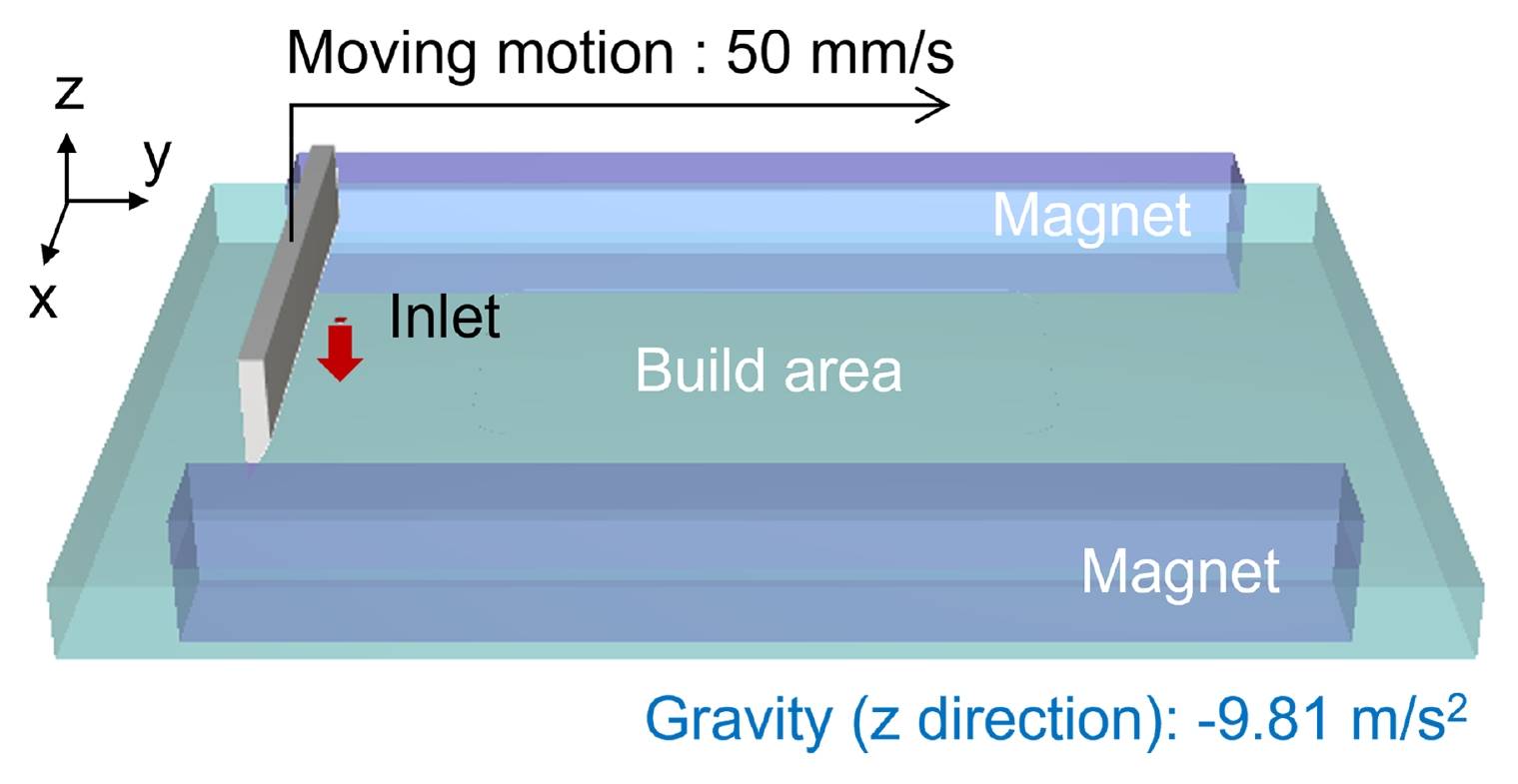
Fig. 4VSM hysteresis loops of NdFeB composites fabricated with and without magnetic field alignment, showing high reproducibility across specimen locations
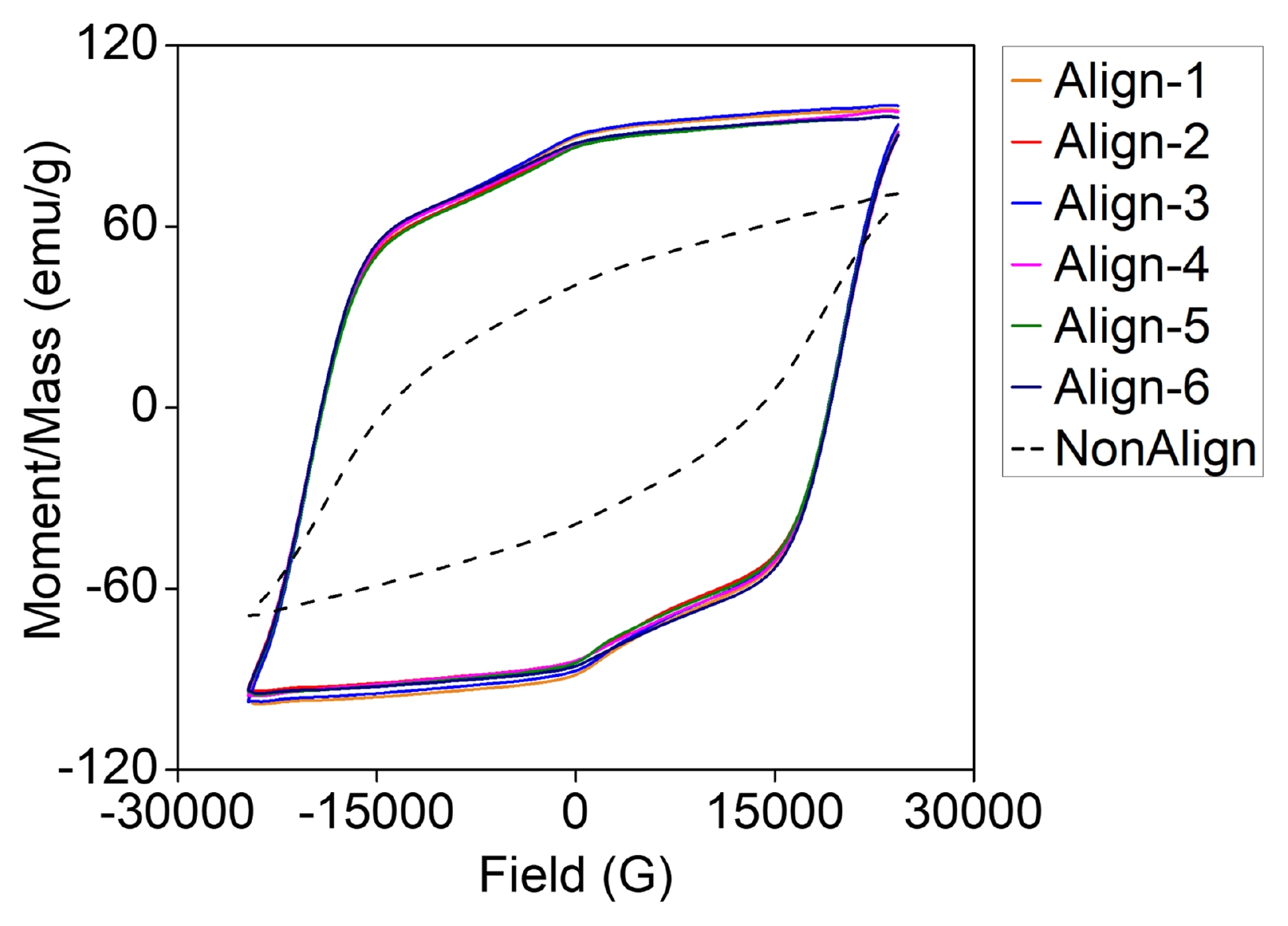
Fig. 5SEM cross-sectional images comparing particle orientation: (a) Non-aligned and (b) Magnetically aligned NdFeB composites
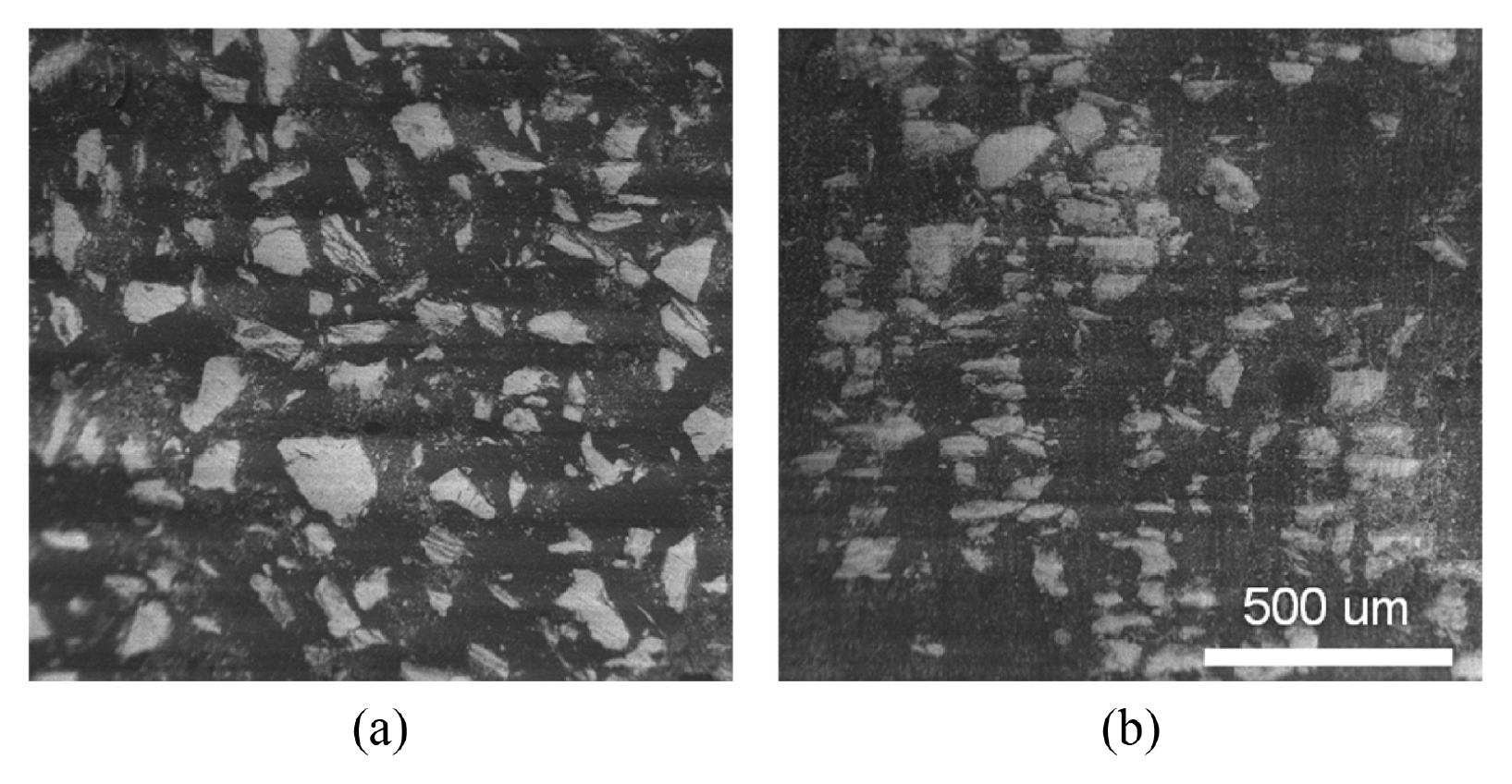
Fig. 6DEM simulation snapshots of particle alignment behavior during the recoating process: (a) Without magnetic field and (b) With magnetic field assistance (arrow indicates magnetic field direction)
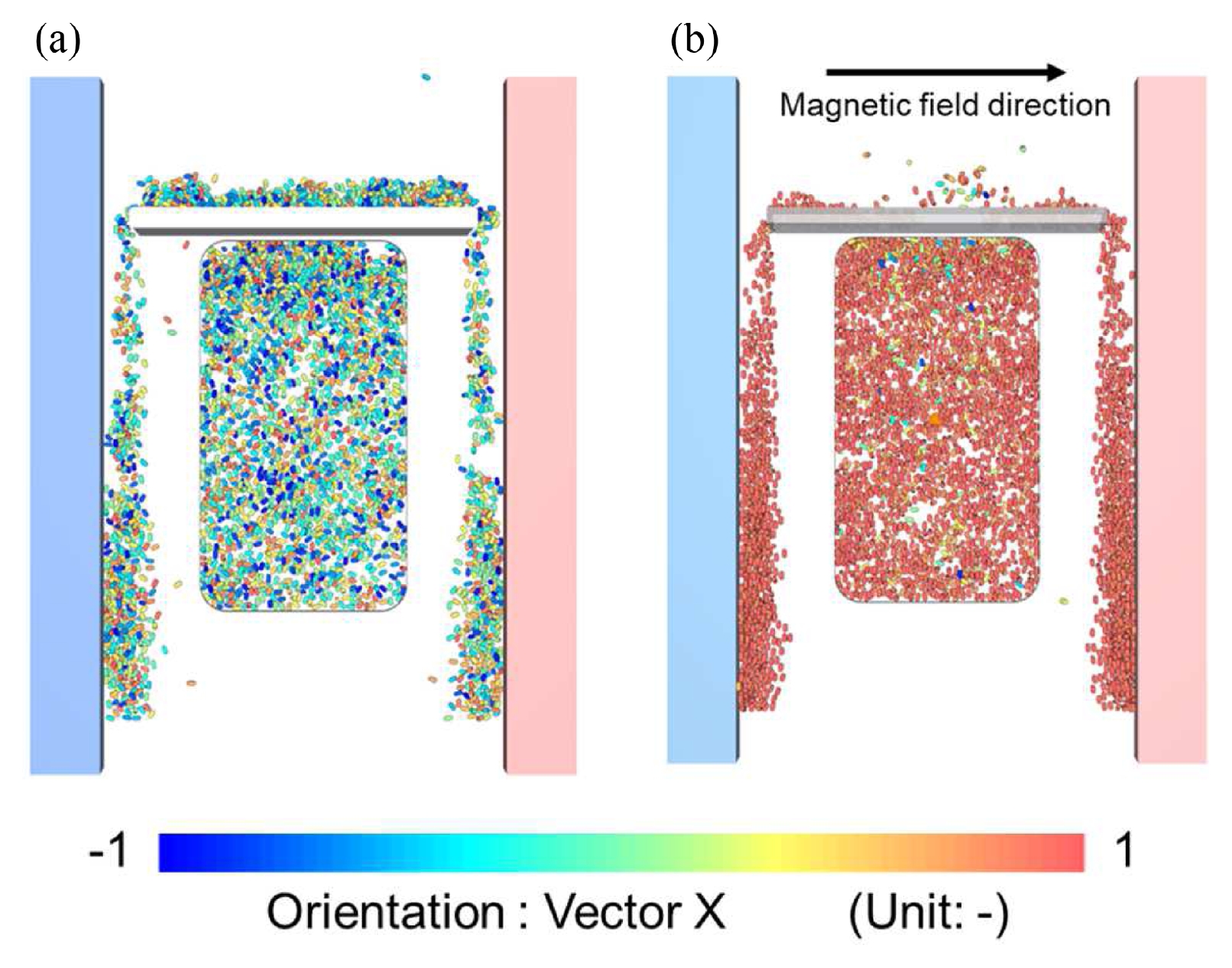
Fig. 7Quantitative comparison of alignment degree obtained from experiments and DEM simulations under non-aligned and aligned conditions
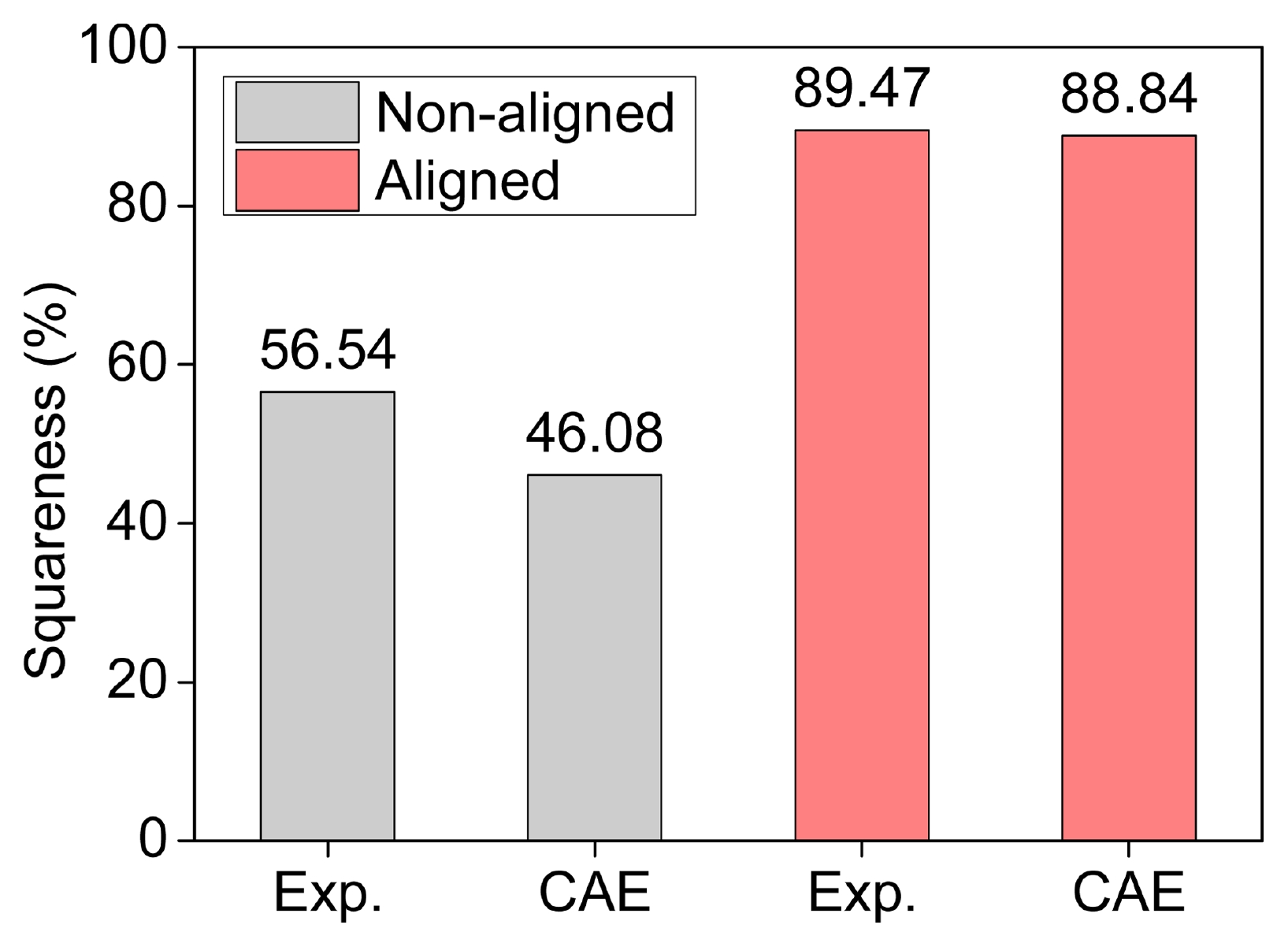
Table 1
Table 1
|
Parameter |
Value |
|
Matrix material |
Clear resin (Formlabs) 90 wt.%
TPO-L (Sigma aldrich) 10 wt.% |
|
Magnetic particle |
NdFeB (MQA-36–19, 80–150 μm) |
|
Layer thickness |
200 μm |
|
UV exposure time |
15 sec/layer |
REFERENCES
- 1. Périgo, E., Jacimovic, J., Ferré, F. G., Scherf, L., (2019), Additive manufacturing of magnetic materials, Additive Manufacturing, 30, 100870.
- 2. Gandha, K., Paranthaman, M. P., Wang, H., Liu, X., Nlebedim, I. C., (2023), Thermal stability of anisotropic bonded magnets prepared by additive manufacturing, Journal of the American Ceramic Society, 106(1), 166-171.
- 3. Mapley, M. C., Tansley, G., Pauls, J. P., Gregory, S. D., Busch, A., (2021), Selective laser sintering of bonded anisotropic permanent magnets using an in situ alignment fixture, Rapid Prototyping Journal, 27(4), 735-740.
- 4. Huber, C., Mitteramskogler, G., Goertler, M., Teliban, I., Groenefeld, M., Suess, D., (2020), Additive manufactured polymer-bonded isotropic NdFeB magnets by stereolithography and their comparison to fused filament fabricated and selective laser sintered magnets, Materials, 13(8), (1916.
- 5. Slapnik, J., Pulko, I., Rudolf, R., Anžel, I., Brunčko, M., (2021), Fused filament fabrication of Nd-Fe-B bonded magnets: Comparison of PA12 and TPU matrices, Additive Manufacturing, 38, 101745.
- 6. Li, L., Tirado, A., Nlebedim, I., Rios, O., Post, B., Kunc, V., Lowden, R., Lara-Curzio, E., Fredette, R., Ormerod, J., (2016), Big area additive manufacturing of high performance bonded NdFeB magnets, Scientific Reports, 6(1), 36212.
- 7. Chang, T., Huang, P., Yu, H., Huang, C., Mo, C., Tsai, M., (2024), Additive manufacturing for skew magnetization fixture of annular magnet, International Journal of Precision Engineering and Manufacturing, 1-9.
- 8. Cao, Y., Zhu, M., Rong, M. Z., Zhang, M. Q., (2023), Injection moldable, self-healable, and recyclable rubber-bonded NdFeB magnets with the magnetic particulates content up to 90 wt%, Advanced Composites and Hybrid Materials, 6(1), 38.
- 9. Qu, Z., Wu, Q., Zhang, M., Wang, Z., Yue, M., Liu, W., (2024), The effect of powder shape on the magnetic anisotropy in NdFeB bonded magnets, AIP Advances, 14(2), 025201.
- 10. Niendorf, K., Raeymaekers, B., (2021), Additive manufacturing of polymer matrix composite materials with aligned or organized filler material: A review, Advanced Engineering Materials, 23(4), 2001002.
- 11. Hu, Y., (2021), Recent progress in field-assisted additive manufacturing: materials, methodologies, and applications, Materials Horizons, 8(3), 885-911.
- 12. Hao, L., Tang, D., Sun, T., Xiong, W., Feng, Z., Evans, K. E., Li, Y., (2021), Direct ink writing of mineral materials: A review, International Journal of Precision Engineering and Manufacturing-Green Technology, 8(2), 665-685.
- 13. Hwang, J. Y., Park, S. J., Son, Y., Jung, H. Y., (2023), Influence of in situ magnetic field on magnetic properties of a bonded permanent magnet manufactured through material extrusion additive manufacturing, Metals, 13(10), 1653.
- 14. Silva, T. F. V., Stoppa, M. H., (2022), Production of complex shape magnets using additive manufacturing: A state-of-the-art analysis, Journal of Thermoplastic Composite Materials, 35(7), 1041-1058.
- 15. Tanska, J., Wieclaw-Midor, A., Misiukiewicz, J., Falkowski, P., Zygmuntowicz, J., Bulejak, W., Wiecinska, P., (2025), Digital light processing followed by pressureless sintering of metal-reinforced ceramics: Adjustment of process parameters and correlation with composites properties, International Journal of Precision Engineering and Manufacturing-Green Technology, 12(1), 169-191.
- 16. Tao, S., Lu, X., Tian, J., Qu, X., Honkura, Y., Mitarai, H., Noguchi, K., (2009), Magnetic properties and thermal stability of anisotropic bonded Nd-Fe-B magnets by warm compaction, Rare Metals, 28(3), 245-247.
- 17. Kirchberg, S., Anhalt, M., Ziegmann, G., (2014), Theoretical consideration of experimental data of thermal and magnetic properties of polymer-bonded soft magnetic composites, Journal of Thermoplastic Composite Materials, 27(5), 663-678.
- 18. Prasad Mishra, T., Leich, L., Krengel, M., Weber, S., Röttger, A., Bram, M., (2023), NdFeB Magnets with Well-Pronounced Anisotropic Magnetic Properties Made by Electric Current-Assisted Sintering, Advanced Engineering Materials, 25(1), 2201027.
- 19. Maccari, F., Mishra, T. P., Keszler, M., Braun, T., Adabifiroozjaei, E., Radulov, I., Jiang, T., Bruder, E., Guillon, O., Molina-Luna, L., (2023), Nanocrystalline Nd–Fe–B anisotropic magnets by flash spark plasma sintering, Advanced Engineering Materials, 25(18), 2300252.
- 20. Kim, M., Lee, H., Shin, D., Choi, J. P., Ha, T., Jeun, J.-P., Lee, P.-H., (2025), Magnetic alignment and electron beam post-curing of NdFeB materials via lithography-based composite manufacturing, Virtual and Physical Prototyping, 20(1), e2593543.
- 21. Kim, M., Shin, D., Choi, J. P., Ha, T., Lee, P. H., (2026), Achieving uniform magnetic field and high particle alignment in lithography-based composite manufacturing of anisotropic NdFeB, Proceedings of the ASME 2026 21st International Manufacturing Science and Engineering Conference, (In press).
Biography
- Mijin Kim
Student Researcher at the Korea Institute of Machinery and Materials (KIMM). Her research interest is additive manufacturing process.
- Min-Kyo Jung
Senior researcher in Korea Institute of Machinery & Materials. His research interests include metal additive manufacturing systems and processes, and computational fluid dynamics (CFD).
- Yongrae Kim
Engineer in Korea Institute of Machinery & Materials. His research interest is additive manufacturing equipment development and smart manufacturing.
- Taeho Ha
Principal researcher in Korea Institute of Machinery & Materials. His research interest is additive manufacturing process and system development.
- Joon Phil Choi
Principal researcher in Korea Institute of Machinery & Materials. His research interest is additive manufacturing process and system development.
- Dongwoon Shin
Senior researcher in Korea Institute of Machinery & Materials. His research interests include AI-driven monitoring and control of additive manufacturing processes, as well as micro- and nanoscale 3D printing systems and process technologies.
- Pil-Ho Lee
Principal researcher in Korea Institute of Machinery & Materials. His research interest is additive manufacturing process and system development.
Citations
Citations to this article as recorded by